
Independent practices can stop the most common revenue leaks with three prioritized actions: verify eligibility at intake, submit clean claims, and tighten A/R follow-up. These three steps address the front-end, mid-cycle, and back-end phases of revenue cycle management (RCM), and the AMA recommends targeting a first-pass acceptance rate of 95% and keeping days in A/R under 30 to protect cash flow. For a small practice running on thin margins, those aren't aspirational benchmarks — they're survival metrics.
Your three-action checklist for today:
- Verify eligibility before every visit. Run automated eligibility checks at scheduling and again 24–48 hours before the appointment. Catching a lapsed policy before the patient walks in costs nothing; catching it after a denial costs staff hours and delays cash.
- Submit clean claims the first time. Audit your claim scrubbing process for missing modifiers, incorrect diagnosis codes, and mismatched provider NPI data. Aim for a clean claim rate above 95%; anything below that is leaving reimbursement on the table.
- Own your A/R aging report. Review claims older than 30 days weekly. Assign a named person to work every bucket — 30–60, 60–90, and 90+ days — and set a policy that no claim ages past 90 days without an appeal or write-off decision.
Practices that execute these three steps consistently see fewer denials, faster cash conversion, and a more predictable monthly revenue picture. Himshield's pre-submission detection layer is built specifically to support this kind of front-end and mid-cycle discipline for independent physician practices.
Table of Contents
- What is revenue cycle management and why does it matter for independent practices?
- How the RCM process maps across your practice workflow
- Which KPIs should every independent practice track?
- Where do independent practices lose money, and how do you fix it?
- In-house, outsourced, or automated: which RCM model fits your practice?
- Your 30/60/90-day RCM implementation plan
- How do you choose the right RCM partner or tool?
- Key Takeaways
- The case for catching problems before they leave your practice
- Himshield protects the revenue your practice has already earned
- Useful sources for further reading
What is revenue cycle management and why does it matter for independent practices?
RCM is the end-to-end financial process that connects a patient's first appointment to the final dollar collected — covering scheduling, registration, insurance verification, clinical documentation, coding, charge capture, claim submission, payment posting, denial management, and patient collections. AHIMA frames it as three linked phases: front-end processes (registration, verification, authorizations), mid-cycle (coding, documentation, charge capture), and back-end (claims, denials, reimbursement). Every step feeds the next, and a failure anywhere in the chain compounds downstream.
Independent practices are uniquely exposed to RCM breakdowns. Unlike hospital systems with dedicated billing departments, most small practices rely on one or two staff members to manage the entire cycle. Thin margins, complex payer contracts, and frequent coding changes leave little room for error. The AMA and AAFP both note that independent practices face disproportionate pressure from payer complexity and staffing constraints, making process discipline more critical here than in any other care setting.
That gap between what your P&L shows and what's actually in your bank account is the clearest early warning sign that your revenue cycle has a leak. A practice can look profitable on paper while burning through cash reserves, simply because A/R is growing faster than collections. Reconciling your P&L, balance sheet, and cash flow statement monthly — and watching for A/R growth that outpaces revenue growth — is the financial discipline that keeps independent practices solvent.
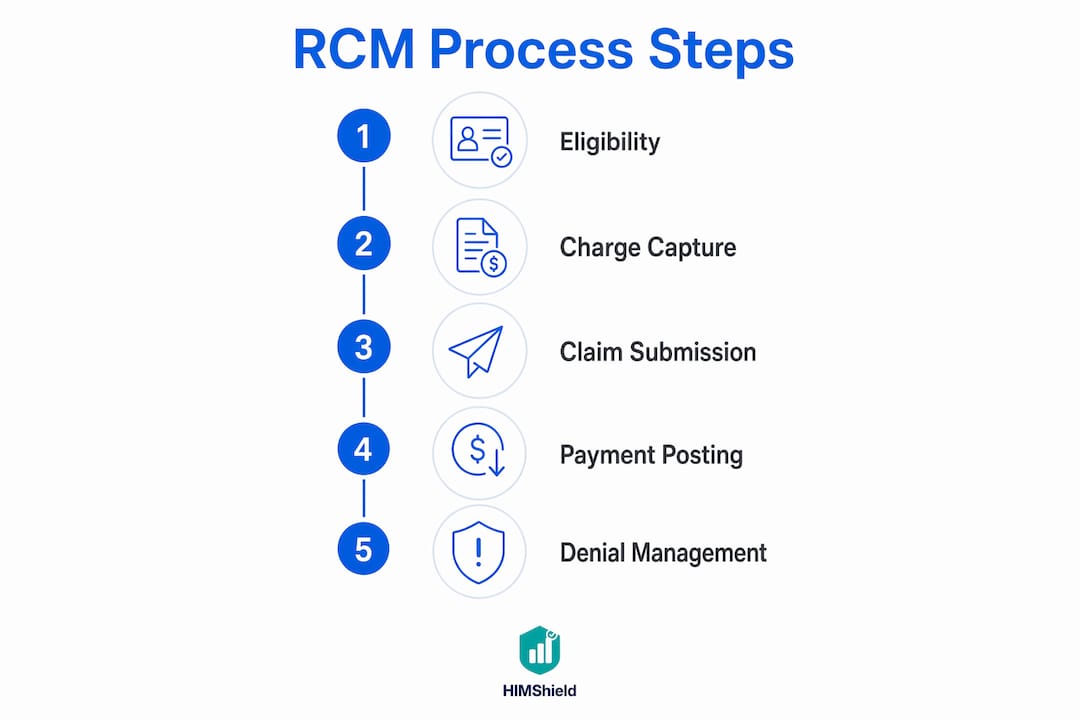
Consider a single missed eligibility check: the patient is seen, the claim is submitted, and the payer denies it because coverage lapsed two weeks earlier. Your biller now spends 45 minutes researching the denial, drafting an appeal, and resubmitting. That one error adds days to your A/R, consumes staff time, and may still result in a write-off. Multiply that by 10–15 visits per week and the operational drag becomes significant.
How the RCM process maps across your practice workflow
Understanding practice finances starts with knowing exactly which step belongs to which phase and who owns it. The table below maps 12 common RCM steps to their phase and typical role owner in a small independent practice.

| Step | Phase | Typical Owner |
|---|---|---|
| Patient scheduling | Front-end | Front desk |
| Insurance eligibility verification | Front-end | Front desk |
| Prior authorization | Front-end | Front desk / clinical lead |
| Patient registration & demographics | Front-end | Front desk |
| Copay / cost-share collection | Front-end | Front desk |
| Clinical documentation | Mid-cycle | Physician / APP |
| Medical coding (ICD-10, CPT) | Mid-cycle | Coder / biller |
| Charge capture & charge entry | Mid-cycle | Biller / clinical staff |
| Claim scrubbing | Mid-cycle | Biller / PM software |
| Claim submission to payer | Back-end | Biller |
| Remittance posting (ERA/EOB) | Back-end | Biller |
| Denial management & appeals | Back-end | Biller / practice manager |
| Patient statement & collections | Back-end | Front desk / biller |
Where handoffs break down most often in small practices:
- Front desk to biller: Incomplete or inaccurate registration data (wrong insurance ID, missing secondary coverage) reaches the biller only after the visit, making clean claim submission impossible without rework.
- Physician to coder: Vague or incomplete clinical documentation forces the coder to under-code or query the physician, adding charge lag and creating compliance risk. Documentation quality directly affects reimbursement.
- Biller to practice manager: Denial trends go unreported because there's no structured denial log or weekly review meeting, so the same root causes repeat month after month.
Cross-team communication isn't a soft skill in RCM — it's a revenue protection mechanism. The AMA identifies lack of integration between front desk, clinical staff, and billing as one of the primary drivers of revenue leakage in independent practices.
Which KPIs should every independent practice track?
The AAFP recommends tracking five core metrics to assess RCM health. Here are the definitions, formulas, and target ranges your practice should know.

Days in A/R Formula: (Total A/R ÷ Average Daily Charges) Target: ideally under 40 days, with anything approaching or above 50 days indicating a collection problem.
Denial Rate Formula: (Total Denied Claims ÷ Total Claims Submitted) × 100 Target: Under 5–7%. BlueFish benchmarks for independent practices set denial rate at less than 5–7%, with a first-pass acceptance rate above 95%.
First-Pass Acceptance Rate (Clean Claim Rate) Formula: (Claims Accepted on First Submission ÷ Total Claims Submitted) × 100 Target: very high first-pass acceptance rates are the standard for well-run physician practices.
Adjusted Collection Rate (Net Collection Rate) Formula: (Payments Collected ÷ [Charges − Contractual Adjustments]) × 100 Target: 95%+. This is the metric the AAFP recommends tracking over raw cash collections, because it isolates operational losses from expected contractual write-offs. A rate below 95% means you're leaving earned reimbursement uncollected.
Charge Lag Formula: Days between date of service and date charge is entered Target: Same-day or next-day entry. Charge lag beyond 48–72 hours increases the risk of missed charges and pushes out your payment timeline.
Collection Rate on Patient Balances Formula: (Patient Payments Collected ÷ Patient Balance Billed) × 100 Target: Varies by payer mix, but practices should aim above 70–80% on patient-responsibility balances. With high-deductible health plans growing, this metric is increasingly material.
Prioritization tip: Fix the KPI where impact × ease-to-change is highest. For most independent practices, that's first-pass acceptance rate — a single workflow change (automated claim scrubbing) can move it from 85% to 95%+ within 30 days, with an immediate reduction in denial volume and A/R days.
Your payer mix also shapes how you interpret these numbers. A practice with a high Medicare or Medicaid share will see different payment turnaround times (typically 14–30 days for electronic claims) than one with a commercial-heavy mix, so always segment KPIs by payer when diagnosing a problem.
Where do independent practices lose money, and how do you fix it?
Revenue leakage in independent practices almost always traces back to one of eight failure points. Each one has a practical, low-cost fix.
- Missed eligibility checks. Fix: Automate eligibility verification through your practice management (PM) system or a standalone tool. Run checks at scheduling and again 24–48 hours before the visit. Catching a lapsed or changed policy pre-visit eliminates the denial entirely.
- Uncollected copays at time of service. Fix: Train front desk staff to collect copays before the patient enters the exam room, not at checkout. Post a clear policy and use your PM system to display the expected copay at check-in.
- Charge capture misses. Fix: Implement a daily charge reconciliation process — compare the appointment schedule against charges posted each evening. Any visit without a corresponding charge gets flagged before the day closes.
- Coding errors (under-coding, up-coding, or mismatched diagnosis codes). Fix: Run a coding audit quarterly. Use your EHR's coding suggestions as a starting point, but validate against documentation. Himshield's platform scans EHR data pre-submission to flag coding and documentation gaps before they become denials.
- Unclean claims (missing modifiers, wrong NPI, incomplete data). Fix: Enable claim scrubbing in your PM system or clearinghouse. Every claim should pass a scrub before submission. This single step is the highest-ROI automation available to a small practice.
- Delayed charge entry. Fix: Set a hard policy — charges entered within 24 hours of service. Assign a backup person for days when the primary biller is absent.
- Poor denial follow-up. Fix: Build a denial log in a shared spreadsheet or your PM system. Categorize denials by reason code weekly. The top three reason codes in any given month get a root-cause fix, not just an appeal.
- Patient confusion about bills. Fix: Send itemized statements with plain-language explanations. Offer a payment plan option upfront. Practices that communicate costs clearly before and after the visit collect patient balances faster and with fewer disputes.
Pro Tip: Front-end prevention is significantly cheaper than back-end appeals. The AMA notes that preventing errors pre-submission with eligibility checks and claim scrubbing costs far less in staff time and lost interest than working denials after the fact. Every dollar spent on front-end automation pays back multiples in reduced denial management labor.
Quick leakage audit: Pull your last 90 days of denied claims. Sort by denial reason code. If the top three codes account for more than 60% of your denials, you have a systemic process failure — not a random error pattern. That concentration is your starting point for root-cause remediation.
In-house, outsourced, or automated: which RCM model fits your practice?
There's no single right answer, but the tradeoffs are clear once you map them against your practice's size, staff capacity, and risk tolerance.
| Model | Cost | Control | Risk | Best Fit |
|---|---|---|---|---|
| In-house billing | Lower direct cost; higher staff burden | Full visibility | Single point of failure if key staff leave | Practices with stable, experienced billing staff |
| Outsourced RCM | Percentage of collections (varies by vendor) | Less day-to-day visibility | Vendor dependency; slower response to payer changes | Practices with high claim volume or billing staff turnover |
| Automation-first / hybrid | Low per-transaction cost; upfront setup | High, with real-time data | Requires staff to act on alerts | Practices wanting control with reduced manual labor |
The AMA specifically flags single-point-of-failure risk as a critical vulnerability for independent practices that rely on one or two staff for all RCM tasks. Cross-training at least one backup person for eligibility verification, charge entry, and claim submission is a non-negotiable continuity measure.
Automation priorities for the highest ROI in small practices:
- Eligibility verification: Automated checks through your PM system or a clearinghouse integration eliminate the most common front-end denial cause with minimal staff effort.
- Claim scrubbing: Built into most modern PM systems; if yours doesn't include it, a clearinghouse like Availity or Change Healthcare provides it as a service.
- Payment portals: Online patient payment options reduce the time-to-collect on patient balances and cut statement mailing costs.
- Denial tracking dashboards: Real-time visibility into denial reason codes lets you act on trends before they compound.
HIPAA and vendor due diligence: Any tool or vendor that touches protected health information (PHI) must sign a Business Associate Agreement (BAA) with your practice. Verify BAA status before onboarding any RCM vendor, clearinghouse, or automation platform. Confirm their data encryption standards, breach notification procedures, and access controls. HIPAA compliance isn't optional — it's a baseline requirement, and a vendor that can't produce a BAA quickly is a red flag.
Your 30/60/90-day RCM implementation plan
| Time Window | Key Activity | Owner | Metric to Track | Expected Outcome |
|---|---|---|---|---|
| Days 1–30 | Audit current denial reasons; implement automated eligibility checks; establish daily charge reconciliation | Practice manager + biller | Denial rate; charge lag | Denial volume drops; charge lag under 24 hours |
| Days 1–30 | Train front desk on copay collection policy; update registration scripts | Practice manager | Copay collection rate | Fewer uncollected time-of-service balances |
| Days 31–60 | Enable or upgrade claim scrubbing; run first coding audit; build denial log | Biller + coder | First-pass acceptance rate | Clean claim rate trending toward 95% |
| Days 31–60 | Reconcile P&L, balance sheet, and cash flow; identify A/R buckets over 60 days | Practice owner + biller | Days in A/R; adjusted collection rate | Clear picture of cash flow vs. net income gap |
| — | Work A/R aging: assign every claim over 60 days; appeal or write off 90+ day claims | Biller | A/R days; collection rate | A/R under 40 days; no unworked claims over 90 days |
| — | Implement patient payment portal; update billing statements with plain-language explanations | Front desk + biller | Patient balance collection rate | Faster patient collections; fewer billing disputes |
| Ongoing | Monthly KPI review meeting (denial rate, first-pass rate, days in A/R, adjusted collection rate) | Practice manager | All five core KPIs | Sustained performance above benchmarks |
Realistic expectations: Most practices see measurable improvement in first-pass acceptance rate and denial volume within the first 30 days of implementing automated eligibility checks and claim scrubbing. The cash impact — shorter A/R days and higher adjusted collection rate — typically becomes visible in days 31–60 as cleaner claims move through payer adjudication faster. The 90-day mark is when you have enough data to identify whether remaining issues are systemic (process failures) or episodic (payer-specific anomalies).
Small improvements compound quickly for low-margin practices. Reducing your denial rate from 10% to 5% on a practice billing $500,000 annually in charges means recovering a meaningful portion of previously delayed or lost reimbursement, plus the staff hours that were spent working those denials.
How do you choose the right RCM partner or tool?
Vendor selection is where many independent practices make expensive mistakes. The wrong partner costs you money twice: once in fees, and again in the revenue you don't recover because their process is weak.
Questions to ask every vendor before signing:
- What is your average first-pass acceptance rate across your independent practice clients?
- How do you report denial trends, and how often?
- What EHR systems do you integrate with, and how long does onboarding take?
- Who is my named account contact, and what is your escalation process for unresolved denials?
- What does your BAA cover, and can I review your HIPAA compliance documentation?
- What are your contract terms — specifically, what is the exit process if I'm not satisfied?
Red flags to walk away from:
- Opaque reporting: if a vendor can't show you denial rates, first-pass acceptance, and days in A/R by payer, they're hiding underperformance.
- No performance guarantees or benchmarks in the contract.
- No references from practices similar in size and specialty to yours.
- Long-term lock-in contracts (24+ months) with no performance-based exit clause.
- Vague answers about HIPAA compliance or reluctance to sign a BAA.
Piloting a vendor or tool:
Scope a 30–90-day pilot on a defined subset of claims — ideally one payer or one provider. Measure first-pass acceptance rate, denial rate, and days in A/R before and after. Set a minimum acceptable threshold upfront (for example, first-pass rate above 93% within 60 days). If the vendor won't agree to a pilot with measurable exit criteria, that's a red flag in itself.
Align vendor SLAs to your KPI targets. If your goal is a denial rate under 5%, your contract should specify that the vendor is accountable for denial rates attributable to their process errors, with a defined remediation timeline. Vague SLAs produce vague results.
Pro Tip: Ask for a coding compliance review as part of any vendor onboarding. A vendor that audits your coding and documentation before taking over billing is far more likely to improve your first-pass rate than one that simply resubmits what your practice already produces.
Key Takeaways
Revenue cycle management for independent practices comes down to one principle: prevent errors at the front end, measure everything in the middle, and own every dollar at the back end.
| Point | Details |
|---|---|
| Front-end prevention pays the most | Automated eligibility checks and claim scrubbing cost less than denial appeals and protect cash flow from the start. |
| Target five core KPIs | Track days in A/R (under 30–40), denial rate (under 5–7%), first-pass rate (95%+), adjusted collection rate (95%+), and charge lag (under 24 hours). |
| Cross-train to eliminate single points of failure | The AMA flags one- or two-person RCM teams as a critical vulnerability; at least one backup must be trained for every core billing task. |
| Use the 30/60/90 plan as your execution roadmap | Assign owners, set measurable milestones, and review all five KPIs monthly once the plan is complete. |
| Himshield scans EHR data pre-submission | Himshield identifies coding, documentation, and charge-capture gaps before claims go out, reducing denials and protecting earned revenue for independent practices. |
The case for catching problems before they leave your practice
Most RCM advice focuses on what to do after a denial lands. That's understandable — denials are visible, urgent, and demand a response. But the more I study how independent practices actually lose revenue, the more convinced I am that the real leverage point is upstream: in the documentation, coding, and charge-capture decisions that happen before a claim ever reaches a payer.
A denial is a symptom. The root cause is almost always a documentation gap, a coding mismatch, or a charge that was captured incorrectly — problems that were baked in at the point of care and invisible until the payer rejected the claim 14–30 days later. By then, the physician has moved on, the clinical context is harder to reconstruct, and your biller is spending time on appeals instead of submitting new claims.
Pre-submission detection changes that equation. When your platform scans EHR data and flags a documentation gap or a coding risk before the claim goes out, you fix it in minutes instead of weeks. The physician gets a clear, specific correction request — not a vague denial notice from a payer. The claim goes out clean. The cash arrives faster.
Independent practices that build this kind of pre-submission discipline into their workflow don't just reduce denials. They build a compliance posture that holds up under payer audits, protects against recoupment demands, and gives the practice owner a real-time picture of revenue integrity across every provider. That's not a nice-to-have for a small practice. It's the difference between a practice that grows and one that slowly bleeds revenue it earned but never collected.
Himshield protects the revenue your practice has already earned
Every recommendation in this guide — pre-submission eligibility checks, clean claim submission, coding accuracy, documentation quality — maps directly to what Himshield does inside your EHR before a claim leaves your practice. Himshield scans your chart data, quantifies coding and documentation gaps by provider and payer, and auto-drafts corrections with one-click physician e-signature. You get a per-provider Revenue Leakage Report that shows exactly where reimbursement is at risk, not after a denial, but before submission.
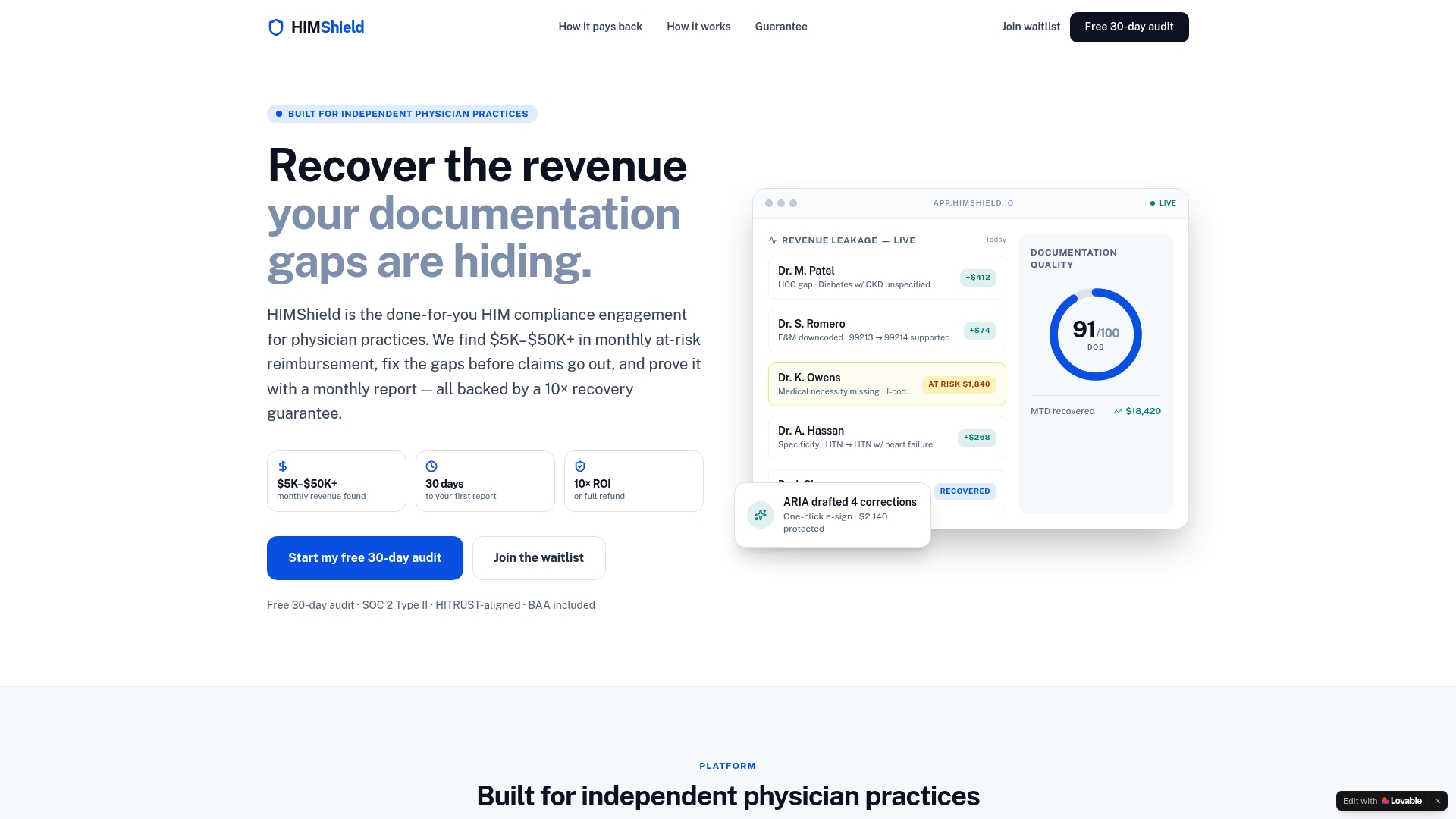
The free 30-day audit delivers a concrete deliverable: a Revenue Leakage Report identifying your top coding, documentation, and charge-capture risks, with estimated dollar impact. No long-term commitment is required to start. Practices typically see $5K–$50K+ in identified at-risk reimbursement in the first audit cycle.
Start your free 30-day audit and see exactly where your practice is leaving earned revenue uncollected. If you want to understand the platform mechanics first, see how Himshield works before you commit to anything.
Useful sources for further reading
These are the primary sources used throughout this guide. Each one is worth bookmarking for ongoing revenue cycle education.
- AMA: Power Up Your Private Practice's Revenue Cycle Management — The AMA's practical guidance on KPI targets, front-end automation, and staffing risk for independent practices. The most directly applicable resource for physician-owned practices.
- AAFP: Practice Finances and Revenue Cycle Management — AAFP's definitions and benchmark ranges for days in A/R, adjusted collection rate, and denial rate. Use this as your KPI reference standard.
- BlueFish: Revenue Cycle Management for Independent Practices — Practical benchmarks (clean claim rate, denial rate, payment turnaround) and a step-by-step RCM framework tailored to independent practices.
- Northstar Financial Advisory: Physician Owner's Guide to Reading Financial Statements — Explains the relationship between P&L, balance sheet, and cash flow, and why A/R growth is an early warning sign of RCM problems.
- AHIMA: Revenue Cycle — AHIMA's authoritative framework for front-end, mid-cycle, and back-end RCM phases, with role definitions and compliance context.
- PMC: Revenue Cycle Management — The Art and the Science — Peer-reviewed analysis of RCM performance and financial outcomes, useful for understanding the evidence base behind best practices.
- Himshield Blog: Independent Practice Revenue Leakage Examples — Operational examples of revenue leakage in independent clinics, with root-cause analysis and suggested fixes.
- Himshield Blog: Annual Coding Review for Physician Practices — A practical checklist for annual coding and documentation reviews; use alongside the 30/60/90 plan for long-term monitoring.