
What is a risk-based audit in physician practice?
A risk-based audit is an internal review approach that concentrates audit effort on the billing and documentation areas carrying the greatest financial and compliance exposure. Rather than reviewing every claim or code with equal attention, it prioritizes high-risk areas where errors are most likely to trigger payer denials, overpayment demands, or OIG scrutiny.
For independent physician practices, this distinction is critical. You don’t have a large compliance department. Every hour spent auditing low-risk claims is an hour not spent protecting the revenue that actually matters.
The core elements of a risk-based audit include:
-
Risk identification: Pinpointing billing codes, documentation patterns, and charge-capture processes with the highest denial or error potential
-
Risk evaluation: Assessing both the likelihood of an error and its financial impact on the practice
-
Prioritized audit scope: Directing review resources toward high-exposure areas rather than applying uniform coverage
-
Data-driven focus: Using claims data, payer denial trends, and prior audit findings to guide where attention goes
-
Continuous reassessment: Updating risk profiles as billing codes, payer rules, or clinical workflows change
Traditional audits treat every process as equally important. A risk-oriented audit approach asks a sharper question: where would a failure hurt most?
Why independent physician practices need risk-based auditing
Independent practices operate with limited administrative bandwidth. Applying the same audit intensity to a routine office visit as to a high-dollar surgical procedure wastes time and misses the exposures that actually threaten revenue.
Targeting high-priority threats produces real efficiency gains. A systematic review of studies found quantifiable reductions in audit time, increases in risk-prioritization accuracy, and improvements in audit resource-allocation efficiency. That evidence base spans regulated industries, but the mechanics apply directly to physician billing.
The benefits of risk-based auditing for independent practices include:
-
Fewer denials on high-dollar codes because errors are caught before submission
-
Faster reimbursement cycles when documentation is consistently accurate
-
Better use of coding staff time by focusing reviews on flagged areas
-
Earlier detection of payer-specific denial patterns before they compound
-
A shift from reactive error correction to proactive revenue protection
The Institute of Internal Auditors recommends risk-based methods precisely because they align limited resources with the organization’s most pressing exposures. For a solo or small-group practice, that alignment isn’t optional. It’s the only way auditing pays for itself.
How to conduct a risk assessment for your practice’s audit
The risk assessment is the engine of the entire process. Get it right, and every audit hour that follows is well spent.
-
Define your practice’s core objectives. Compliant, rapid reimbursement is the typical anchor. Your audit should protect that goal directly.
-
Identify high-risk areas. High-dollar procedures, frequently denied codes, documentation gaps in E/M visits, and HCC capture failures are common starting points.
-
Evaluate likelihood and impact. A code that is denied 40% of the time on low-dollar claims may matter less than one denied 10% of the time on high-dollar procedures. Score both dimensions.
-
Pull claims data and denial trends. Payer remittance data and your practice management system hold the pattern evidence you need.
-
Prioritize your audit scope. Rank risks by combined exposure and focus your first audit cycles there.
-
Map risks to business objectives. Practice-specific business goals must anchor the risk list. Without that connection, the audit loses focus.
Pro Tip: Reassess your risk profile every time a major billing code change, new payer contract, or workflow shift occurs. A static risk list becomes inaccurate faster than most practices expect.
How to implement risk-based auditing in daily operations
Implementation is where most practices stall. The methodology makes sense on paper; the challenge is building it into how your team actually works.
-
Set clear audit objectives tied to revenue goals. Every audit cycle should connect directly to protecting reimbursement on your highest-volume or highest-value services.
-
Assign audit responsibilities by risk level. Direct your most experienced coder or compliance reviewer to the highest-risk code sets, not to routine low-complexity claims.
-
Deploy automated risk detection. Tools like Himshield scan for coding, documentation, and charge-capture risks before claims go out, flagging issues that manual spot-checks routinely miss.
-
Focus on payer-flagged code sets. If a payer has recently increased scrutiny on a specific CPT range, that code set moves to the top of your audit queue immediately.
-
Train staff on the purpose of auditing. When your team understands that audits protect their paycheck and the practice’s viability, documentation accuracy improves without coercion.
-
Use findings to drive education. Every audit cycle should produce at least one documentation or coding education point that gets shared with the clinical team.
Pro Tip: Build a simple audit log that tracks which codes were reviewed, what errors were found, and what corrective action was taken. That log becomes your defense if a payer audit arrives.
Common misconceptions about risk-based audits in physician practices
Several beliefs keep independent practices from adopting this approach. Most of them are wrong.
-
“Risk-based audits are only for large health systems.” The opposite is true. Smaller practices benefit more because they have fewer resources to waste on low-priority reviews.
-
“Audits are punitive surveillance.” A well-run risk-based audit is a strategic feedback loop, not a gotcha exercise. It tells you where the practice is exposed before a payer finds out first.
-
“We did an audit last year, so we’re covered.” Risk-based auditing is a continuous cycle, not a one-time event. Payer rules, coding guidelines, and clinical workflows change constantly.
-
“We need to check every control equally.” Uniform coverage is exactly what risk-based methodology replaces. Equal attention to unequal risks produces poor results.
-
“Our denial rate is low, so we don’t have a problem.” A low overall denial rate can mask concentrated losses on specific high-dollar codes. The risk-based audit finds those pockets.
Understanding why practices face OIG audits often starts with exactly these blind spots.
How aligning your audit with business goals sharpens its impact
An audit without a defined business objective is just a checklist. Connecting audit focus to what the practice is actually trying to achieve is what makes findings matter.
-
Name your objectives explicitly. Revenue protection, clean claim submission rates, and compliant HCC capture are concrete goals that give the audit a target.
-
Map each identified risk to a specific objective. If the objective is rapid reimbursement, then documentation gaps that delay adjudication become high-priority risks.
-
Communicate findings in financial terms. “We found upcoding risk on 12% of reviewed E/M claims” lands differently with a physician owner than “we found some documentation issues.”
-
Keep the audit plan flexible. When a new payer contract changes reimbursement rules, the audit scope should shift within weeks, not at the next annual review.
-
Build stakeholder buy-in through relevance. Risk-based audit reports that speak to business outcomes get acted on. Reports that list control failures get filed.
A solid audit methodology for HIM teams builds this objective alignment into every phase of the review cycle.
How Himshield supports risk-based auditing for independent practices

Himshield is built specifically for the risk detection needs of independent physician practices. The platform automates the identification of coding, documentation, and charge-capture risks before they reach a payer, giving your team clear, prioritized alerts instead of raw data to interpret.
Key capabilities mapped to the risk-based audit process:
| Risk-Based Audit Component | Himshield Capability |
|---|---|
| Risk identification | Automated scanning of claims for coding and documentation gaps |
| Risk prioritization | Flags high-exposure codes and charge-capture issues first |
| Audit resource allocation | Directs reviewer attention to highest-risk claims |
| Continuous reassessment | Ongoing monitoring adapts to billing and workflow changes |
| Compliance guidance | Physician-friendly explanations of each flagged risk |
| Denial prevention | Catches errors before submission to reduce payer denials |
Practices using Himshield can also access educational resources including payer audit preparation guides and documentation training materials. The platform integrates with existing workflows so that risk detection becomes part of how claims are processed, not a separate compliance exercise bolted on afterward.
What types of risks does a physician practice audit evaluate?
A physician-focused risk assessment covers several distinct risk categories, each with direct revenue implications.
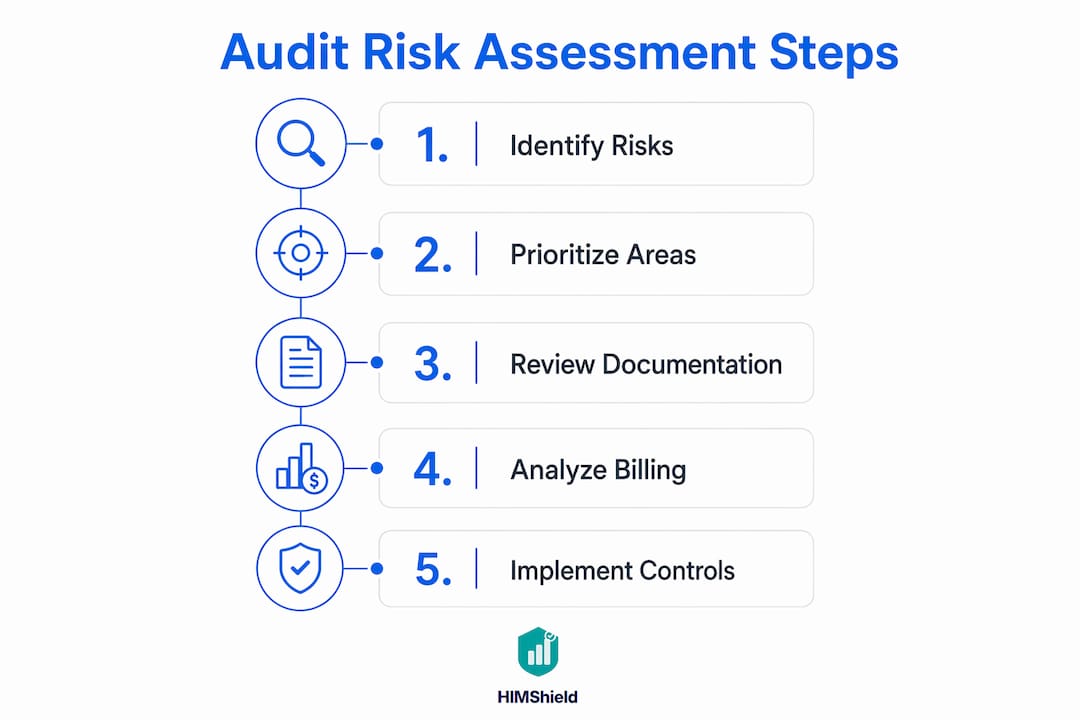
Coding risks include upcoding, undercoding, unbundling, and use of unsupported diagnosis codes. High-dollar E/M codes and procedure-intensive specialties carry the most exposure here. Documentation risks involve missing signatures, insufficient medical necessity support, incomplete HCC documentation, and visit notes that don’t match the billed code. Charge-capture risks cover services rendered but not billed, incorrect modifiers, and facility versus professional fee errors. Payer-specific risks include billing patterns that trigger a specific payer’s prepayment review or post-payment audit flags. Staying current on HIPAA compliance requirements also surfaces regulatory risks that intersect with billing accuracy.
How risk-based audits prevent coding and billing denials
Denials don’t arrive randomly. They follow patterns, and those patterns are detectable before a claim goes out. A risk-based audit process identifies the specific codes, documentation habits, and billing sequences most likely to trigger a denial, then corrects them upstream.
When your audit targets the codes a payer has flagged in its most recent Local Coverage Determination updates, you stop submitting claims that were going to be denied anyway. When documentation gaps are caught during the audit cycle rather than after adjudication, the reimbursement cycle shortens. Practices that audit reactively spend time on appeals. Practices that audit proactively spend that time on patient care.
Key metrics that signal high-risk areas in your practice
You don’t need a sophisticated analytics platform to identify where risk concentrates. A few core metrics point directly to the problem areas.
Denial rate by CPT code shows which specific services are being rejected most often. First-pass resolution rate measures how many claims pay on the first submission without correction. Documentation deficiency rate tracks how frequently records fail to support the billed level of service. Charge-lag time identifies delays between service delivery and billing that increase denial risk. Payer-specific denial reason codes reveal whether a problem is documentation-based, coding-based, or eligibility-related. Reviewing these metrics monthly, rather than quarterly, gives you a current risk picture rather than a historical one.
Staff roles and responsibilities during the audit process
A risk-based audit works only when everyone understands their part. Diffuse responsibility produces gaps.
The billing manager or compliance lead owns the audit plan, sets the review schedule, and tracks findings against prior cycles. Coders review flagged claims, apply corrections, and document the rationale for any code changes. Physicians respond to documentation queries promptly and participate in education sessions when patterns of deficiency emerge. Practice administrators receive findings in financial terms and authorize any workflow changes the audit recommends. For practices without a dedicated compliance role, self-audit techniques can distribute these responsibilities across existing staff without requiring a new hire.
Protect your revenue before the next payer audit arrives
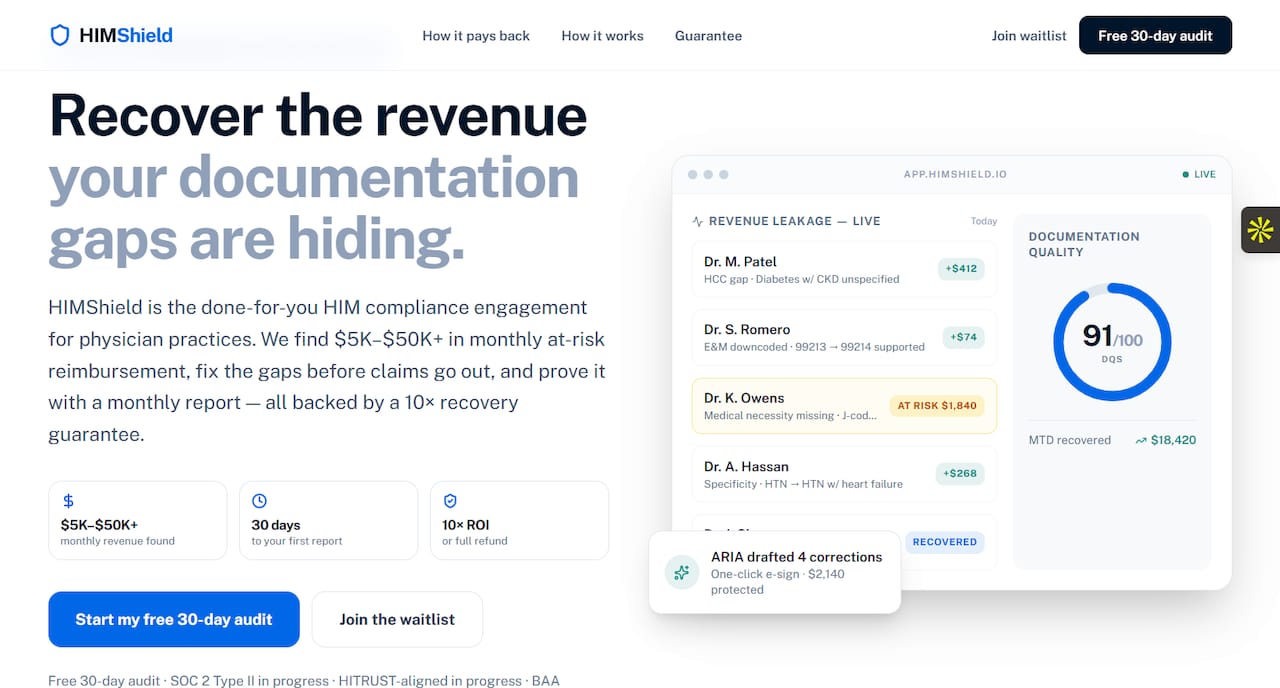
Himshield gives independent physician practices the automated risk detection they need to catch coding, documentation, and charge-capture issues before they become denials or audits. Clear alerts, physician-friendly guidance, and continuous monitoring built for practices that can’t afford to leave earned revenue on the table.
Recover hidden practice revenue and see what Himshield finds in your claims today.
Key Takeaways
A risk-based audit protects physician practice revenue by concentrating audit effort on the highest-exposure billing and documentation areas before payer denials occur.
| Point | Details |
|---|---|
| Focus on highest-risk codes | Direct audit resources to high-dollar, frequently denied CPT codes rather than reviewing all claims equally. |
| Continuous reassessment required | Update your risk profile whenever billing codes, payer rules, or clinical workflows change. |
| Align audit to business goals | Connect every audit objective to revenue protection or clean claim submission to keep findings actionable. |
| Staff roles must be defined | Assign billing, coding, and physician responsibilities explicitly so no audit task falls through the gaps. |
| Automated detection accelerates results | Platforms like Himshield identify coding and documentation risks before submission, reducing denial rates upstream. |