
A coding backlog shrinks when you stop feeding it. Most of the encounters sitting in a coder's queue are not waiting for coding. They are waiting for a missing diagnosis, an unsigned note, an unanswered query or a charge nobody captured. Clear the backlog you have with a shared, prioritized queue. Then catch documentation and charge gaps before claims are built, so the pile does not return. That second step is what our free 30-day Revenue Leakage Audit is built to show you, using your own EHR data.
TL;DR
- Measure the backlog in encounters, dollars and days before you change anything, so you can prove it is shrinking.
- Work it down with one shared queue, ordered by dollars and deadlines, not one queue per payer or per coder.
- Prevent new backlog at the source: closed encounters within 72 hours, fast provider queries and specific documentation.
- Automation helps most when it drafts and a physician signs; review stays with the clinician.
- Track days to final bill, denial rate and coder productivity weekly, and watch for compliance drift as speed rises.
Table of Contents
- What a coding backlog really is
- Step 1: Measure the backlog before you touch it
- Step 2: Clear the existing pile with one shared queue
- Step 3: Fix what feeds the backlog
- Step 4: Decide who does the work
- Step 5: Use automation where it removes rework
- Step 6: Track results without adding burden
- A 30-day plan
- Promo: see the leakage behind your backlog
- Perspective
- FAQ
- Sources
What a coding backlog really is
A coding backlog is the set of completed patient visits that have not been turned into billable codes and a claim. In a small practice it usually builds quietly: a physician falls behind on notes, a coder holds encounters while waiting on an answer, a payer rule changes and a batch gets parked.
The cost is not only delay. Every day an encounter sits uncoded pushes out cash, and encounters that age close to payer filing limits risk becoming write-offs. MGMA defines days in A/R as total accounts receivable divided by average daily charges. Its July 30, 2026 report on days in A/R recommends clinicians close encounters within 72 hours and staff post charges within two days. It contrasts that with a three- to seven-day lag seen across the sector. If your lag sits at the long end, your backlog is partly a timing habit, not a staffing shortage.
Step 1: Measure the backlog before you touch it
You cannot manage a pile you have not sized. Pull three numbers from your practice management system and EHR:
- Count: encounters with a date of service but no final claim, split into "not coded," "coded, on hold" and "waiting on provider."
- Dollars: the expected charge value of those encounters, by provider and by payer.
- Age: how many days each encounter has been open, bucketed at 0 to 3, 4 to 7, 8 to 14, 15 to 30 and over 30 days.
The split in the first number matters most. If most of the pile is "waiting on provider," hiring another coder will not help. If most is "not coded," you have a capacity or routing problem.
Then set a baseline for the outcomes you care about. CMS's ICD-10 assessment and maintenance toolkit recommends tracking days to final bill, days to payment, claim acceptance and rejection rates, denial rates split by authorization and coding, coder productivity per hour, coder questions, and incomplete or missing charges and diagnosis codes. You do not need all of them on day one. Pick four, record today's values and write down the date.
An older AHIMA article on reducing accounts receivable adds one more habit worth keeping: set a specific threshold, in dollars or A/R days, for the unbilled balance and monitor it regularly. A threshold turns a vague worry into an alert.
A worked example
Say a four-physician group finds 640 open encounters. Sorting them shows 90 are uncoded, 210 are coded but held for missing documentation, and 340 are waiting on a physician signature or query response. The coders are not the bottleneck. Nearly 90 percent of the pile sits upstream of them. The first fix is a provider-side routine, not a hire.

Step 2: Clear the existing pile with one shared queue
Once you know what is in the pile, work it in a deliberate order.
Pool the work. A Labor Management Partnership case study describes a coding team that replaced individual per-payer queues with a shared "blitz" queue until the backlog came down, and processed 50 percent more claims as a result. The lesson for a small practice is simple: when every coder owns one payer or one provider, a slow queue stays slow while another coder is idle. Let everyone pull from the same list until the backlog is gone.
Order by dollars and deadlines. MGMA's guidance is to run A/R aging by payer and to work denials daily, starting with high-dollar claims and the nearest appeal deadlines. Apply the same logic to uncoded encounters: highest expected charge first, then those closest to a payer's timely-filing limit, then the oldest.
Route by what is missing, not by who touches it. Send "waiting on provider" items to a physician-facing list, with a fixed daily slot for sign-offs. Send clean, uncoded encounters to coders. Send payer-specific edge cases to your most experienced coder. A single triage pass each morning, 15 minutes, keeps the three lists honest.
Protect coder focus. The AHIMA accounts-receivable article also recommends staggered schedules for coder and analyst positions, concurrent coding as the primary method and a noise-free environment for coders. These are low-cost changes. A coder who is interrupted every ten minutes codes fewer charts and makes more errors, and errors become tomorrow's rework.
If you want a vocabulary for the different ways a group can organize this work, our physician group coding workflow guide walks through the common models.

Step 3: Fix what feeds the backlog
A cleared backlog refills within weeks unless you change the inputs. Four causes account for most of the refill.
Late or incomplete notes
The 72-hour target for closing encounters is the single most useful rule. Make it visible: a weekly list by provider of encounters still open past 72 hours, shared with the physician owners. Visibility does more than reminders.
Documentation that does not support the code
The FY2026 ICD-10-CM Official Guidelines require diagnosis codes to be reported to the highest number of characters available and the highest level of specificity documented. HIPAA requires adherence to the guidelines when assigning ICD-10-CM diagnosis codes. The guidelines also treat provider and coder collaboration as essential for complete, accurate documentation. The ICD-10-CM guidelines are reissued each fiscal year starting October 1, so confirm you are working from the version in force for your date of service.
In practice this means a coder who sees "diabetes" without type, control status or complication cannot assign the specific code, and the chart goes to a queue. Every such query costs days. The answer is not to push coders to guess. Selecting a code the note does not support is inappropriate under the guidelines. The answer is documentation that is specific the first time. Our piece on why coding specificity reduces audits and denials covers the audit side of the same point.
Slow query turnaround
CMS's toolkit notes that lag in responses to coder questions drags on days to final bill and on denials for lack of medical necessity. It also suggests checking whether documentation differences come from individual providers, vendor templates or payer requirements. That check is worth an afternoon: a single poorly built template can generate the same query hundreds of times.
AHIMA's guidance on clinical documentation improvement programs describes queries as routine communication and education tools, not accusations. It also recommends written policies for query format, retention, audit and monitoring. Adopt a one-page version: what a compliant query looks like, who answers within what time, and how repeat queries feed provider education.
Missed charges
Charges that never reach the coder are invisible backlog. They do not show up in any queue because nobody knows they exist. They also never turn into revenue. This is the category most practices underestimate, and it is the one that benefits most from a systematic scan of EHR data rather than a manual sample.
Step 4: Decide who does the work
Staffing is the question every practice owner asks, so be careful about the order. Fix routing and documentation first, then size the team to what remains.
AHIMA's CDI guidance says staffing models can draw on HIM professionals (RHIA or RHIT credentials, preferably with the CCS coding credential), registered nurses with case-management or utilization-review experience, or physicians and physician assistants. Hybrid and multidisciplinary models are also described. It names patient volume, availability of qualified staff and compensation as the factors that drive the choice. AHIMA's Best Practices: What Works article adds that cost-leading organizations eliminated backlogs and matched staff skill level to the work performed. Better performers on accuracy used productivity standards, regular internal and external review with targeted education, and consistent coding staff.
For a small practice, that translates to:
- Give experienced coders the complex and payer-specific cases. Do not spend them on routine encounters.
- Set a realistic productivity standard per coder and publish it.
- Review a small random sample of each coder's work every month and use misses for training, not blame.
- Keep your coders. Turnover resets the learning curve on your payers and your providers.
The cheapest capacity you will ever add is the time your coders stop spending on rework.
Step 5: Use automation where it removes rework
Automation reduces backlog in two places: before the claim, by finding gaps in documentation and charges, and after, by speeding corrections. A useful way to sequence it is to start with the repetitive checks that consume the most coder time. Adjet Marketing's overview of what to automate first in medical practices is a good prompt for that exercise.
The evidence on AI drafting points to the same design principle: the clinician reviews. In a 2025 pilot randomized trial of 17 physicians reported on medRxiv, a clinician-in-the-loop AI workflow cut the time to produce a discharge summary by 59.4 seconds versus clinician-only drafting. It also outperformed clinician-only drafting in most quality domains. Drafts produced with no clinician review were fastest but lowest in quality. The study is a small pilot on discharge summaries, not on outpatient coding, so treat it as support for a workflow shape: the machine drafts, the physician confirms.
That is the shape HIMShield follows. Our platform identifies and quantifies coding, documentation and charge-capture gaps in your EHR data before claims are submitted. It auto-drafts corrections that the physician approves with a one-click e-signature, so the physician stays in control and the correction takes seconds instead of a back-and-forth. Compliance alerts and real-time documentation quality scoring are designed to stop the same gap from recurring. Our four-step coding correction process shows how a correction moves from detection to signature.
Step 6: Track results without adding burden
A backlog plan that creates a reporting project will not survive a busy month. Keep the dashboard to one page and review it weekly for 15 minutes.
| Measure | Why it matters | Healthy direction |
|---|---|---|
| Open encounters by age bucket | Shows whether the pile is shrinking and where it is stuck | Fewer, with no growth in the 15+ day bucket |
| Encounters closed within 72 hours | Tracks the input side | Rising |
| Days to final bill | Tracks end-to-end turnaround | Falling |
| Denial rate, coding vs. authorization | Shows whether speed is costing accuracy | Flat or falling |
| Coder productivity per hour | Shows capacity | Steady, not spiking |
| Open queries and average response time | Shows provider-side lag | Fewer, faster |
The fourth row is your compliance guardrail. If coders speed up and coding denials rise, you are trading accuracy for throughput. A monthly coding sample catches the drift. Our guide to coding audits explains how to run one, and the denial prevention guide shows how to read denial patterns back into your front-end routine.
For a longer-cycle check, an annual coding review gives you a structured look at specialty-specific risk areas.
A 30-day plan
Week 1. Size the backlog by count, dollars, age and cause. Record baseline measures. Set a dollar or A/R-day threshold.
Week 2. Merge queues into one shared list. Start the daily 15-minute triage and a fixed physician sign-off slot.
Week 3. Publish the 72-hour list by provider. Review the top ten recurring queries and fix the template or education behind them.
Week 4. Re-measure. Compare against the baseline. Decide whether the remaining gap is capacity, documentation or charge capture, and act on that.
Promo: see the leakage behind your backlog
If your count shows most of the backlog is held for documentation or missing charges, the fastest way to size the money at stake is to look at your own data. Our free 30-day Revenue Leakage Audit scans your EHR data and delivers a Revenue Leakage Report by provider and by payer, so you see which gaps cost you the most. It works without new staff or software training for your team, and the audit comes with our performance guarantee before any paid subscription.
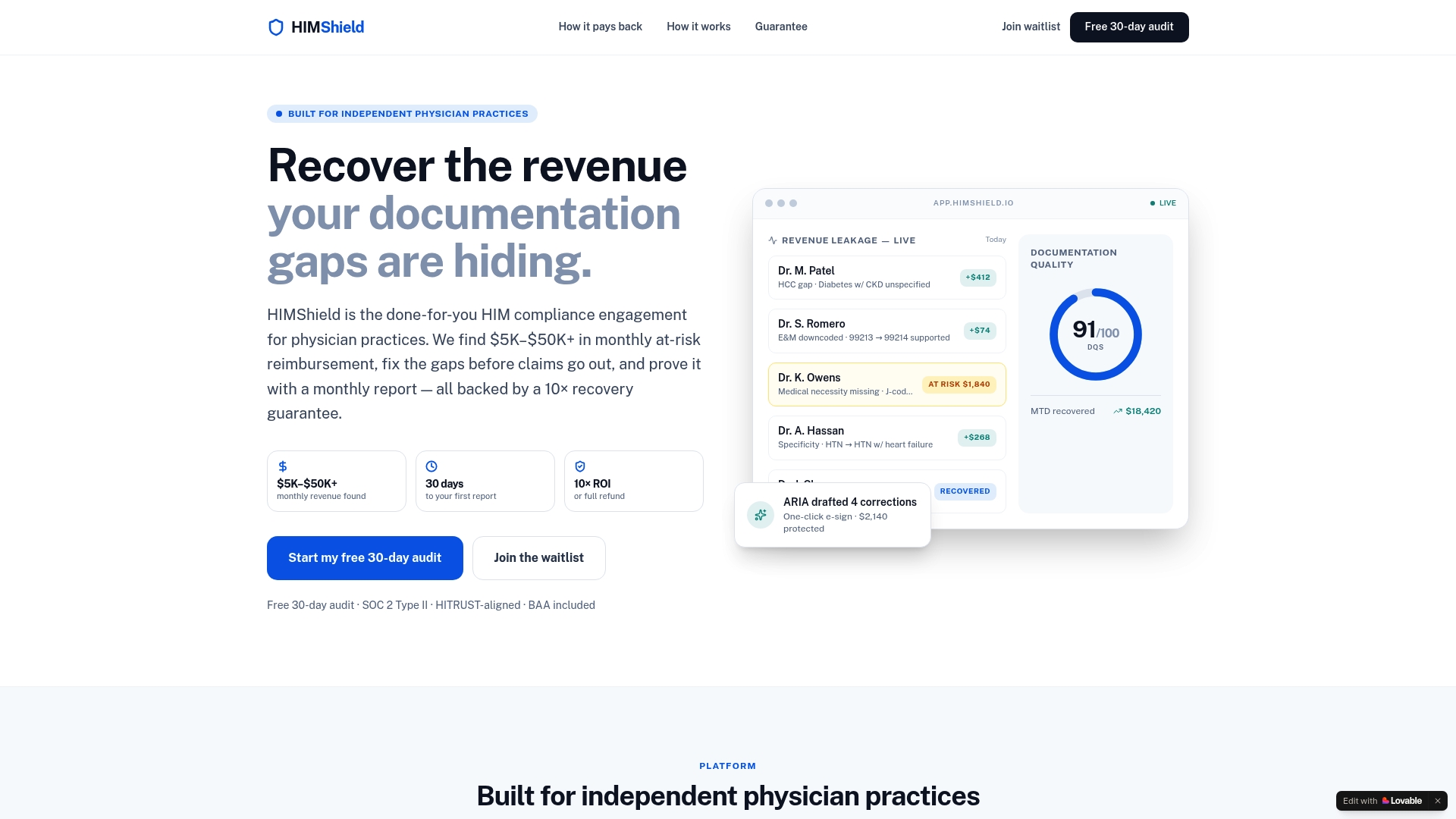
Start your free 30-day Revenue Leakage Audit, or see how the HIM compliance engagement fits an independent practice.
Perspective
Practices come to us asking how to code faster. The better question is why the encounters are not ready to be coded. A coder can only work with what the chart supports, and when the chart is thin, the encounter waits.
We built HIMShield around that idea. Find the gap in the EHR data before the claim goes out. Quantify it per provider and per payer so the owner sees where the money is. Draft the fix, and let the physician sign it in one click. That removes the back-and-forth that turns a one-day task into a three-week backlog.
Our approach is done-for-you because independent practices do not have spare hours for another project. We want the physician's role to be a signature, the coder's role to be the complex cases, and the administrator's role to be reading one report. Backlog is a symptom. Clean documentation at the source is the cure, and it is the part we are designed to take off your hands.
Elena
FAQ
How long should it take to clear a coding backlog?
It depends on the size and the cause. A pile held mostly in coder capacity can fall within a few weeks of pooling queues and ordering by dollars and deadlines. A pile held for provider documentation moves only as fast as physicians close encounters, so the 72-hour target and a weekly provider list are the levers. Re-measure each week against your baseline.
Should I hire another coder to reduce the backlog?
First split the backlog by cause. If most open encounters are waiting on provider responses or missing charges, another coder will sit behind the same bottleneck. If most are clean and uncoded, added capacity helps. AHIMA's guidance lists patient volume, availability of qualified staff and compensation as the factors that shape staffing choices.
Can AI code encounters without a physician reviewing them?
The safest design keeps the clinician in the loop. In a 2025 pilot trial, drafts reviewed by a clinician were higher in quality than unreviewed AI drafts. Under the ICD-10-CM guidelines, the code must reflect what the provider documented, which is why we draft corrections and route them to the physician for e-signature.
Which metrics show the backlog plan is working?
Start with open encounters by age, encounters closed within 72 hours, days to final bill and coding-related denial rate. CMS's ICD-10 toolkit lists these and several more, including coder productivity and incomplete charges. Rising speed with a flat or falling denial rate means the plan is working without adding compliance risk.
Sources
- MGMA: Days in A/R holds steady for most practices, but payer pressure persists in 2026
- CMS: Next Steps for Providers Assessment & Maintenance Toolkit
- AHIMA: Reducing Accounts Receivable Through Benchmarking and Best Practices Identification
- Labor Management Partnership: Coding Team's Blitz Bulldozes Backlogged Claims
- CMS: ICD-10-CM FY2026 Official Guidelines
- AHIMA: Guidance for Clinical Documentation Improvement Programs
- AHIMA: Best Practices: What Works
- medRxiv: Evaluating an LLM-Assisted Workflow for Clinical Documentation
- Adjet Marketing: AI Automation For Medical Practices