
Physician group coding workflow types define how medical coding tasks are organized, sequenced, and executed to protect billing accuracy and revenue cycle performance. The three primary models used in physician group practices are retrospective, concurrent, and single-path coding. Each operates under different timing constraints, staffing requirements, and technology dependencies. Understanding which model fits your practice's encounter volume, specialty mix, and EHR environment is the first decision that determines whether your CPT® codes and AMA-compliant documentation hold up under payer scrutiny or generate denials.
1. What are physician group coding workflow types?
Physician group coding workflow types are structured frameworks that govern when and how coders assign diagnosis and procedure codes to patient encounters. The term "coding workflow" is the recognized industry term in health information management (HIM) circles, covering everything from charge capture to claim submission. In practice, these workflows determine whether your revenue cycle runs tight or leaks money at multiple points. Choosing the wrong model for your practice size or specialty is one of the most common and costly administrative errors in independent physician groups.

2. What is retrospective coding workflow and when is it used?
Retrospective coding is the process of assigning codes after a patient encounter is fully documented and the visit record is closed. This is the most traditional medical coding workflow and remains common in smaller practices where encounter volume is manageable and coding staff work from completed charts.
Advantages of retrospective coding:
- Full documentation is available before coding begins, reducing query volume
- Coders can apply thorough review and audit controls at each stage
- Lower technology dependency makes it accessible for practices without advanced EHR integration
- Edit and audit stages are easier to build into the workflow because the record is static
Challenges to watch for:
- Delays between encounter and code assignment increase denial risk from timely filing rules
- Missed charges are harder to recover once the billing window closes
- Retrospective review can mask upstream intake problems until they become denial patterns
Pro Tip: Run a weekly aging report on unworked charts. If retrospective coding queues exceed five business days, you are losing revenue to timely filing limits before a single claim goes out.
Retrospective coding works best for low-volume specialty practices, practices with complex documentation that requires full chart review before coding, and settings where provider query turnaround is slow. It is not the right fit for high-volume primary care or hospital-based physician groups where speed of claim submission directly affects cash flow.
3. How does concurrent coding workflow increase coding efficiency?
Concurrent coding is the practice of assigning codes within 24 hours of a patient encounter, while the provider is still actively documenting or immediately after discharge. Concurrent coding workflows can double capture rates on targeted high-value encounters without doubling staff. That result is only achievable when the workflow includes disciplined triage and fast provider query turnaround.
The operational requirements are specific. Coders review encounters within 24 hours of discharge. Providers respond to queries within 24–48 hours. Any longer and the efficiency advantage disappears.
Steps to implement concurrent coding effectively:
- Identify your top 5–10% of encounters by expected reimbursement value
- Route those encounters to concurrent coding queues immediately after discharge
- Assign a dedicated coder with strong query skills to each high-value service line
- Use an integrated query tool within your EHR or coding platform to eliminate handoff delays
- Track provider response times weekly and escalate non-responders to the practice administrator
Concurrent coding demands different skills than retrospective coding. Coders must assign codes from incomplete documentation and communicate quickly with providers. Practices that attempt concurrent coding without integrated communication tools inside their coding platform create handoff bottlenecks that cancel out the speed advantage.
Focusing concurrent coding resources on 5–10% of high-value encounters can yield large revenue returns without overwhelming your coding staff. Applying it to every encounter is the fastest way to burn out your team and degrade quality.
Pro Tip: Do not apply concurrent coding to every encounter. Ruthless triage that targets only high-value encounters is what makes the model financially viable.
4. What is single-path coding and how does it streamline workflows?
Single-path coding assigns both facility and professional-fee coding of an encounter to one coder. This eliminates the redundant handoffs that occur when separate coders handle facility and professional sides of the same visit. The result is a leaner workflow with fewer communication gaps and a lower risk of conflicting code assignments on the same encounter.
Key benefits of single-path coding:
- Fewer handoffs mean fewer opportunities for documentation to be misread or misapplied
- One coder managing both sides improves documentation improvement facilitation and provider communication
- Compliance is easier to track because one person owns the full encounter record
- Single-path coding can reduce denials and improve coding accuracy by consolidating review into one accountable role
Risks if the model is applied without proper expertise:
- Modifier application across facility and professional fee coding requires expert-level knowledge
- Errors in modifier usage on professional claims are among the most common audit triggers
- A coder who is strong on professional fee coding but weak on facility coding creates compliance gaps that are hard to detect until a payer audit surfaces them
| Factor | Single-path coding | Split-path coding |
|---|---|---|
| Handoff complexity | Low | High |
| Coder skill requirement | Expert level | Moderate per role |
| Denial risk from conflicting codes | Low | Higher |
| Staff headcount needed | Lower | Higher |
| Best fit | Mid-size specialty groups | Large, high-volume facilities |
Single-path coding is emerging as a leading solution to remove redundancy and overhead in physician group coding processes. It is not a beginner model. Practices that adopt it without verifying coder competency in both coding types will see short-term efficiency gains followed by a spike in denials and audit exposure.
5. How does automation impact physician group coding workflows?
Automation changes the structure of healthcare coding processes by inserting decision gates at defined points in the workflow rather than relying on manual review at every step. The right automation reduces correction burden and improves quality. The wrong rollout creates compliance gaps that are invisible until a payer or OIG audit makes them visible.
Piloting coding automation requires a 4–6 week controlled test in a specific clinical workflow lane with named reviewers and measurable gates. That structure is not optional. Practices that skip the pilot phase and deploy automation across all service lines simultaneously lose the ability to isolate errors and trace them back to a root cause.
Best practices for automation implementation:
- Assign a named clinical owner to each automated workflow lane before go-live
- Track correction burden and escalation quality weekly during the pilot period
- Build audit trails and access controls into the platform from day one
- Structured governance including weekly review huddles documented in writing improves clinical acceptance and compliance
- Do not expand automation scope until the pilot lane meets your quality threshold for three consecutive weeks
Automation also affects intake quality. Most coding workflow problems stem from weak front-end capture, including intake errors and poor documentation readiness. Automation applied downstream of a broken intake process will produce faster errors, not fewer errors. Fixing healthcare intake efficiency before deploying automation is the correct sequence.
6. How to choose the best coding workflow for your physician group
The right coding workflow for your practice is determined by four variables: encounter volume, coder expertise, provider responsiveness, and technology infrastructure. No single model is universally superior. Many high-performing physician groups use hybrid approaches that combine concurrent coding for high-value encounters with retrospective coding for routine visits.
Decision criteria by practice profile:
- Low volume, complex specialty (e.g., neurosurgery, oncology): Retrospective coding with strong audit controls. Full documentation availability reduces query burden.
- High volume, primary care or urgent care: Concurrent coding for the top revenue encounters, retrospective for the rest. Speed of claim submission matters more than thoroughness on routine visits.
- Mid-size multispecialty group: Single-path coding if you have coders credentialed in both facility and professional fee coding. Reduces overhead without sacrificing compliance.
- Any practice with EHR integration gaps: Fix intake and documentation readiness first. Coding issues that originate upstream from intake problems cannot be solved by changing the downstream workflow model.
Technology compatibility is a hard constraint. Concurrent coding requires an integrated query tool. Single-path coding requires a coder who can access and work both sides of the encounter record in your EHR. If your EHR does not support those functions natively, you need a third-party coding platform that integrates via API before you change your workflow model. Reviewing what to automate and what to keep manual in your clinical workflows is a practical first step before committing to any model.
Key takeaways
The most effective physician group coding workflow is one that matches your encounter volume, coder expertise, and technology infrastructure before any automation or structural change is introduced.
| Point | Details |
|---|---|
| Retrospective coding suits low-volume practices | Use it when full documentation availability matters more than speed of claim submission. |
| Concurrent coding requires disciplined triage | Target only the top 5–10% of high-value encounters to avoid staff overload and quality loss. |
| Single-path coding demands expert coders | Assign only coders credentialed in both facility and professional fee coding to avoid modifier errors. |
| Automation needs a structured pilot | Run a 4–6 week controlled test with named reviewers and measurable gates before expanding scope. |
| Intake quality determines workflow success | No downstream workflow model prevents denials if front-end capture and documentation readiness are weak. |
Why workflow selection is harder than it looks
I have reviewed coding operations across dozens of independent physician practices, and the pattern is consistent. Practices that struggle with denials are almost never using the wrong workflow type on paper. They are using the right workflow type with the wrong implementation. A concurrent coding program without an integrated query tool is just a retrospective program with an artificial deadline. A single-path model staffed by a coder who is strong on professional fee coding but untested on facility coding is a compliance liability waiting to surface.
The advice I give every administrator who asks me which workflow to choose is this: audit your intake process before you audit your coding process. The upstream intake problems that generate denials are invisible inside a coding workflow review. You will spend months optimizing a concurrent or single-path model and still see the same denial rate because the root cause is documentation readiness at registration, not code assignment at the back end.
Provider engagement is the other variable that most workflow redesigns underestimate. Concurrent coding lives or dies on provider query response time. If your providers take five days to respond to a query, you do not have a concurrent coding program. You have a retrospective program with extra steps. Build provider response time into your workflow SLAs before you commit to any model, and measure it weekly from the first day of implementation.
— Elena
How Himshield helps you protect every earned dollar
Your coding workflow is only as strong as the risk detection behind it. Himshield scans your physician group's coding, documentation, and charge-capture data to identify revenue leakage and compliance risks before they become denials or audits.
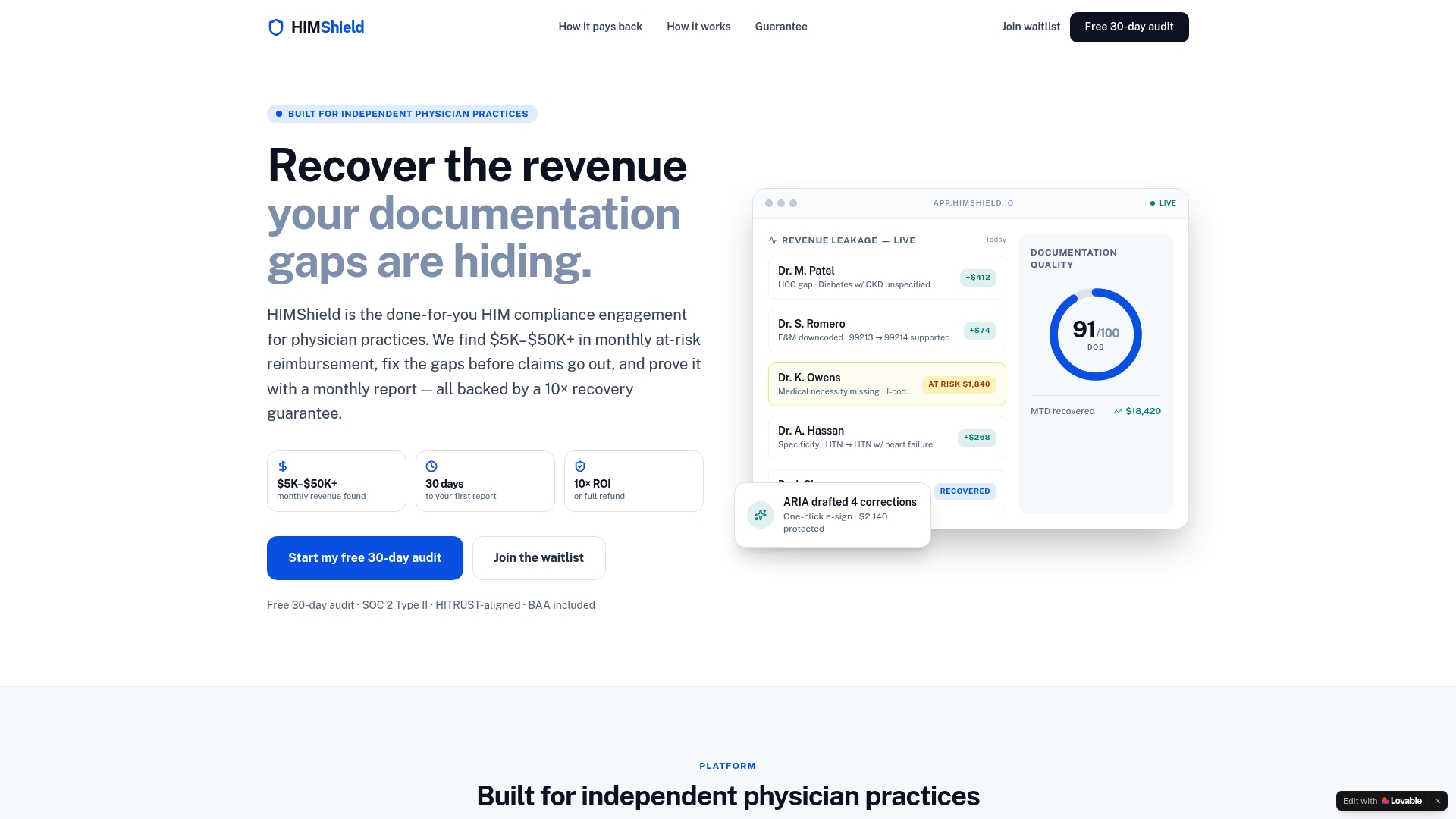
Himshield delivers automated risk detection and physician-friendly guidance built for independent practices. Whether you are running a retrospective model, piloting concurrent coding, or evaluating single-path workflows, Himshield gives you the clear, fast insights you need to keep your revenue cycle clean. Practices using Himshield recover $5K–$50K+ in hidden revenue by catching the coding and documentation gaps that standard EHR workflows miss. Recover hidden practice revenue and see what your current workflow is leaving on the table.
FAQ
What are the main physician group coding workflow types?
The three primary types are retrospective, concurrent, and single-path coding. Each differs in timing, staffing requirements, and technology needs.
When should a physician group use concurrent coding?
Concurrent coding works best when coders can review encounters within 24 hours of discharge and providers can respond to queries within 24–48 hours. It is most effective when applied only to high-value encounters.
What makes single-path coding risky without the right staff?
Single-path coding requires one coder to handle both facility and professional fee coding, including modifier application. A coder without expertise in both areas creates compliance gaps that often surface only during a payer audit.
How does automation affect coding workflow efficiency?
Automation reduces correction burden and improves quality when introduced through a structured 4–6 week pilot with named reviewers and measurable decision gates. Deploying it without a pilot phase makes errors harder to trace and correct.
Why does intake quality affect coding workflow outcomes?
Most coding errors originate from weak front-end capture, including intake errors and incomplete documentation. No downstream workflow model, whether retrospective, concurrent, or automated, can fully compensate for poor documentation readiness at the point of registration.