
Payer recoupment is a formal reclaiming of money a health plan already paid you, triggered when the payer decides a claim was overpaid, duplicated, or unsupported by documentation. The moment a recoupment notice lands, your first move is to log it, pull the claim and its full chart, and check your appeal deadline before a single dollar changes hands. CMS and the AMA both frame this as a race against the clock, not a paperwork formality.
TL;DR:
- Verifying patient eligibility immediately before billing and tracking prior authorizations prevent most common recoupment triggers, especially mismatched procedures and expired approvals.
- Accurate clinical documentation tied to each code, along with thorough charge capture reconciliation, reduces coding and overbilling issues that often lead to post-payment recoveries.
- Analyzing recent recoupment notices by cause helps practices prioritize process improvements on the most frequent issues like documentation gaps and authorization lapses.
- Promptly responding within CMS 30-day deadlines and requesting clear methodology from payers strengthen appeal positions and prevent recoupment from starting due to missed windows.
- Implementing a structured recoupment prevention playbook with assigned ownership, ongoing training, and technology fixes minimizes the risk of losing revenue to payer clawbacks.
Table of Contents
- What Is Payer Recoupment Prevention, and Why Does It Matter?
- How Can You Prevent Recoupment Before You Submit a Claim?
- What Post-Payment Monitoring Catches Recoupment Risk Early?
- How Do You Respond to a Recoupment Notice?
- What CMS and State Deadlines Govern Recoupment?
- How Should Independent Practices Structure a Recoupment Prevention Playbook?
- Why Prevention Beats Reactive Recovery Every Time
- Get a Revenue Leakage Report Before a Payer Does
- Where to Verify These Recoupment Rules
- Sources
- FAQ
What Is Payer Recoupment Prevention, and Why Does It Matter?
Recoupment prevention means catching the errors that trigger payer clawbacks before a claim ever leaves your practice, rather than fighting to get the money back after a payer has already taken it. That distinction between prevention and recovery is where independent practices either protect their cash flow or bleed it slowly.
Recoupment is not the same thing as a reversal or an offset, and mixing up the terms costs practices leverage during a dispute. A reversal voids a claim entirely, as if it never happened. An offset is the mechanism payers use to collect: they deduct the disputed amount from a future, unrelated payment instead of asking you to cut a check. Recoupment is the underlying demand, the payer's determination that you were overpaid, with the offset as the collection method. Readjudication is what happens when the payer reprocesses the original claim under new rules or corrected information, which can trigger either a recoupment or an additional payment.
Payers find these overpayments through several channels. Post-payment audits comb through paid claims months after the fact. The CMS Recovery Audit Program uses Recovery Audit Contractors and similar entities to run systematic reviews across Medicare claims, and many commercial payers run parallel programs modeled on the same approach. Some audits sample a handful of claims, then extrapolate the error rate across your entire claim volume for that code or date range, turning a small documentation gap into a five or six figure demand. Pharmacy benefit managers run their own audit cycles on top of this, often with tighter documentation standards than medical payers.
The recurring causes behind most recoupment demands fall into a short, predictable list:
- Duplicate payments — the same service billed and paid twice, often after a resubmission error.
- Coordination of benefits (COB) errors — the wrong payer paid first, and the secondary payer later discovers it.
- Fee-schedule reprocessing — a payer retroactively adjusts its rates and reclaims the difference on already-paid claims.
- Documentation and coding shortfalls — the chart note doesn't support the code billed, a common trigger during E/M level audits.
- Missing or expired prior authorization — the service was approved, but the authorization lapsed or didn't cover the exact date of service billed.
Each cause maps to a specific control you can build into your workflow, which is exactly where prevention starts.
How Can You Prevent Recoupment Before You Submit a Claim?
Every recoupment prevented at the front end is money you never have to fight for later. The controls below target the five causes above, and none of them require enterprise-level infrastructure to implement.
- Verify eligibility for the exact date of service. A patient's coverage can lapse or change plans between the time you schedule and the day they show up. Running an eligibility check on the morning of the visit, not just at intake weeks earlier, catches lapsed coverage before you bill it.
- Capture and track prior authorizations with expiration dates. Authorizations aren't permanent. Build a tracker that flags approvals nearing expiration, and confirm the authorized CPT or HCPCS code matches what you're actually billing. A mismatch between the authorized procedure and the billed procedure is one of the most common, and most avoidable, recoupment triggers.
- Tie every code to the clinical note before submission. Coders should confirm that the CPT, ICD-10, and modifier combination is fully supported by the documentation, not just plausible given the visit type. This is especially critical for E/M codes, where auditors specifically look for a gap between complexity billed and complexity documented.
- Validate charge capture against units and line items. Time-based codes, infusion codes, and multi-unit procedures are frequent sources of overbilling that show up months later as recoupment demands. A quick line-by-line reconciliation against the encounter catches this before the claim goes out.
- Configure your claim scrubber to flag, not just fix. Most scrubbers catch format errors well. Fewer are configured to flag high-risk patterns: high-dollar claims, unusual modifier stacking, or multiple CPT codes billed together. Set human review triggers for these specific patterns rather than relying on the scrubber's default rule set.
- Run a recurring training cadence, not a one-time session. Intake staff, coders, and clinicians each contribute to different failure points. Quarterly refreshers focused on your practice's actual denial and recoupment history, not generic compliance training, close the gaps that repeat.
Pro Tip: Pull your last twelve months of recoupment notices and sort them by cause before you build any new workflow. Most independent practices find that two or three root causes, usually prior auth mismatches and E/M documentation gaps, account for the majority of dollars at risk. Fix those two first.
Documentation checklists matter most for the codes payers scrutinize hardest. If your practice bills E/M codes at volume, a structured documentation checklist for 99214 closes the exact gap auditors target. For coding errors specifically, a three-step coding protection workflow gives your coders a repeatable process instead of ad hoc judgment calls. And because prior authorization lapses are such a common trigger, tightening your prior authorization tracking and reversal process pays off well beyond the recoupment problem, since the same gaps that cause recoupment also cause upfront denials.
The AMA's own overpayment recovery toolkit recommends automating as much of this tracking as possible through your practice management system rather than relying on manual spreadsheets, precisely because manual tracking is where prior auth expirations and eligibility gaps slip through.
What Post-Payment Monitoring Catches Recoupment Risk Early?
Prevention doesn't stop once a claim is paid. The gap between "paid" and "safe" is where most independent practices lose visibility, and it's exactly the window payers use for post-payment review.
Reconciling your 835 remittance files against expected payment is the single highest-leverage habit here. Every 835 carries CARC and RARC codes explaining exactly why a payer adjusted, denied, or is flagging a claim, and most practice management systems don't surface these in a way anyone actually reviews. Converting that raw remittance data into categorized trends, by CARC/RARC code, by CPT, and by payer, turns a pile of remittance files into an early warning system. Industry guidance on structuring a denials prevention program treats this categorization as the foundation of any serious prevention effort, not an optional add-on.

Duplicate payment detection deserves its own workflow, separate from general remit reconciliation. Run a monthly report matching patient, date of service, and CPT code across your paid claims. Any duplicate that surfaces internally, before the payer finds it, gives you the option to proactively refund and avoid a formal recoupment notice altogether, which almost always preserves better terms than waiting to get caught.
The scale of the underlying problem is not small. CMS reported a Medicare fee-for-service improper payment rate of 6.55%, totaling $28.83 billion, in FY2025. That figure covers the entire Medicare FFS program, but it tells you something specific about your own risk exposure: documentation and coding issues are not rare edge cases. They are a routine, measurable share of every claim stream in the country, including yours.
Four KPIs give you a real-time read on your recoupment exposure without requiring a data science team:
- Clean claim rate — the percentage of claims that pay on first submission with no edits.
- Remittance denial rate — denials as a percentage of total claims processed, tracked by payer.
- Recoupment dollars aged — total dollars under active recoupment, broken out by how long they've been outstanding.
- First-level appeal overturn rate — the share of appealed recoupments and denials that get reversed in your favor.
Track these monthly, and use the trend, not the snapshot, to prioritize where you appeal versus where you simply fix the upstream process. A payer with a rising remittance denial rate on a specific CPT code is telling you exactly where to focus your next coding audit. For a deeper look at how denial patterns compound across a practice, reducing claim denials walks through the mechanics of turning remit data into a prevention loop rather than a monthly fire drill.
How Do You Respond to a Recoupment Notice?
The steps you take in the first 48 hours after a recoupment notice arrives determine whether you're negotiating from a position of strength or scrambling to catch up on a deadline you didn't track.
- Log the notice immediately with the date received, the payer, the claim numbers, and the demand amount. This becomes your internal deadline tracker.
- Pull the full claim file, including the original submission, remittance, prior authorization, and every piece of clinical documentation tied to the date of service.
- Request the payer's sample and extrapolation methodology in writing, if the demand is based on a statistical sample rather than a claim-by-claim review. This single request is often the most valuable thing you can do, because a small sample can generate a disproportionately large recoupment figure, and providers who don't push back on the methodology rarely get a chance to later.
- Assemble your documentation package: the disputed claim, the complete medical record, any prior authorizations, prior correspondence with the payer about that claim, and the original remittance advice.
- Confirm your deadline before you do anything else. Missing an appeal window doesn't just delay your case, it forfeits your right to appeal at all in most payer contracts and in Medicare's own process.
Once you have the file assembled, you're choosing between three paths: refund the amount outright, negotiate a reduced settlement, or appeal. Small, clearly valid overpayments (a genuine duplicate, a clear coding slip) are usually worth refunding quickly to avoid interest or escalation. Anything based on extrapolation, a disputed medical necessity determination, or unclear methodology deserves an appeal, especially since legal and compliance guidance consistently advises against ignoring a recoupment notice or accepting the first number a payer presents.
For Medicare claims specifically, the appeal path runs through a defined sequence: redetermination first, then reconsideration through a Qualified Independent Contractor, and finally an Administrative Law Judge hearing if the amount and circumstances warrant it. Commercial payers each run their own internal appeal tiers defined in your provider contract, so pull that contract language before you assume Medicare's timeline applies. If you're building your appeal package for a medical necessity dispute, a documented playbook for medical necessity denials gives you a template for packaging clinical evidence persuasively rather than just attaching the chart and hoping. Preparing your response the same way you'd prepare for a live audit, methodically and with every document cross-referenced, tends to produce faster resolutions; a payer audit preparation checklist covers that process step by step.
What CMS and State Deadlines Govern Recoupment?
The clock matters more in recoupment disputes than in almost any other part of revenue cycle management, and the deadlines differ depending on whether you're dealing with Medicare or a commercial payer under state law.
For Medicare, the mechanics are specific and unforgiving. CMS guidance states that filing a redetermination request by Day 30 from the date of the demand letter prevents recoupment from starting on Day 41. Miss that 30-day window, and the offset process begins on schedule regardless of whether you eventually win your appeal. File on time, and the recoupment is paused while your redetermination is under review, which is the single most important date on your calendar the moment a Medicare demand letter arrives.
Commercial payer timelines are governed by state law, and the variation is significant, as detailed in the GAPP Denial Appeal in Georgia: What to File and When. At least 24 states have enacted overpayment statutes that set limits on how far back a payer can look, what notice they must give you, and how they must document their claim. Some states cap lookback periods at 12 or 18 months from the date of payment. Others require the payer to specify the exact claims and dollar amount in the initial notice, not just an aggregate demand. Because these rules vary by state and change over time, check your state insurance department's current statute language before you assume any specific number applies to your practice, and involve legal counsel when a demand exceeds a threshold that would materially affect your cash flow, or when a payer refuses to disclose methodology after a written request.
A few practical triggers for escalation beyond your standard appeal process:
- The payer's demand cites a lookback period longer than your state statute allows.
- The payer won't provide the sample or extrapolation methodology in writing after a direct request.
- The recoupment amount, if collected via offset, would create a genuine cash-flow crisis for the practice.
- You suspect the demand is based on a fee-schedule dispute rather than a genuine documentation or coding error.
Any of these situations is a legitimate reason to loop in your state medical society or an attorney experienced in payer disputes before you agree to anything.
How Should Independent Practices Structure a Recoupment Prevention Playbook?
A playbook only works if it assigns clear ownership, because recoupment problems tend to stall when nobody is sure whose job it is to respond.
- Assign one owner for logging every recoupment notice the day it arrives, regardless of dollar amount. This is usually your billing manager, not the clinician involved.
- Set a dollar-and-probability threshold for automatic write-off versus mandatory appeal. A common structure: anything under a set amount you define, with high confidence the payer is correct, gets refunded fast. Anything above that threshold, or based on extrapolation, triggers a mandatory appeal review regardless of size.
- Require sign-off from an owner or administrator before any refund check goes out. This prevents billing staff from quietly settling disputes that should have been appealed.
- Schedule a monthly audit and denial review, using your clean claim rate, remittance denial rate, and recoupment-dollars-aged KPIs as the standing agenda.
- Run a quarterly training refresh targeted at your actual denial and recoupment causes from the prior quarter, not a generic annual compliance module.
- Prioritize technology fixes in this order for a small practice: remit analytics and 835 categorization first, claim scrubber rule tuning second, and a prior authorization expiration tracker third. Trying to fix all three simultaneously with limited staff usually means none of them get done well.
Pro Tip: Write your escalation matrix down on one page and post it where your billing team can see it. The practices that handle recoupment notices best aren't the ones with the fanciest software, they're the ones where everyone already knows who does what within the first hour of a notice arriving.
Why Prevention Beats Reactive Recovery Every Time
Independent practices tend to treat recoupment as a legal problem that shows up occasionally and gets handled case by case. That framing is backwards, and it costs practices money they never see as a line item.
The math is straightforward once you look at it. CMS's own FY2025 improper payment rate of 6.55% on Medicare FFS claims tells you that documentation and coding gaps are a constant, measurable feature of claims processing, not an occasional lapse. Combine that with evidence that structured denial prevention and root-cause analysis materially reduce avoidable write-offs, and the conclusion is hard to avoid: the practices losing the most to recoupment aren't unlucky, they're unmonitored.
The HIM function, historically a hospital-side discipline, is exactly the missing piece for most independent practices. Coding accuracy, documentation quality, and charge-capture validation are HIM responsibilities everywhere else in healthcare; independent practices have simply never had affordable access to that discipline. That gap is what a dedicated HIM function brings to revenue integrity that most solo and small-group practices operate without.
A Free 30-day Revenue Leakage Audit can quantify coding, documentation, and charge-capture gaps before a payer finds them, not after. That's the entire difference between prevention and recovery, and it's the gap this article has been mapping the whole way through.
— Elena
Get a Revenue Leakage Report Before a Payer Does
A platform that scans EHR data can identify and quantify coding, documentation, and charge-capture gaps before claims are ever submitted, addressing the gap between a claim going out the door and a payer deciding, months later, that it was wrong.
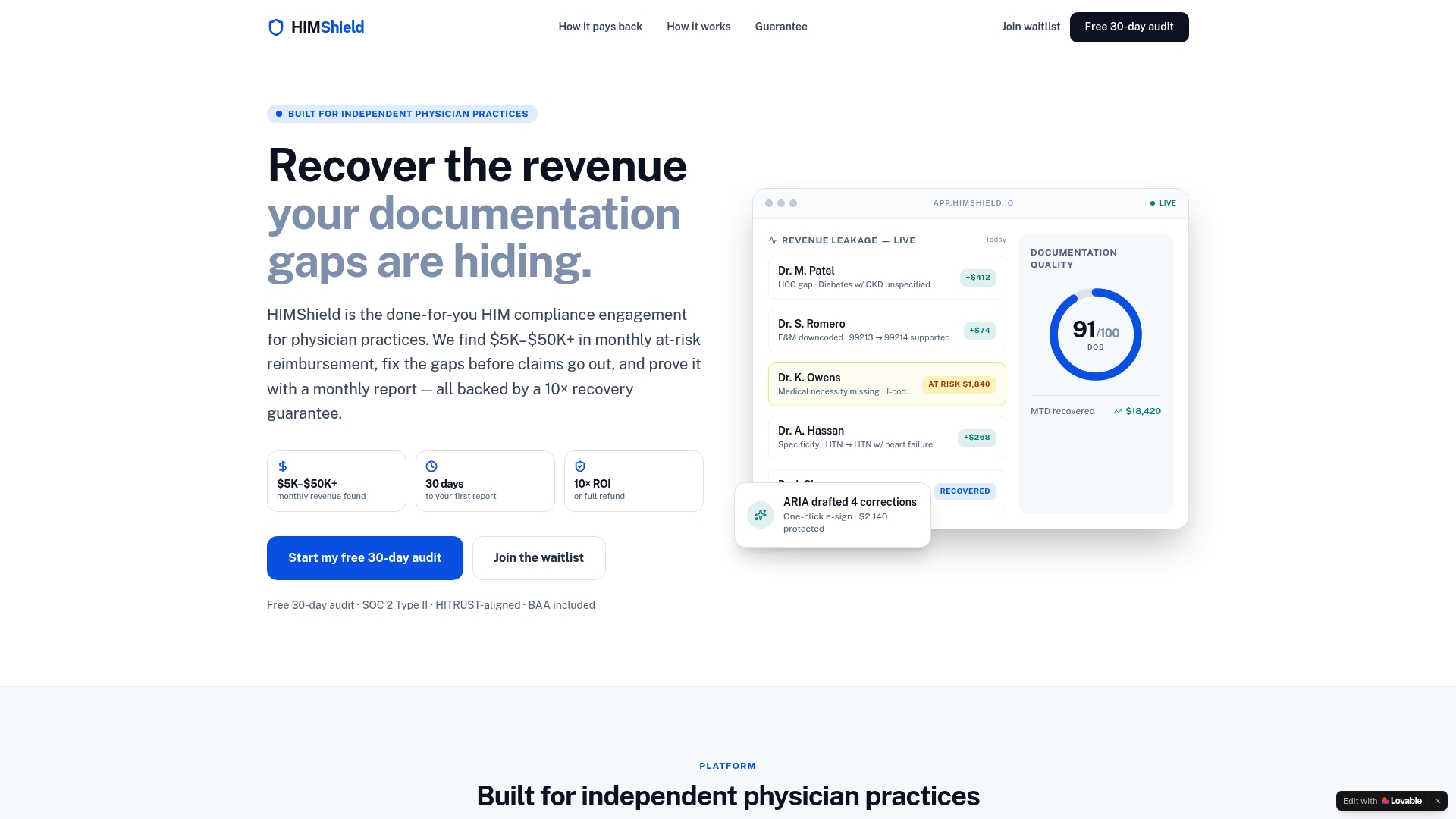
The Free 30-day Revenue Leakage Audit delivers a per-provider, per-payer breakdown of exactly where your practice is exposed, without requiring new staff, new software training, or a long-term commitment before you see the numbers. If the audit surfaces the kind of systemic gaps that lead to recoupment demands, a full HIM compliance engagement plugs directly into the playbook outlined above: automated compliance alerts, one-click physician e-signature for corrections, and submission-ready documentation if a payer audit does land on your desk. Start with the free audit and see your own numbers before deciding what comes next.
Where to Verify These Recoupment Rules
The guidance in this article draws on primary CMS and AMA sources, which are worth bookmarking directly rather than relying on secondhand summaries. CMS's Medicare Overpayments Fact Sheet lays out the redetermination and recoupment timeline in plain language, and the CMS Recovery Audit Program page explains how post-payment reviews get triggered. The AMA's overpayment recovery guidance covers state statute variability, and its payment appeals toolkit is a practical resource for building your own appeal packages.
Sources
FAQ
How far back can an insurance company recoup a payment?
It depends on whether the payer is Medicare or a commercial insurer. Medicare's recoupment timeline centers on the 30 day redetermination window from the demand letter, while commercial payer lookback periods are set by state law, and at least 24 states have statutes capping how far back a payer can go.
What is the Medicare deadline for responding to an overpayment recoupment?
You must file a redetermination request within 30 days of the demand letter's date to prevent recoupment from starting on Day 41. Missing that deadline means the offset process begins on schedule even if you later win an appeal, according to CMS guidance.
What is a recoupment in health insurance billing?
Recoupment is a payer's formal demand to reclaim money it already paid on a claim, usually discovered through a post-payment audit or a Recovery Audit Contractor review. It's distinct from a reversal, which voids the claim entirely, and an offset, which is simply the collection mechanism payers use to deduct the disputed amount from a future payment.
Is recoupment the same thing as reimbursement?
No. Reimbursement is the payment a provider receives for services rendered, while recoupment is the reverse process: a payer taking that reimbursement back after determining it was paid in error. The two terms describe opposite directions of money movement in the same billing relationship.
What's the single most effective way to reduce recoupment risk?
Fixing pre-submission controls, especially prior authorization tracking and E/M documentation accuracy, prevents the majority of recoupment triggers before a claim ever goes out. A structured audit, like the kind Himshield's Free 30-day Revenue Leakage Audit provides, quantifies exactly where those gaps exist so you can fix the highest-dollar risks first.