
The fastest way to protect revenue in an independent practice is to operationalize the OIG's seven components into physician-friendly, small-practice actions you can start this week. Three moves you can make in the next 7–30 days:
- Designate a compliance lead with explicit authority to pause suspect billing.
- Run a focused E/M documentation audit on your top five highest-volume codes.
- Stand up a confidential reporting channel (a web form or dedicated email) so staff can flag concerns without fear.
These three actions, anchored in OIG guidance and reinforced by AMA-endorsed physician-partnership principles, form the foundation of every section below. Himshield accelerates each step with automated detection and per-provider revenue leakage reports.
Pro Tip: Frame every compliance conversation around "protecting earned revenue," not policing. Physicians respond faster when they see documentation gaps as direct revenue leakage, not regulatory risk.

Table of Contents
- How to build physician compliance culture using the OIG's seven components
- Embed compliance into daily workflows so it becomes habit, not extra work
- Design a non-punitive reporting system that catches problems early
- Select and empower compliance champions inside your teams
- Monitoring, auditing, and the KPIs that signal revenue risk
- How to investigate incidents and implement corrective actions that stick
- Design a training plan physicians will actually follow
- How to sustain the culture through leadership, incentives, and communication
- Your 30/90/180-day roadmap with quick wins and measurable milestones
- When does technology actually help, and what should you look for?
- How Himshield supports a physician-centered compliance culture
- Key Takeaways
- Why culture beats policing in physician compliance
- A low-risk way to quantify your practice's revenue risk
- Authoritative sources and further reading
How to build physician compliance culture using the OIG's seven components
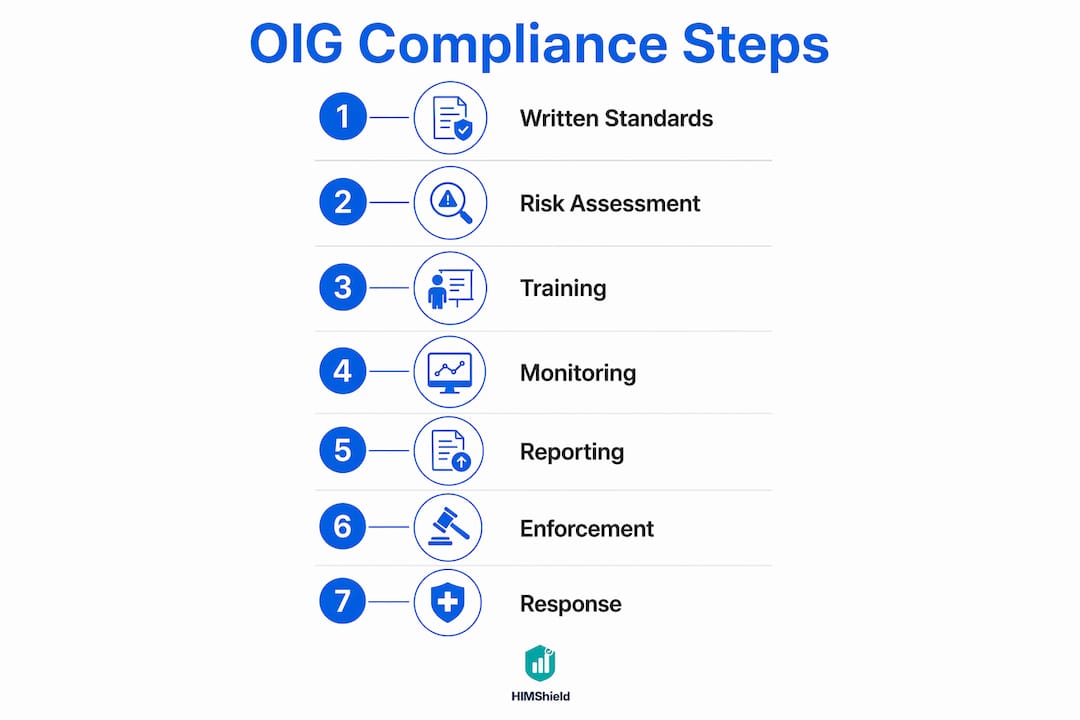
The OIG seven components are the recognized federal blueprint for physician compliance programs. For a small independent practice, each component maps to a lean, high-impact control.
| OIG Component | Small-Practice Action | Owner | Priority |
|---|---|---|---|
| Written standards | Adopt an ASOA model policy referencing False Claims Act, Anti-Kickback, and Stark rules | Administrator | Day 1–30 |
| Compliance officer/committee | Name a compliance lead with billing-halt authority | Administrator | Day 1 |
| Training & education | Monthly 5-minute role-specific huddles; annual full session | Compliance lead | Ongoing |
| Lines of communication | Anonymous web form or hotline; non-retaliation policy posted | Administrator | Day 1–30 |
| Monitoring & auditing | Quarterly focused E/M audit; monthly denial-trend review | Compliance lead | Ongoing |
| Investigation & discipline | Written incident log; just-culture framework for sanctions | Compliance lead | Day 30–90 |
| Corrective action | Root-cause template with owner, deadline, and verification step | Compliance lead | Day 30–90 |
For small practices, a lean compliance approach means tracking your top 8–10 risks in a shared spreadsheet or dashboard rather than building a compliance department. Exclusion checks against the OIG exclusion database should run monthly for all providers and contractors. Focused E/M audits on your highest-volume codes catch the most revenue risk per hour spent.
Pro Tip: Give your compliance lead written authority to place a hold on a claim before submission. Without that authority, the role is advisory, not protective.
Embed compliance into daily workflows so it becomes habit, not extra work
Make compliance part of how work gets done, not a separate task physicians resent. The most effective physician-clinician partnerships treat compliance as reducing administrative burden, not adding to it.
Practical workflow integration points:
- Front desk: Verify insurance and capture referral authorizations at check-in to prevent downstream claim denials.
- Rooming staff: Confirm the visit reason matches the scheduled code and flag any HCC gaps for the clinician before the encounter begins.
- EHR prompts: Configure smart text or alert fields that remind physicians to document medical necessity for high-risk codes (e.g., level 4/5 E/M, procedures with modifier requirements).
- Clinician sign-off: Build a two-field attestation into the note-close workflow: "Medical necessity documented?" and "All services captured?"
- Coder review: Flag notes with missing or mismatched diagnoses before claim submission, not after denial.
Role-specific, scenario-based micro-training outperforms annual checkbox sessions for retention. A 5-minute huddle on a real denial from last week is worth more than a 60-minute slide deck. Rotate topics monthly: one month on E/M leveling, the next on modifier use, the next on HCC documentation. Keep it tied to your own data.
Design a non-punitive reporting system that catches problems early
A non-punitive reporting system increases the volume of incidents surfaced and reduces repeat violations. The goal is to learn from errors before they become patterns. Moving beyond a project mindset to continuous culture means fixing systems, not blaming individuals.
| Step | Action | Timeline | Owner |
|---|---|---|---|
| Report received | Acknowledge to reporter within 48 hours | 48 hrs | Compliance lead |
| Initial triage | Categorize: billing error, documentation gap, or potential fraud | 48 hours | Compliance lead |
| Investigation | Gather records, interview staff, determine root cause | 7–14 days | Compliance lead + administrator |
| Corrective action | Assign owner, deadline, and verification step | 14–30 days | Administrator |
| Close-out | Notify reporter of outcome (anonymized if needed) | 30 days | Compliance lead |
Essential components of a working reporting system:
- Anonymous web form or dedicated compliance email, separate from HR
- Written non-retaliation policy, signed by leadership and posted visibly
- Defined triage categories so reports are prioritized consistently
- A feedback loop that tells reporters what changed after their submission
Pro Tip: Use "learn-first" language in all internal communications: "We found a documentation pattern we want to fix" lands better than "We found a violation." Closing the loop with reporters, even anonymously, is the single fastest way to increase future reporting volume.
Select and empower compliance champions inside your teams
Compliance champions bridge policy and daily practice by providing peer-to-peer modeling and real-time feedback that no policy document can replicate. Choose one champion per clinical team and one for the billing/coding function.
The ideal champion profile:
- Respected by peers, not necessarily the most senior person in the room
- Comfortable asking questions and raising concerns without escalating every issue
- Willing to spend roughly 30 minutes per week on compliance activities
A sample weekly champion routine:
- Attend or lead a 5-minute compliance huddle at the start of the week.
- Review two to three charts flagged by the EHR or coder for documentation gaps.
- Log any escalation-worthy findings in the shared incident tracker.
- Relay one compliance reminder or tip to the team, drawn from recent denial data.
Track champion effectiveness with three lightweight metrics: monthly reporting volume from their team, average time from flag to escalation, and documentation quality scores before and after their involvement. These numbers tell you whether the champion role is producing results or just adding a title.
Monitoring, auditing, and the KPIs that signal revenue risk
Choose a small KPI set that correlates directly to revenue risk. Tracking too many metrics dilutes focus; tracking too few leaves gaps. For independent practices, five KPIs cover most of the exposure.
| KPI | Definition | Frequency | Alert Threshold |
|---|---|---|---|
| Denial rate by code | % of claims denied per CPT code | Monthly | >5% for any single code |
| Documentation quality score | % of audited notes meeting all required elements | Quarterly | — |
| Provider-level revenue leakage | Estimated dollars lost to undercoding or missing charges | Monthly | Any provider trending down >10% |
| Query response time | Days from coder query to physician response | Weekly | >3 business days |
| Time-to-correction | Days from identified error to corrected claim submission | Monthly | >7 days |
A simple audit-sampling plan: pull 10 charts per provider per quarter for focused E/M review, plus 100% of claims flagged by your denial-trend review. For practices with common OIG audit triggers, add a monthly sample of your top three highest-risk codes.
Revenue leakage estimate: multiply your monthly charge volume by your denial rate, then add an estimated undercoding rate based on your documentation quality score. Even a conservative estimate often reveals $5,000–$50,000 in recoverable revenue per year.
Pro Tip: Review denial trends before your quarterly audit, not after. Denial data tells you exactly which codes and providers to sample, so you spend audit time where the money is.
How to investigate incidents and implement corrective actions that stick
An investigation should determine root cause and assign a clear corrective action with a named owner and a hard deadline. Consistent enforcement across all seniority levels is what gives the process credibility.
Investigation checklist:
- Collect the relevant claims, notes, and EHR audit trail within 48 hours of the report.
- Interview the involved clinician and coder separately, using neutral, learn-first language.
- Identify whether the root cause is a knowledge gap, a workflow flaw, or a system limitation.
- Document findings in a written incident log with date, description, root cause, and recommended action.
Corrective action template:
- Issue: Brief description of the problem and its revenue or compliance impact
- Root cause: Knowledge gap / workflow flaw / system limitation
- Action: Specific fix (e.g., add EHR prompt, update coder checklist, schedule targeted training)
- Owner: Named individual
- Deadline: Specific date
- Verification: Follow-up audit date and pass/fail criterion
After corrective action is implemented, run a focused follow-up audit on the same code set or provider within 60 days. Document the results. Regulators want to see that you identified a problem, fixed it, and confirmed the fix worked.
Design a training plan physicians will actually follow
Role-relevant, short, scenario-based training beats long checkbox sessions every time. Scenario-driven micro-learning improves retention and keeps physicians engaged without consuming clinical time.
Sample 12-month training calendar:
| Month | Topic | Audience | Format | Duration |
|---|---|---|---|---|
| January | E/M leveling refresher | Clinicians | Huddle + case review | 10 min |
| March | Modifier use and common errors | Coders | Workshop | 30 min |
| May | HCC documentation gaps | Clinicians | EHR tip sheet + huddle | 10 min |
| July | Denial trends: what went wrong | All staff | Team meeting | 5 minutes |
| September | Physician query process | Clinicians + coders | Live Q&A | 5 minutes |
| November | Annual compliance program review | All staff | Full session | 60 min |
Micro-learning topics by role:
- Front desk: Insurance verification, authorization requirements, patient identity confirmation
- Coders: Modifier rules, bundling edits, payer-specific documentation requirements
- Clinicians: Medical necessity language, HCC gap documentation, physician query best practices
Measure training effectiveness with three data points: comprehension scores on post-training checks, time-to-query-response before and after clinician training, and physician satisfaction ratings collected quarterly. If scores are not improving, the content or format needs to change, not the frequency.
How to sustain the culture through leadership, incentives, and communication
Consistent, visible leadership and even small incentives sustain compliance culture far longer than any policy document. Leadership modeling and protected reporting are the primary drivers of a successful compliance environment.
Leadership checklist for practice administrators and physician owners:
- Open monthly team meetings with one compliance data point (denial rate, audit score, or a resolved incident).
- Publicly recognize the first team member each quarter who surfaces a documentation issue before it becomes a denial.
- Review the KPI dashboard personally each month and ask one specific question about a trend.
- Apply sanctions consistently across all providers, including senior physicians. Exempting senior providers erodes culture faster than almost any other single behavior.
Recognition ideas that resonate with physicians:
- Share a monthly "revenue protected" figure that credits the team's documentation improvements.
- Tie compliance performance to the practice's growth goals, connecting it to practice growth strategy and physician compensation discussions.
- Use a quarterly pulse survey (three questions, five minutes) to measure whether physicians feel compliance is helping or hindering their work.
"Compliance and physicians share the same goals: better patient care, reduced administrative burden, and a practice that stays financially healthy. When compliance is framed as a partner in those goals rather than a watchdog, physician buy-in follows." — AMA guidance on physician-compliance collaboration
Your 30/90/180-day roadmap with quick wins and measurable milestones
Prioritize quick wins that protect revenue within 30 days, then scale controls at 90 and 180 days.
| Phase | Milestone | Owner | Measurable Outcome |
|---|---|---|---|
| Day 1–30 | Name compliance lead; run focused E/M audit on top 5 codes; stand up reporting channel | Administrator | Audit report delivered; channel live |
| Day 30–90 | Deploy compliance champions; implement KPI dashboard; complete first training cycle | Compliance lead | Champions named; 5 KPIs tracked weekly |
| Day 90–180 | Complete first quarterly audit; review denial trends; run corrective action on top finding | Compliance lead + coders | Denial rate reviewed; one corrective action closed |
| Day 180+ | Annual program review; update risk register; measure revenue leakage before/after | Administrator | Year-over-year leakage comparison |
Quick wins checklist for the first 30 days:
- Designate compliance lead with billing-halt authority (Day 1)
- Pull denial report for the last 90 days and identify top three problem codes (Day 3)
- Run a 10-chart E/M audit on your highest-volume provider (Day 7–14)
- Post non-retaliation policy and open reporting channel (Day 14)
- Schedule first compliance huddle with clinical team (Day 21)
When does technology actually help, and what should you look for?
Technology should speed detection and reduce physician friction, not add another system to manage. For independent practices, the right tool fits into existing EHR workflows and delivers findings physicians can act on in seconds.
Must-have features for independent practices:
- EHR connectivity: Direct integration or FHIR API connection so data flows without manual exports
- Pre-claim documentation scoring: Flags gaps before submission, not after denial
- Per-provider revenue leakage reports: Shows each physician exactly where their documentation is leaving money uncaptured
- Automated compliance alerts: Surfaces high-risk codes and patterns without requiring a manual audit
- Physician e-signature workflow: Lets clinicians approve corrections in one click, reducing query turnaround from days to minutes
Vendor evaluation criteria:
- Does it connect to your specific EHR without a lengthy IT project?
- Does it produce findings in plain language a clinician can act on, not just a coder?
- Does it include audit-defense support (submission-ready responses)?
- Is there a low-risk pilot option before a long-term commitment?
A short pilot plan:
- Connect the platform to your EHR and run a 30-day audit on a single provider or code set.
- Review the Revenue Leakage Report with your compliance lead and one physician champion.
- Implement the top three recommended corrections and measure denial rate and documentation score at 60 days.
- Decide on full deployment based on measured revenue recovery, not projected savings.
Pro Tip: Measure physician experience during the pilot, not just compliance metrics. If physicians find the tool adds friction, adoption will stall regardless of the compliance results. A short satisfaction survey at day 15 gives you time to adjust before the pilot ends.
How Himshield supports a physician-centered compliance culture
Himshield accelerates the playbook by identifying documentation and coding gaps before submission and delivering physician-friendly guidance tied to each finding. For independent practices, that means faster detection, less manual audit work, and corrections that physicians can approve without disrupting their day.
Core capabilities administrators rely on:
- Per-provider, per-payer Revenue Leakage Reports that quantify exactly where each physician's documentation is costing the practice money
- Automated coding and documentation alerts triggered before claims leave the practice
- One-click physician e-signature for corrections, reducing query turnaround from days to minutes
- Submission-ready audit responses that assemble supporting documentation automatically when a payer challenges a claim
- Real-time documentation quality scoring embedded in the EHR workflow
Pilot steps you can request today:
- Connect Himshield to your EHR via FHIR API (typically same-day setup).
- Receive a free 30-day audit covering coding gaps, documentation deficiencies, and charge-capture risks.
- Review the Revenue Leakage Report with your compliance lead and physician champion.
- Implement prioritized corrections and measure denial rate and revenue recovery at 60 days.
The free audit delivers a prioritized remediation list so your compliance lead knows exactly where to focus first, without spending weeks on manual chart review.
Key Takeaways
Building a physician compliance culture that protects revenue requires the OIG seven components, physician-friendly workflows, peer champions, and consistent KPI monitoring, all implemented in a prioritized 30/90/180-day sequence.
| Point | Details |
|---|---|
| Start with three quick actions | Designate a compliance lead, run a focused E/M audit, and open a reporting channel within 30 days. |
| OIG seven components are the blueprint | Map each component to a lean, small-practice control using the prioritized owners-and-timeline table. |
| Champions and micro-training drive habits | Peer champions and 5-minute role-specific huddles produce faster behavior change than annual training. |
| Five KPIs cover most revenue risk | Track denial rate, documentation quality score, provider leakage, query response time, and time-to-correction monthly using the five KPIs listed in the audit section. |
| Himshield quantifies leakage before claims submit | A free 30-day audit delivers a per-provider Revenue Leakage Report and prioritized remediation list. |
Why culture beats policing in physician compliance
The practices that protect the most revenue are not the ones with the thickest compliance manuals. They are the ones where physicians understand that documentation accuracy is directly connected to getting paid for the work they already did. That reframe, from regulatory obligation to revenue protection, is what the AMA's guidance on physician-compliance collaboration gets right. When compliance is positioned as a partner in the Quadruple Aim rather than an oversight function, resistance drops and reporting rates climb.
The OIG framework and Himshield's detection capabilities give you the structure and the data. But the culture, the daily habits, the peer conversations, the leadership visibility, is what makes those tools produce lasting results. Policing catches problems after they cost you money. Culture prevents them.
A low-risk way to quantify your practice's revenue risk
Independent practices lose revenue to documentation and coding gaps every day, often without knowing the exact dollar amount. Himshield's free 30-day audit changes that. Connect your EHR, and within 30 days you receive a per-provider Revenue Leakage Report that shows exactly where coding gaps, documentation deficiencies, and charge-capture misses are costing your practice money.
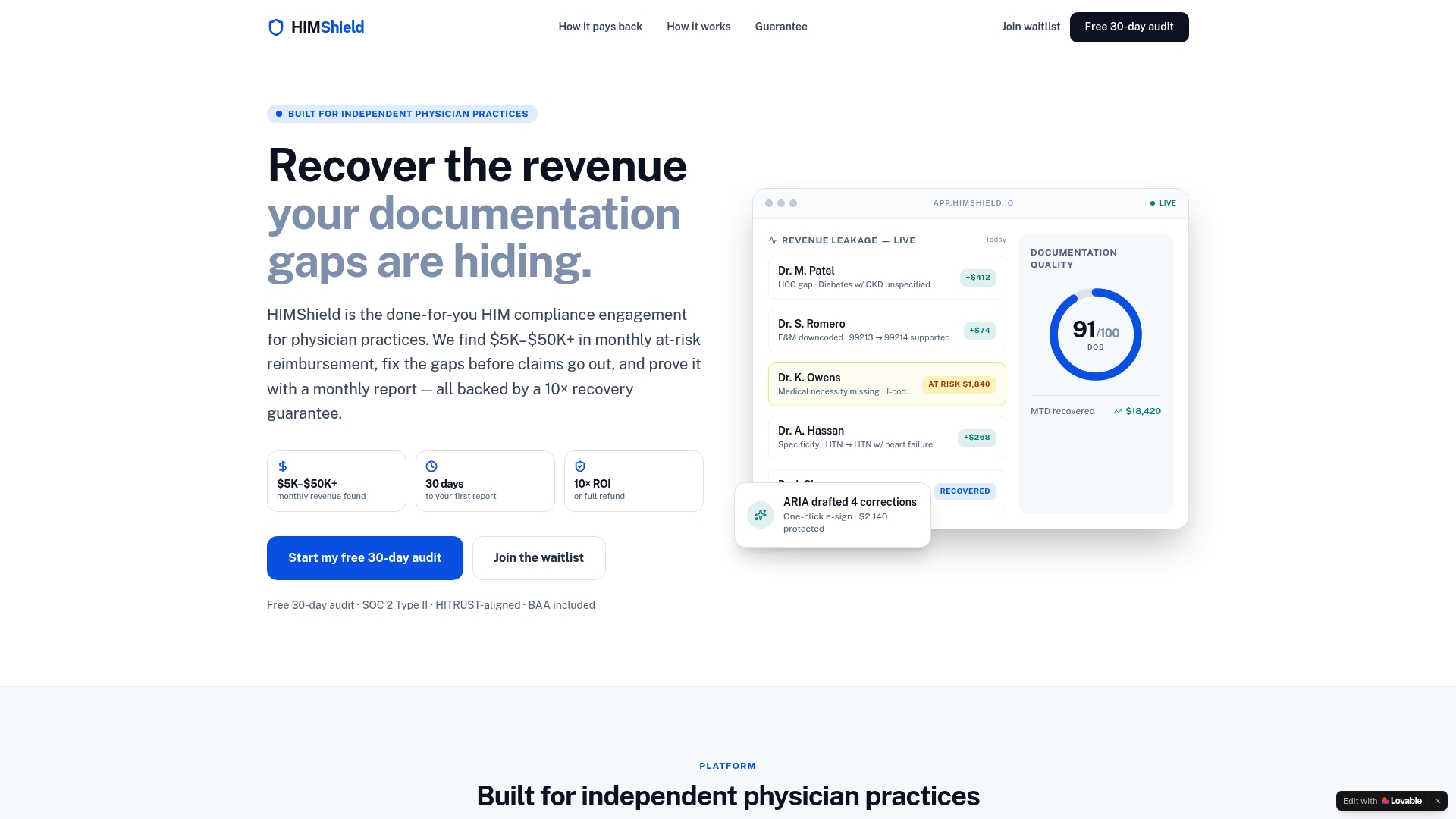
The audit delivers a prioritized remediation list your compliance lead can act on immediately, with no long-term commitment required before you see results. Expected outcomes after a completed pilot: identified revenue leakage by provider and payer, a ranked list of documentation corrections, and a baseline documentation quality score you can track going forward. To get started, request your free audit or schedule a demo to see the platform in action.
Authoritative sources and further reading
"An effective compliance program must include all seven components to meaningfully reduce the risk of fraud and abuse in physician practices." — OIG Compliance Programs for Physicians
- OIG Compliance Programs for Physicians: The primary federal reference for the seven components; use this for policy language and leadership briefings.
- ASOA Model Compliance Program: Sample policy content referencing False Claims Act, Anti-Kickback, and Stark rules; adapt for your written standards.
- AMA: Yes, doctors and compliance officers can work together: AMA guidance on framing compliance as a Quadruple Aim partner; use for physician buy-in conversations.
- AIHC: Creating a Culture of Compliance: Practical guidance on scenario-based training and micro-learning; use for training plan design.
- MGMA: Creating a Culture of Willing Compliance: Practitioner perspective on moving from project to culture; use for leadership briefings.
- ComplyDome: Four Key Elements for Small Practices: Lean compliance framework for independent practices; use for risk-register design and KPI selection.
- We Protect Providers: Leadership in a Compliance-Focused Practice: Guidance on consistent enforcement and just-culture frameworks; use for investigation and disciplinary process design.
- YouCompli: 10 Tips for Building a Compliance Culture: Practical champion and peer-modeling tactics; use for champion program design.
- Himshield Blog: Physician Practice Compliance Program Types Explained: Overview of federal guidelines and the seven essential elements; use for policy templates and administrator training.
- Himshield Blog: Why Physician Documentation Education Matters in 2026: Evidence for investing in physician-facing documentation education; use for training plan justification.
- Digital Ash Agency: Patient Engagement and Outreach: Communications resource for patient-facing compliance elements including consent and messaging.