
Physician practice compliance program types are structured frameworks built around the seven fundamental elements defined by the Office of Inspector General (OIG) to reduce fraud, waste, and abuse in healthcare settings. Every independent practice needs a compliance program. The question is which components to prioritize, how to scale them, and how to keep them functioning beyond the policy document stage. This guide gives healthcare administrators and compliance officers a clear map of the core program types, how they differ by practice size, and what it takes to make them work in the real world.
1. What are the physician practice compliance program types?
The OIG defines seven fundamental elements as the building blocks of every effective compliance program. These elements are not optional add-ons. They are the recognized industry standard for structuring healthcare compliance, and each one functions as a distinct program type or component.
The seven core elements are:
- Written policies and standards of conduct — formal documentation of how the practice operates within legal and regulatory boundaries
- Designated compliance officer and committee — a named individual (and, in larger practices, a committee) accountable for program oversight
- Training and education — recurring instruction for physicians, coders, billers, and administrative staff on applicable regulations
- Open lines of communication — channels for staff to report concerns without fear of retaliation, including anonymous hotlines
- Internal monitoring and auditing — regular reviews of coding accuracy, billing practices, and HIPAA adherence
- Disciplinary enforcement — consistent consequences for violations, applied equally across all staff levels
- Corrective action — documented steps taken when problems are identified, including root cause analysis and follow-up
Together, these elements reduce costs and build a genuine culture of compliance rather than a paper exercise. Each element addresses a specific operational risk, which is why skipping even one creates a gap that auditors and regulators will find.
Pro Tip: Design and implementation are two different things. A written policy that no one follows is a liability, not a safeguard. Document your program, then verify it runs.
2. How compliance program types vary by practice size and risk level
Compliance program infrastructure scales with practice size. A solo physician and a 50-provider group face the same regulatory requirements but need very different program structures to meet them.
| Program Feature | Solo/Small Practice | Medium Practice | Large Practice |
|---|---|---|---|
| Compliance officer | Part-time, often office manager | Designated staff member | Full-time dedicated officer |
| Committee oversight | Informal, physician-led | Small committee | Formal committee with minutes |
| Training frequency | Annual, basic | Semi-annual, role-specific | Quarterly, tracked completions |
| Auditing | Occasional chart reviews | Scheduled internal audits | Dedicated audit program |
| Reporting hotline | Open-door policy | Email or basic hotline | Anonymous third-party hotline |
| Budget | Minimal, shared resources | Defined compliance budget | Dedicated compliance budget |
Small practices often rely on a manual, occasional audits, and basic training sessions. That is appropriate for their risk profile, provided those activities actually happen. Medium and large practices need formal committee structures, documented meeting minutes, and dedicated audit schedules. The risk of a "paper program" grows as practice size increases, because more staff means more opportunity for inconsistency.
The OIG's segment-specific and general guidance supports this tiered approach. Practices should use both to build programs that reflect their actual risk exposure rather than a generic template.
3. What operational activities make compliance programs effective?
Operational compliance activities are where programs either succeed or fail. Policies create the framework. Activities create the evidence that the framework works.
Training and education must be role-specific. A front-desk coordinator needs HIPAA privacy training. A coder needs annual updates on CPT and ICD-10 changes. A physician needs documentation standards tied to the payer mix the practice serves. Generic annual training that covers everything superficially satisfies a checkbox but does not reduce risk.

Internal monitoring and auditing covers three primary areas: coding accuracy, billing compliance, and privacy. Coding audits should sample claims across payers and service types. Billing reviews should check for upcoding, unbundling, and missing modifiers. Privacy audits should verify that access logs, breach protocols, and vendor agreements are current. The RADV audit process is one example of how external scrutiny maps directly onto internal monitoring gaps.
Communication channels work only when staff trust them. An anonymous hotline is the gold standard for larger practices. Smaller practices can use an open-door policy, but only if leadership has demonstrated that reporting concerns does not result in retaliation.
Enforcement and corrective action close the loop. When a violation is found, the response must be documented, consistent, and proportionate. The DOJ evaluates compliance programs on whether investigations are timely and whether corrective steps are actually integrated into daily operations, not just filed away.
Pro Tip: Tie governance updates to your annual organizational calendar. When a vendor changes, update the Business Associate Agreement immediately. When a committee member leaves, replace them on paper before the next meeting.
4. How to assess and tailor compliance program types to your risk profile
Risk-based tailoring means selecting and weighting compliance components based on the specific exposures your practice faces. A practice with a high Medicare Advantage patient volume faces different audit risks than one focused on commercial payers. A multi-specialty group has more coding complexity than a single-specialty practice.
Start with a gap analysis across all seven elements. Identify which components exist only on paper and which are actively functioning. Then prioritize based on where your practice is most exposed.
- Assess your payer mix. Medicare and Medicaid claims carry higher audit risk. Practices with significant government payer volume should weight their auditing and monitoring activities accordingly.
- Review your coding patterns. High-volume E/M coding, procedure-heavy specialties, and HCC-dependent practices all carry specific documentation risks that training and auditing must address.
- Evaluate HIPAA exposure. Every vendor with access to patient data requires a signed Business Associate Agreement. Missing BAAs are one of the most common findings in compliance reviews.
- Check governance freshness. Stale committee rosters, outdated policies, and lapsed training records signal a program that exists on paper only. Regulators and auditors look for evidence of active management.
- Use OIG guidance as your benchmark. The OIG's Medicare Advantage ICPG and general compliance guidance provide a clear standard against which you can measure your current program.
Avoiding a "paper program" requires active gap analysis followed by documented follow-up. The DOJ's evaluation framework specifically examines whether compliance metrics extend beyond policy documentation to include timely investigations and ongoing monitoring in daily operations.
Key takeaways
Effective physician practice compliance programs require all seven OIG elements to be actively implemented, scaled to practice size, and continuously monitored to prevent revenue loss and regulatory exposure.
| Point | Details |
|---|---|
| Seven OIG elements are the standard | Every physician practice compliance program must include all seven elements to meet regulatory expectations. |
| Scale programs to practice size | Solo practices need simpler structures; large groups require dedicated officers, committees, and audit programs. |
| Operational activities create evidence | Training, auditing, and corrective action must be documented and recurring, not one-time events. |
| Risk-based tailoring improves outcomes | Align compliance priorities with your payer mix, coding patterns, and HIPAA exposure for maximum impact. |
| Governance freshness prevents audit failures | Update BAAs, committee rosters, and policies on an annual schedule tied to organizational changes. |
What I have learned from watching compliance programs succeed and fail
The gap between policy and practice is where practices get hurt
I have reviewed compliance programs at independent physician practices ranging from two-physician groups to regional multispecialty organizations. The single most consistent finding is not missing policies. It is missing evidence that the policies are followed.
A practice can have a beautifully formatted compliance manual and still fail a review because no one can produce training attendance records from the past 18 months. Another practice might have a compliance officer title assigned to someone who has never received compliance training themselves. These are not edge cases. They are the norm for practices that treat compliance as an administrative formality rather than an operational discipline.
The maintenance of governance documents is where leadership commitment shows up most clearly. Practices with strong compliance cultures tie their annual reviews to real calendar events: open enrollment, fiscal year close, staff onboarding cycles. They do not wait for an audit notice to check whether their BAAs are current.
Technology helps, but it does not replace judgment. Automated coding review tools and HIM-physician alignment platforms can surface risk patterns that manual reviews miss. The practices that get the most from these tools are the ones that already have a functioning compliance structure to act on the findings. Technology amplifies a good program. It cannot substitute for one.
— Elena
How Himshield supports your compliance monitoring efforts
Compliance monitoring is only as strong as the data behind it. Himshield gives independent physician practices the visibility they need to catch coding, documentation, and charge-capture risks before they become denials or audit findings.
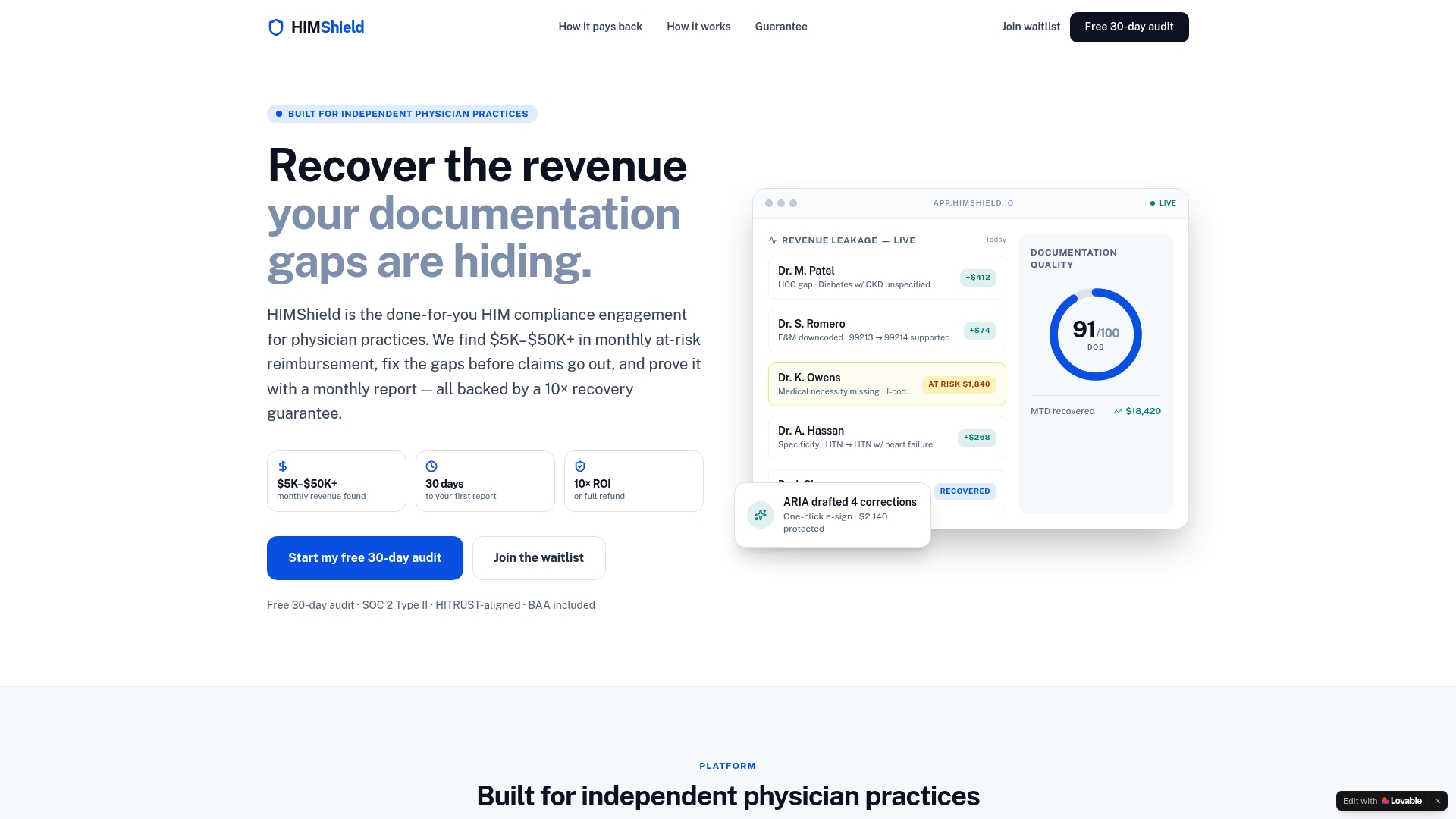
Himshield's platform connects directly to your EHR and scans claims for the exact risk patterns that internal audits are designed to catch: upcoded E/M visits, missing modifiers, HCC documentation gaps, and revenue leakage across payer types. Practices using Himshield have recovered significant revenue that would otherwise have gone uncollected. The monitoring and corrective action elements of your compliance program become far more effective when you have automated risk detection running continuously. Start with a free revenue leakage report to see exactly where your practice stands.
FAQ
What are the seven elements of a physician compliance program?
The OIG defines seven elements: written policies, a designated compliance officer and committee, training and education, open communication lines, internal monitoring and auditing, disciplinary enforcement, and corrective action. Every effective physician practice compliance program includes all seven.
How does practice size affect compliance program structure?
Smaller practices typically use part-time compliance officers, basic training, and occasional audits. Larger practices require dedicated full-time staff, formal committees, anonymous hotlines, and scheduled audit programs scaled to their volume and risk exposure.
What is a "paper program" in healthcare compliance?
A paper program is a compliance plan that exists in documentation but is not actively implemented or enforced. The DOJ and OIG both evaluate whether compliance programs are functioning in practice, not just filed in a binder.
How often should physician practices update their compliance programs?
Practices should review and update compliance programs at least annually. Governance documents, BAAs, committee rosters, and training records should be tied to organizational calendar events to stay current and audit-ready.
What is the biggest compliance risk for independent physician practices?
Missing or outdated Business Associate Agreements with vendors who access patient data are among the most common compliance failures. Coding accuracy and documentation gaps tied to payer-specific requirements are the other leading risk areas.