
HIM-physician alignment is defined as the structured process of uniting health information management goals with physician clinical priorities to improve care coordination, reduce revenue leakage, and protect practice financial health. Applying HIM-physician alignment best practices is no longer optional for independent practices facing tighter margins and stricter payer audits. Only 26% of healthcare organizations have a formal physician retention plan. That gap signals how many practices are operating without a real alignment strategy, leaving both revenue and physician trust at risk.
1. What are the foundational principles of effective HIM-physician alignment?
Physician autonomy is the single most important driver of long-term alignment. Small gains in physician control yield significant engagement improvements and reduce burnout. That means alignment cannot be built on compensation alone.
The foundational pillars of physician autonomy in HIM alignment include:
- Clinical decision-making authority. Physicians must retain control over care protocols and documentation standards without administrative override.
- Scheduling control. Allowing physicians to influence their own patient load and scheduling reduces friction and improves retention.
- Strategic growth input. Physicians who help shape practice growth plans are far more invested in executing them.
- Mission alignment. Physicians need to see their personal values reflected in the organization's stated mission, not just its financial targets.
Trust in executive leadership is the second pillar. Physicians must be at decision tables from step one, not brought in as late-stage consultants after decisions are already made. Late inclusion destroys credibility and signals that physician input is performative rather than genuine.
Pro Tip: Schedule a quarterly physician input session before any major administrative decision reaches the planning phase. Physicians who shape the question are far more likely to support the answer.

2. How does the '8 Cs' framework drive sustained physician buy-in?
The American Medical Association's 8 Cs framework integrates multiple behavioral drivers to produce sustainable change in physician practice patterns. Each "C" targets a distinct motivational lever, making it one of the most complete physician engagement techniques available.
The eight components are:
- Competence. Physicians engage when they trust that new processes reflect clinical evidence, not just administrative preference.
- Competition. Transparent performance dashboards that show peer comparisons drive improvement without mandates.
- Compensation. Financial incentives must align with the specific behaviors the practice wants to reinforce.
- Control. Physicians need meaningful input into how metrics are defined, not just how they are measured.
- Complexity reduction. Removing documentation friction directly increases physician willingness to participate in HIM initiatives.
- Collegiality. Peer-to-peer learning and recognition programs outperform top-down directives in changing behavior.
- Clarity. Goals, metrics, and expectations must be stated in plain clinical language, not administrative jargon.
- Communication. Feedback must be timely, specific, and closed-loop, not delivered in annual reviews.
"Physician engagement fails most often not because physicians refuse to participate, but because leaders never close the feedback loop on what happened to physician input." — Medical Economics
Applying the 8 Cs to value-based care metric design means letting physicians co-author the quality benchmarks they will be held to. Practices that use gamification elements, such as real-time leaderboards tied to HCC gap closure rates, report stronger voluntary participation in documentation improvement programs.
3. Which structural models best support physician alignment in HIM?
The dyad leadership model is the most effective structural approach to physician alignment. It pairs a physician leader directly with an administrator, giving clinical and operational perspectives equal weight in every major decision. Effective physician alignment requires embedding physicians early in decision processes to avoid credibility loss from late-stage input.
| Model | Alignment Strength | Key Risk |
|---|---|---|
| Dyad leadership | High. Physician and administrator share authority. | Requires strong interpersonal trust between partners. |
| Employment model | Moderate. Provides stability and shared infrastructure. | Physicians may feel reduced autonomy over time. |
| Joint venture | Moderate. Shared financial stake increases investment. | Complex governance can slow decision-making. |
| Physician ownership | High for engaged owners. | Excludes non-owner physicians from alignment benefits. |
| Co-management agreement | Variable. Aligns incentives around specific service lines. | Regulatory risk if service scope is unclear. |
Co-management agreements deserve special attention. Financial alignment agreements require regular review to prevent strategic drift and reduce regulatory exposure. Practices that set annual contract review cycles catch misalignment before it becomes a compliance problem.
Pro Tip: When evaluating any financial alignment model, require a written definition of clinical service scope before signing. Vague exclusivity clauses are the most common source of regulatory disputes in co-management arrangements.
4. What communication strategies improve care coordination and physician retention?
Closing the feedback loop on physician input is the single most underused retention tool in healthcare administration. Physicians who submit ideas or concerns and never hear the outcome disengage faster than those who receive a clear "no" with a reason.
A practical communication rhythm for independent practices includes:
- Monthly physician-administration check-ins. Keep these to 45 minutes. Focus on one operational topic and one clinical topic per session.
- Quarterly strategy retreats. Use these to share financial performance data, review alignment metrics, and collect physician input on the next quarter's priorities.
- Annual alignment audits. Formally assess whether the practice's stated mission still matches physician and administrative priorities.
- Real-time feedback channels. A shared digital channel, such as a dedicated EHR messaging thread or a practice management platform inbox, lets physicians flag documentation issues before they become denials.
Integrating physicians into workflow redesign is equally critical. When a practice changes a charge-capture process or updates a coding protocol, physicians who helped design the new workflow adopt it faster and with fewer errors. Practices that skip physician input during workflow redesign consistently see higher denial rates in the first 90 days after implementation.
- Assign a physician champion for every major workflow change.
- Share denial data with physicians in plain language, not just billing codes.
- Celebrate wins publicly when physician-led changes reduce claim rejections.
5. How can standardized care models enhance HIM-physician collaboration?
Standardized, risk-stratified care models are the operational backbone of effective HIM-physician collaboration. Shifting from episodic to proactive care management with multidisciplinary teams improves patient safety and resource use. That shift also creates natural alignment points between HIM staff and physicians because both groups are working from the same patient risk data.
| Care Model Element | HIM Benefit | Physician Benefit |
|---|---|---|
| Risk stratification | Targets documentation efforts on high-risk patients | Focuses clinical attention where outcomes matter most |
| Multidisciplinary team rounds | Surfaces coding gaps in real time | Reduces solo decision-making burden |
| Standardized communication protocols | Reduces documentation variation and audit exposure | Decreases time spent on clarification requests |
| Shared performance dashboards | Tracks charge capture and denial trends | Provides clinical outcome visibility across the practice |
Systemwide adoption of standardized care reduces gaps in complex care delivery and improves resource utilization. The practices that implement this most successfully treat HIM staff not as back-office coders but as clinical partners who surface risk data that physicians need to act on. That reframing alone changes how physicians interact with HIM teams during documentation reviews.
Healthcare's future success depends on alignment over scale, with shared performance dashboards managing enterprise capacity as a unified system. Independent practices that adopt this mindset early gain a structural advantage over larger systems still operating in departmental silos.
Key takeaways
Effective HIM-physician alignment requires preserving physician autonomy, embedding physicians in decisions from the start, and using structured frameworks like the 8 Cs to drive sustainable engagement and financial outcomes.
| Point | Details |
|---|---|
| Autonomy drives alignment | Physicians who control clinical decisions and scheduling stay engaged longer than those motivated by compensation alone. |
| 8 Cs framework works | Applying all eight behavioral drivers, especially complexity reduction and closed-loop communication, produces lasting practice change. |
| Dyad model leads structurally | Pairing a physician leader with an administrator gives clinical priorities equal weight in every operational decision. |
| Feedback loops are non-negotiable | Physicians who never hear what happened to their input disengage faster than those who receive a clear, reasoned response. |
| Standardized care aligns teams | Risk-stratified, proactive care models create shared data that HIM staff and physicians both act on together. |
What I've learned about alignment that most administrators get wrong
The most common mistake I see is treating physician alignment as a one-time initiative rather than an ongoing operating discipline. Administrators launch an engagement program, collect physician input in a survey, and then move on. Six months later, they wonder why physician satisfaction scores dropped.
The real issue is that physicians notice when their input disappears into a process and produces no visible result. That silence is interpreted as dismissal. The fix is not more surveys. The fix is a documented, visible response to every physician input cycle, even if the answer is "we considered this and here is why we are not moving forward."
The second thing I have observed is that small autonomy gains produce outsized loyalty. A physician who wins the right to adjust their own patient panel size, or who gets to co-author a new documentation template, becomes a vocal internal advocate for the practice. You do not need to give physicians control over everything. You need to give them genuine control over something that matters to their daily work.
The practices I have seen sustain alignment through leadership transitions, payer contract changes, and EHR migrations all share one trait. They treat physicians as partners in the business of the practice, not just providers of clinical services. That distinction sounds simple. Executing it consistently is where most practices fall short.
— Elena
Protect your revenue while you build physician alignment
Strong physician alignment produces better documentation, fewer coding gaps, and cleaner claims. But even well-aligned practices leave revenue on the table when coding and charge-capture risks go undetected before claims go out the door.
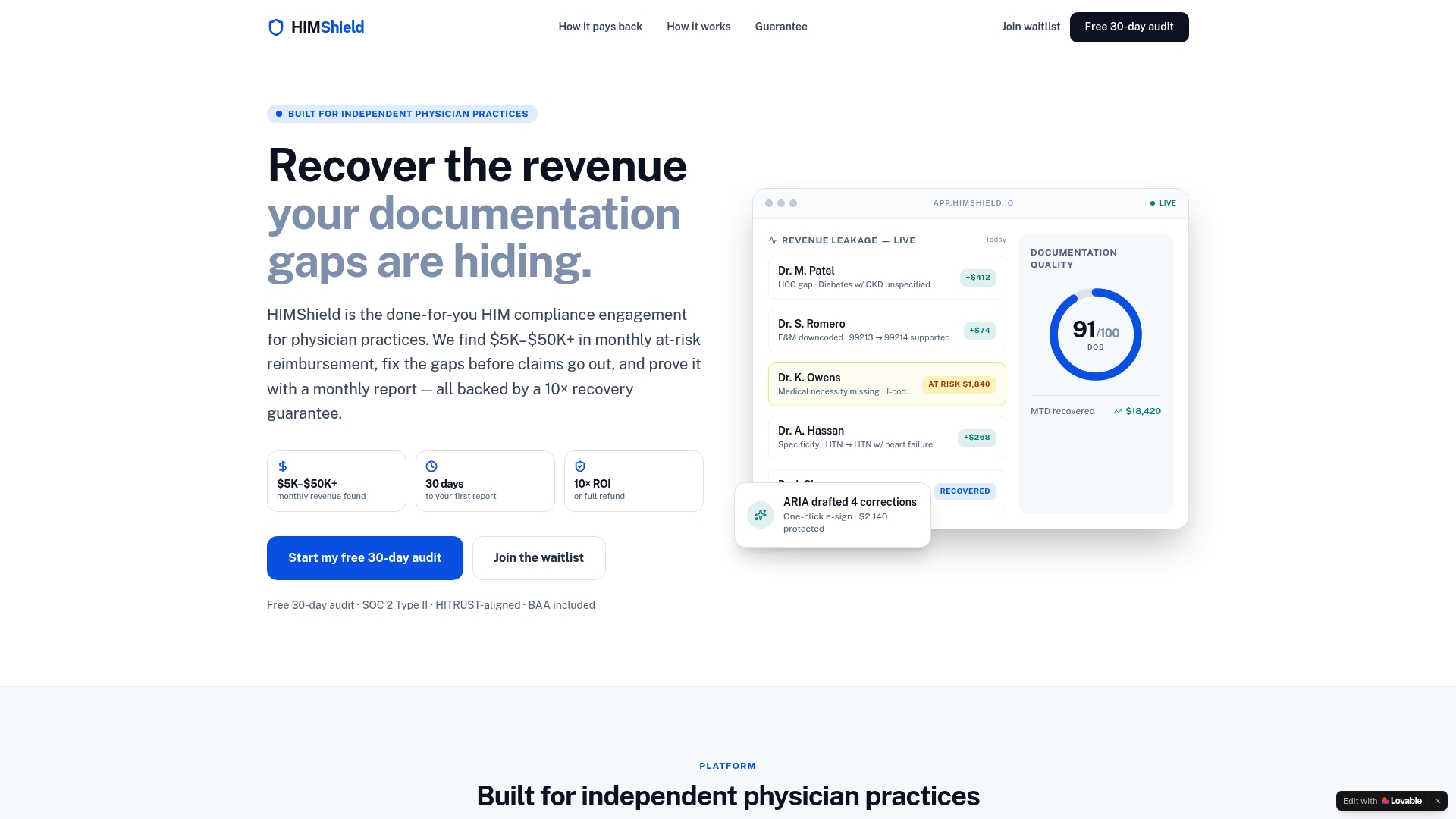
Himshield scans your practice's coding, documentation, and charge-capture patterns to identify risks before they become denials or audits. Independent practices using Himshield recover $5K–$50K+ in hidden revenue without adding administrative headcount. If your alignment work is producing better clinical documentation, Himshield makes sure that documentation translates into every dollar your practice has earned. Practices that pair strong physician engagement with proactive compliance monitoring protect both their revenue and their physician relationships at the same time. For practices managing HIPAA-aligned IT infrastructure alongside alignment initiatives, healthcare IT support can reduce the operational friction that undermines physician buy-in.
FAQ
What is HIM-physician alignment?
HIM-physician alignment is the process of coordinating health information management functions with physician clinical priorities to improve documentation accuracy, care coordination, and practice revenue integrity.
Why does physician autonomy matter more than compensation in alignment?
Long-term alignment relies more on preserving physician voice and autonomy than on ownership or pay structures. Small gains in physician control reduce burnout and increase voluntary participation in HIM initiatives.
What is the dyad leadership model in healthcare?
The dyad model pairs a physician leader with an administrator to share decision-making authority. It is the structural model most effective at building trust and keeping physician priorities central to operational planning.
How does the 8 Cs framework improve physician engagement?
The 8 Cs framework addresses eight behavioral drivers, including competence, control, and communication, that together produce sustainable changes in how physicians engage with value-based care and HIM processes.
How often should financial alignment agreements be reviewed?
Financial alignment agreements, including co-management contracts, should be reviewed at least annually. Regular review prevents regulatory risk from unclear service scopes and catches strategic misalignment before it affects practice operations.