
The Office of Inspector General audits medical practices to detect billing irregularities and compliance failures that risk improper Medicare and Medicaid payments. Understanding why practices face OIG audits is the first step toward protecting your revenue and avoiding costly enforcement actions. The OIG, operating under the Department of Health and Human Services, works alongside CMS and the DOJ to identify practices whose billing patterns deviate from peer norms. Audits rarely arrive without warning signals. Data analytics flag outlier behaviors in coding frequency, modifier use, and documentation quality long before a formal notice lands in your mailbox.
Why practices face OIG audits: the core triggers

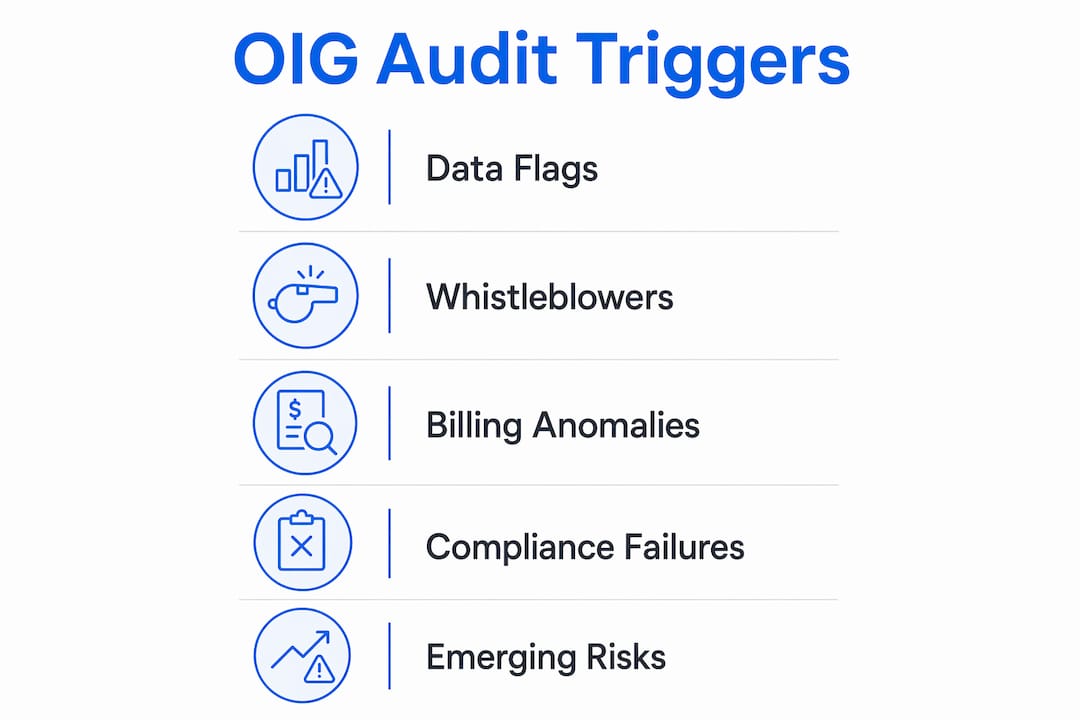
Most practices believe audits are random. They are not. Automated review systems identify practices for scrutiny before any complaint is filed. The OIG and CMS use statistical models to compare your billing patterns against peers in the same specialty and geography. When your numbers stand out, you move up the review queue.
The most common reasons for OIG audits fall into four categories:
- Outlier billing patterns. Practices that bill high-complexity Evaluation and Management (E&M) codes at rates significantly above their specialty average draw immediate attention. The OIG focuses on the 20% of billing activities that generate 80% of risk.
- Modifier misuse. Modifier 25 misuse is one of the most audited issues in 2026. Appending Modifier 25 to a claim without adequate documentation of a separate, significant E&M service is a direct audit trigger.
- Whistleblower complaints. Former employees, billing staff, and even patients can file complaints through the OIG Hotline. These referrals carry significant weight and often initiate formal reviews.
- UPIC referrals. Unified Program Integrity Contractors conduct their own data reviews and refer suspicious patterns to the OIG. UPIC inquiries are frequently underestimated by practices, but they can escalate to subpoenas and False Claims Act litigation.
- Telehealth and incident-to billing gaps. Telehealth documentation that fails to confirm patient location, provider credentials, or medical necessity is a growing red flag in 2026.
Pro Tip: Pull your own billing frequency reports quarterly and compare them against CMS specialty benchmarks. If your E&M level 5 rate is double your specialty average, you have a problem to fix before the OIG finds it first.
How does the OIG audit process work?
The OIG audit process follows a structured sequence. Understanding each stage helps you respond appropriately and avoid making a manageable situation worse.
- Intake and triage. The OIG receives a trigger, whether from data analytics, a UPIC referral, or a whistleblower complaint. Staff assess whether the issue warrants further review.
- Preliminary risk assessment. Analysts pull claims data, review billing patterns, and compare your practice against peer benchmarks. This phase is largely invisible to you.
- Evidence gathering. The OIG may request medical records, billing documentation, and contracts. At this stage, early legal counsel engagement is critical. Statements made during interviews can affect both civil and criminal outcomes.
- Formal audit or investigation. A written request for documents arrives. This is the stage most administrators recognize as an "audit." The audit lifecycle from initial inquiry through investigation follows a defined methodology.
- Draft report and management comment. The OIG issues a draft report and gives your practice an opportunity to respond. This is your best chance to correct factual errors and present mitigating context.
- Final report and outcomes. Outcomes range from repayment demands and civil monetary penalties to Corporate Integrity Agreements and exclusion from Medicare and Medicaid programs.
One critical distinction: a UPIC audit and an OIG investigation require different internal responses and legal strategies. Distinguishing the inquiry type early determines how your compliance team and legal counsel should respond.
Which billing areas does the OIG prioritize in 2026?
The OIG Work Plan is a living document, updated throughout the year as new vulnerabilities emerge. Compliance officers who treat it as a static annual publication miss the point entirely. The 2026 Work Plan identifies several high-risk billing areas that practices must address now.
| Billing Area | Specific Risk | Why It Matters |
|---|---|---|
| E&M level selection | Upcoding to level 4 or 5 without documented complexity | Triggers statistical outlier flags |
| Modifier 25 | Appending without a distinct, documented E&M service | One of the most audited modifiers in 2026 |
| Incident-to billing | Services billed under the physician when a non-physician provided care | Requires strict supervision documentation |
| Telehealth compliance | Missing patient location, consent, or provider credentials | Expanded telehealth rules created new documentation gaps |
| Medicare Advantage risk adjustment | HCC coding without supporting clinical documentation | Recent audits revealed millions in improper payments |
| Place of Service coding | Billing facility rates for services rendered in an office | A straightforward error with significant financial consequences |
Remote patient monitoring and quality reporting are emerging concerns in the 2026 Work Plan. Practices that added these services during the telehealth expansion era often lack the documentation protocols to support their claims.
Pro Tip: Treat the OIG Work Plan as your internal audit calendar. Each time the OIG adds a new project, schedule an internal review of that billing area within 60 days. You will find problems before auditors do.
What is the impact of OIG audits and how can practices reduce risk?
The consequences of an OIG audit extend well beyond a single repayment demand. Enforcement actions can include coordination with the DOJ, large settlements, and exclusion from federal healthcare programs. Exclusion is the most severe outcome. It means your practice cannot bill Medicare or Medicaid, which effectively ends operations for most independent practices.
Reducing audit risk requires a proactive compliance program, not a reactive one. Lack of an active compliance program is treated as an aggravating factor in enforcement actions. The OIG expects practices to self-police. When you cannot demonstrate that effort, penalties increase.
The most effective risk reduction strategies include:
- Internal audits aligned with OIG priorities. Review your top 10 billed codes quarterly. Compare your patterns against CMS specialty data. A coding review program built around OIG Work Plan priorities catches problems before they become audit triggers.
- Documentation integrity. Clinical documentation that fails to link directly to billed services is the fundamental weakness in most OIG audits. Every billed service needs a corresponding note that supports the code, the level, and the medical necessity.
- Staff training on high-risk areas. Coders and physicians need regular training on E&M documentation requirements, modifier rules, and telehealth compliance. Training records also serve as evidence of good faith during an audit.
- Formal compliance program structure. A written compliance program, a designated compliance officer, and a clear reporting process signal to the OIG that your practice takes its obligations seriously. Review the compliance program types available to independent practices and choose the structure that fits your size and risk profile.
- Early legal counsel when inquiries arrive. Do not respond to UPIC or OIG document requests without legal guidance. Statements and document productions made without counsel can create new liability.
The financial impact of avoiding a single audit cycle, including legal fees, staff time, and potential recoupments, far exceeds the cost of a proactive compliance program. Practices that lose reimbursement through coding errors often do not realize the exposure until an external review surfaces it.
Key Takeaways
OIG audits target practices whose billing patterns deviate from peer norms, making proactive internal auditing and documentation integrity the most effective defenses against enforcement actions.
| Point | Details |
|---|---|
| Audits are data-driven, not random | Automated systems flag outlier billing before any complaint is filed. |
| UPIC inquiries can escalate fast | Treat every UPIC request seriously; they frequently lead to formal OIG investigations. |
| Documentation is your primary defense | Every billed service needs a clinical note that directly supports the code and medical necessity. |
| The OIG Work Plan is your audit calendar | Use it to schedule internal reviews of high-risk billing areas before auditors arrive. |
| Compliance programs reduce penalties | An active, documented compliance program is treated as a mitigating factor in enforcement actions. |
The OIG Work Plan is the most underused tool in compliance
Most compliance officers I speak with treat the OIG Work Plan as background reading. That is a mistake. The Work Plan is a published list of exactly where federal auditors plan to look next. Using it as a proactive internal audit guide is the single most effective shift a compliance officer can make in 2026.
The practices that get into serious trouble are not usually the ones committing fraud. They are the ones that never built a system to catch their own errors. A physician who consistently selects level 5 E&M codes because the EHR auto-populates them is not acting in bad faith. But the OIG does not distinguish intent from pattern. The data flags the practice, and the practice has to defend itself.
The other mistake I see repeatedly is treating all government inquiries as equivalent. A UPIC records request and a formal OIG subpoena require completely different responses. Practices that respond to a UPIC inquiry the same way they would respond to a routine payer audit often hand investigators exactly what they need to escalate.
Documentation weaknesses are almost always avoidable. The gap between what a physician did clinically and what the billing record shows is a process problem, not a knowledge problem. Fixing it requires structured documentation templates, regular internal chart reviews, and a feedback loop between coders and physicians. That loop does not exist in most independent practices, and the OIG knows it.
Compliance officers who use data analytics to run their own outlier reports, before any external party does, are the ones who protect their practices. The tools exist. The OIG Work Plan tells you where to look. The only variable is whether you act before or after the audit notice arrives.
— Elena
How Himshield helps practices stay ahead of audits
Independent practices face real financial exposure when coding and documentation errors go undetected. Himshield identifies those risks before they become audit triggers or denied claims.
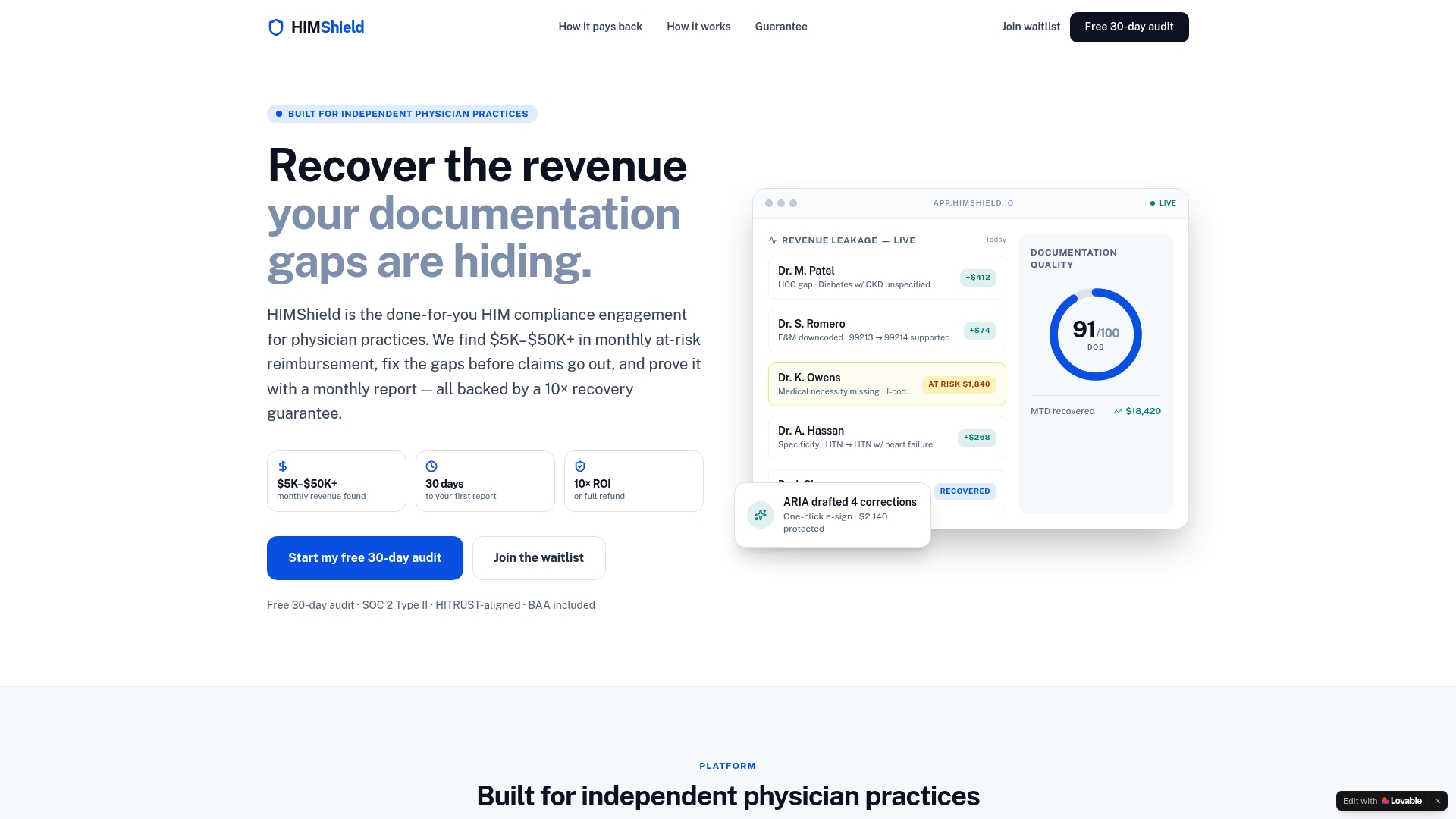
Himshield connects directly to your EHR and scans for billing anomalies, modifier misuse, and documentation gaps across your highest-risk codes. The platform quantifies at-risk reimbursement and delivers physician-friendly guidance that your team can act on immediately. Practices using Himshield have recovered $5K–$50K+ in hidden revenue while building the compliance record they need to defend against OIG scrutiny. If your practice bills Medicare or Medicaid, the question is not whether your patterns will be reviewed. The question is whether you find the problems first. See how Himshield works and connect your EHR to start recovering revenue within 30 days.
FAQ
What triggers an OIG audit of a medical practice?
The OIG most commonly initiates audits based on data analytics that flag outlier billing patterns, whistleblower complaints, or referrals from Unified Program Integrity Contractors. Practices whose E&M code frequency, modifier use, or claim volumes deviate significantly from specialty peers are the most likely targets.
How long does an OIG audit process take?
The OIG audit process varies widely depending on the complexity of the issues and whether the matter escalates from a records review to a formal investigation. Simple audits may resolve in months, while investigations involving the DOJ can extend for years.
What are the consequences of failing an OIG audit?
Consequences range from repayment demands and civil monetary penalties to Corporate Integrity Agreements and exclusion from Medicare and Medicaid programs. The OIG treats the absence of a compliance program as an aggravating factor when determining penalties.
Is a UPIC audit the same as an OIG investigation?
No. A UPIC audit is conducted by a federal contractor reviewing claims for payment errors, while an OIG investigation is a formal federal enforcement action. UPIC findings frequently serve as the foundation for OIG investigations, so practices should treat every UPIC inquiry with the same seriousness as a formal audit.
How can a practice prepare for an OIG audit?
The most effective preparation combines a documented compliance program, regular internal audits aligned with the OIG Work Plan, and documentation protocols that directly link clinical care to billed codes. Engaging legal counsel before responding to any government inquiry is also critical.