
A chart audit workflow is a standardized, systematic process for reviewing clinical documentation in electronic medical records to verify coding accuracy, compliance, and medical necessity. Healthcare administrators and HIM professionals use this process to protect revenue, meet CMS and HIPAA requirements, and catch documentation errors before they become claim denials or regulatory penalties. Most practices should conduct at least annual comprehensive audits, with high-risk specialties or practices onboarding new staff requiring monthly or quarterly reviews. Understanding what is a chart audit workflow gives your practice a concrete defense against revenue leakage and compliance exposure.
What is a chart audit workflow, and what does it include?
A chart audit workflow is defined as a repeatable, structured sequence of steps that guides reviewers through evaluating medical records against established documentation and coding standards. The industry term used by HIMSS, ACMSO, and CMS-aligned compliance programs is "clinical documentation review," though "chart audit workflow" describes the operational process that carries it out. Both terms appear throughout HIM literature, and knowing both helps you communicate across departments.
The workflow covers six core components:
- Audit plan: Defines scope, objectives, sampling method, and the clinical areas to review.
- Sampling criteria: Determines which records to pull, whether random, targeted, or risk-based.
- Standardized audit tool: A template or checklist that keeps every reviewer applying the same criteria.
- Review process: The actual record-by-record evaluation against coding guidelines and documentation standards.
- Discrepancy escalation: A defined path for flagging errors, querying providers, and resolving disagreements.
- Feedback loop: The mechanism that converts findings into education, corrective action, or a Performance Improvement Project (PIP).
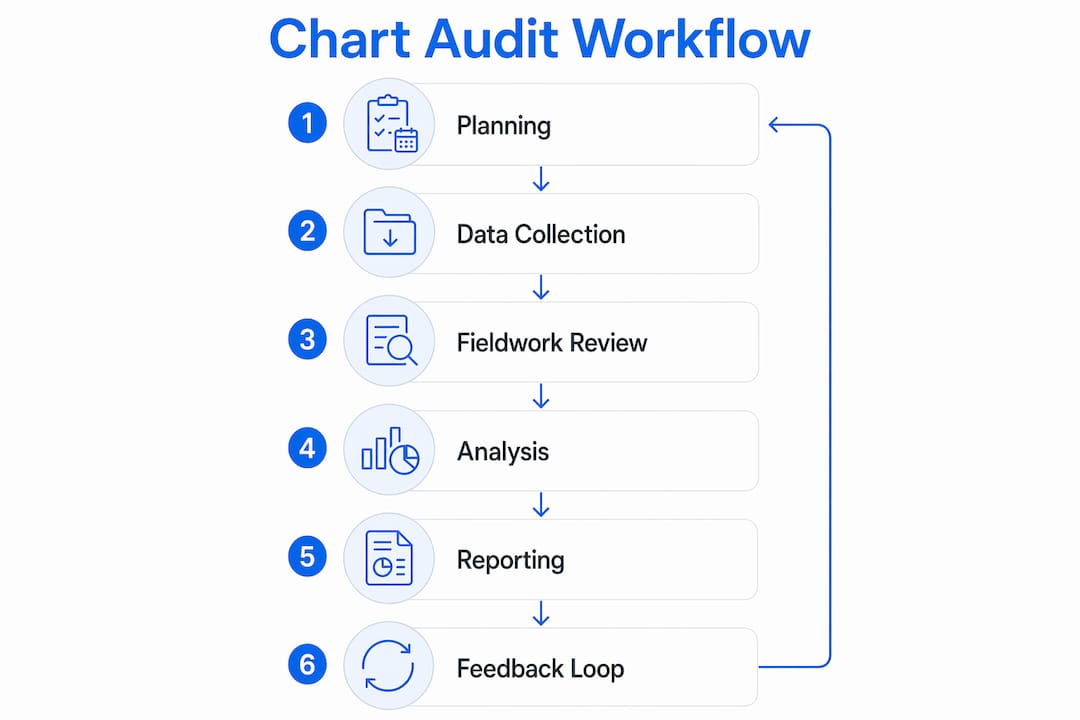
The chart audit process moves through six sequential phases: planning, data collection, fieldwork review, analysis, reporting, and follow-up. Each phase builds on the last. Skipping the follow-up phase is the most common mistake practices make. Without it, audits become static compliance checks rather than tools that actually change behavior.
Pro Tip: Prioritize high-risk clinical areas with complex documentation, such as benign lesion removals or chronic care management, when building your audit plan. These areas carry the highest compliance and revenue exposure and deliver the most impact per audit hour.

Retrospective audits review records after billing. Concurrent audits review records while the patient is still receiving care or before the claim goes out. Concurrent reviews give you the best chance to correct errors before payer deadlines, while retrospective reviews reveal systemic patterns. Most effective audit programs use both.
How does technology support the chart audit process?
Audit management software centralizes and coordinates the entire chart review workflow, replacing spreadsheets and paper checklists with a single platform that tracks every step. Technology accelerates audit turnaround, improves data consistency, and creates a clear communication channel between auditors and providers. That matters because manual processes introduce inconsistency, and inconsistency is what payers look for when they challenge claims.
Key features that define capable audit management platforms include:
- Automated sampling: The system pulls records based on predefined risk criteria, removing selection bias.
- Workflow tracking: Every audit step is logged with timestamps, creating a defensible audit trail.
- Risk scoring: Records are ranked by documentation risk before a human reviewer ever opens them.
- Analytics dashboards: Aggregate findings surface patterns across providers, service lines, or time periods.
- Provider communication tools: Queries go directly to the responsible clinician with a structured response format.
Natural language processing (NLP) and computer-assisted coding (CAC) tools add another layer. NLP reads clinical notes and flags documentation gaps before a coder assigns a code. CAC suggests codes based on note content, reducing the chance a coder misses a billable diagnosis. Both tools work best when a trained human auditor reviews their output.
Pro Tip: Technology supplements but does not replace human clinical judgment. Use dashboards to identify where to focus your auditors' attention, not to replace their analysis.
The practical result of technology integration is faster cycle times and better data. Practices that track audit findings in a centralized platform can spot a provider-level documentation trend in weeks rather than quarters. That speed is what separates a proactive compliance program from a reactive one.
What are the common compliance risks in chart audit workflows?
Documentation failures are the leading cause of audit findings, and most of them are preventable. Target, Probe, Educate audits in certain procedure areas revealed a 91% failure rate tied to missing documentation that links clinical complaints to medical necessity. That figure shows how often practices assume a diagnosis code alone is sufficient when payers require explicit narrative support.
The most frequent audit failures include:
- Missing medical necessity linkage between the clinical complaint and the procedure performed
- Invalid or missing provider signatures on orders and notes
- Absent lesion measurements or anatomical specificity required for procedure coding
- Incomplete history and physical documentation for evaluation and management (E/M) visits
- Addenda added after an audit begins, which auditors typically disregard as evidence
That last point deserves direct attention. Documents must be complete at the time of service. Post-audit chart amendments do not fix the underlying compliance problem and can raise additional scrutiny. The chart audit steps your team follows must reinforce real-time documentation discipline, not a cleanup habit.
Provider queries should be educational and objective, never accusatory. A collaborative query approach improves provider engagement and documentation quality. Providers respond better when queries focus on care quality rather than billing justification.
Timeliness is equally critical. Audit reports issued within 5–10 business days of review give providers a realistic window to address findings before payer deadlines close. Delayed reporting turns correctable errors into permanent revenue losses. Build your reporting cadence around that window.
The audit workflow must also maintain a detailed record of the query process as evidence of good-faith compliance efforts. If a payer or regulator questions your documentation practices, that query log is your defense.
What are the practical benefits of regular chart audit workflows?
Regular chart audits deliver measurable improvements across compliance, revenue, and care quality. The benefits compound over time because each audit cycle produces data that sharpens the next one.
- Fewer claim denials: Accurate documentation and correct coding reduce the rate of payer rejections. Practices that audit regularly catch mismatches between diagnosis codes and procedure codes before claims go out.
- Early risk detection: Audits surface billing risks, including upcoding, undercoding, and unbundling, before they attract payer scrutiny or OIG attention.
- Regulatory readiness: Continuous tracking of compliance patterns means your practice is never starting from zero when a payer audit or RADV review arrives.
- Provider engagement: When audit findings drive targeted education rather than punitive action, providers begin to view documentation accuracy as part of their clinical practice, not a billing department concern.
- Operational data: Aggregate audit findings reveal which service lines, providers, or documentation types carry the most risk. That data supports staffing decisions, training investments, and EHR template improvements.
The feedback loop that converts findings into re-education or PIPs is what separates a high-performing audit program from a checkbox exercise. Without that loop, the same errors repeat across audit cycles. With it, compliance improves quarter over quarter. For independent physician practices, that improvement translates directly to protected revenue and reduced exposure. You can also explore CDI best practices to reinforce what your audit findings reveal about documentation gaps.
Key Takeaways
A chart audit workflow is the most direct tool a practice has to protect revenue, verify compliance, and prevent recurring documentation errors before they reach a payer.
| Point | Details |
|---|---|
| Define the workflow clearly | A chart audit workflow is a standardized, sequential review of medical records against coding and documentation standards. |
| Use both audit types | Combine concurrent and retrospective audits to catch errors before billing and identify systemic patterns after. |
| Act on findings fast | Issue audit reports within 5–10 business days so providers can correct errors before payer deadlines close. |
| Close the feedback loop | Convert every audit finding into targeted education or a PIP to prevent the same errors from recurring. |
| Use technology as a multiplier | Audit management software, NLP, and CAC tools improve speed and consistency, but human auditor judgment remains the core. |
Why audits only work when they become permanent
Most practices treat chart audits as a response to a problem. A denial spike triggers a review. A payer letter prompts a scramble. That reactive posture is the most expensive way to run a compliance program.
The practices I have seen protect revenue most effectively treat audits as a permanent business function, not a project. They schedule reviews on a fixed cadence, assign clear ownership, and build provider education into the calendar alongside the audit itself. The audit is not the end of the process. It is the beginning of a correction cycle.
The other shift worth making is in how you query providers. Accusatory queries create defensiveness and silence. Educational queries, framed around care quality and documentation completeness, create conversation. That conversation is where real improvement happens. Providers who understand why a documentation element matters are far more likely to include it consistently than providers who feel policed.
Technology is worth adopting, but adopt it with clear expectations. A dashboard that shows you where risk is concentrated is valuable. A system that replaces your auditor's judgment is a liability. The best audit programs I have seen use technology to direct human attention, not to substitute for it. Customize your audit plan to focus on your highest-risk service lines first. That is where the compliance exposure and the revenue recovery opportunity are both the largest.
— Elena
How Himshield supports your chart audit workflow
Independent physician practices face real pressure to keep every earned dollar while staying ahead of payer scrutiny. Himshield connects directly to your EHR and automates key audit processes, including risk scoring, coding gap detection, and charge-capture review, so your team spends time on findings rather than record-pulling.
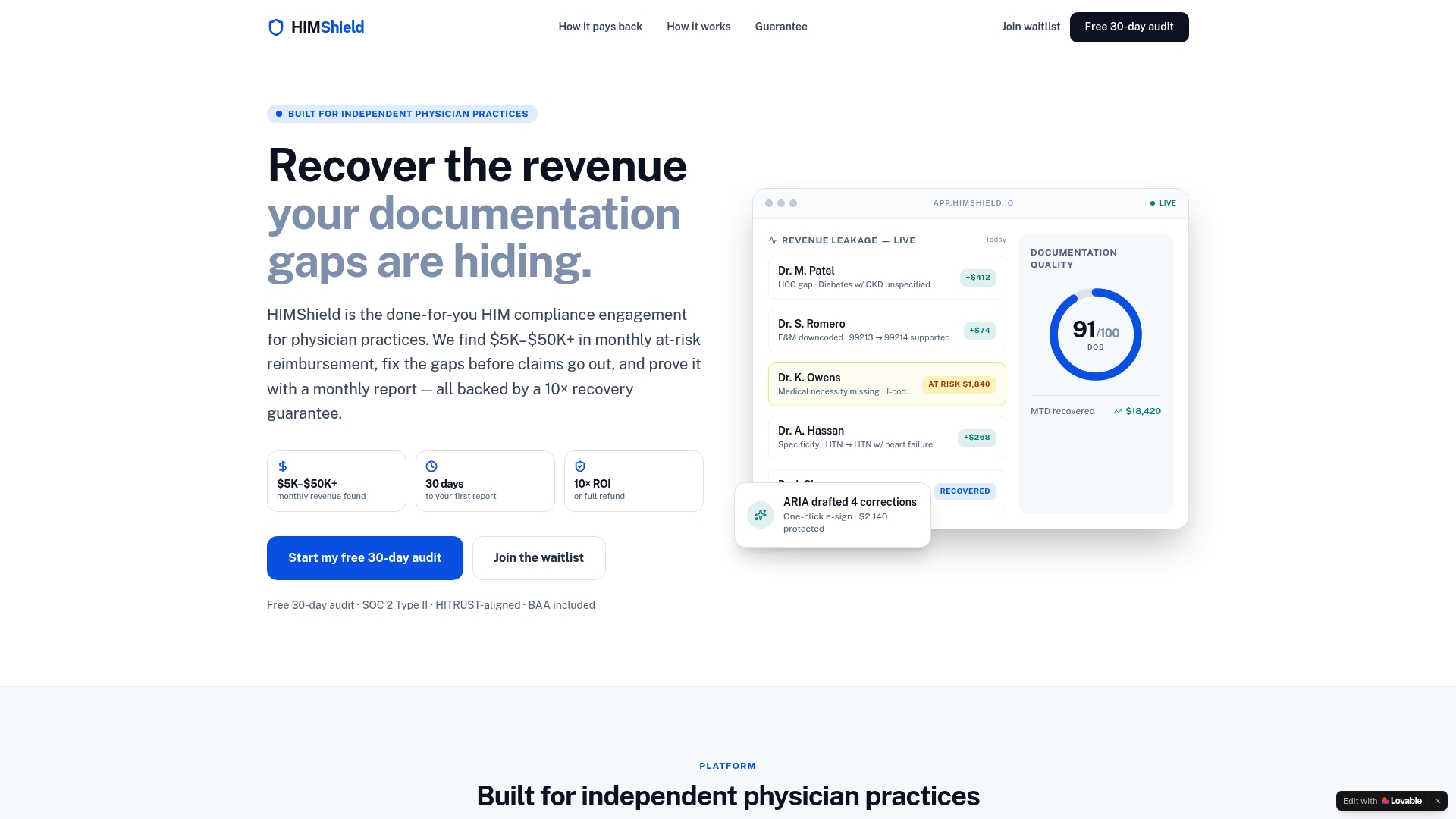
Himshield scans your clinical documentation for coding errors, missing medical necessity linkage, and charge-capture gaps before they become denials. Practices using Himshield recover between $5,000 and $50,000 or more in hidden revenue within the first 30 days. Start with a free revenue leakage report to see exactly where your practice stands. If you are ready to build a defensible, data-driven audit program, Himshield's platform gives you the tools to do it.
FAQ
What is a chart audit workflow in simple terms?
A chart audit workflow is a step-by-step process for reviewing medical records to verify that documentation, coding, and billing are accurate and compliant with payer and regulatory standards.
How often should a practice perform chart audits?
Most practices should conduct at least annual comprehensive audits. High-risk specialties or practices with new staff benefit from monthly or quarterly reviews to catch errors early.
What is a medical record audit vs. a chart audit?
A medical record audit and a chart audit refer to the same core process. "Medical record audit" is the broader regulatory term; "chart audit" is the operational term used by HIM professionals and practice administrators.
What are the most common reasons chart audits fail?
The most frequent failures involve missing medical necessity documentation, invalid signatures, and absent clinical specifics like lesion measurements. Post-audit addenda typically do not resolve these findings with payers.
How does a feedback loop improve chart audit outcomes?
A feedback loop converts audit findings into targeted provider education or a Performance Improvement Project. Without it, the same documentation errors repeat across audit cycles and compliance does not improve.