
Modifier usage in physician billing is defined as the practice of appending two-character alphanumeric codes to CPT or HCPCS codes to clarify the circumstances of a service without altering its core meaning. These codes directly affect reimbursement decisions, claim approvals, and audit exposure. Incorrect modifier application can cost a family medicine practice up to $120 per office visit. Family physicians see 60–80 patients weekly, meaning that cumulative loss compounds into thousands of dollars every month. Modifiers 25, 59, and 50 are the most scrutinized in physician billing, and getting them right is the difference between clean claims and costly denials.
What are the most critical physician billing modifiers?
Physician billing modifiers are two-character codes that tell payers why a service was performed in a specific way. They do not change the procedure itself. They change the context payers use to calculate payment. Up to 4 modifiers can be appended to a single CPT code, giving billers significant flexibility to describe complex clinical scenarios accurately.
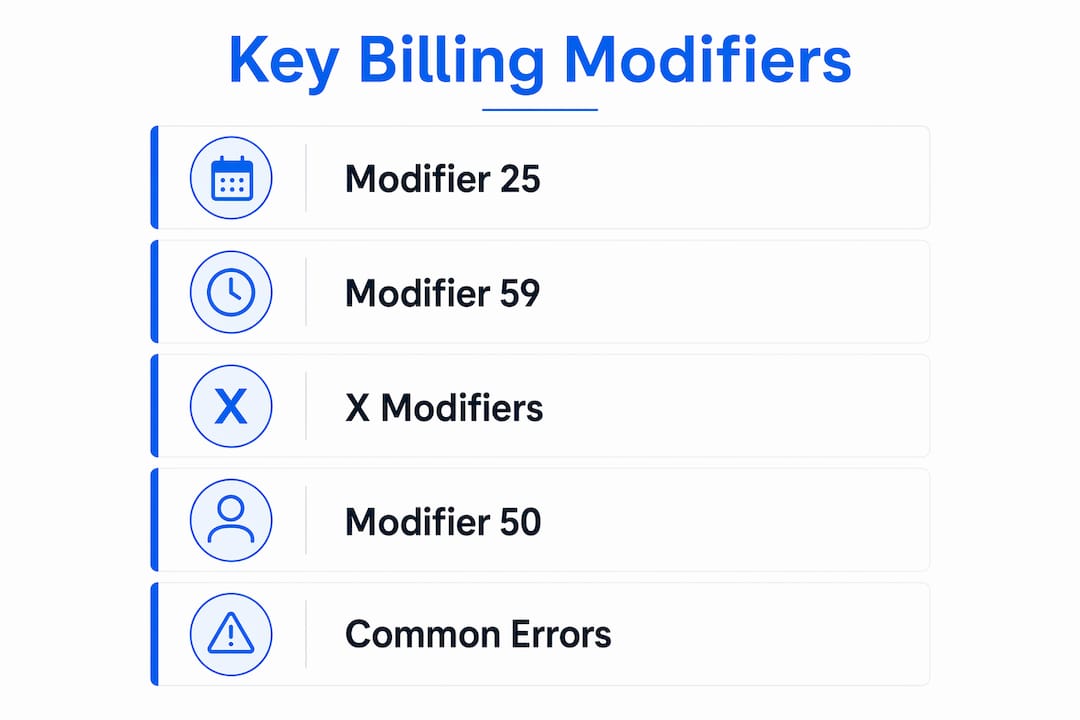
Modifier 25: the most commonly audited code
Modifier 25 signals that a physician performed a separate and significant evaluation and management (E/M) service on the same day as a procedure. The E/M must be distinct from the pre-procedure assessment. A physician who treats a patient’s laceration and also evaluates a new complaint of chest pain during the same visit can bill both services, but only with Modifier 25 attached to the E/M code. Payers audit this modifier aggressively because it is frequently misapplied when the E/M is simply part of the procedure workup.

Modifier 59 and the x modifiers: distinct procedural services
Modifier 59 identifies a distinct procedural service that would otherwise be bundled under National Correct Coding Initiative (NCCI) edits. Experienced billers prefer X modifiers over the general Modifier 59 because they provide greater specificity and face less payer pushback. The four X modifiers are:
-
XE: Separate encounter on the same day
-
XS: Separate anatomical structure
-
XP: Separate practitioner
-
XU: Unusual non-overlapping service
Each X modifier tells the payer exactly why two services are distinct. That specificity reduces denials and strengthens your audit defense.
Modifier 50 and its revenue impact
Modifier 50 indicates a bilateral procedure performed during the same operative session. Accurate use of Modifier 50 increases reimbursement by approximately 50% compared to a unilateral code. A practice performing bilateral knee injections without Modifier 50 leaves half the reimbursement uncollected. This is one of the clearest examples of how a single modifier directly protects revenue integrity.
Quick comparison: key modifiers at a glance
| Modifier | Purpose | Common Use Case | Risk if Misused |
|---|---|---|---|
| 25 | Separate E/M same day as procedure | Office visit plus minor procedure | Denial, audit trigger |
| 59 | Distinct procedural service | Unbundling NCCI-bundled codes | Overpayment allegation |
| XE/XS/XP/XU | Specific reason for distinct service | Preferred alternative to 59 | Fewer risks than 59 |
| 50 | Bilateral procedure | Same-session bilateral surgery | Revenue loss if omitted |
| 51 | Multiple procedures, same session | Second procedure at reduced rate | Underpayment if missing |
Pro Tip: When you have a choice between Modifier 59 and an X modifier, always choose the X modifier. It tells the payer exactly why the services are distinct, and that specificity translates directly into fewer denials.
How to document modifiers correctly for compliance
Payers approve claims based on documented evidence, not simply on the presence of a modifier. A modifier without supporting documentation is a liability, not an asset. Safwan Azeem at AMBCI states that “modifiers are not a payment request but documentation labels reflecting true clinical scenarios.” That framing should guide every coding decision your team makes.
Correct documentation for modifier use follows a clear sequence:
-
Establish medical necessity first. The clinical note must justify why the service was performed. For Modifier 25, the note must show that the E/M addressed a problem separate from the procedure indication.
-
Document “separate and distinct” language explicitly. For Modifiers 25 and 59, the physician’s note should clearly describe two independent clinical decisions. Vague notes like “patient seen and treated” do not meet this standard.
-
Link the documentation to the specific CPT code. Each modifier on the claim must trace back to a specific section of the clinical note. Auditors follow this trail directly.
-
Maintain an audit trail in your EHR. Date-stamped entries, addenda, and co-signature logs all support modifier validity during a payer review.
-
Align clinical documentation improvement (CDI) workflows with modifier selection. CDI specialists and coders should review high-modifier claims together before submission, not after a denial.
Poor documentation is the single most common reason modifier-supported claims fail on audit. Payers do not give the benefit of the doubt. They follow the record. If the record does not support the modifier, the claim is denied and the practice faces potential repayment demands.
Pro Tip: Build a modifier checklist into your charge capture workflow. Before any claim with Modifier 25 or 59 leaves the practice, a second reviewer should confirm the supporting note exists and is specific enough to withstand payer scrutiny.
How do you apply multiple modifiers on one claim?
Applying multiple modifiers to a single CPT code is common in surgical and procedural billing. The sequencing of those modifiers is not arbitrary. Pricing modifiers must appear before informational modifiers to prevent systematic underpayment. Incorrect sequencing causes clearinghouse payment errors that are difficult to trace and easy to miss.
The rule is straightforward: list modifiers that affect payment calculation first, then list modifiers that provide context only.
For example, a bilateral procedure with a distinct service would sequence as: 50, 59 (or 50, XS). Modifier 50 affects the payment rate. Modifier 59 or XS explains why the second service is distinct. Reversing that order can trigger incorrect payment calculations at the payer level.
Common sequencing scenarios
| Scenario | Correct Sequence | Why It Matters |
|---|---|---|
| Bilateral + distinct service | 50, XS | 50 affects price; XS clarifies distinction |
| Multiple procedures, same session | 51, 59 | 51 triggers reduced rate; 59 unbundles |
| Professional component only | 26, 59 | 26 affects payment split; 59 clarifies service |
| Separate encounter, bilateral | 50, XE | Pricing first, then encounter context |
Common sequencing mistakes include placing Modifier 59 before Modifier 50, omitting Modifier 51 on secondary procedures, and using Modifier 25 in a sequence position where it affects a surgical code rather than an E/M code. Each of these errors creates a payment discrepancy that compounds across hundreds of claims per month.
Pro Tip: Create a modifier sequencing reference card for your billing team. Post it at every workstation. Most sequencing errors are not knowledge failures. They are workflow failures caused by rushing through charge entry.
What are the most common modifier errors that trigger audits?
Inconsistent or reckless modifier use leads directly to increased audits and unnecessary rework. Revenue cycle experts call this “modifier overconfidence,” the assumption that appending a modifier automatically justifies a claim. It does not. Payers track modifier usage rates by provider and flag outliers for review.
The most frequent errors billing specialists encounter include:
-
Overuse of Modifier 25: Attaching it to every E/M performed on a procedure day, regardless of whether the E/M was truly separate. Payers compare your Modifier 25 rate against specialty benchmarks. A rate significantly above average triggers a probe audit.
-
Misuse of Modifier 59 as a denial fix: Appending Modifier 59 after a denial without verifying that the services are genuinely distinct. This practice creates overpayment liability and can escalate to a fraud allegation.
-
Omitting Modifier 50 on bilateral procedures: This is pure revenue loss. The claim pays at the unilateral rate, and the practice has no recourse after the timely filing window closes.
-
Ignoring NCCI edits before submission: NCCI edits define which code pairs require a modifier to be billed together. Submitting without checking these edits first guarantees denials on bundled pairs.
“A disciplined modifier audit framework tied to NCCI edits and medical necessity criteria improves revenue while reducing payer pushback.” — Physician Fee Schedule Reimbursement Guide
Regular modifier audits linked to NCCI edits and medical necessity criteria are the most reliable defense against both underuse and overuse. A quarterly audit that reviews a random sample of claims with Modifiers 25, 59, and 50 will surface patterns before they become payer red flags. Train your staff to treat every modifier as a clinical statement, not a billing shortcut.
Key takeaways
Correct modifier usage in physician billing requires matching every modifier to documented clinical evidence, sequencing pricing modifiers before informational ones, and auditing usage patterns regularly to prevent denials and audit exposure.
| Point | Details |
|---|---|
| Modifiers affect payment directly | Incorrect or missing modifiers cost practices up to $120 per visit in lost reimbursement. |
| X modifiers outperform Modifier 59 | XE, XS, XP, and XU provide payer-preferred specificity that reduces denials compared to general Modifier 59. |
| Sequencing order is non-negotiable | Pricing modifiers like 50 must appear before informational modifiers to prevent underpayment at the clearinghouse level. |
| Documentation drives approval | Payers approve modifiers based on clinical notes, not the modifier code alone. CDI alignment is required. |
| Audits start with usage patterns | Modifier overuse or misuse triggers payer probe audits. Quarterly internal audits catch problems before payers do. |
Why modifiers deserve more respect than they get
I have reviewed billing workflows at dozens of independent practices, and the pattern is consistent. Modifiers get treated as a last resort rather than a first-line coding decision. A claim gets denied, someone appends Modifier 59, and the team moves on. That reactive approach is exactly what payers expect, and it is exactly what they audit.
The practices that protect their revenue treat modifiers as documentation extensions. Before a claim is submitted, the coder asks: does the clinical note actually support this modifier? That question, asked consistently, changes everything. It forces a conversation between the coder and the clinician that should have happened at the point of care.
My strongest recommendation is to stop separating modifier management from clinical documentation improvement. They are the same process. A CDI specialist who understands NCCI edits and a coder who understands clinical documentation are more valuable together than either is alone. Build that collaboration into your weekly workflow, not your denial management queue.
The shift from Modifier 59 to X modifiers is also worth prioritizing now. Payers have flagged Modifier 59 as a high-risk code for years. The X modifiers exist specifically to replace it with greater precision. Practices still defaulting to Modifier 59 are carrying unnecessary audit risk when a more defensible option is available.
Modifiers are not administrative details. They are revenue-protecting statements about the care your physicians delivered. Treat them accordingly.
— Elena
How Himshield helps practices recover modifier revenue
Modifier errors are silent revenue leaks. They do not always generate immediate denials. They generate underpayments, missed bilateral reimbursements, and audit exposure that surfaces months later. Himshield scans your claims for exactly these patterns, identifying missed Modifier 50 opportunities, Modifier 25 documentation gaps, and sequencing errors before they cost you money.
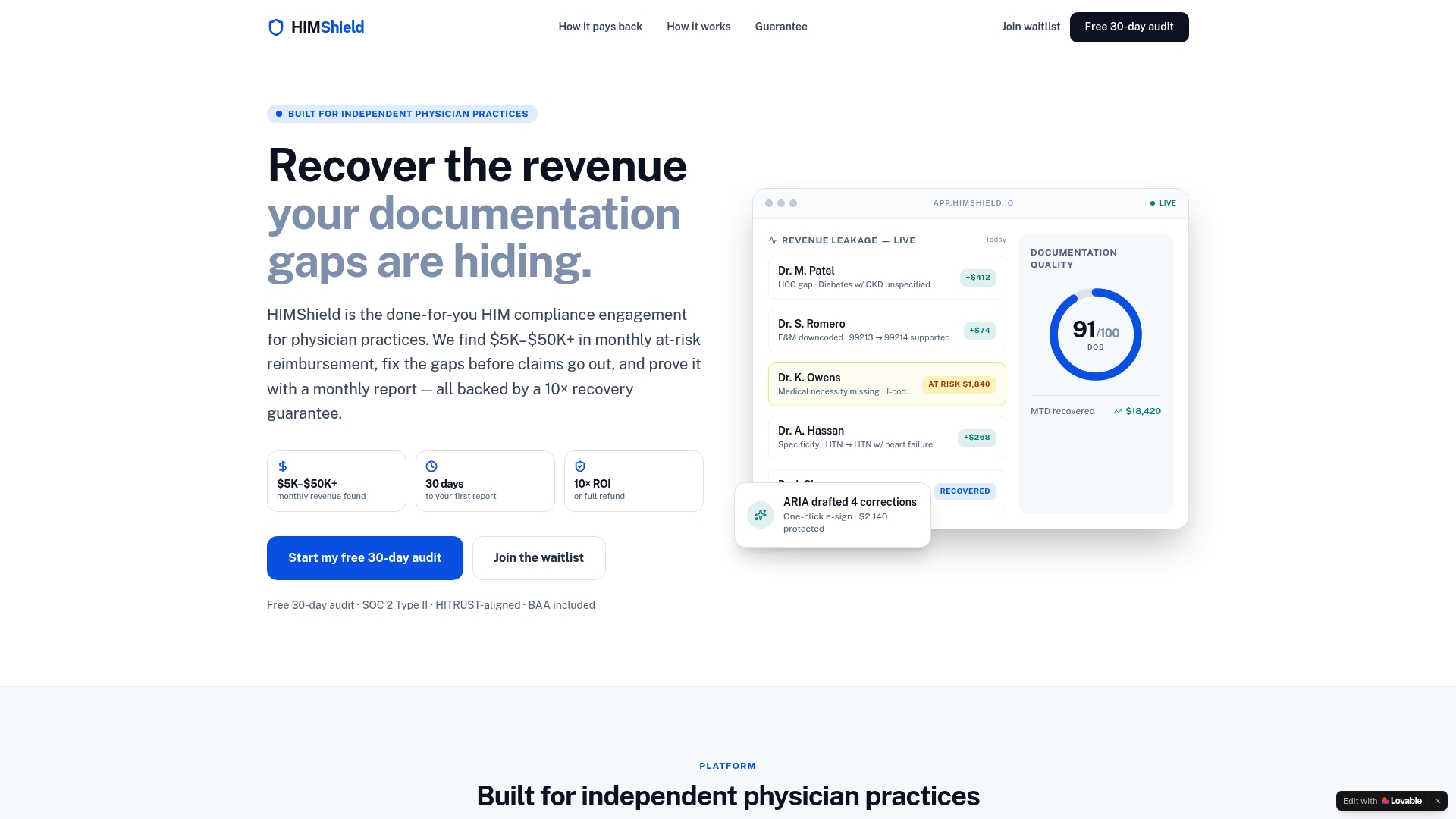
Independent practices using Himshield recover $5K–$50K+ in hidden revenue by catching coding and modifier risks at the charge capture stage, not after a payer audit. If your practice bills 60 or more patients per week, the modifier revenue at risk is significant. Himshield gives you the audit defense and coding clarity to keep every dollar your physicians have earned.
FAQ
What is modifier usage in physician billing?
Modifier usage in physician billing is the practice of appending two-character codes to CPT or HCPCS codes to clarify the clinical circumstances of a service. These codes affect payer reimbursement decisions without changing the procedure’s core definition.
When should you use modifier 25 vs. modifier 59?
Use Modifier 25 when a physician performs a separate, significant E/M service on the same day as a procedure. Use Modifier 59 (or an X modifier) when two distinct procedural services would otherwise be bundled under NCCI edits.
Why do x modifiers reduce denials better than modifier 59?
X modifiers provide greater specificity by explaining exactly why two services are distinct, whether by separate encounter, anatomical site, or practitioner. That precision gives payers a clear clinical rationale, which reduces the likelihood of a denial.
What happens if you sequence modifiers incorrectly?
Incorrect modifier sequencing causes clearinghouse payment errors that result in systematic underpayment. Pricing modifiers like Modifier 50 must always appear before informational modifiers on the claim line.
How often should a practice audit its modifier usage?
A quarterly audit of claims containing Modifiers 25, 59, and 50 is the standard recommendation. Regular audits tied to NCCI edits and medical necessity criteria catch overuse and underuse patterns before payers flag them for investigation.