
A concurrent audit program is a real-time review process conducted alongside daily operations to verify accuracy, compliance, and financial integrity before errors become denials or regulatory findings. Unlike traditional retrospective audits that examine records months after the fact, concurrent auditing embeds review steps directly into workflows, flagging problems while they can still be corrected. For independent physician practices managing complex billing, documentation, and regulatory requirements, this timing advantage is the difference between catching a coding error today and receiving a payer audit notice six months from now. Himshield works with practices that face exactly this challenge, and the evidence for proactive auditing is clear.
What is a concurrent audit program in healthcare?
A concurrent audit program performs review simultaneously with operations, providing real-time assurance by embedding review steps into workflows and flagging issues early. The industry also refers to this as concurrent auditing or real-time compliance monitoring, and both terms describe the same core methodology. The defining characteristic is timing: review happens as transactions occur, not weeks or quarters later.
In a physician practice, this means a biller submits a claim, and the audit system checks it against payer rules, documentation requirements, and coding guidelines before or immediately after submission. If a charge for a level-4 evaluation and management visit lacks supporting documentation, the exception surfaces the same day. Staff can correct the record before the claim reaches the payer, preventing a denial entirely.

Concurrent chart audits in healthcare verify that billing charges reflect services provided, are physician-ordered, and comply with protocols. Monthly audit statistics from these reviews help identify trends for corrective action in specific departments. That trend data is what separates a one-time fix from a lasting improvement in practice operations.
What is the concurrent audit process step by step?
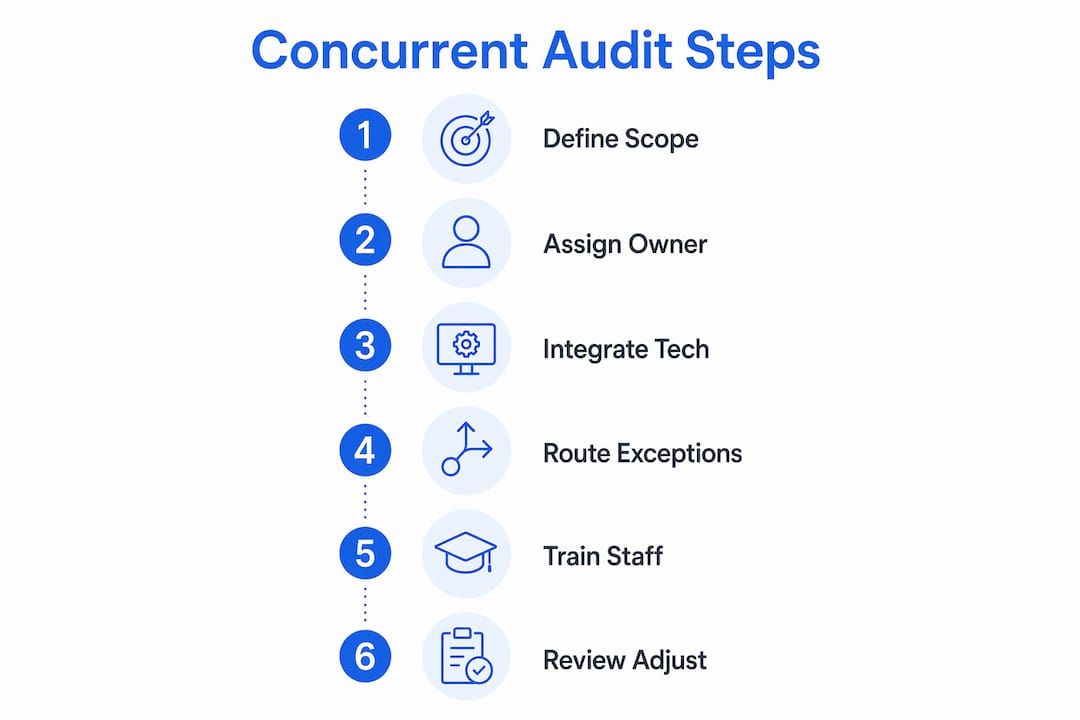
The concurrent audit operating cycle includes transaction review, document verification, compliance checks, exception reporting, and follow-up on past exceptions to close the loop. Each step builds on the previous one, creating a continuous improvement cycle rather than a series of isolated reviews.
-
Transaction and documentation review. Auditors or automated tools examine claims, charge captures, and clinical notes daily or weekly. In a physician practice, this typically covers evaluation and management codes, procedure codes, modifier usage, and diagnosis linkage.
-
Compliance checks. Each transaction is measured against internal policies, payer contracts, and regulatory standards such as CMS guidelines or HIPAA documentation requirements. A claim missing a required modifier or carrying an unsupported diagnosis code fails this check immediately.
-
Exception reporting. Flagged items are compiled into a prioritized report. High-risk exceptions, such as duplicate billing or charges exceeding authorization limits, rise to the top. Lower-risk items are queued for routine review.
-
Triage and assignment. Each exception is routed to a responsible owner, whether a coder, biller, or physician. Ownership is the critical step that separates a functioning audit program from a report that nobody reads.
-
Follow-up and closure. Unresolved exceptions from prior cycles are re-tested. A closed-loop process routes exceptions to responsible owners and re-tests them to confirm resolution, preventing recurring issues from becoming systemic problems.
Pro Tip: Schedule a brief weekly exception review meeting with your billing team. Reviewing open items together takes 20 minutes and prevents exceptions from aging past the point where correction is possible.
In a typical independent practice, the documents reviewed include encounter notes, charge tickets, superbills, prior authorization records, and remittance advice. The scope should match your highest-risk service lines, not every transaction equally.
How does automated monitoring enhance concurrent audit programs?
Technology-enabled concurrent audit techniques with embedded controls, automated testing, and real-time exception reporting significantly enhance audit effectiveness and efficiency. Manual concurrent audits rely on a reviewer physically checking records, which limits both speed and coverage. Automated monitoring removes that bottleneck.
Automated concurrent audit tools embed audit controls directly into EHR and billing platforms. When a transaction is entered, the system checks it against a rule set and flags anomalies immediately. This is fundamentally different from pulling a monthly sample and reviewing it after the fact.
Key capabilities of automated concurrent audit systems include:
- Real-time flagging of unusual or non-compliant transactions, such as duplicate payments or approvals that exceed authorization limits
- Exception reporting that surfaces red flags for immediate auditor review rather than waiting for a scheduled audit cycle
- Embedded system controls within EHR and billing platforms that check every transaction, not just a statistical sample
- Trend dashboards that show exception rates by provider, code, or payer over time
- Automated re-testing of previously flagged items to confirm resolution
Embedding exception logic at the application layer within integrated systems enables immediate flagging for audit teams, expanding coverage and reducing time lags compared to sample-based approaches. That shift from periodic sampling to continuous oversight is the most significant operational change automation delivers.
Manual audits in a small practice might review 5–10% of claims in a given month. Automated monitoring can cover every claim. That difference in coverage directly affects how much revenue leakage you catch and how quickly you catch it.
What are the key benefits of concurrent audit programs for independent physician practices?
Concurrent audits in healthcare reduce claim denials, improve documentation accuracy, and support regulatory compliance, with cost savings outweighing initial staffing expenses. For an independent practice operating without a large compliance department, these benefits are not incremental. They are foundational to financial stability.
"The main advantage of concurrent audits is timing: auditing alongside or immediately after transactions enables early detection and correction rather than retrospective discovery." — Concurrent Audit Guide 2026
The practical benefits for physician practices include:
- Fewer claim denials. Errors caught before submission never become denials. Practices that review claims concurrently spend less time on rework and appeals.
- Reduced revenue leakage. Undercoded visits, missing charges, and unbilled procedures are identified in real time rather than discovered during an annual retrospective review.
- Stronger documentation accuracy. When coders and physicians receive immediate feedback on documentation gaps, they correct their habits. The improvement compounds over time.
- Regulatory readiness. A practice running concurrent audits maintains a current, defensible compliance record. If a payer or CMS auditor requests documentation, the records are already in order.
- Staff accountability. Routing exceptions to named owners creates clear responsibility. Staff know their work is reviewed, which raises accuracy at the point of entry.
Reviewing CDI best practices for medical groups alongside a concurrent audit program compounds these gains. Documentation improvement and real-time auditing reinforce each other: better documentation produces fewer exceptions, and fewer exceptions free up audit capacity for higher-risk reviews.
How to implement a concurrent audit program in a physician practice
Successful concurrent audits require strong integration with operational teams to rapidly evaluate transactions and act on exceptions, making audits more than just periodic reports. Implementation does not require a large team or a major technology investment. It requires a clear scope, defined ownership, and consistent follow-through.
Manual vs. automated concurrent audit approaches
| Factor | Manual concurrent audit | Automated concurrent audit |
|---|---|---|
| Coverage | Sample-based, typically 5–10% of transactions | Continuous, covers all transactions |
| Speed | Days to weeks for exception identification | Real-time or same-day flagging |
| Cost | Higher labor cost per exception found | Higher upfront setup, lower per-exception cost |
| Scalability | Limited by reviewer capacity | Scales with transaction volume |
| Best fit | Small practices with low claim volume | Practices with high claim volume or complex payer mix |
Steps to build your program
Step 1: Define audit scope. Start with your highest-risk areas. For most physician practices, this means evaluation and management coding, modifier usage in billing, and high-dollar procedure codes. Prioritizing high-volume and high-risk transactions for frequent review optimizes audit resources while maximizing risk coverage.
Step 2: Assign ownership. Designate a lead auditor or compliance coordinator. In smaller practices, this may be a part-time role or a shared responsibility between the billing manager and an external coding consultant.
Step 3: Integrate technology. Connect your audit process to your EHR and practice management system. Even basic rule-based alerts within your billing platform provide meaningful real-time coverage. More advanced platforms embed exception logic directly into the workflow.
Step 4: Design exception routing. Every flagged item needs a named owner and a resolution deadline. Build a simple tracking log or use your practice management system's task function. Without routing, exceptions accumulate and the program loses credibility with staff.
Step 5: Train clinical and billing staff. Staff who understand why exceptions are flagged correct errors faster and make fewer of them. A 30-minute onboarding session covering the most common exception types pays for itself within the first billing cycle.
Step 6: Review and adjust quarterly. Audit programs that never change stop catching new risk patterns. Review your exception rate trends quarterly and update your rule set to reflect new payer policies or coding changes.
Pro Tip: Run a pilot on one service line or one provider before rolling out practice-wide. A focused pilot surfaces process gaps without disrupting your entire billing operation.
Key Takeaways
A concurrent audit program is the most effective tool for independent physician practices to catch billing errors, prevent claim denials, and maintain regulatory readiness in real time.
| Point | Details |
|---|---|
| Concurrent audit definition | Real-time review embedded in operations to catch errors before they become denials or audit findings. |
| Closed-loop process | Every exception must be assigned an owner and re-tested to confirm resolution, not just logged. |
| Automation expands coverage | Automated monitoring reviews every transaction; manual sampling typically covers only 5–10%. |
| Start with high-risk areas | Focus initial audit scope on evaluation and management coding, modifiers, and high-dollar procedures. |
| Benefits compound over time | Concurrent auditing improves documentation habits, reduces denials, and builds a defensible compliance record. |
Why timing is the real competitive advantage in concurrent auditing
After working with independent physician practices on compliance programs for years, the pattern I see most often is this: practices invest in retrospective audits, find problems, fix them, and then repeat the same cycle six months later. The root cause never changes because the feedback loop is too slow.
Concurrent auditing breaks that cycle. When a coder receives an exception report the same day they submitted a claim, the correction is immediate and the lesson sticks. When that same feedback arrives three months later in a retrospective audit report, the coder barely remembers the encounter. The educational value is almost zero.
The practices that build real compliance cultures are the ones that treat auditing as an operational function, not a periodic event. Dedicated audit teams embedded within operational departments facilitate quick exception triage and maintain operational connectivity. That proximity is what makes the difference between an audit program that changes behavior and one that generates reports nobody acts on.
The technology barrier is lower than most administrators expect. You do not need a purpose-built audit platform on day one. A structured exception log, a weekly review meeting, and a clear escalation path will outperform an expensive tool that nobody uses consistently. Build the process first. Add automation as your volume and complexity grow.
— Elena
How Himshield helps practices run concurrent audits
Independent physician practices that want real-time compliance coverage without building an internal audit department have a direct path forward with Himshield.
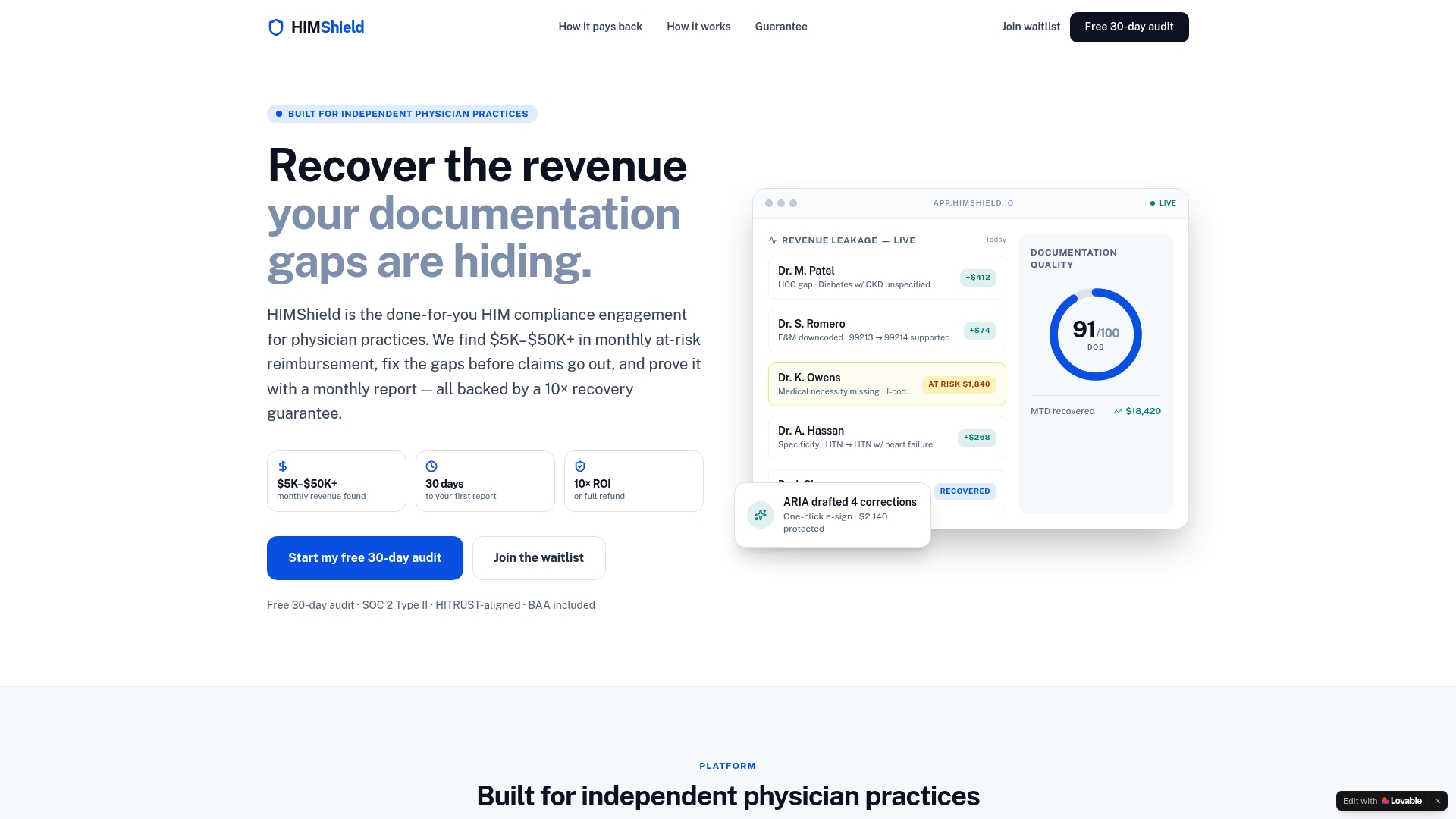
Himshield scans your EHR and billing data to identify coding errors, documentation gaps, and charge-capture risks before they reach the payer. The platform flags exceptions in real time, quantifies the revenue at risk, and delivers physician-friendly guidance your team can act on immediately. Practices using Himshield have recovered $32K per month by catching issues that retrospective reviews missed entirely. If you want to see where your practice stands today, a free revenue leakage report gives you a clear picture of at-risk reimbursement with no commitment required.
FAQ
What is concurrent auditing in simple terms?
Concurrent auditing is the practice of reviewing transactions and clinical records as they happen, rather than after the fact. The goal is to catch errors and compliance issues while correction is still possible.
How does a concurrent audit differ from a retrospective audit?
A concurrent audit reviews records in real time or near real time during operations. A retrospective audit reviews records after a period has closed, which limits the ability to correct errors before they affect revenue.
Is a concurrent audit program effective for small physician practices?
Yes. Even a manual concurrent audit covering high-risk claims delivers measurable benefits by reducing denials and improving documentation accuracy. Automated tools make the process feasible at any practice size.
What documents does a concurrent audit typically review?
Concurrent audits in physician practices typically cover encounter notes, charge tickets, prior authorization records, modifier usage, and diagnosis-to-procedure code linkage. The scope should focus on your highest-volume and highest-risk service lines.
How often should a concurrent audit program run?
The most effective programs run daily or weekly exception reviews, with quarterly scope adjustments to reflect new payer policies and coding updates. Frequency should match your claim volume and risk profile.