
Point-of-care coding guidance is help that reaches the physician while the note is still open: a prompt about what the record needs to support the level billed, before the claim exists. For an independent practice, it is the cheapest place to fix a coding problem, because the physician still remembers the visit. Fixing it later means a query, a rework or a denial. We built our approach around that idea: find the gap in EHR data before submission, show the physician a short, clear correction and keep the physician's judgment in charge.
This guide covers what good guidance should prompt for, how to document medical decision making (MDM), what a strong assessment and plan looks like, how to keep prompts compliant and how to turn the findings into coaching that physicians accept.
TL;DR
- Since 2021, most office E/M visit levels are chosen by MDM or total time. History and exam no longer set the level, so the assessment and plan carry the weight.
- Good point-of-care prompts ask for the reasoning behind the decision: problems addressed, data reviewed, and risk. They never suggest a diagnosis or mention payment.
- Queries must cite clinical indicators and must not lead the provider to a specific code or state reimbursement impact.
- Coaching works best with real case examples and outcome reporting per provider, not generic reminders.
- A free 30-day Revenue Leakage Audit shows where your own charts lose revenue before you change any workflow.
Table of Contents
- Why the point of care is where coding is won or lost
- What changed in E/M and why it shapes your prompts
- MDM rationale: what the note has to show
- Assessment and plan quality: a practical standard
- Keeping prompts compliant: queries must never lead
- Turning insights into provider coaching
- Safeguards: validate prompts and audit what they produce
- How we approach it at HIMShield
- See your own gaps first
- FAQ
- Sources
Why the point of care is where coding is won or lost
A claim can only be as strong as the note behind it. CMS states that documentation must support the CPT, HCPCS and ICD-10-CM codes reported on the claim. If the note is thin, one of two things happens. The practice under-codes and leaves earned revenue behind, or it over-codes and carries audit risk. Both start in the exam room or in the minutes after it.
The discipline behind this is clinical documentation improvement (CDI). AHIMA's 2018 practice brief describes CDI as work that improves the clinical clarity of the health record and notes that it has expanded from hospital inpatient settings into physician practice and ambulatory settings. The same brief ties documentation to measures that matter to practices: in the physician office, patient acuity is typically measured by a Risk Adjustment Factor (RAF) score, and the CMS Quality Payment Program is strongly influenced by complete and accurate documentation.
The timing matters because physicians document at different moments. The AAFP notes that notes may be finished in the exam room or later, between visits, after hours or at home, and that documentation style drives the time and effort involved. Guidance has to meet the physician wherever that happens, and it has to be short.
What changed in E/M and why it shapes your prompts
The 2021 office and outpatient E/M revisions changed what a prompt should ask. CMS explains that for most visit families the level is selected by MDM or practitioner time, and history and exam no longer affect level selection. The AAFP adds that the MDM table was revised to reflect cognitive work, and that time now means total physician or qualified health professional time on the date of the encounter, face-to-face and non-face-to-face.
Three practical consequences follow:
- A long history no longer raises the level. Prompts that push physicians to add more history are wasted effort. History and exam are still documented as medically appropriate, but they do not select the code.
- The assessment and plan are the evidence. The thinking that justifies the level has to be visible there.
- Time needs a record of what the time was spent on. When time is used, the full time threshold must be met. CMS states that the usual midpoint rule for timed services does not apply. For the five checks we run before any time-based claim, see our guide to time-based E/M coding.
MDM rationale: what the note has to show
MDM has three elements: the number and complexity of problems addressed, the amount and complexity of data reviewed and analyzed, and the risk of patient management. The AAFP states that two of the three elements must be met to support a level. It also advises physicians to document their thought process, including treatment options considered but not selected, when those options contributed to the diagnosis and treatment plan.

The FCSO Medicare guidance, published September 23, 2026, lists what a strong MDM note contains: the problems addressed, the data reviewed, the assessment and treatment plan, medication-management decisions with the clinical rationale, and patient-specific risk considerations.
Prompts that work
A good rationale prompt is a question about the physician's own reasoning. Examples of the kind of wording that helps:
- Problems: Which problems did you address today, and which are stable, worsening or new?
- Data: Which results, outside records or independent interpretations informed today's decision?
- Risk: What did you decide about medication changes, further testing or referral, and why? Was an option considered and set aside?
- Time: If you are billing on time, what was your total time on the date of the visit, and what did it include?
Notice what these prompts leave out. They do not name a code, a diagnosis or a dollar figure. That is deliberate, and it is also a compliance requirement, covered below.
Time as a total-day measure
The MGMA's 2021 MDM tool lists the activities that count toward total time: reviewing the record before the visit, obtaining separately obtained history, counseling, ordering, referring and communicating, independently interpreting results, and documenting in the EHR. A point-of-care prompt that lists these categories helps the physician record a number that can be defended. The same tool notes that code 99201 was deleted in 2021 and that history and exam are no longer counted as elements.
Assessment and plan quality: a practical standard
The assessment and plan is the part of the note an auditor reads first. CMS's compliance guidance says each encounter note should include the reason for the encounter with relevant history, exam findings and prior diagnostic results, an assessment or diagnosis, the rationale for ordering diagnostic and ancillary services, a medical plan of care, and the date of service with the legible identity of the observer. You can read the full list on the CMS E/M compliance page.
Turn that into a five-point test a physician can apply in seconds:
- Complete. Every problem addressed has an assessment and a plan, not only a diagnosis in a list.
- Clear. Another clinician could tell what was decided and why.
- Specific. Codes reflect the highest level of specificity the record supports, and unspecified codes are used only when the record is insufficient. A reference on code specificity in billing shows how much detail a single code family can require.
- Consistent. The services billed match what the note describes: the tests ordered, the time stated, the medications managed.
- Attributable. The note shows who did what. For shared visits in a facility setting, the SGO's 2024 coding update says the note should show either more than half of total time or a substantive part of MDM to justify which provider bills.
For chronic conditions and risk adjustment, the same test applies, with one addition: each condition is supported in the note for the date of service. Our 90-day HCC documentation plan walks through how independent practices sequence that work, and our guide to medical necessity documentation examples shows what supportive wording looks like.
Keeping prompts compliant: queries must never lead
The line between guidance and leading is the single most important rule in point-of-care coding help. AHIMA's Guidelines for Achieving a Compliant Query Practice defines a query as a communication tool used to clarify documentation for accurate code assignment. A leading query is one not supported by clinical elements in the record or one that directs a provider to a specific diagnosis or procedure. The guidance says queries should come with relevant clinical indicators and should not indicate impact on reimbursement. It compares this to a courtroom: an attorney cannot lead a witness, and coders cannot lead providers.
In practice, compare two prompts:
| Prompt | Why it works or fails |
|---|---|
| "Labs show an A1c of 9.1 and metformin was increased. Please clarify the status of the diabetes in your assessment." | Cites clinical indicators, asks for clarification, names no code and no payment. |
| "Add diabetes with hyperglycemia to raise the visit level." | Directs a diagnosis and points to reimbursement. Not compliant. |
Prompts that inform and do not interrupt
Workflow design matters as much as wording. A 2025 peer-reviewed tutorial in PMC (Liu et al.) recommends tiered alerts by urgency, suppression of lower-tier alerts, actionable recommendations and monitoring of override rates so prompts inform rather than interrupt. It also describes delivering prompts at set touchpoints in the EHR, such as order entry, through standards like SMART on FHIR or CDS hooks.
A 2026 PMC study (Doo et al.) adds a principle that fits coding well: ask clinicians for their own view before showing a suggestion, and let them record a disagreement rather than simply dismiss it, so the physician's judgment stays cleanly attributable. The ACP's 2024 position, summarized in the tutorial, is that AI tools must not replace or interfere with patient–physician decisions.
For your practice, that translates into three design rules:
- Show one or two prompts per note, not a wall of alerts.
- Let the physician answer in their own words or decline, and keep the response in the record.
- Review how often prompts are overridden. A prompt that is always dismissed needs rewriting.
Turning insights into provider coaching
Prompts fix one note. Coaching fixes the pattern. AHIMA's 2018 CDI brief recommends case examples as education for physicians, clinicians and administrators and outcomes reporting to track opportunity and success.
A coaching routine that physicians tolerate looks like this:
- Pick one pattern per provider. For example, plans that list a medication change without a stated reason.
- Use that provider's own de-identified chart. A real note is more persuasive than a template.
- Show the before and after in clinical language. Describe what the record was missing, not what it would have paid.
- Agree on one habit. One sentence in the plan beats a binder of rules.
- Re-measure in the next cycle. Share the trend per provider so progress is visible.
This is also where practice-wide education pays off. We cover the reasoning in why physician documentation education matters and the link between notes and payment in why documentation affects reimbursement.
Safeguards: validate prompts and audit what they produce
Guidance that is never checked drifts. CMS's Your Medical Documentation Matters handout gives a basic self-audit sequence that any practice can follow: write a documentation policy, use an audit tool, select charts, perform the audit and use the results. Apply it to your prompts too.
- Sample by provider and payer. A problem in one specialty or one payer's claims can hide in practice-wide averages.
- Check prompts for leading language. Review the text against the AHIMA rules above at least once a year.
- Compare notes before and after. Did the assessment and plan get clearer, or only longer?
- Keep a record of changes. Log which prompts changed, when and why.
- Reconcile claims with notes. Every code billed should be traceable to a line in the record.
The OIG also publishes compliance program guidance for individual and small group physician practices, which covers internal monitoring, auditing and training standards. Small practices can use it as a framework for the steps above. For a structured start, our documentation improvement plan lays out a 90-day sequence, and our telehealth coding compliance checklist covers virtual visits, where documentation gaps are common.
How we approach it at HIMShield
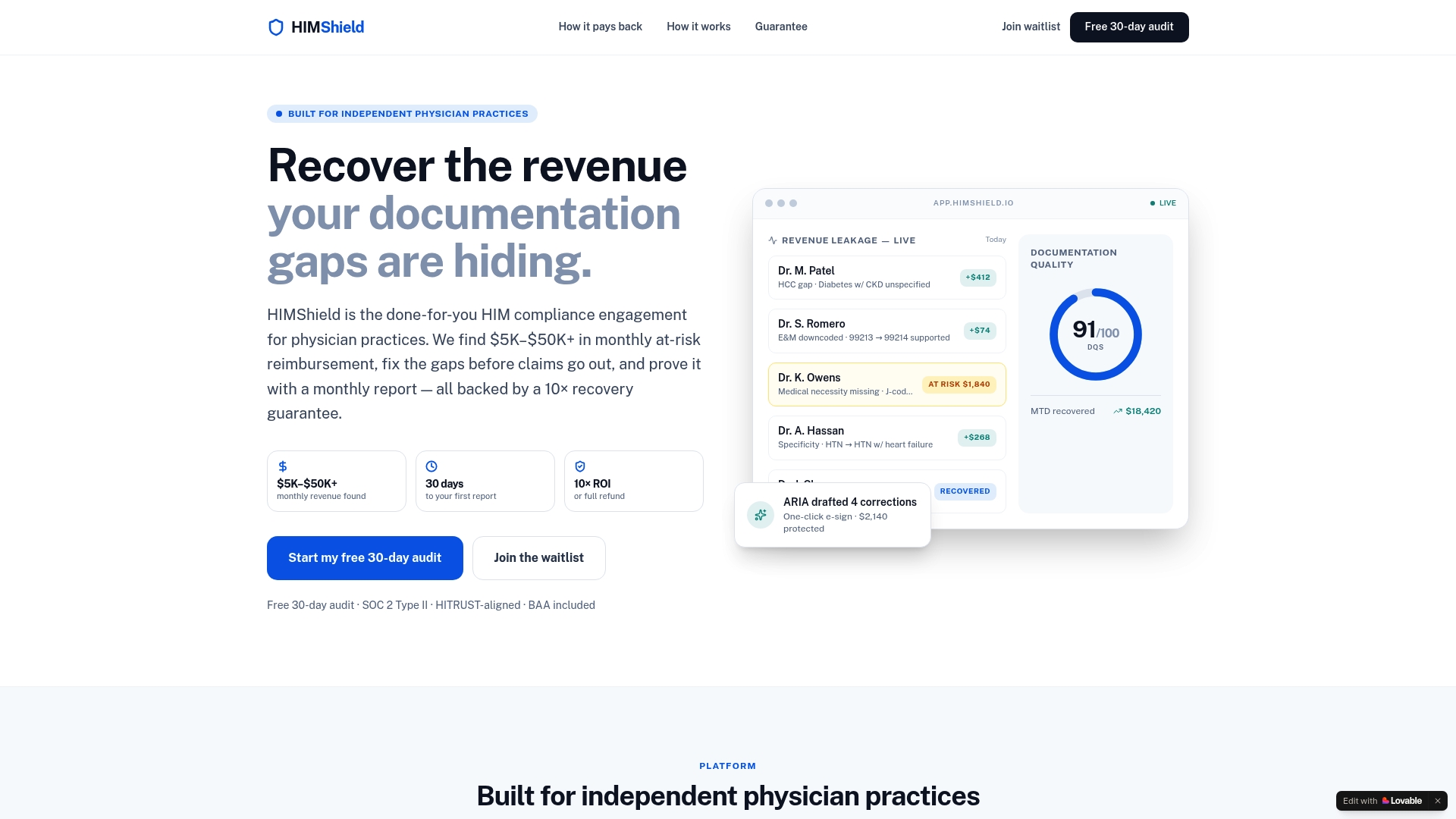
HIMShield is an AI-powered platform for independent physician practices. It scans EHR data before claims are submitted and quantifies coding, documentation and charge-capture gaps. It issues per-provider, per-payer Revenue Leakage Reports, sends automated compliance alerts and scores documentation quality in real time. For corrections, it drafts the change and routes it to the physician for a one-click e-signature, so the physician stays the author of the record. If a payer audits you, the platform assembles a submission-ready response.
That sequence maps to the guidance above. The report supplies the case examples for coaching. The scoring supplies the outcome tracking. The physician's signature keeps judgment attributable.
We started from a simple observation: independent practices do not have a spare coding team to chase notes after the fact. Our view is that guidance belongs before the claim, where a short correction costs a physician seconds and protects revenue that was already earned.
We built HIMShield to work without new staff or software training for your team, and to put a dollar figure on the gaps per provider and per payer. A number is what lets a practice owner decide where coaching should start.
Our promise is a done-for-you compliance layer backed by a performance guarantee, and a free 30-day audit so you see your own results first.
Elena
See your own gaps first
Our free 30-day Revenue Leakage Audit reads your EHR data and delivers a quantified report by provider and payer, so you can see which notes need prompts and which physicians need coaching. A performance guarantee comes with it, and a paid subscription, scaled to provider count and chart volume, follows only after the audit and report. Start with the free 30-day Revenue Leakage Audit, or see the full HIM compliance engagement.
FAQ
What is point-of-care coding guidance?
It is guidance delivered while the physician is documenting, pointing out what the record needs to support the services billed. Good guidance asks about the physician's reasoning, such as problems addressed, data reviewed and risk. It never names a diagnosis or code to choose.
Can a prompt tell a physician which diagnosis to document?
No. AHIMA's compliant query guidance says queries must include relevant clinical indicators and must not direct a provider to a specific diagnosis or procedure. They also must not indicate reimbursement impact. A compliant prompt cites the chart facts and asks the physician to clarify.
Does the history and exam still matter for E/M levels?
They are still documented as medically appropriate, but under the 2021 revisions they no longer determine the level for most office visits. The level comes from MDM or total time, which is why the assessment and plan deserve the most attention.
How do we know our documentation prompts are working?
Audit a sample of charts before and after, by provider. Use the CMS self-audit steps: a policy, an audit tool, selected charts, the review and action on results. Look for clearer assessments and plans, fewer queries and fewer denials tied to documentation.
Sources
- AHIMA, Best Practices in the Art and Science of Clinical Documentation Improvement (2018 Update)
- AAFP, Physician Documentation: Techniques and Guidelines
- CMS, Evaluation & Management Services compliance tips
- AAFP, E/M Coding: Guidelines and FAQs
- FCSO, Medical Decision Making and the Impact of Prescription Drug Management
- MGMA, 2021 E/M MDM Tool
- SGO, Coding Corner: 2024 Update to Split/Shared E/M Visits
- Drug test CPT codes billing guide
- AHIMA, Guidelines for Achieving a Compliant Query Practice
- Liu et al., Prompt Engineering in Clinical Practice: Tutorial (PMC, 2025)
- Doo et al., Realizing the value of the divergence event in clinical AI (PMC, 2026)
- CMS, Your Medical Documentation Matters