
A documentation improvement plan is a structured program that raises the accuracy, specificity, and completeness of clinical notes so care, coding, and reimbursement all reflect the actual work performed. The fastest path to results starts today, not next quarter.
Run this three-step starter checklist this week:
- Pull a baseline sample. Review 20 to 30 recent charts across your top three payers.
- Assign one owner. A single accountable lead, physician champion, or CDI specialist, prevents the plan from stalling.
- Deliver one quick-win training. A 15-minute huddle on your most common specificity gap builds momentum fast.
Pro Tip: Before building anything else, run a free 30-day chart audit. It tells you which diagnoses and payers are leaking the most revenue, so your plan targets real problems instead of guesses.
Key Takeaways
A documentation improvement plan succeeds when baseline audit data, clear governance, physician-embedded workflows, and consistent KPI tracking operate as one connected system rather than separate initiatives.
| Point | Details |
|---|---|
| Start with a baseline audit | Sample 20 to 30 charts per provider before designing any workflow changes. |
| Assign clear ownership | A CDI lead and physician champion prevent the plan from stalling after launch. |
| Track five core KPIs | Monitor completeness, specificity, HCC capture, query turnaround, and denial rate. |
| Follow a 90-day phased rollout | Assess, pilot, then scale, with milestones owned by named roles. |
| Consider a purpose-built tool | HIMShield surfaces coding and charge-capture gaps before claims submission, supporting faster query resolution. |
Table of Contents
- What Is Clinical Documentation Improvement, and Why Does It Matter?
- Who Owns the Plan, and How Should Governance Work?
- What Core Components Belong in Every Documentation Improvement Plan?
- How Do You Roll Out a Documentation Improvement Plan in 90 Days?
- Which Tools and Technologies Actually Support CDI?
- How Do You Measure and Sustain Documentation Gains?
- What Pitfalls Sink Documentation Improvement Programs?
- How Does CDI Fit Into Broader Quality and Risk Management?
- What Do Real Documentation Improvement Rollouts Look Like?
- How Do You Get Clinicians to Actually Adopt These Changes?
- What Actually Separates a Real Program From a Binder Full of Policies
- Recover Revenue With a Documentation Improvement Plan Built for Independent Practices
- Frequently Asked Questions
- Sources
What Is Clinical Documentation Improvement, and Why Does It Matter?
Clinical documentation improvement, or CDI, is the discipline of making sure a patient's chart accurately captures diagnosis severity, treatment complexity, and medical necessity at the moment care happens. A documentation improvement plan is simply the operational vehicle that turns CDI principles into daily habits, staffed roles, and measurable checkpoints.
For independent practices, three value streams justify the effort:
- Clinical quality and safety. Accurate problem lists and severity coding support better care transitions and reduce ambiguity for the next clinician who opens the chart.
- Coding and reimbursement integrity. Diagnosis specificity drives correct code assignment, and CMS's ICD-10 resources set the standard for what "specific enough" actually means.
- Compliance and audit readiness. Well-documented medical necessity is the practice's best defense when a payer requests records.
The stakes are real. ACDIS reports that in a survey of 193 CDI professionals, a significant portion of outpatient providers had no formal outpatient CDI program at all, leaving risk-adjusted revenue and audit exposure largely unmanaged. That gap is exactly what a baseline audit is designed to close, and it's the right place to start before you build anything else.
Who Owns the Plan, and How Should Governance Work?
A documentation improvement plan fails without clear ownership. Six roles typically anchor a lean program:
- CDI lead or specialist who runs day-to-day chart review and query workflows.
- Physician champion who translates clinical realities to peers and defends the program's credibility.
- Coding team that flags specificity gaps and DRG or HCC mismatches.
- Quality and risk staff who tie documentation to patient safety metrics.
- IT/EHR administrator who builds templates and point-of-care prompts.
- Practice manager or finance lead who tracks ROI and resource needs.
A lightweight governance model works best for independent practices: a steering group meets monthly, an operational subgroup meets biweekly, and any clinician disagreement escalates to the physician champion first, not administration.
Pro Tip: Clinicians buy in faster when queries are framed as clarification requests, not corrections. Show them the reimbursement or quality stakes behind one specific diagnosis, and resistance tends to drop within a few weeks.
What Core Components Belong in Every Documentation Improvement Plan?
Skipping any of these five elements is the most common reason programs stall after a strong launch.
Baseline audit methodology. Review 20 to 30 charts per provider across your highest-volume diagnosis codes, following chart-review steps outlined in the ACDIS/NCHA white paper, one of the more practical audit frameworks available for outpatient settings.
Defined goals and KPIs, including:
- Documentation completeness rate
- Diagnosis specificity score
- HCC capture rate for risk-adjusted populations
- Query turnaround time
Standardized workflows covering the query process, pre-visit chart prep, point-of-care prompts, and consistent template or macro standards so notes don't vary wildly by provider.
Training and education plan, differentiated by role: clinicians need workflow-embedded prompts, coders need specificity refreshers, and CDI specialists need query-writing technique.
Chart review cadence. Monthly spot audits during rollout, moving to quarterly once metrics stabilize. AHIMA's CDI education resources offer structured curricula for building this cadence without overloading staff.
Track completeness rate, specificity score, and HCC capture from day one. These three numbers tell you whether the plan is working before revenue impact even shows up.
How Do You Roll Out a Documentation Improvement Plan in 90 Days?
A 90-day rollout gives you enough runway to pilot changes without losing organizational patience. Break it into three phases.
- Weeks 0 to 2, assess. Run the baseline audit, identify your top three documentation gaps, and finalize governance roles.
- Weeks 3 to 6, plan and pilot. Build templates for the highest-impact diagnosis categories, train two or three physician volunteers, and launch a limited pilot.
- Weeks 7 to 12, scale and measure. Expand successful templates practice-wide, publish the first KPI dashboard, and adjust workflows based on pilot feedback.
| Milestone | Owner | Target week |
|---|---|---|
| Baseline audit complete | CDI lead | Week 2 |
| Pilot templates live | Physician champion + IT | Week 6 |
| Practice-wide rollout | Practice manager | Week 10 |
| First KPI report published | CDI lead | Week 12 |
Resource planning matters as much as the calendar. Budget for CDI lead time at roughly 4 to 6 hours weekly during rollout, physician training at one hour per provider, and either a licensed CDI tool or an internal analyst for chart review support. Practical guidance for launching office-based programs, including staffing ratios, is available through specialty society resources on CDI initiation.
Which Tools and Technologies Actually Support CDI?
Not every CDI tool earns its subscription fee. Before you buy, check for these capabilities:
- Pre-visit risk surfacing that flags likely HCC gaps before the patient walks in.
- Point-of-care prompts embedded in the EHR workflow, not a separate login.
- Longitudinal record review that catches inconsistencies across multiple visits.
- Audit trail exports for defending queries during payer review.
- Native EHR integration, since AMA research on EHR usability consistently finds that tools bolted onto clinician workflow get abandoned within months.
Selection should weigh ease of integration, whether the tool preserves an evidence trail for every query, and whether it tracks ROI in dollars, not just chart counts.
HIMShield fits directly into the 90-day plan above. It scans EHR data for coding, documentation, and charge-capture gaps before claims go out, generates per-provider Revenue Leakage Reports, and drafts corrections for one-click physician signature, which shortens the query turnaround KPI significantly compared to manual chart-by-chart review.

Run any tool pilot for 30 days and track two numbers: time saved per chart review and dollar value of gaps identified.
How Do You Measure and Sustain Documentation Gains?
Five KPIs cover most of what matters: documentation completeness, specificity rate, HCC capture rate, query rate and turnaround time, and denial rate tied to documentation gaps.
Reporting cadence should match audience:
- Weekly for the operational CDI team, tracking query volume and turnaround.
- Monthly for the governance steering group, reviewing trend lines across all five KPIs.
- Quarterly for practice leadership, focused on dollar impact and denial rate movement.
A simple dashboard works better than a complex one. Track completeness rate, specificity score, HCC capture, and denial rate on one page, with a trend line for each. That single view is usually enough to show leadership whether the investment in training hours and tool licensing is paying off.
Given that nearly two-thirds of outpatient providers still lack formal outpatient CDI programs, even modest, consistent tracking puts a practice ahead of most peers in its market.
What Pitfalls Sink Documentation Improvement Programs?
Five failure patterns show up repeatedly: low clinician engagement, workflow friction, weak audit methodology, template overuse that produces copy-paste notes, and governance that exists on paper only.
Mitigation is specific to each:
- Pair every new workflow change with a physician champion's endorsement, not an administrative memo.
- Keep training sessions under 15 minutes; longer sessions lose clinicians.
- Build prompts directly into the EHR rather than a separate portal.
- Audit template usage quarterly to catch note bloat before it becomes habit.
Pro Tip: If a wound care or specialty template keeps triggering the same query, redesign the template itself instead of repeating the same correction request. One structural fix eliminates dozens of future queries; specialty-specific frameworks like the wound care documentation playbook from MyLTC Apps offer a good model for this kind of redesign.
How Does CDI Fit Into Broader Quality and Risk Management?
A documentation improvement plan should never operate as an island. Practices that treat CDI as a standalone coding exercise miss its biggest strategic value: documentation quality is the connective tissue between clinical quality reporting, patient safety programs, and financial risk management.
Consider how the pieces link. Quality reporting programs depend on accurate problem lists and HCC capture to reflect true patient acuity. Risk management depends on defensible documentation to withstand malpractice review or payer audit. Patient safety committees rely on complete records to trace care transitions accurately. When these three functions operate separately from CDI, the practice ends up duplicating chart review work three different ways.
The fix is structural, not procedural. Bring your CDI steering group, quality committee, and risk management function into the same reporting cycle. Share the same dashboard. Joint Commission guidance on program governance reinforces that staff training and clear policy integration are what separate durable safety programs from ones that exist only in a binder.
For independent practices without dedicated risk management staff, the practice manager typically absorbs this integration role. That's manageable if the CDI dashboard already tracks the metrics risk and quality teams need, rather than building a second reporting structure from scratch.
What Do Real Documentation Improvement Rollouts Look Like?
Independent practices that formalize outpatient CDI tend to follow a recognizable arc: a rocky first month, a turning point around week six, and measurable gains by month three.
The rocky start is normal. Physicians push back on query volume, and coders flag inconsistent chart quality across providers. Practices that push through this phase usually do so because a physician champion, not an administrator, keeps reinforcing why the queries matter clinically, not just financially.
The turning point tends to arrive once templates get redesigned around real chart patterns instead of generic macros. One documented pattern across outpatient CDI programs leveraging technology shows that HCC capture rates improve fastest once point-of-care prompts replace after-the-fact query lists, because clinicians correct gaps while the encounter is still fresh.
By month three, most practices see the query rate drop even as specificity scores rise, a sign the workflow changes are sticking rather than just adding review overhead. That's the signal governance teams should watch for before declaring a pilot successful and scaling it practice-wide.
How Do You Get Clinicians to Actually Adopt These Changes?
Technical design solves half the problem. Adoption solves the other half, and it's usually the half that gets underfunded.
Three change management practices separate programs that stick from ones that fade after the pilot ends. First, involve physicians in template design from the start rather than presenting finished workflows for approval. Clinicians who help build a prompt are far more likely to use it. Second, communicate wins early and often. Sharing a specific example, like a diagnosis category where specificity improved and reimbursement followed, does more to build trust than a generic completeness percentage.
Third, protect clinician time deliberately. Solventum's research on physician champions found that governance and change management, not the technology itself, typically determine whether AI-assisted CDI tools achieve lasting adoption. A tool that saves five minutes per chart still fails if clinicians never trust the prompts enough to act on them.
Sustained adoption also requires a feedback loop. When a clinician overrides a prompt repeatedly, that pattern should trigger a template review, not a compliance reminder. Programs that treat repeated overrides as design signals, rather than clinician failures, tend to keep physician trust intact through the scaling phase.
What Actually Separates a Real Program From a Binder Full of Policies
Most documentation improvement advice treats CDI as a checklist problem: buy a template library, schedule some training, review a few charts, done. That framing misses what the outpatient data actually shows. With nearly two-thirds of outpatient providers still lacking a formal program, the gap isn't awareness. It's follow-through past the first 60 days.
The conventional advice oversells technology and undersells governance. A tool can surface every specificity gap in a chart, but if there's no physician champion translating why it matters, clinicians route around the prompts within weeks. The practices that sustain gains treat governance as the product, not the paperwork around the product.
If you prioritize one thing from this playbook, prioritize the baseline audit and the KPI dashboard together, before you touch templates or tools. Everything else, including which software you pick, should be judged against whether it moves those specific numbers. That's a more honest test than any feature list.
Recover Revenue With a Documentation Improvement Plan Built for Independent Practices
Building the governance, training, and KPI tracking described above takes real time, and most independent practices don't have a spare CDI analyst on staff to run it manually. HIMShield gives you the audit and detection layer without adding headcount: it scans your EHR data for coding, documentation, and charge-capture gaps before claims go out, then generates per-provider, per-payer Revenue Leakage Reports your team can act on immediately.
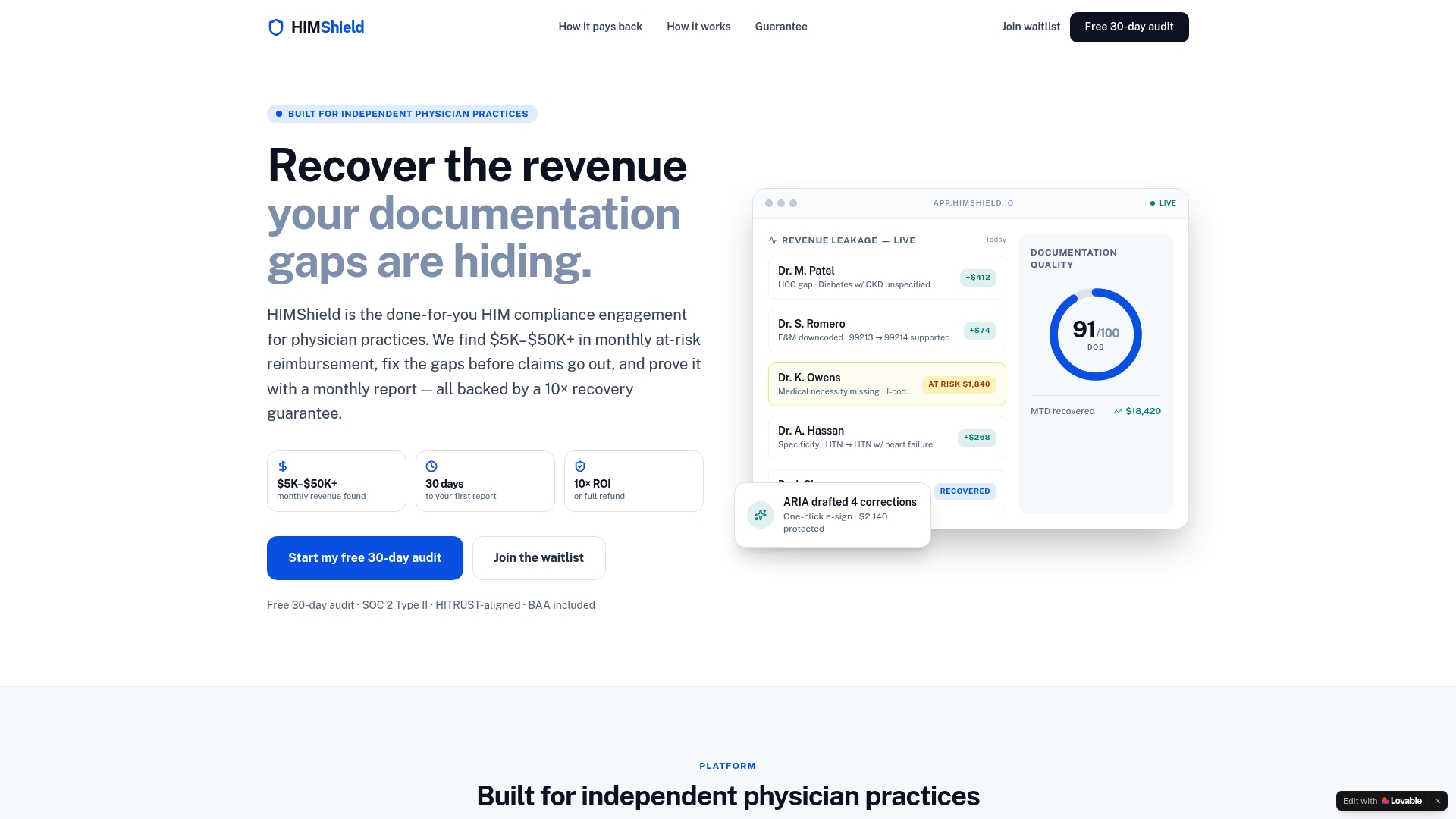
Corrections come pre-drafted for one-click physician e-signature, so the query turnaround KPI in your dashboard actually moves instead of stalling in a shared inbox. Practices start with a free 30-day audit that surfaces top documentation gaps before any subscription commitment, which matches exactly the baseline-audit-first approach this plan recommends. If you're ready to see what your own charts reveal, start with HIMShield's revenue audit and get your first Revenue Leakage Report before your next billing cycle closes.
Frequently Asked Questions
How long does a documentation improvement plan take to show results? Most practices see measurable KPI movement within 90 days, with query turnaround and specificity scores improving fastest since they respond directly to workflow changes made during the pilot phase.
Who should lead a documentation improvement plan in a small practice? A single accountable owner, often a CDI specialist or a physician champion, should lead day-to-day execution, with a practice manager overseeing budget and a steering committee meeting monthly for governance decisions.
What's the difference between a coding audit and a documentation improvement plan? A coding audit is a point-in-time review that identifies specific errors, while a documentation improvement plan is an ongoing program built around that audit's findings, including training, workflow redesign, and continuous KPI tracking.
Do outpatient practices really need CDI, or is it just for hospitals? Outpatient CDI has become essential for risk-adjusted contracts, and industry data shows most outpatient providers still operate without a formal program, leaving both revenue and audit exposure unmanaged.
What does a documentation improvement plan typically cost to run? Costs scale with practice size and mostly involve staff time, roughly 4 to 6 weekly hours for a CDI lead during rollout, plus any licensing fees for a chart review or automation tool.
This article is general information, not a substitute for advice from a qualified financial advisor. Consult a qualified financial professional about your own circumstances before acting on anything here.

Sources
For audit methodology and KPI design, review the ACDIS/NCHA chart-review white paper and AHIMA's CDI education resources. For coding and regulatory guidance, CMS's ICD-10 resources remain the definitive reference. Practical templates and training approaches are covered in why documentation education matters for physicians and how documentation affects reimbursement.