
A revenue code is a mandatory four-digit numeric identifier used on institutional medical claims to specify the hospital department or service category responsible for each charge. Standardized by the National Uniform Billing Committee (NUBC), these codes appear on UB-04 and 837I claim forms and tell payers the "where" of care. They do not appear on professional claims like the CMS-1500 or 837P. For billing specialists and healthcare administrators managing institutional claims, understanding revenue codes is the foundation of accurate reimbursement and denial prevention.
What is a revenue code and how does it work?
A revenue code is a four-digit numeric code required on institutional claims that identifies the specific hospital department or service area generating a charge. The NUBC maintains the master list of valid codes, and payers use them to route each line item through the correct reimbursement logic. Without a valid revenue code, a payer cannot process the claim line.
The code functions as a cost-center label. It tells the payer whether a charge originated in the emergency department, the pharmacy, a medical-surgical room, or the laboratory. That classification directly affects how the payer prices and adjudicates the service. Revenue codes drive payer reimbursement logic and fee schedules, meaning an incorrect code can trigger underpayment or an outright denial.

Revenue codes also carry compliance weight. CMS billing rules require proper entry and formatting of revenue codes in Form Locator 42 (FL 42) on the UB-04. FL 42 is where accommodation and ancillary charges are identified, and errors at that field level cause claim-level rejections, not just line-level ones.
How are revenue codes structured and what types exist?
Revenue codes follow a hierarchical structure where the first three digits define a broad service category and the fourth digit designates a subcategory. This design lets facilities report both the general service area and a specific type of service within it. For example, code 0300 represents general laboratory services, while 0301 identifies chemistry specifically.
The table below summarizes the most common revenue code categories and examples you will encounter on institutional claims.
| Category | Code Range | Example | What it covers |
|---|---|---|---|
| Room and Board, Medical/Surgical | 010x–021x | 0120 | Semi-private room charges |
| Pharmacy | 025x | 0250 | General pharmacy dispensing |
| Laboratory | 030x–031x | 0301 | Chemistry, pathology services |
| Emergency Services | 045x | 0450 | General emergency department |
| Physical Therapy | 042x | 0420 | General physical therapy |
| Radiology | 032x | 0320 | Diagnostic imaging |
Different facility types use different subsets of these codes. A critical access hospital bills differently than a large academic medical center, and payers may only accept specific codes for each facility type. Individual payers maintain their own active revenue code lists and mandate particular coding requirements beyond the NUBC standard. No single universal list applies across all payers.
Pro Tip: Review your payer contracts annually and compare their accepted revenue code lists against your Charge Description Master (CDM). Payer-specific lists change, and a code that was valid last year may now trigger a denial.

What is the relationship between revenue codes and CPT/HCPCS codes in claims?
Revenue codes and CPT/HCPCS codes serve different but complementary roles on institutional claims. Revenue codes identify where care occurred. CPT and HCPCS codes identify what service was provided. Payers validate this pairing to approve claims, and mismatches between the two are a leading cause of rejections.
The pairing matters because payers set reimbursement methodologies like Ambulatory Payment Classifications (APCs) or Diagnosis-Related Groups (DRGs) based on the combined signal from both code types. A revenue code of 0450 (emergency services) paired with a CPT code for a low-complexity office visit creates a conflict. The payer's edit system flags it, and the claim fails. Misalignment misclassifies services, leading to denied or reduced payments.
Key points for managing this pairing correctly:
- Revenue codes appear in FL 42 on the UB-04; CPT/HCPCS codes appear in FL 44 on the same form.
- Payer edit systems cross-reference both fields before adjudicating any line item.
- A mismatch at the line level can cause the entire claim to reject, not just the affected line.
- CDM governance must link each charge code to both a revenue code and a valid CPT/HCPCS code.
- Denial analytics should track rejections by revenue code to identify systemic pairing errors.
CDM governance is the structural fix here. Revenue codes are primary drivers for payer adjudication and should be managed as critical data elements within a CDM program, not as secondary labels attached after the fact. Each charge in your CDM needs a validated revenue code and procedure code pairing before it ever reaches a claim.
Pro Tip: Run a quarterly report that cross-references your CDM revenue codes against your top denial reasons. If a single revenue code appears repeatedly in denials, the pairing logic for that cost center needs review. Tracking claim denial patterns by revenue code is one of the fastest ways to find systemic billing errors.
How do revenue codes differ from place-of-service codes?
Revenue codes and place-of-service (POS) codes both describe location, but they operate on entirely different claim forms and serve different purposes. Revenue codes belong on institutional claims (UB-04/837I) and identify internal hospital cost centers. POS codes belong on professional claims (CMS-1500/837P) and indicate the broad setting where a physician provided a service.
Confusing these two code types is a frequent mistake, and the consequences are direct. Payers do not recognize POS codes in institutional claim fields. Submitting a POS code where a revenue code is required causes an immediate rejection. The reverse is equally problematic: a revenue code submitted on a professional claim form is invalid and will reject.
Common errors billing teams make when mixing these code types:
- Entering a POS code (e.g., "22" for outpatient hospital) in the revenue code field of a UB-04.
- Applying revenue code logic to CMS-1500 claims for hospital-employed physicians billing professionally.
- Assuming the same code set governs both facility and professional billing for the same encounter.
- Failing to train staff on which form type each code set applies to.
The practical rule is straightforward. If the claim is institutional, use revenue codes. If the claim is professional, use POS codes. The revenue code definition is tied to the institutional billing context, and applying it outside that context creates rejections that are entirely avoidable.
What are best practices for managing revenue codes to reduce denials?
Effective revenue code management is a discipline, not a one-time setup task. Billing accuracy depends on maintaining clean, current, and validated code assignments across every cost center in your facility. The following practices reflect what high-performing billing teams do consistently.
-
Maintain rigorous CDM governance. Assign a CDM coordinator or team responsible for reviewing revenue code assignments at least quarterly. Every new service line or charge code added to the CDM must include a validated revenue code before it goes live.
-
Prevent revenue code drift. Using generic codes instead of specific departmental codes dilutes billing accuracy and hampers denial analytics. Code 0999 (other ancillary) is a red flag. If a charge cannot be mapped to a specific revenue code, the underlying service definition needs review.
-
Audit revenue and CPT/HCPCS pairings regularly. A pairing that was valid when your CDM was built may no longer match current payer edits. Schedule a formal pairing audit at least twice per year and after any major payer contract renewal.
-
Track payer-specific code requirements. No single revenue code list applies to all payers. Build a payer matrix that documents which revenue codes each major payer accepts, and flag discrepancies before claims go out. An annual coding review is the right time to reconcile this matrix against current payer bulletins.
-
Use denial analytics to close the loop. Every denial tied to a revenue code error is a data point. Aggregate those data points by code, by payer, and by cost center. Patterns in denial data reveal where CDM governance has broken down.
-
Train billing staff on the distinction between code types. Revenue codes, POS codes, and CPT/HCPCS codes each have a defined role. Staff who understand revenue integrity fundamentals make fewer submission errors and catch problems before claims leave the facility.
Pro Tip: Build a "revenue code watchlist" of the 10 codes most frequently associated with your denials. Review that list monthly and treat any new entry as an immediate CDM investigation trigger.
Key Takeaways
Revenue codes are four-digit NUBC-standardized identifiers that determine payer reimbursement logic on institutional claims, and errors in their assignment directly cause denials, underpayments, and revenue loss.
| Point | Details |
|---|---|
| Revenue code definition | A four-digit NUBC code on UB-04/837I claims that identifies the hospital department or service category for each charge. |
| Hierarchical structure | The first three digits set the broad category; the fourth digit specifies the subcategory within that service area. |
| Mandatory pairing with CPT/HCPCS | Payers validate revenue codes against CPT/HCPCS codes; mismatches are a leading cause of institutional claim rejections. |
| Revenue codes vs. POS codes | Revenue codes belong on institutional claims only; POS codes belong on professional claims; mixing them causes immediate rejections. |
| CDM governance prevents drift | Regular CDM audits and payer-specific code list reviews are the primary defense against revenue code errors and denials. |
Revenue codes are more consequential than most billing teams realize
I have reviewed billing workflows across a range of institutional settings, and the same pattern appears repeatedly. Revenue codes get assigned once during a CDM build, and then nobody touches them for years. The assumption is that a four-digit code is a minor administrative detail. That assumption is wrong, and it costs practices real money.
The most damaging version of this problem is what the industry calls revenue code drift. A billing team under pressure to get claims out the door starts defaulting to generic codes because they are faster to apply. Over time, the CDM fills with 0999 entries and other catch-all codes that obscure what actually happened clinically. Payer edit systems flag these codes more aggressively, denial rates climb, and the root cause is invisible in the data because the codes are too vague to analyze.
The fix is not complicated, but it requires discipline. Treat revenue codes as critical data elements in your CDM program, not as labels. Assign ownership. Set a review cadence. Map every charge to the most specific code available. The practices that do this consistently see fewer denials and cleaner denial analytics when problems do occur.
Payer requirements also shift more often than most billing teams expect. A revenue code that your largest payer accepted without issue in 2024 may now require an accompanying HCPCS modifier or may have been removed from their active list entirely. Staying current requires a process, not just awareness. The billing teams that build that process into their workflow protect revenue that others leave uncollected.
— Elena
Himshield helps you protect every earned dollar
Revenue code errors are one of the most preventable sources of claim denials, but catching them requires visibility into your coding patterns before claims go out.
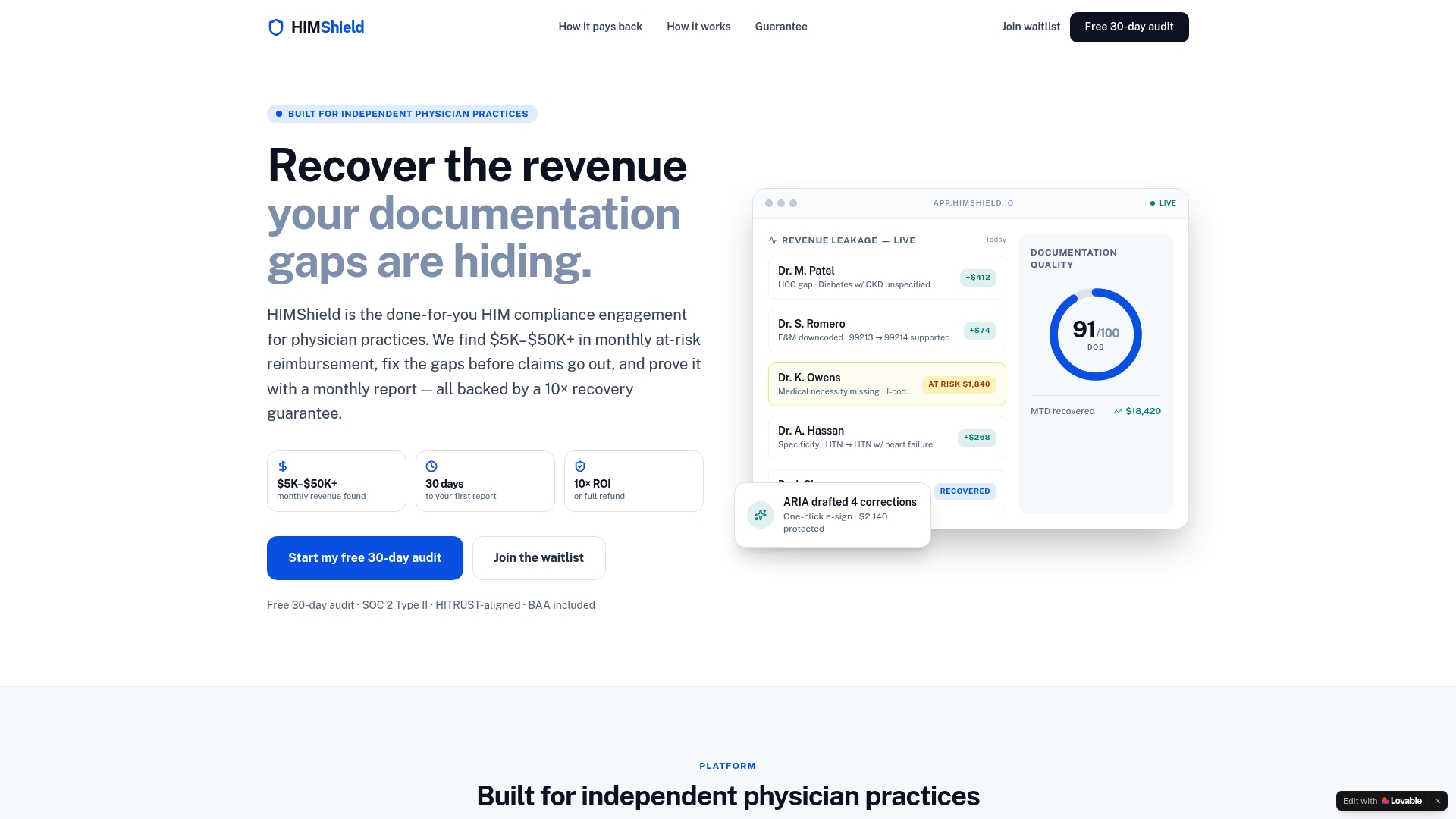
Himshield scans your coding, documentation, and charge-capture data to identify risks before they become denials or audits. The platform connects directly to your EHR and delivers clear, physician-friendly guidance on where revenue is at risk. Independent practices using Himshield recover $5K–$50K+ in hidden revenue by fixing the coding gaps that standard billing workflows miss. If your CDM governance or revenue code pairing accuracy needs attention, see how Himshield works and find out what your practice may be leaving on the table.
FAQ
What is a revenue code in medical billing?
A revenue code is a four-digit numeric code required on institutional claims (UB-04/837I) that identifies the hospital department or service category responsible for a charge. The NUBC standardizes these codes, and payers use them to determine reimbursement logic for each claim line.
Are revenue codes the same as CPT codes?
Revenue codes and CPT codes are not the same. Revenue codes identify where care occurred within a facility; CPT codes identify what service was performed. Payers require both on institutional claims and validate the pairing before approving payment.
What is the difference between a revenue code and a place-of-service code?
Revenue codes appear on institutional claims (UB-04) and identify internal hospital cost centers. Place-of-service codes appear on professional claims (CMS-1500) and indicate the broad setting where a physician provided care. Using one in place of the other causes an immediate claim rejection.
Where do revenue codes appear on a UB-04 claim?
Revenue codes appear in Form Locator 42 (FL 42) on the UB-04 institutional claim form. Proper entry and formatting in FL 42 is required for claim acceptance under CMS billing rules.
What causes revenue code denials?
The most common causes are mismatched revenue and CPT/HCPCS code pairings, use of generic codes instead of specific departmental codes, and failure to comply with payer-specific active code lists. Regular CDM audits and denial pattern analysis are the most effective ways to prevent these errors.