
You find coding gaps by comparing what the chart shows (problem list, medications, labs, specialist notes) with the diagnoses and charges that reached the claim, then validating every mismatch against the full record before anyone changes a code. Done by hand, that is slow work for a small practice. Our free 30-day Revenue Leakage Audit runs the comparison across your EHR data and quantifies the gaps per provider and per payer, so your team starts from a ranked list instead of a stack of charts.
TL;DR
- A coding gap is a condition or service the record supports, or suggests, that never made it onto the claim, or made it without documentation strong enough to hold up.
- Start with the problem list, medication list and labs over the previous 12 to 18 months, then read visit notes and specialist consults.
- Validate every suspected gap against the record and CMS audit criteria before coding it. A gap is a question for the physician, never an instruction to add a code.
- Close gaps before the end-of-year submission, with short physician queries and a routine you repeat each year.
- Track closure rate, documentation quality and audit exposure by provider and payer, so you see where revenue leaks.
Table of Contents
- What a coding gap is, and what it is not
- Step 1: Pull the right data
- Step 2: Flag suspected gaps by type
- Step 3: Validate each gap against the record
- Step 4: Close the gap with a repeatable workflow
- Step 5: Track whether gaps are really closing
- Know the model your codes are scored against
- Our perspective
- See your own gaps in 30 days
- FAQ
- Sources
What a coding gap is, and what it is not
A coding gap is a mismatch between the clinical picture in a patient's record and what was reported. It comes in three common forms:
- A missing diagnosis. A patient on insulin and with chronic kidney disease labs has no matching chronic condition coded this year.
- A diagnosis without support. The code is on the claim, but the note does not show the condition was evaluated, monitored, assessed or treated.
- An uncaptured charge. A service was performed but never billed, or was billed at a level the note does not reach.
The distinction matters because the fix differs. A missing diagnosis needs a clinician to assess the patient and document the condition at a face-to-face visit. An unsupported diagnosis needs a documentation correction or a coding correction. An uncaptured charge needs a charge-capture fix. Treating all three as "add more codes" is how practices create audit exposure instead of recovering revenue.
In Medicare Advantage risk adjustment, gaps matter because AHIMA's guidance says ICD-10-CM coding for HCC reporting aims to report all conditions affecting the patient's health status across the continuum of care. An HCC (hierarchical condition category) is a group of related diagnoses that CMS uses to predict a patient's expected cost of care. When a chronic condition is not reported accurately, the patient looks healthier on paper than in the exam room.
Step 1: Pull the right data
You cannot spot a gap from the claim alone. You need a second source to compare it against. AHIMA lists three useful comparison sources for aberrant coding patterns:
- Disease registries, for example for atrial fibrillation, heart failure, chronic kidney disease, COPD, depression or morbid obesity.
- CMS Chronic Conditions Prevalence data, which shows how common a condition is, so you can see whether your coded rate looks unusually low or high.
- Claims data analyzed with clinical data. AHIMA's example is methotrexate prescriptions plus positive rheumatoid factor labs, compared against the diagnosis codes reported.
The third source is the one most practices can act on this week. Medication and lab results sit in your EHR as structured data. If a patient has the drug and the lab but not the diagnosis, you have a lead.
For a chart-level review, AAPC recommends looking at 12 to 18 months of history across primary care and specialist visits. Begin with the problem and medication lists, then diagnostic tests and lab results, then specific visit notes. Consultation notes often reveal newly diagnosed conditions that never reached your own problem list.
Where manual review breaks down
Two things slow a small practice. First, the data lives in several places: the problem list, the scanned specialist letter, the lab interface. Second, a coder reading one chart at a time cannot see patterns, such as one provider who under-documents a particular condition for one payer. The HIMShield platform scans EHR data before claims submission and produces per-provider, per-payer Revenue Leakage Reports, which is where those patterns show up.
Step 2: Flag suspected gaps by type
Sort what you find so each flag goes to the right person. A simple working set:
| Flag | What you see | Who acts |
|---|---|---|
| Missing chronic condition | Medication or lab evidence, no matching diagnosis this year | Physician assesses at next visit |
| Documentation weak | Diagnosis on claim, note lacks status or plan | Physician addendum or query |
| Specificity gap | Unspecified code where the note describes more detail | Coder, with physician confirmation if unclear |
| Charge capture | Service in the note, no charge on the claim | Billing staff |
| Possible over-coding | Code with no clinical support | Coder and compliance lead |
Note the last row. AHIMA's guidance frames the review as finding both under-coding and over-coding. A gap review that only hunts for added revenue is a review you cannot defend. One that also catches unsupported codes protects you.
If your charts include lab-driven services, check that each code matches the test actually performed. A reference on drug test CPT codes shows the code ranges for presumptive and definitive testing, a common place for mismatches between the lab order and the billed code.

Step 3: Validate each gap against the record
A flag is not a finding. Before a gap becomes a code, test it against the same criteria an auditor would use. The CMS RADV checklist (RADV is the Risk Adjustment Data Validation audit CMS uses to verify Medicare Advantage diagnoses) asks whether:
- the record is for the correct enrollee and the correct calendar year;
- there is a date of service for a face-to-face visit;
- the provider type is valid, with credentials and a signature;
- the diagnosis in the record supports the requested HCC.
The checklist also shows how gaps go wrong in practice. A "history of cancer" notation without current treatment may not validate the cancer HCC. Complication HCCs, such as diabetes with renal manifestations, need language from an acceptable specialist linking the complication to the disease. A lab value in a chart does not substitute for a clinician's documented assessment.
If you want a fuller picture of how those audits unfold, our guide to the RADV audit process for physician practices walks through it.
A worked example
Suppose a 72-year-old patient has an active methotrexate prescription and a positive rheumatoid factor result, but no rheumatoid arthritis diagnosis in the current year's claims. That is a suspected gap. Before anything is coded:
- Check that the patient was seen face to face this calendar year by an acceptable provider type.
- Read the notes. Did the physician evaluate the joint condition, or only refill the medication?
- If the condition is not assessed in the note, send the physician a short query. Do not add the code on the strength of the lab and drug alone.
- If the physician confirms and documents the condition with status and plan, code it. If a visit is still needed, schedule it.
The outcome is a supported diagnosis tied to a real encounter, which is the only kind that survives review.
Step 4: Close the gap with a repeatable workflow
Finding gaps once helps. Building a routine is what protects revenue year after year. AAPC's pre-visit review model targets suspected HCC conditions, diagnoses that may not have been accurately captured, conflicting or incomplete notes, missing status updates and coding errors. Findings go to the clinician through concise queries or electronic messaging, and the physician addresses the conditions and completes the note.
The HCC Institute's discussion guide adds practical habits for physician practices:
- Track the diagnosis codes on claims so each chronic condition a patient has is reported at least once per year.
- Run internal and external chart audits for coding accuracy.
- Schedule peer-to-peer review of complex cases.
- Assign staff to review charts regularly for coding opportunities.
Timing matters too. AHIMA advises identifying and addressing areas of concern before the end-of-year final submission. Waiting until December leaves no room to schedule the visit a gap may require.
If you are starting from nothing, our 90-day HCC documentation plan lays out a first-quarter audit sequence, and the four-step coding correction process covers how to correct what you find.
Make the query short
Physicians will answer a query they can read in ten seconds. State the finding ("Methotrexate on med list, positive RF 03/2026, no RA assessment in note"), then ask one question. Long templates get ignored, and ignored queries are gaps that stay open. This is the step where HIMShield takes work off your team: it drafts corrections and routes them for one-click physician e-signature, so the physician reviews and signs instead of writing.
Step 5: Track whether gaps are really closing
A gap list that nobody measures goes stale. Track these by provider and by payer:
- Gap closure rate. Gaps flagged versus gaps resolved with a supported diagnosis or a documented decision not to code.
- Documentation quality. The share of notes that include status, assessment and plan for each chronic condition. AAPC notes that routine audits of medical record documentation are vital to a clinical documentation improvement program.
- Query turnaround. Days between a query and the signed response.
- Compliance exposure. Codes with weak support, and denials tied to documentation.
- Charge-capture misses. Services documented but not billed, by provider.
Review these monthly. A provider whose closure rate lags usually has a workflow problem, such as queries landing at the wrong time of day, not a skills problem.
Know the model your codes are scored against
Gap lists age as the rules change. CMS moved Medicare Advantage to a newer HCC model, called V28, and some conditions no longer count. A V28 provider reference guide from 2025 lists conditions removed from the model, including angina pectoris, protein-calorie malnutrition and cachexia, supraventricular tachycardia, and certain major depressive disorder codes. Chasing a code that no longer carries risk weight wastes physician time, so rebuild your target list against the current model each year. Our annual coding review guide shows how to build that yearly checkpoint into your calendar.
Our perspective
Independent practices rarely lack the data to find gaps. The medication list, the labs and the specialist letter are already in your EHR. What you lack is hours. A coder reading charts one at a time finds a few leads a day, and by the time the list reaches a physician, the patient's visit has passed.
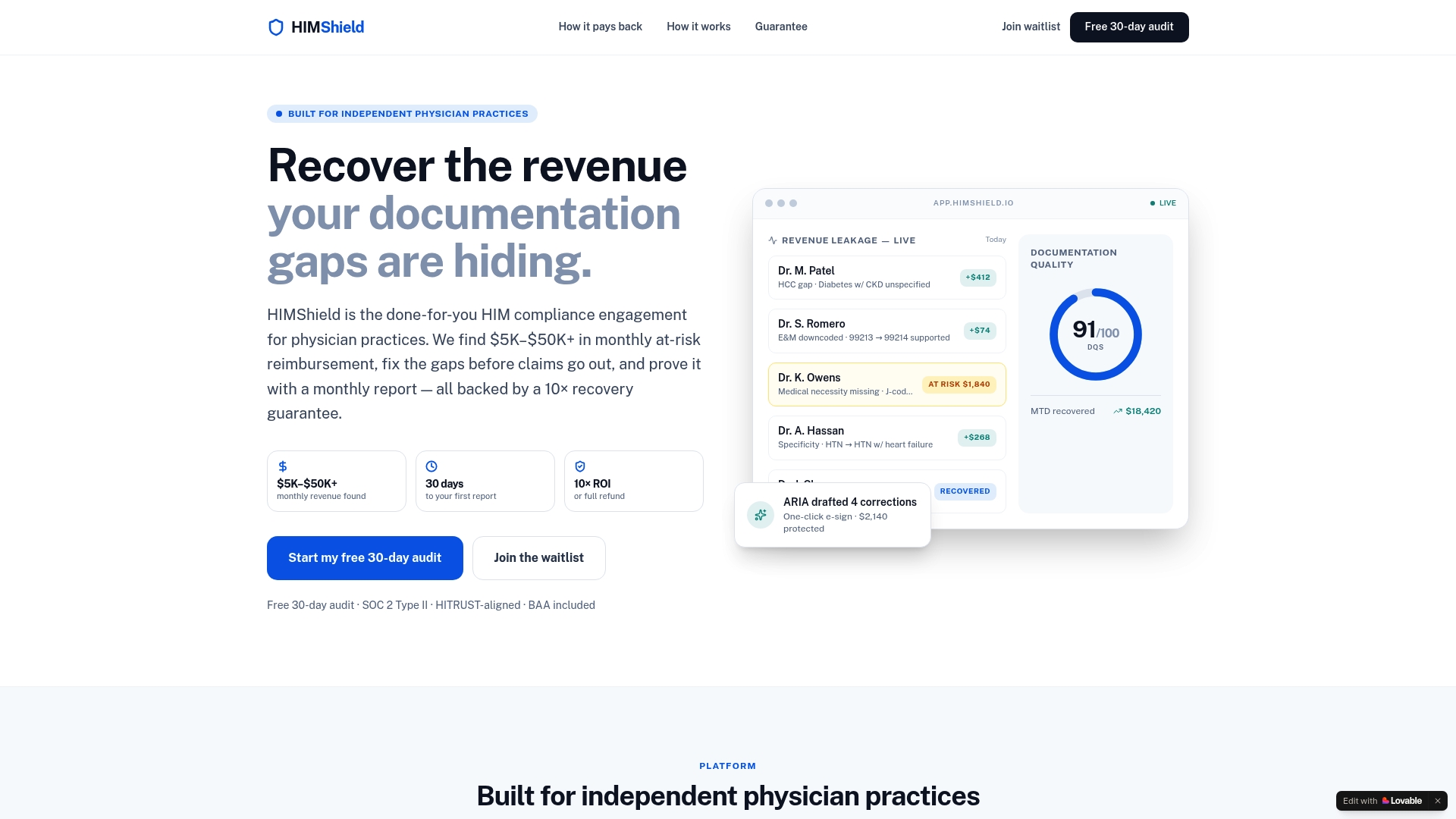
We built HIMShield around the idea that the comparison should run before the claim goes out. It scans EHR data, quantifies coding, documentation and charge-capture gaps, and gives you reports per provider and per payer, so you see which charts and which payers are leaking revenue. Corrections are drafted for you, and physicians sign with one click. It works without new staff or software training for your team.
The same discipline protects you in an audit. When every code traces back to a signed note, assembling a payer response is a matter of pulling what already exists, and our platform assembles submission-ready responses for you. That is why we pair finding gaps with documentation scoring and compliance alerts rather than treating them as separate jobs.
Elena
See your own gaps in 30 days
The fastest way to learn what your charts hold is to measure them. Our free 30-day Revenue Leakage Audit quantifies coding, documentation and charge-capture gaps in your EHR data and delivers the findings per provider and per payer. It comes with a performance guarantee, and a paid subscription follows only after you have seen the report. Subscription pricing scales with your provider count and chart volume.
If you would like to talk through your practice's setup first, start from himshield.com.
FAQ
How often should a practice look for coding gaps?
Run a full review at least once a year, and a lighter one monthly or quarterly. AHIMA advises addressing concerns before the end-of-year final submission, so the review should finish well before then. A monthly check on new patients and upcoming visits keeps the list short.
Can we code a diagnosis just because the labs and medications point to it?
No. A diagnosis needs a clinician's documented assessment from a face-to-face visit by an acceptable provider type. The CMS RADV checklist asks whether the diagnosis in the record supports the HCC. Use labs and medications to start a query, then let the physician evaluate and document.
What is the difference between a coding gap and a charge-capture gap?
A coding gap concerns diagnoses and specificity: the record supports something the claim does not report, or the reverse. A charge-capture gap is a documented service that was never billed. Both leak revenue, but they route to different people. Coders and physicians handle the first, and billing staff handle the second.
Do gaps matter if most of our patients are not on Medicare Advantage?
Yes. HCC gaps apply most directly to Medicare Advantage risk adjustment, but documentation and charge-capture gaps affect every payer through denials and audits. Per-payer reporting shows where your exposure sits. Our guide to finding upcoding audit risk covers the compliance side.
Sources
- AHIMA: Documentation and Coding Practices for Risk Adjustment and Hierarchical Condition Categories
- AAPC: The Power and Profitability of Pre-Visit Risk Adjustment Reviews
- AAPC: Risk Adjustment Documentation and Diagnosis Coding
- CMS: RADV checklist
- HCC Institute: Risk Adjustment and HCC Coding discussion guide
- Provider MRA V28 Comprehensive Reference Guide
- Drug test CPT codes billing guide