
Coding compliance alerts are automated notifications that flag coding, documentation, or billing problems before a claim goes out the door, pulling signals from authoritative guidance, encoder analytics, and monitoring platforms. Their job is simple: catch high-risk errors early, cut denial rates, and shrink audit exposure. Coders, compliance officers, revenue-cycle leaders, and providers all rely on them to keep billing defensible.
TL;DR:
- Rely on OIG and CMS guidance for core rules, then add specialty newsletters, payer bulletins, and clearinghouse feeds for service line and local changes.
- Prioritize place of service mismatches: a 2026 OIG audit found more than $15 million in improper hospital payments and $922,524 in physician payments.
- Have coders review alerts, compliance leads validate chart support, and physicians approve corrections; log outcomes, hold claims for material gaps, and fix clerical errors promptly.
- Check denial trends weekly, verify NCCI and encoder files quarterly, remove obsolete codes in late September, and pause high volume batches October 1 through 14.
- Choose systems that scan EHR notes, encoder flags, charge capture gaps, and payer edits, then rank risks by dollar exposure rather than error counts.
Table of Contents
- Where Should Your Alerts Come From?
- What Audit Flags Should Your Alerts Catch?
- How Do You Put Alerts Into Daily Practice?
- How Do Automated Alert Systems Actually Work?
- What's Your Checklist for the October Update Spike
- Why Proactive Alerts Change a Practice's Compliance Posture
- Get a Free 30-Day Revenue Leakage Audit
- FAQ
- Sources
Where Should Your Alerts Come From?
Not every alert source carries the same weight, and building your monitoring list around authoritative, timely channels matters more than chasing volume. The strongest programs pull from a mix of federal guidance and specialty-specific updates, then layer in automated scans so nothing slips through during a busy billing cycle.
- OIG compliance resources, including the physician compliance roadmap, which lays out the core components of a monitoring and auditing program.
- CMS MLN bulletins and change requests covering ICD-10, CPT, and NCCI edits, since these drive most annual rule shifts.
- Specialty coding clinics and professional body newsletters, which catch red flags specific to a service line.
- Payer bulletins and clearinghouse feeds, which surface local coverage changes faster than federal sources often do.
Timing drives all of this. The fiscal-year ICD-10 update and quarterly NCCI edits create predictable windows where outdated code tables cause denials, so subscribing to email lists, RSS feeds, and vendor coding-clinic alerts ahead of those dates keeps your encoder and practice management system current instead of reactive. Our practical guide to medical coding compliance walks through how these program components fit together.
What Audit Flags Should Your Alerts Catch?
Alert rules only work if they're built around the errors that actually trigger denials and audits. A handful of patterns account for most of the risk, and each one leaves a detectable fingerprint in claims data.
- Upcoding, where documentation doesn't support the billed level of service.
- Unbundling, splitting a bundled procedure into separately billed components.
- Place-of-service mismatches, such as emergency department procedure codes billed against a non-ED site.
- Modifier 25 misuse, appending it to claims without a clearly separate, significant E/M service.
- Duplicate labs or tests, often a sign of system error rather than intentional fraud but still a denial trigger.
- Services lacking documentation support, the single most common finding in payer reviews.
- Claims tied to excluded providers, a compliance risk that carries legal exposure beyond a simple denial.
A 2026 OIG audit found more than $15 million in improper and potentially improper hospital payments, plus $922,524 in improper physician payments, from ED procedure codes billed with non-ED place-of-service codes. That single pattern shows how one overlooked field can carry real financial weight across thousands of claims. CMS fraud and abuse guidance reinforces the same point: if documentation doesn't support the code, it's treated as if the service wasn't performed at all. Our breakdown of place-of-service coding and upcoding audit risk covers both patterns in more depth.
How Do You Put Alerts Into Daily Practice?
An alert that nobody acts on is just noise. Turning alerts into protected revenue means assigning clear ownership and building a triage flow that fits into your existing claims cycle rather than slowing it down.
A workable RACI looks like this: coders review the alert first, a compliance lead or coding manager validates the documentation gap, and the treating physician signs off on any correction before resubmission. The triage flow itself follows three steps: alert intake, rapid validation against the chart, and remediation before the claim goes out or a note attached for audit response if it's already submitted. Hold a claim when the documentation gap is material; correct and resubmit quickly when it's a clerical fix like a wrong modifier.
- Log every alert with a timestamp, reviewer name, and resolution action.
- Track alert-to-resolution time as your core operational metric.
- Measure what percentage of alerts prevented a denial versus caught one after the fact.
Pro Tip: Keep a one-page remediation template on hand so corrections are documented the same way every time, which matters if a payer ever asks for your audit trail.
Our four-step coding correction process outlines how to structure remediation so it holds up under payer scrutiny.
How Do Automated Alert Systems Actually Work?

Automated platforms evaluate far more than a standard claims scrubber touches. They scan EHR notes, encoder flags, charge-capture gaps, and payer edit histories together, looking for patterns a manual review would miss because the signal is spread across dozens of charts instead of concentrated in one.
Pattern-based detection adds value beyond a standard scrub by surfacing provider-level risk scores: which clinician's documentation habits create recurring denial risk, and which payer's edits are changing fastest. That's a meaningfully different lens than a one-off claim check.
- Prioritized risk lists ranked by dollar exposure, not just error count.
- Physician-friendly correction workflows that don't require new software training.
- Submission-ready documentation for audit response when a payer comes asking.
OIG-identified gaps in coding compliance across independent practices point to a widespread need for this kind of continuous, automated detection, a theme we explore further in our analysis of coding risk detection. Practically, this means prioritized lists instead of raw error dumps, one-click physician correction paths, and a documentation trail ready if an auditor requests it.
What's Your Checklist for the October Update Spike
The October 1 ICD-10 and NCCI update window is the single most predictable risk period on the compliance calendar, and a short checklist run every year keeps it from becoming a denial spike.
- Weekly: scan denial reason codes for emerging patterns before they become a trend.
- Quarterly: confirm NCCI edit files and encoder updates have actually loaded, not just downloaded.
- Late September: pull deleted or revised codes out of note templates and order sets.
- October 1 through 14: pause high-volume batch submissions until the first wave of claims confirms the new code set is processing cleanly.
- Ongoing: escalate any high-severity alert, such as an excluded-provider claim, to a named compliance contact within 24 hours according to HIPAA breach notification requirements.
Trade coverage confirms this window reliably produces a denial spike, and practices that verify code tables and encoder loads immediately after October 1 see fewer downstream corrections. Our October readiness guide covers the same window with more specific CMS action steps.
| Task | Owner | Cadence |
|---|---|---|
| Review denial reason trends | Compliance lead | Weekly |
| Confirm encoder/NCCI file loads | Coding manager | Quarterly |
| Scrub templates for deleted codes | Senior coder | Late September |
| Pause mass submissions for verification | Billing manager | Oct. 1 to 14 |
| Escalate high-severity alerts | Compliance officer | As triggered |
Why Proactive Alerts Change a Practice's Compliance Posture
I've watched one modifier 25 habit, applied the same way across dozens of visits, turn into a six-figure audit exposure before anyone noticed the pattern. An alert that fires on the first instance, not the fiftieth, is the difference between a quick note to a provider and a formal corrective action plan.
Alerts alone aren't a compliance program. They need governance behind them and training that teaches coders and providers why a flag matters, not just how to clear it. Put those three together and compliance stops being a once-a-year audit scramble.
— Elena
Get a Free 30-Day Revenue Leakage Audit
Reading about alert strategy is one thing; seeing your own practice's exposure is another. Our free 30-day Revenue Leakage Audit scans your actual EHR data and hands back a prioritized list of coding, documentation, and charge-capture gaps, along with sample corrective actions and an estimate of at-risk reimbursement, no new software or staff training required.
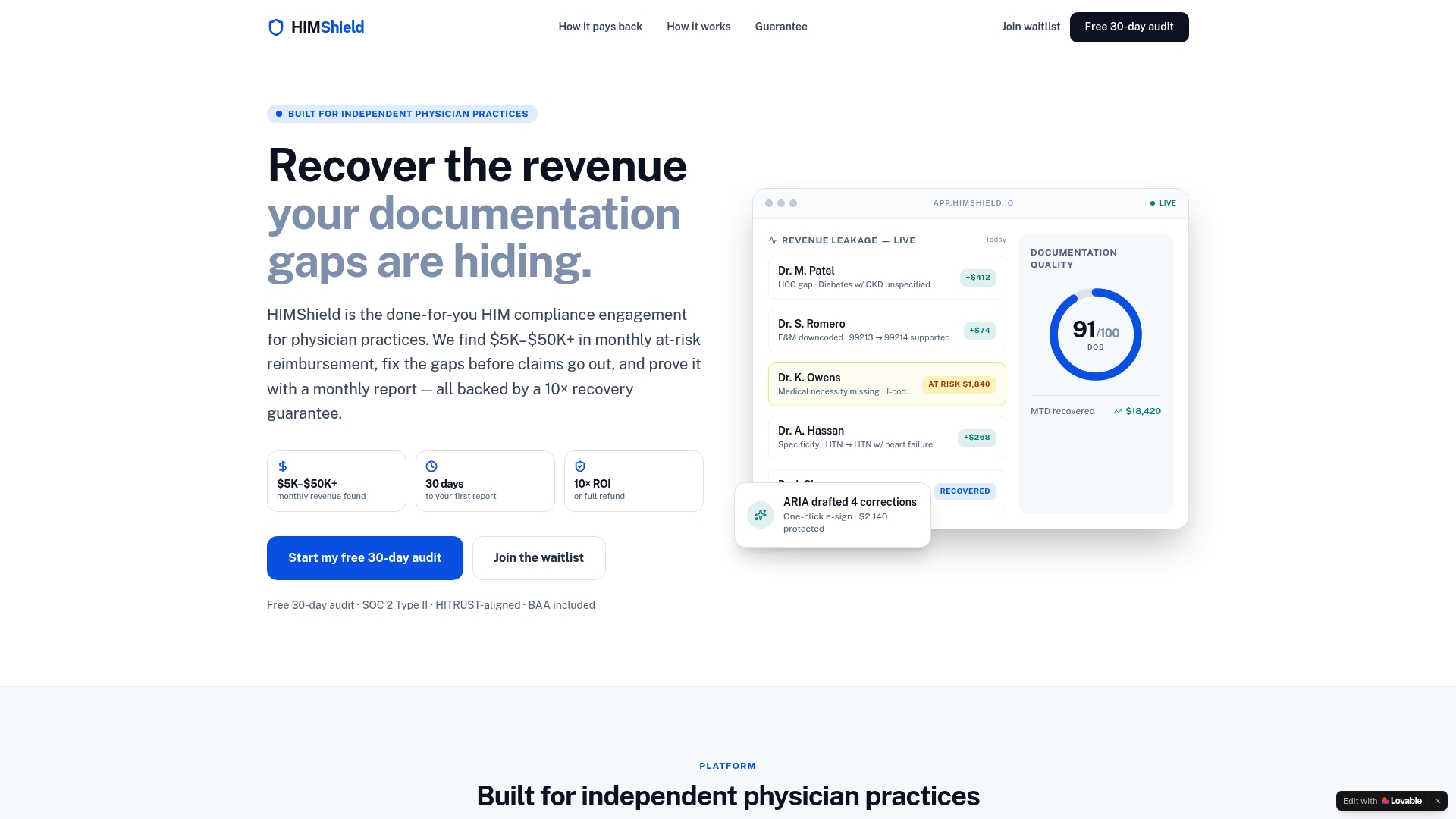
This fits independent physician practices and practice administrators who want a clear picture before committing to anything. During the audit, charts are reviewed, patterns that match the risks covered above are flagged, and a report your team can act on immediately is delivered.
- Prioritized risk list ranked by dollar exposure.
- Sample corrective actions you can hand to coders right away.
- A revenue-impact estimate tied to your own claims data.
Start with the free audit or visit HIMShield to see how the full platform supports ongoing alerting once the audit wraps up.
FAQ
What does coding compliance mean?
Coding compliance means billing claims that match what's documented in the chart and following the coding and documentation standards set by CMS, OIG, and payer policy. A solid program includes internal monitoring, written standards, training, and a way to correct errors once found, as outlined in OIG's compliance guidance.
What are 5 common coding errors?
The most common errors are upcoding, unbundling, place-of-service mismatches, modifier 25 misuse, and billing without supporting documentation. CMS guidance notes that undocumented services are treated the same as services that were never performed, which is why these patterns draw payer attention.
What is a code alert?
A code alert is a notification, automated or manual, that flags a coding, billing, or documentation issue needing review before or after a claim submits. Alerts can come from authoritative sources like CMS and OIG, from coding clinics, or from monitoring platforms that scan EHR and claims data directly.
What should be included in a coding compliance plan?
A coding compliance plan should include written coding standards, a designated compliance contact, regular monitoring and auditing, staff training, and a documented process for correcting errors once identified. Our guide to medical coding compliance breaks down how these pieces work together in an independent practice.
Sources
- Compliance program guidance for physicians (OIG roadmap)
- Medicare Fraud & Abuse: Prevent, Detect, Report (CMS MLN MLN4649244)
- Oct. 1 brings new codes, coding edits and Medicaid limits for practices (Physicians Practice)