
The changes coders need to act on now are the April and October 2026 ICD-10-CM/PCS updates, the CPT 2026 code set from the AMA, quarterly HCPCS Level II drug and biologic determinations, and the CY 2026 Medicare Physician Fee Schedule policy shifts covering telehealth and APCM add-on codes. Watch April 1, July 1, and October 1 as your critical effective dates. Download the official CMS code files today and run test claims through your encoder and grouper before those dates hit.
TL;DR:
- Coding teams must update ICD-10-CM/PCS codes by October 1, 2026, and ensure claims from October 1, 2026, through September 30, 2027, use the new codes.
- CPT 2026 updates include new codes and revisions, especially in digital health and remote monitoring, but coverage depends on payer policies, not just the code description.
- HCPCS Level II drug, biologic, and supply codes change quarterly, with manufacturer-specific codes often launching under MAC pricing before national rates are set.
- Medicare Physician Fee Schedule changes affect reimbursement for telehealth and care management codes, requiring practices to verify updated service lists and billing workflows.
- Performing a pre-deployment audit, testing claims, and updating documentation templates are essential to preventing coding errors, denials, and revenue loss during the transition.
Table of Contents
- What's New at a Glance for 2026
- ICD-10-CM/PCS Updates for April and October 2026
- CPT 2026 Changes and the Documentation Implications
- HCPCS Level II Updates and Quarterly Drug and Biologic Cycles
- CY 2026 Medicare Physician Fee Schedule Changes That Affect Coding
- NCD Coding Maintenance: April, July, and October 2026
- Clinical Laboratory Fee Schedule and CLIA Updates for October 2026
- Priority Implementation Checklist for Coding Teams
- Documentation and Denial Risks Tied to 2026 Updates
- Closing 2026 Coding Gaps With an Audit-First Workflow
- Prioritizing Payment-Impacting Updates Over Documentation-Only Changes
- A Faster Path to 2026 Compliance for Independent Practices
- FAQ
What's New at a Glance for 2026
2026 is both a code-set year and a payment-policy year, and coding teams that treat it as only one or the other will miss something. Some changes affect how you code a service. Others affect what you get paid for the same code, sometimes on the same claim.
- ICD-10-CM/PCS: updates land April 1 and October 1, 2026, with the FY 2026 ICD-10-CM Coding Guidelines governing discharges and encounters from October 1, 2026 through September 30, 2027.
- CPT 2026: the AMA's annual release adds new codes and revises others, with notable activity in digital health and procedural descriptors.
- HCPCS Level II: quarterly drug and biologic determinations, including the second-quarter 2026 cycle, introduce manufacturer-specific codes that often launch as MAC-priced before national pricing follows.
- CY 2026 PFS: telehealth list additions, new APCM add-on codes, and conversion-factor adjustments change reimbursement even when the underlying CPT code stays the same.
- CLFS and lab codes: October 2026 updates touch CLIA-related HCPCS status and PAMA reporting timing for laboratories.
Primary care and internal medicine practices feel the APCM and telehealth changes first. Specialty practices tied to infusion, oncology, or diagnostic labs need to watch HCPCS and CLFS cycles closely. Every practice, regardless of specialty, needs to track the ICD-10 October transition because it touches nearly every claim filed after that date.
Official notices live in predictable places: CMS's ICD-10 page for diagnosis codes, the CMS HCPCS quarterly application summaries for drugs and biologics, the CMS Newsroom for PFS fact sheets, and the AMA's own CPT release announcements. Bookmark all four; none of them substitute for the others.
ICD-10-CM/PCS Updates for April and October 2026
The April and October updates are not interchangeable, and treating them as one annual event is a common source of miscoded claims. April 1 is a biannual update, typically smaller in scope, addressing corrections and new codes identified since the prior October release. October 1 is the annual, fiscal-year update, and it is the one that carries the bulk of new and revised codes each year.
The FY 2026 ICD-10-CM Coding Guidelines confirm that the October 1, 2026 diagnosis code set applies to discharges and encounters from October 1, 2026 through September 30, 2027. That date-of-service rule matters more than the calendar date you happen to submit the claim. A claim filed in November for a September encounter uses the old code set, not the new one, and getting that backward triggers denials that look like coding errors but are really date-of-service errors.
- Pull the CMS ICD-10 files as soon as they post, note the version tag, and read the accompanying readme.txt before loading anything into your systems.
- Cross-reference the relevant change requests, including CR 14300 and CR 14503, for the specific implementation instructions tied to your Medicare Administrative Contractor.
- Build or update date-of-service logic in your encoder so claims spanning the October 1 boundary route to the correct code set automatically.
- Sync your encoder and grouper updates on the same schedule; a mismatch between the two is one of the fastest ways to generate MS-DRG assignment errors.
- Run test claims that deliberately straddle the transition date to confirm your system applies the right code set before you go live.
CMS's own ICD-10 page lists both the April and October 2026 files, and the October release already includes FY 2027 preparation work relevant to codes used for discharges beginning October 1, 2026. File names follow CMS's standard convention, and skipping the readme.txt is how teams miss quiet deprecations buried in the update.
Pro Tip: Keep last year's and this year's code files loaded side by side in a test environment for at least 30 days after each transition so you can catch encoder logic errors before they hit production claims.
CPT 2026 Changes and the Documentation Implications
The AMA released the CPT 2026 code set with new codes, deletions, and revisions concentrated in digital health, remote monitoring, and procedural updates, alongside the usual annual maintenance across surgical and evaluation and management sections. Coders need the updated code book in hand, but the code descriptor is only half the compliance picture.
A new or revised CPT code does not automatically mean Medicare or a commercial payer covers it or covers it the way the descriptor implies. Coverage sits in National Coverage Determinations and payer policy, separately from the CPT definition, and reconciling the two is where teams get tripped up. A code can exist and be billable in the CPT sense while still being non-covered, bundled, or subject to frequency limits under an NCD or local coverage determination.
- Update your encoder's CPT tables the moment the new code set loads, including deletions that would otherwise let staff bill a retired code out of habit.
- Revise chargemaster entries for every changed code, not just the new ones, since revised descriptors can shift the correct charge amount or units.
- Notify clinicians directly about documentation changes tied to new codes, especially where a new code requires more specific detail than the one it replaces.
- Check each new or revised code against applicable NCDs before assuming coverage follows automatically from the CPT release.
Skipping the chargemaster step is the single most common gap practices report after a CPT release, because deletions and revisions often outnumber the flashy new additions that get all the attention.
HCPCS Level II Updates and Quarterly Drug and Biologic Cycles
HCPCS Level II codes move on a faster clock than CPT or ICD-10, with quarterly application cycles that introduce new drug, biologic, and supply codes throughout the year. The second-quarter 2026 HCPCS application summary lists final coding determinations for drugs and biologics, and many of the resulting codes carry an October 1, 2026 effective date.
Manufacturer-specific codes exist because a single drug can have multiple formulations, dosages, or delivery routes that generic J-codes cannot distinguish. That specificity helps with accurate billing but also means coders need to match the exact product administered to the exact code, not just the drug class.
- Check whether a new code is MAC-priced or nationally priced, since CMS guidance notes that code activation alone doesn't guarantee national payment: some codes launch under contractor pricing before a national rate is set.
- Confirm JA and JB modifier use on drug codes billed by administration route, since incorrect modifier assignment is a frequent denial trigger on infusion claims.
- Handle Not Otherwise Classified codes carefully during the gap between a drug's market availability and its permanent code assignment, documenting the specific product in the claim narrative.
- Verify payer-specific pricing rather than assuming Medicare's rate applies universally, since commercial payers often set their own timelines for adopting new HCPCS codes.
Labs and infusion centers feel these quarterly cycles more than most specialties, since a missed manufacturer-specific code update can mean months of underpayment before anyone notices the pattern.
CY 2026 Medicare Physician Fee Schedule Changes That Affect Coding
The CY 2026 Medicare Physician Fee Schedule final rule changes what you get paid, not just what you code, and several of its provisions touch daily coding workflows directly.
Telehealth sees additional services added to the Medicare telehealth list, along with changes to supervision requirements for certain services. Practices that built telehealth workflows around last year's list need to check the updated list against their current service mix. For a deeper walkthrough of what qualifies and how to document it, our telehealth coding compliance guide covers the documentation specifics payers expect.
The Advanced Primary Care Management add-on codes, G0568 through G0570, give practices an optional way to bill for care management work layered onto primary care visits. These codes come with same-practitioner, same-month billing rules, which means someone on your team needs to own the monthly reconciliation between who delivered the service and who is billing for it. Practices juggling multiple providers on a shared patient panel should map this workflow explicitly; our guide on physician group coding workflow types walks through ownership models that prevent the add-on codes from falling through the cracks.
Provider resource hubs, including Agnes America's provider resources, also offer training material relevant to APCM base-code reporting and related behavioral health add-on workflows, which can help clinical staff understand documentation expectations before claims go out.
- Cross-check the updated telehealth list against your current service lines before assuming a service still qualifies.
- Confirm same-practitioner, same-month logic is built into your billing system for APCM add-on codes.
- Watch conversion factor and efficiency adjustments in the final rule, since they can shift reimbursement on unchanged codes.
- Review place-of-service and modifier requirements tied to telehealth and care management billing, since these are common denial points after policy updates.
None of these changes require a new CPT code to affect your bottom line. That is the part coding teams most often underestimate about a PFS year.
NCD Coding Maintenance: April, July, and October 2026
National Coverage Determination coding updates are maintenance, not expansion, and confusing the two leads to claims submitted under the assumption that a new code means new coverage. CMS issues change requests in April, July, and October to keep ICD-10 and other code references inside NCDs current, and the guidance in MM14464 makes clear that this maintenance is largely administrative: contractors typically do not proactively reprocess claims but will act when a claim is brought to their attention.
Several 2026 NCD items are worth flagging specifically: updates touching next-generation sequencing, PET imaging, sacral nerve stimulation, and CAR-T therapy coding all carry coverage nuances that a code list alone will not capture.
- Read the NCD text itself, not just the code list, since mappings can be inappropriate when the policy language carries conditions the code alone doesn't convey.
- Check your MAC's website for local coverage determinations that layer additional requirements on top of the national policy.
- Document medical necessity in the terms the NCD uses, matching the clinical criteria the policy specifies rather than generic necessity language.
- Flag claims proactively rather than waiting for a denial to discover a code-to-policy mismatch, since contractors generally respond rather than initiate correction.
Clinical Laboratory Fee Schedule and CLIA Updates for October 2026
Labs face their own October cycle, separate from the ICD-10 update but landing on the same date, which makes October a genuinely heavy month for coding and billing teams. MM14569 details the October 2026 Clinical Laboratory Fee Schedule update, covering HCPCS code status changes and CLIA payment edits that determine which labs can bill which tests.
- Confirm CLIA certificate status against each HCPCS lab code you bill, since certificate mismatches are a fast path to denial.
- Apply the QW modifier correctly on waived tests, since CMS ties waived-test payment eligibility directly to that modifier.
- Track PAMA reporting timing, since legislative changes affecting private payer rate reporting can shift phase-in schedules for lab pricing.
- Monitor MAC-specific pricing for lab codes that launch without a national rate, since local contractors often set interim prices.
Labs that treat the October CLFS update as a footnote to the ICD-10 release risk missing status changes that directly block payment on routine test panels.
Priority Implementation Checklist for Coding Teams
A 2026 rollout works best as a sequence, not a scramble. Coding teams that download files the day they post, test before going live, and monitor for 30 days afterward catch problems before they become a pattern of denials.
- Schedule file retrieval from the CMS Data Center and the AMA release calendar so nothing lands unnoticed; assign one person ownership of the download calendar.
- Read every readme.txt and version tag before loading a file, since deprecations and format changes often live there rather than in the headline announcement.
- Update encoders, groupers, and the Medicare Code Editor together, on the same day if possible, to avoid the mismatch errors that come from staggered updates.
- Run end-to-end test claims covering pricing, coverage, and bundling scenarios, not just code validity, before the effective date arrives.
- Update local edits and payer-specific pricing tables, coordinating directly with lab and pharmacy teams on HCPCS and J-code pricing since their cycles run on a separate clock from ICD-10 and CPT.
- Deploy clinician documentation templates reflecting the new code requirements before the effective date, not after the first denial arrives.
- Run a 30-day monitoring window post-deployment specifically to catch exception claims and reconcile them before they age into a bigger denial backlog.
- Define an escalation path in advance: know when to open an issue with your MAC, which transmittal contact to use, and how to request a claim adjustment if a system error caused incorrect payment.
Our annual coding review guide walks through this cycle in more depth, including how to structure the review calendar across a full year rather than reacting to each update as it lands.
Pro Tip: Assign a single owner for each of the four 2026 update tracks (ICD-10, CPT, HCPCS, PFS policy) so no change falls into the gap between coding, billing, and clinical documentation teams.
Documentation and Denial Risks Tied to 2026 Updates
Most denials that follow a coding update are not caused by the update itself. They are caused by documentation that did not keep pace with it. Missing clinician attribution on APCM add-on codes, medical necessity language that does not match NCD terminology, and CLIA or QW modifier mismatches on lab claims are the recurring patterns.
- Missing attribution language on care management add-ons leaves claims unable to prove which practitioner performed the qualifying work in that month.
- Generic medical necessity notes that do not echo the specific criteria in an NCD create a mismatch even when the underlying care was appropriate.
- MAC-priced drug and lab codes create timing risk: a claim submitted before national pricing is set can process at the wrong rate.
- CLIA and QW modifier errors on waived tests are avoidable with a pre-submission cross-check built into the billing workflow.
Attestation language that ties the clinician's note directly to the billed code, paired with a pre-submission cross-check for CLIA and modifier accuracy, catches most of these before the claim ever leaves the building. Our medical necessity documentation guide has concrete clinician prompt examples that map directly to this kind of gap. When a denial does slip through, treat it as a pattern signal, not an isolated event: pull the last 90 days of similar claims and check for the same root cause before resubmitting one at a time.
Pro Tip: Build a short clinician-facing checklist for each new add-on code that spells out exactly what attestation language the claim needs, since generic training rarely translates into consistent chart notes.
Closing 2026 Coding Gaps With an Audit-First Workflow
Independent practices rarely have a dedicated team watching four separate CMS update cycles at once, which is exactly where revenue leakage starts. An audit-first workflow scans EHR data for coding, documentation, and charge-capture gaps before claims go out, prioritizes findings by payment impact, and routes each one to a specific fix rather than a generic warning.

Mapping APCM add-on codes to a monthly practitioner workflow is a good example: the scan identifies which encounters qualify, flags missing attribution language, and routes a correction with a one-click physician e-signature instead of a manual chart pull. For teams that want to see this kind of workflow explained more generally, our coding audit guide covers how scan-prioritize-remediate cycles work in practice.
Prioritizing Payment-Impacting Updates Over Documentation-Only Changes
Not every 2026 update carries the same urgency, and treating them as equal is how teams burn a quarter on low-stakes fixes while a payment-affecting change sits unaddressed. I prioritize anything that changes coverage or reimbursement first: the PFS policy shifts, the HCPCS pricing cycles, the NCD maintenance that touches an active service line. Documentation-only updates matter, but they rarely cost a practice money the same week they take effect.
Getting this right takes coordination between IT, coding staff, clinical leadership, and revenue integrity, because no single team sees the whole picture. Set a short monitoring window, usually 30 days, after each deployment, and name one person responsible for reconciling exceptions before they pile up.
— Elena
A Faster Path to 2026 Compliance for Independent Practices
Running down four separate CMS update cycles while keeping a practice open takes time most independent physician practices do not have to spare. A free 30-day Revenue Leakage Audit can scan your EHR data for coding, documentation, and charge-capture gaps and deliver a per-provider, per-payer report quantifying the associated costs.
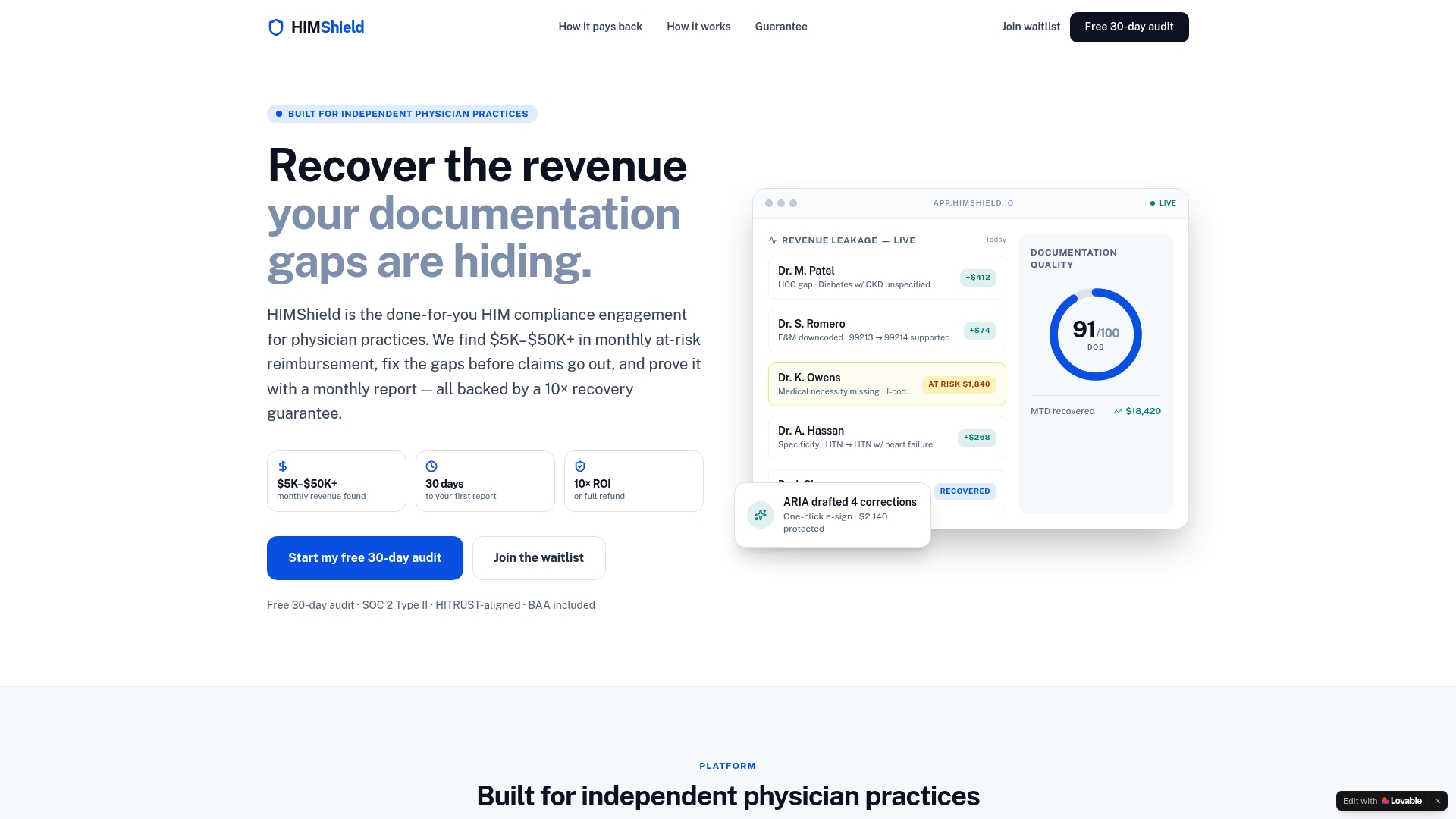
The audit maps directly to the checklist above: it flags APCM attribution gaps, NCD documentation mismatches, and charge-capture errors tied to the 2026 code changes, then drafts corrections with a one-click physician e-signature to streamline the fix process. If a payer audit follows, a platform may assemble a submission-ready response. Start with the free 30-day Revenue Leakage Audit to see where your practice stands before the October deadlines hit, or visit HIMShield to learn more about the full compliance engagement.
This article is general information, not a substitute for advice from a qualified doctor. Consult a qualified healthcare professional about your own circumstances before acting on anything here.
FAQ
What are the major updates in medical coding for 2026?
The major updates span four tracks: ICD-10-CM/PCS changes on April 1 and October 1, the CPT 2026 code set from the AMA, quarterly HCPCS Level II drug and biologic determinations, and CY 2026 Medicare Physician Fee Schedule policy changes covering telehealth and care management add-on codes. Each track has its own release schedule and official source, so tracking them separately avoids missed updates.
What are the CMS updates for April 2026?
April 2026 brings a biannual ICD-10-CM/PCS update along with coding revisions to National Coverage Determinations, detailed in change requests such as MM14263. These are generally smaller in scope than the October annual update but still require encoder and local edit changes before the effective date.
How many ICD-10-CM codes were revised in 2026?
CMS does not publish a single revision count that applies uniformly across the April and October 2026 updates in the guidelines document itself. The FY 2026 ICD-10-CM Coding Guidelines and accompanying code files are the authoritative source for the specific additions, deletions, and revisions, and coding teams should review the official file list directly rather than relying on secondhand counts.
What are the latest updates from CMS?
The most current CMS activity spans the October 2026 ICD-10-CM/PCS file release, the second-quarter HCPCS application summary for drugs and biologics, and the CY 2026 Physician Fee Schedule final rule covering telehealth and payment policy. Coding teams should check CMS's ICD-10 page and HCPCS quarterly summaries directly, since each update track refreshes on its own calendar.