
ICD-10 specificity is defined as the level of diagnostic detail captured in a claim code that directly determines whether a payer approves or denies reimbursement. For healthcare administrators and billing specialists in independent physician practices, this is not a technical footnote. It is the difference between a paid claim and a denial. The ICD-10-CM system now includes over 72,000 codes, compared to approximately 14,000 in ICD-9-CM. That expansion exists precisely to capture clinical detail that payers require to validate medical necessity. Low specificity in ICD-10 coding triggers denials, flags audits, and leaves earned revenue uncollected.
What is ICD-10 specificity in physician practice management?
ICD-10 specificity in a physician practice refers to how accurately and completely a diagnosis code reflects the patient's documented condition. Healthcare reimbursement depends not solely on services performed but on how precisely the diagnosis code matches the clinical documentation. A vague or unspecified code tells the payer almost nothing about the patient's condition. That ambiguity gives payers a legitimate reason to deny the claim.
Specificity in ICD-10 is also not just a billing detail. It underpins accurate public health data tracking, quality reporting, and reimbursement fairness across the entire healthcare system. When your practice submits a code like M79.3 (panniculitis, unspecified) instead of the correct lateralized, site-specific code, you are not just risking a denial. You are misrepresenting the clinical picture. Understanding how documentation affects reimbursement is the first step toward fixing the problem.
Key documentation elements that drive coding specificity
High specificity coding depends on what the physician documents, not what the coder guesses. Achieving high specificity requires documenting disease type, severity, laterality, episode of care, and complications. When any of these elements are missing from the clinical note, the coder defaults to an unspecified code, and the claim becomes vulnerable.
The core documentation elements your physicians must capture include:
- Disease type and subtype: Specify whether a condition is acute or chronic, primary or secondary, infectious or autoimmune.
- Severity and stage: For conditions like chronic kidney disease or diabetic retinopathy, the stage or severity level maps directly to a specific code.
- Laterality: Left, right, or bilateral must appear in the note for any condition affecting a paired body part.
- Episode of care: Initial encounter, subsequent encounter, or sequela. Each maps to a different code and has different reimbursement implications.
- Comorbidities and associated conditions: Documenting a complication like diabetic peripheral neuropathy alongside Type 2 diabetes produces a more specific code set and supports higher acuity.
When any of these elements are absent, coders are forced into unspecified territory. That is where denials begin.
Pro Tip: Build a documentation checklist into your EHR templates for high-volume diagnosis categories. A structured note template for conditions like diabetes, fractures, or hypertension can eliminate the most common specificity gaps before the claim is ever submitted.

How does ICD-10 code structure support specificity?
Every ICD-10-CM code is built from a 3–7 character alphanumeric structure, and each character adds a layer of clinical detail. Codes are 3–7 characters, with the seventh character reserved for encounter type, such as initial treatment, subsequent care, or sequela. Understanding this structure helps billing specialists identify exactly where a code falls short of full specificity.
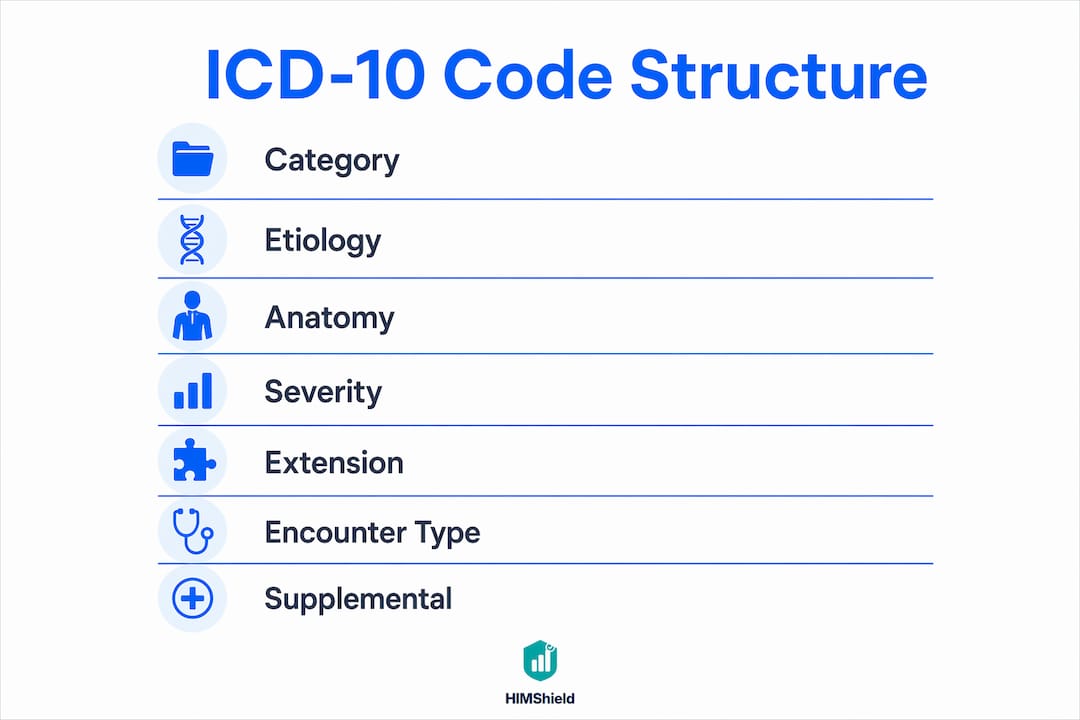
| Character position | What it represents | Example (S52.501A) |
|---|---|---|
| 1st character | Category (letter) | S = injury |
| 2nd–3rd characters | Condition subcategory | 52 = fracture of radius |
| 4th character | Anatomical site or type | 5 = unspecified end of radius |
| 5th character | Specificity detail | 0 = unspecified |
| 6th character | Laterality or severity | 1 = right side |
| 7th character | Encounter type | A = initial encounter |
One critical detail that trips up many practices: the seventh character "A" (initial encounter) does not mean the patient's first visit to your office. It means the patient is still in the active treatment phase. Using the 7th character "A" indicates active treatment, not the patient's first visit. Misapplying this character is a structural coding error that payers flag during review.
Placeholder characters also cause problems. Some codes require a placeholder "X" to hold a position so the seventh character can be assigned correctly. Healthcare providers often overlook the placeholder "X" needed for seventh character slots, producing invalid codes that fail claim edits before a human reviewer ever sees them.
Pro Tip: When auditing claims, filter for codes shorter than their required character length. A five-character code where seven are required is almost always missing laterality or an encounter type. That filter alone can surface a significant share of your specificity errors.
Practical steps for improving ICD-10 accuracy in your practice workflow
Improving coding specificity is a workflow problem as much as a knowledge problem. The fix requires coordination between clinical, coding, and administrative teams. A physician group coding workflow that builds specificity checkpoints into each step produces far fewer denials than one that relies on coders to catch gaps after the fact.
-
Train physicians on documentation requirements regularly. Physicians do not need to know ICD-10 codes. They need to know what clinical details the codes require. Quarterly training sessions focused on your top 20 diagnosis categories produce measurable improvements in documentation quality.
-
Implement a clinical documentation improvement (CDI) program. CDI programs improve ICD-10 coding specificity and documentation quality by creating a structured review process before claims go out the door. A CDI specialist reviews notes for missing elements and queries the physician before the claim is submitted. Reviewing CDI best practices for medical groups gives your team a concrete framework to follow.
-
Use a formal query process for ambiguous documentation. When a note is unclear, the coder should send a structured query to the physician rather than defaulting to an unspecified code. Queries must be compliant, non-leading, and documented in the record.
-
Run regular coding audit cycles. An annual coding review catches patterns that individual claim reviews miss. Audits should focus on your highest-volume diagnosis codes and any code categories with recent ICD-10-CM updates.
-
Coordinate coding and clinical teams directly. Coders who attend clinical team meetings understand documentation patterns better. That context reduces the number of queries and speeds up the coding cycle.
-
Adopt integrated coding tools. Technology that flags incomplete codes or missing characters before submission catches errors that manual review misses. The key is integration with your EHR so the check happens in the workflow, not after the fact.
Common ICD-10 specificity mistakes and how to fix them
The most damaging specificity errors are not random. They follow predictable patterns, and recognizing them is the fastest path to fewer denials.
- Overusing unspecified codes when documentation supports specificity. CMS and commercial payers may deny claims when specificity is available but unused. Coders sometimes default to unspecified codes out of habit or time pressure, even when the physician's note contains the required detail.
- Omitting the seventh character or laterality. These are structural errors. A code missing its seventh character is technically invalid and will fail claim edits automatically.
- Ignoring Excludes1 and Excludes2 notes. Excludes1 notes forbid reporting two conditions together, while Excludes2 notes allow them. Confusing the two produces claim combinations that payers reject outright. Mid-year ICD-10 updates, such as the april 2026 CMS release, change these relationships, so your team must review updates as they publish.
- Delayed physician responses to queries. A query sitting unanswered for two weeks becomes a held claim. Set a 48-hour response standard for coding queries and track compliance.
- Using unspecified codes despite clear clinical evidence. Payer algorithms flag unspecified codes when clinical evidence is clear, increasing audit risk. This is not just a denial risk. It is an audit trigger.
"The misconception that unspecified codes are a safe fallback is one of the most expensive beliefs in medical billing. Payers have automated systems that cross-reference your documentation against your codes. When the documentation says 'left tibial stress fracture' and the code says 'unspecified lower leg,' the algorithm notices. The physician documented the specificity. The coder just did not use it."
When a denial does come back for specificity reasons, do not just recode and resubmit. Trace the denial to its root cause. Was the documentation missing the detail? Was the coder unaware of the correct code? Was the code structure incomplete? Each root cause requires a different fix.
Key Takeaways
ICD-10 specificity in a physician practice is the single most controllable factor in claim approval, and every denial tied to an unspecified code represents revenue that was earned but not collected.
| Point | Details |
|---|---|
| Specificity drives reimbursement | Payers validate medical necessity through code detail, not just service documentation. |
| Documentation is the source | Missing laterality, severity, or episode of care forces coders into unspecified codes. |
| Code structure matters | The seventh character and placeholder "X" are structural requirements, not optional fields. |
| CDI programs reduce denials | Clinical documentation improvement programs catch specificity gaps before claims are submitted. |
| Updates require active monitoring | Mid-year ICD-10-CM changes, including Excludes1 and Excludes2 revisions, cause immediate denials if ignored. |
What I have learned about specificity after years in the revenue cycle
The practices that struggle most with ICD-10 specificity are not the ones with bad coders. They are the ones where coding and clinical teams operate in separate silos. Physicians document for patient care. Coders translate that documentation into codes. When those two groups never talk, the translation breaks down constantly.
The most effective change I have seen independent practices make is simple: bring one CDI specialist into the clinical workflow. Not as an auditor after the fact, but as a real-time resource who reviews notes before they close. That single structural change reduces unspecified code rates faster than any training program alone.
Continuous training matters too, but only if it is targeted. Generic ICD-10 refreshers do little. Training built around your practice's own denial data, your top 20 diagnosis codes, and your physicians' specific documentation habits produces results you can measure in the next billing cycle.
The uncomfortable truth is that most specificity problems are fixable with existing documentation. The physician wrote down the laterality. The coder just did not find it. Better workflow, not more knowledge, is usually the answer.
— Elena
How Himshield helps practices recover revenue through coding accuracy
Independent physician practices lose significant revenue to coding gaps that never get identified until a denial arrives. Himshield changes that sequence.
Himshield scans your coding, documentation, and charge-capture data to identify specificity risks before they become denials or audits. The platform flags unspecified codes where documentation supports a more specific selection, missing seventh characters, and laterality gaps across your claim volume. Practices using Himshield recover between $5,000 and $50,000 or more in hidden revenue by addressing risks that manual review consistently misses. If your practice is ready to protect what it has already earned, see how Himshield works and connect your EHR to start identifying at-risk reimbursement within 30 days.
FAQ
What is ICD-10 specificity in medical coding?
ICD-10 specificity is the degree of clinical detail captured in a diagnosis code, including disease type, severity, laterality, and episode of care. Higher specificity codes give payers the information they need to validate medical necessity and approve claims.
Why do unspecified ICD-10 codes cause claim denials?
Payer algorithms detect when documentation supports a specific code but an unspecified code was submitted instead. CMS and commercial payers treat this as a coding error and may deny the claim or flag it for audit review.
How does the seventh character affect ICD-10 specificity?
The seventh character identifies the encounter type, such as initial treatment, subsequent care, or sequela. A code missing its seventh character is structurally invalid and will fail automated claim edits before reaching a human reviewer.
What is a CDI program and how does it improve coding accuracy?
A clinical documentation improvement (CDI) program is a structured process where trained specialists review physician notes for missing specificity elements before claims are submitted. CDI programs reduce unspecified code rates and lower denial volumes across a practice.
How often does ICD-10-CM update and why does it matter?
CMS releases ICD-10-CM updates twice per year, in october and april. Mid-year updates change code logic, including Excludes1 and Excludes2 note relationships, and practices that do not apply updates immediately face denials on claims that were previously accepted.