
What does a medical group HIM department do?
A medical group Health Information Management (HIM) department manages the entire lifecycle of patient health data, from the moment it's captured to how it's stored, accessed, coded, and legally protected. Think of it as the operational backbone connecting your clinical teams, billing staff, and compliance functions. Without a functioning HIM department, documentation gaps turn into claim denials, audit vulnerabilities, and real revenue loss.
AHIMA defines HIM professionals as responsible for standardizing disease and procedure classification, which directly affects reimbursement accuracy, public health reporting, and legal defensibility. That scope goes well beyond filing records.
Here's what a medical group HIM department is responsible for at its core:
- Managing patient health data end-to-end: Capture, storage, retrieval, analysis, and secure disposal of both paper and electronic records
- Ensuring documentation accuracy and completeness: Every entry in the medical record must support the clinical decisions made and the codes assigned
- Bridging clinical, administrative, and financial teams: HIM professionals translate clinical language into billing codes and compliance requirements
- Protecting patient privacy: Controlling access, managing Release of Information (ROI) requests, and enforcing HIPAA protocols
- Supporting audits and legal compliance: Maintaining audit trails and documentation that can withstand payer scrutiny and government review
- Enabling quality care decisions: Accurate, accessible records let physicians make informed decisions and avoid duplicating tests or missing diagnoses
HIM professionals span over 40 job categories and 200 distinct titles, bridging clinical, administrative, and IT teams across every type of healthcare setting.
Key functions and responsibilities of your HIM team
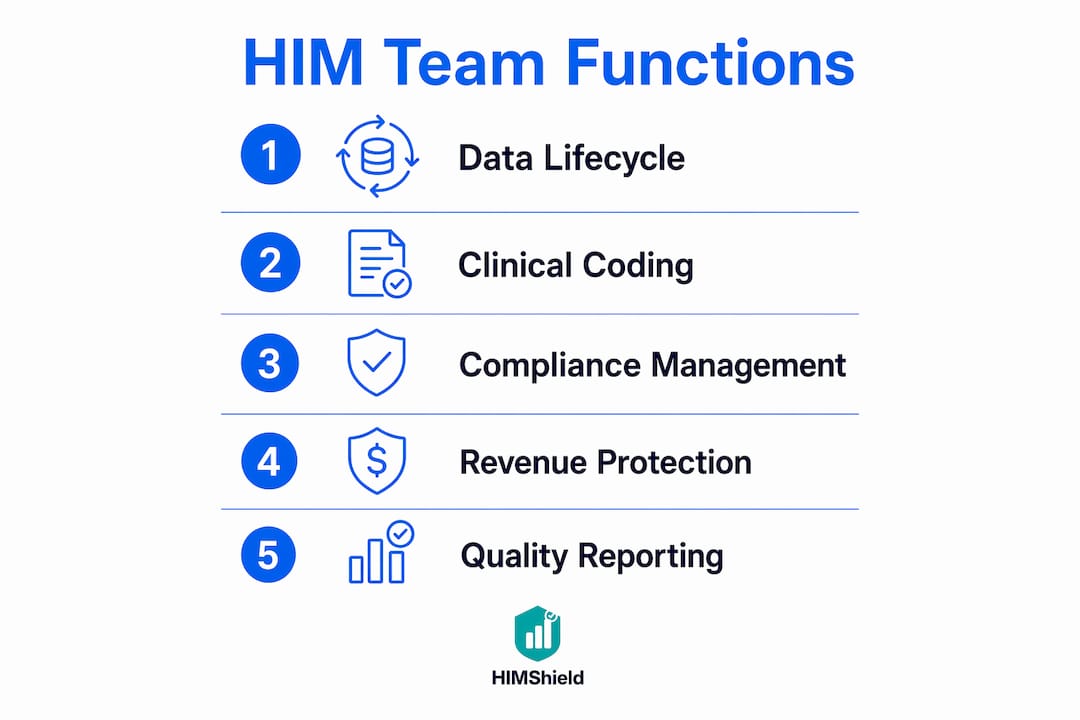
The day-to-day work of an HIM department covers far more ground than most administrators realize. Your HIM staff are simultaneously coders, compliance officers, data analysts, and audit defenders.
Core HIM responsibilities include:
- Release of Information (ROI) management: Processing legally authorized requests for patient records from patients, attorneys, insurers, and government agencies, with full audit trails on every release
- Medical coding accuracy: Assigning ICD-10-CM, CPT, and HCPCS codes that accurately reflect the clinical encounter, directly determining what your practice gets paid
- Clinical documentation improvement (CDI): Working with physicians to clarify vague or incomplete documentation before it reaches the billing queue
- Audit preparation and defense: Conducting internal coding audits and preparing responses to external payer or government audits
- EHR management: Maintaining HIPAA-compliant record storage and retrieval within your electronic health record system
- Data quality coordination: Collaborating with IT and clinical leadership to identify and correct data integrity issues before they affect reporting or billing
Common HIM certifications and credentials:
- RHIA (Registered Health Information Administrator): A four-year degree-level credential from AHIMA, covering data governance, compliance, and management
- RHIT (Registered Health Information Technician): A two-year credential focused on coding accuracy, record analysis, and data quality
- CCS (Certified Coding Specialist): Validates advanced inpatient and outpatient coding proficiency
- CPC (Certified Professional Coder): The AAPC credential most common in physician practice settings
- CHDA (Certified Health Data Analyst): Covers data analysis and reporting for HIM professionals moving into analytics roles
Some certified HIM specialists hold dual credentials as registered nurses and professional coders, combining clinical and coding expertise in ways that significantly improve documentation quality.
Typical HIM department structure in a medical group:
A small to mid-size medical group usually organizes HIM around a Director of Health Information Management or HIM Manager, supported by medical coders, a CDI specialist, an ROI coordinator, and a compliance liaison. Larger groups may add a privacy officer, a data analyst, and dedicated audit staff.

Pro Tip: If your HIM team is handling coding, CDI, and audit defense with the same two or three people, you likely have coverage gaps. Map each core function to a named owner and identify which responsibilities are falling through the cracks.
How HIM directly protects your revenue cycle
Your HIM department is one of the most direct levers you have over revenue cycle performance. Every dollar your practice earns depends on documentation that is complete, accurate, and coded correctly before a claim goes out the door.
HIM ensures medical record documentation completion that is critical for revenue cycle accuracy and legal compliance, influencing reimbursement rates across every payer. When documentation is vague or a code doesn't match the clinical narrative, payers deny the claim or downcode it. Your HIM team catches those problems before submission.
Where HIM protects revenue most directly:
- Pre-bill coding reviews: Catching mismatches between physician documentation and assigned codes before claims are submitted
- CDI queries: Prompting physicians to clarify diagnoses, procedures, or medical decision-making that would otherwise support a lower-paying code
- Denial management: Analyzing denial patterns to identify systemic documentation or coding issues driving repeated rejections
- Payer audit defense: Maintaining documentation that supports the codes billed, reducing the risk of costly takebacks
- Revenue analytics: Tracking coding accuracy rates, denial rates, and documentation deficiency trends to guide operational decisions
Failure to invest in qualified HIM staff leads to increased claim denials, revenue loss, and compliance penalties. That's not a theoretical risk. Practices that treat HIM as a back-office function rather than a revenue protection function tend to discover the cost only after an audit or a string of denials they can't reverse.
The bottom line on revenue: Your HIM department's work on documentation and reimbursement happens upstream of billing. Fix the documentation, and the revenue follows. Skip it, and you're leaving earned dollars uncollected.
How HIM departments keep your practice compliant with HIPAA and privacy law
Privacy and security compliance is not a passive function in HIM. Your HIM team actively manages the controls that keep patient data protected and your practice legally defensible.
HIM professionals maintain strict privacy and security practices including HIPAA compliance, controlled access, and encrypted communications to safeguard patient data. Formal Release of Information processes serve as vital legal defense mechanisms against audits and financial penalties.
How your HIM department manages compliance:
- Access controls and audit trails: Restricting EHR access by role and logging every instance of record access, modification, or release
- ROI legal authorization: Verifying that every record release has proper patient authorization or a legally recognized exception before any information leaves the practice
- HIPAA monitoring: Tracking regulatory updates and translating them into updated policies and staff training
- Breach response protocols: Maintaining a documented response plan for potential data breaches, including notification timelines and reporting requirements
- Staff training: Conducting regular privacy and security training so every team member, not just HIM staff, understands their obligations
Formal audited Release of Information processes are critical legal defenses during external audits and help prevent costly financial penalties. A practice that cannot produce a clean ROI audit trail during a government investigation is in a far weaker position than one whose HIM team has documented every release.
The compliance function also extends to your EHR configuration. HIM staff work with IT to set up role-based permissions, configure audit log retention, and review system settings that affect how data is stored and shared. That's a level of operational detail that falls squarely in HIM's domain.
How HIM has evolved beyond records management
The HIM department your practice has today looks nothing like the records room of 20 years ago. The shift to electronic health records transformed HIM from a document storage function into an information governance partner focused on risk management and revenue protection.
That evolution is still accelerating. HIM professionals increasingly serve as privacy officers, clinical workflow analysts, and data managers, reflecting a broadening portfolio beyond traditional records management.
What modern HIM looks like in a medical group:
- Information governance leadership: Setting policies for how data is created, maintained, accessed, and retired across the entire organization
- Clinical workflow analysis: Identifying bottlenecks in how physicians document encounters and recommending changes that improve both efficiency and coding accuracy
- EHR optimization: Partnering with IT to configure templates, order sets, and documentation prompts that reduce deficiencies
- Automation and rule-based workflows: Using technology to flag incomplete records, route deficiency notices, and check coding rules before claims go out. Electronic health records introduce automation pitfalls like over-copying of physician notes; modern HIM must implement rule-based deficiency detection to keep coder efficiency high
- Emerging specialist roles: Data privacy officers, audit defense specialists, and clinical documentation improvement managers are now standard in larger medical groups
- Health information exchange participation: HIM professionals often serve as the practice's representative in regional health information organizations, ensuring data shared externally meets quality and privacy standards
AHIMA has long recognized HIM professionals as the natural stewards of health data interoperability, given their position at the intersection of clinical, administrative, and technical functions.
Pro Tip: If your practice is still treating HIM as a reactive function that responds to problems after they occur, you're missing the proactive value. Position your HIM team as a standing participant in revenue cycle meetings, EHR upgrade decisions, and payer contract reviews.
How HIM improves patient care quality
The connection between HIM and patient care quality is direct, even though HIM professionals rarely interact with patients directly. Accurate, complete, and accessible records are what allow your clinical team to make the right decisions at the right time.
Health information managers ensure that nurses, physicians, and other healthcare professionals can access medical information when and where they need it. That access prevents medication errors, duplicate testing, and missed diagnoses. A patient who sees multiple specialists within your medical group depends on every provider having a complete, accurate view of their history.
CDI work has a direct quality impact as well. When HIM staff query a physician to clarify whether a patient's condition is a complication or a comorbidity, the resulting documentation doesn't just support a more accurate code. It creates a more complete clinical record that future providers will rely on. The same documentation that protects your revenue also protects your patients.
HIM departments also support quality reporting programs. Accurate ICD-10 coding feeds into quality measures reported to CMS and commercial payers, affecting your practice's performance scores and, in value-based contracts, your reimbursement rates. A coding error isn't just a billing problem. It can misrepresent your patient population's acuity and undermine your quality metrics.
Future trends shaping HIM in medical groups
HIM is moving faster than most practices realize. The forces driving change include artificial intelligence, interoperability mandates, and the continued expansion of value-based care.
What's coming for HIM in medical groups:
- AI-assisted coding: Natural language processing tools are beginning to read clinical notes and suggest codes, with HIM professionals reviewing and validating the output rather than coding from scratch. The coder's role shifts toward quality control and exception handling
- FHIR API integration: The HL7 FHIR standard is enabling real-time data exchange between EHRs, payers, and health information exchanges. HIM professionals are increasingly responsible for governing what data flows where and ensuring it meets quality standards
- Expanded privacy regulations: State-level privacy laws are layering additional requirements on top of HIPAA, particularly around mental health, reproductive health, and substance use records. HIM teams will need to manage a more complex compliance matrix
- Remote and virtual HIM operations: Certified HIM professionals now operate securely from monitored remote environments during U.S. business hours with enterprise-grade technology, giving medical groups access to specialized expertise without requiring on-site staff
- Population health data management: As medical groups take on more risk-based contracts, HIM professionals are being asked to manage and analyze population-level data to identify care gaps and support chronic disease management programs
- Stronger audit environments: CMS and commercial payers are increasing post-payment audit activity. HIM teams that have built strong chart audit workflows and documentation standards will be far better positioned to defend their claims
The practices that invest in HIM infrastructure now, before the next audit cycle or regulatory change, are the ones that will recover revenue faster and face fewer compliance surprises.
How Himshield supports your HIM and revenue protection goals
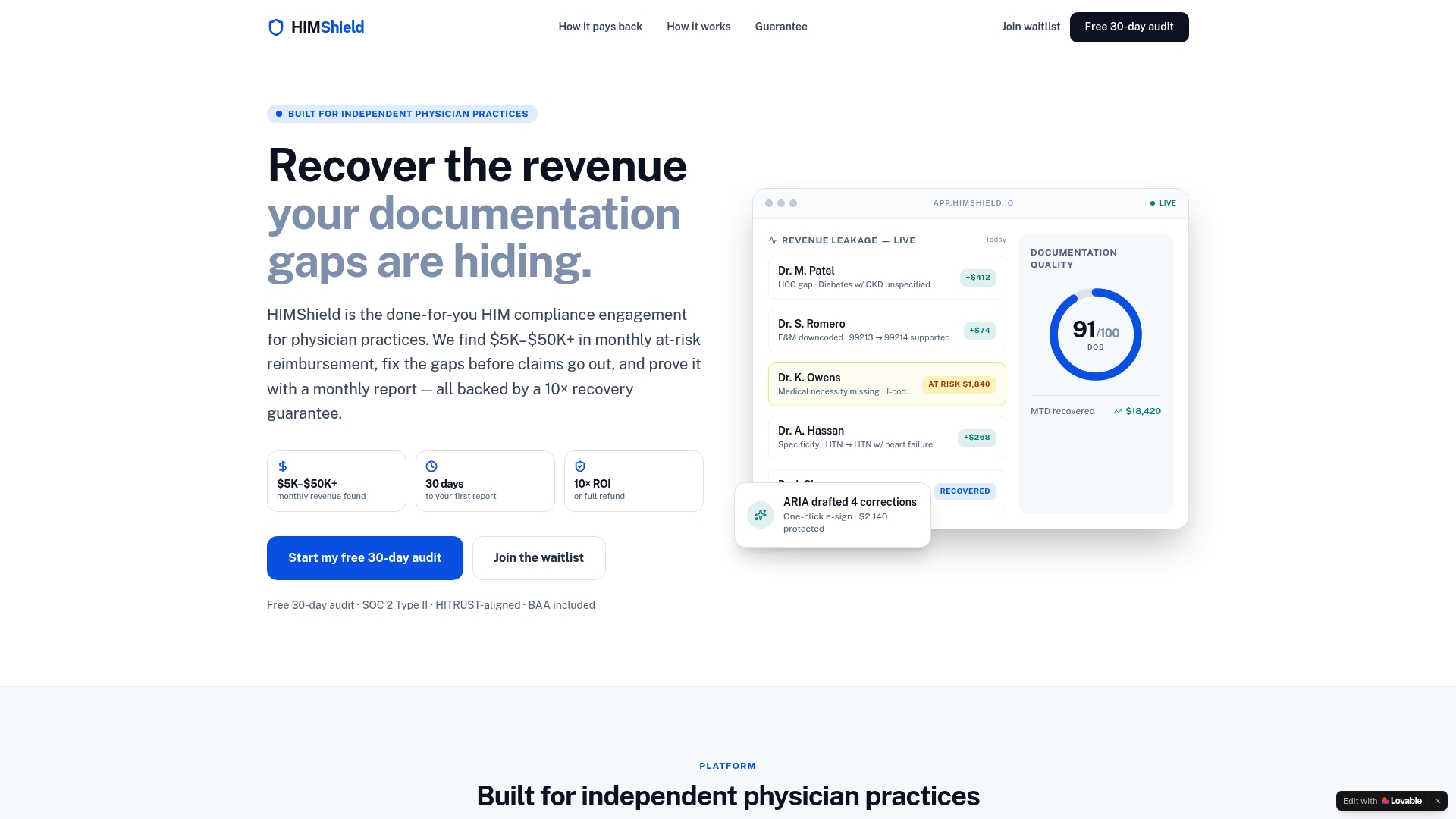
Himshield is built specifically for independent physician practices that need HIM-level insight without building a full department from scratch. The platform scans your coding, documentation, and charge capture for risks before they become denials or audits, giving your team clear, physician-friendly guidance on exactly where revenue is at risk.
If your practice is leaving $5K–$50K+ on the table through coding gaps, documentation deficiencies, or missed charge capture, Himshield identifies those risks automatically. You connect your EHR, and the platform gets to work. No lengthy implementation. No consultant fees. Just fast, clear answers about where your revenue is exposed.
See how Himshield works and find out what your practice could recover in the next 30 days.
Key Takeaways
A medical group HIM department is the operational core connecting clinical documentation, coding accuracy, revenue integrity, and regulatory compliance, and its effectiveness directly determines how much revenue your practice keeps.
| Point | Details |
|---|---|
| HIM spans clinical and financial functions | HIM professionals bridge clinical teams, billing staff, and compliance functions across over 40 job categories. |
| Coding accuracy drives reimbursement | Every ICD-10 and CPT code assigned by HIM staff directly determines what your practice collects from payers. |
| HIPAA compliance is an active HIM function | HIM manages access controls, ROI authorization, audit trails, and breach response, not just record storage. |
| HIM has evolved into information governance | Modern HIM professionals serve as privacy officers, workflow analysts, and audit defense specialists, not just records managers. |
| Proactive HIM reduces denials and audit risk | Practices that position HIM as a revenue protection function catch documentation gaps before claims are submitted. |