
A benchmark audit compares your practice's measurable revenue-cycle performance against validated peers or industry standards to find and fix revenue loss before a payer or OIG auditor finds it first. For independent physician practices, that means putting concrete numbers on coding accuracy, charge capture, and denial rates, then tracing every gap back to a fixable root cause. The six-phase benchmarking methodology gives you a repeatable structure for that work, and the Institute of Internal Auditors (IIA) is clear that results should guide deeper questions, not replace clinical judgment. Himshield applies exactly this framework to help practices recover revenue that coding, documentation, and charge-capture gaps are quietly draining.
Table of Contents
- Which metrics should your practice actually benchmark?
- How to run a benchmark audit: the six-phase process
- How to interpret results without drawing the wrong conclusions
- Turning findings into an accountable remediation plan
- What a benchmark audit costs and how long it takes
- When should your practice run a benchmark audit?
- DIY, vendor, or hybrid: which approach fits your practice?
- Key Takeaways
- Why benchmark audits work better than most practices expect
- Himshield helps practices recover revenue without the manual lift
- Useful sources and further reading
Which metrics should your practice actually benchmark?
Not every number in your practice management system deserves audit attention. Focus on the metrics directly tied to revenue leakage and payer scrutiny.
Primary revenue-cycle metrics:
| Metric | What it measures | Why it matters |
|---|---|---|
| Coding accuracy (code-to-encounter concordance) | Correct CPT/ICD-10 assignment per visit | Undercoding and upcoding both trigger audits |
| Charge capture rate | Billed charges vs. documented services | Missed charges = direct revenue loss |
| Initial claim denial rate | First-pass denials ÷ total claims submitted | High rates signal systemic coding or auth gaps |
| Net collection per encounter | Actual payment ÷ expected allowed amount | Reveals payer-specific underpayment patterns |
| Documentation quality indicators | Completeness scores from chart reviews | Drives medical necessity and HCC accuracy |
| MUE triggers | Medically Unlikely Edit flags per provider | Flags billing patterns that attract RAC attention |
Secondary metrics worth tracking include days in accounts receivable, payer-specific denial patterns, resubmission rates, and authorization or charge-entry lag times. Pull data from EHR encounter logs, practice management billing exports, clearinghouse reports, payer remittance files, and internal chart-audit samples.
Data standardization is where most practices stumble. The audit finding rate formula, calculated as (number of findings ÷ total audits) × 100, only produces valid comparisons when every practice in your peer group defines "finding" the same way. Before you pull a single report, lock down your definitions: what counts as an initial claim denial versus a resubmission, how you count encounters, and which payers are included.

How to run a benchmark audit: the six-phase process
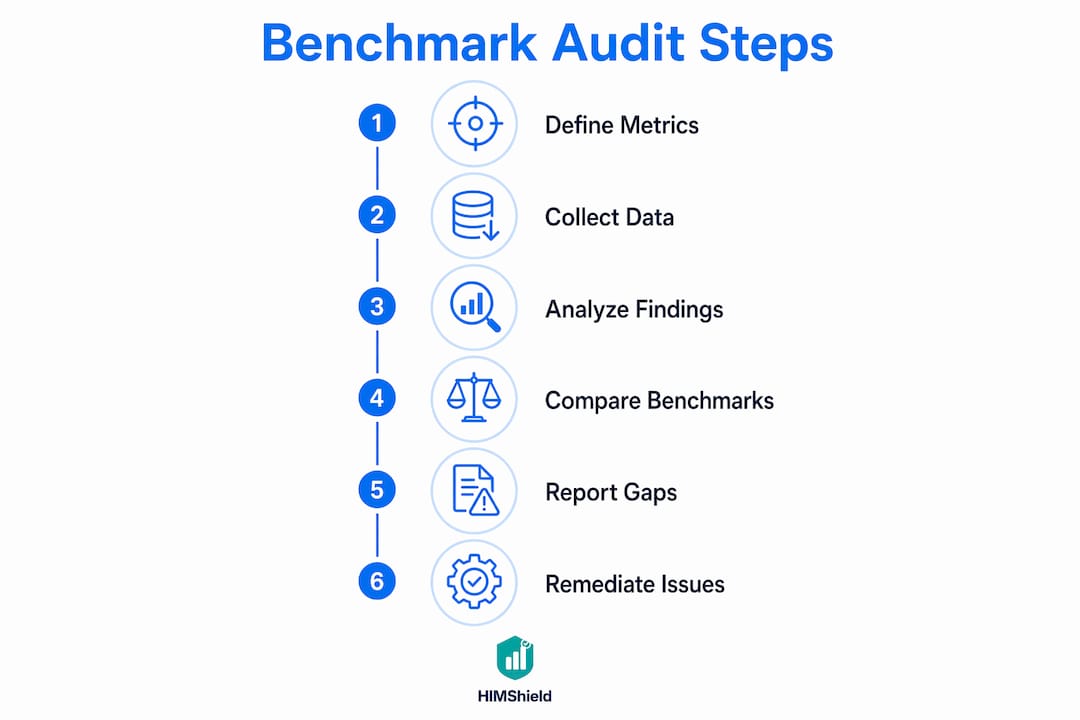
Benchmarking follows a six-phase process that moves from objective-setting through to an accountable action plan. Here is how each phase applies to an independent practice.
-
Define objectives and your comparator group. Decide what revenue risk you are targeting (denials, undercoding, charge capture) and identify valid peers: same specialty, similar payer mix, comparable patient volume. A solo family medicine practice should not benchmark against a 20-physician multispecialty group.
-
Select precise metrics and definitions. Choose three to five primary metrics from the table above. Write down the exact definition for each before gathering any data. This step takes an hour and saves weeks of rework.
-
Gather, clean, and standardize data. Export from your EHR, billing system, and clearinghouse. Reconcile date ranges, remove test claims, and apply your locked definitions uniformly. Consistent metric definitions are the hardest and most critical stage of any benchmark analysis.
-
Analyze performance gaps quantitatively. Compare your numbers to peer or industry benchmarks. Calculate the gap in absolute percentage terms so leadership can see the dollar impact.
-
Investigate root causes. A gap is a hypothesis, not a verdict. Trace each gap to technology (EHR configuration, clearinghouse edits), workflow (charge-entry timing, auth processes), or documentation (provider specificity, HCC capture). This is where benchmarking converts vague questions into targeted improvement plans.
-
Build an action plan with owners and deadlines. Every finding gets a corrective step, a named owner, a deadline, and a verification metric. No owner, no accountability.
Pro Tip: The single most common failure point is skipping Step 2. Practices that compare "initial claim denials" to a peer group that counts "resubmissions" in the same bucket produce meaningless gap numbers. Define first, gather second, always.
In a small practice, the office manager typically owns data extraction, the billing lead owns gap analysis, and HIM staff or an external auditor handles chart-review sampling. A minimum of 30–50 charts per provider gives you a statistically defensible sample for coding accuracy.
How to interpret results without drawing the wrong conclusions
Benchmarking is imprecise and should be treated as one input among many when assessing performance. Use results to prompt deeper questions and root-cause analysis, not as hard targets or final verdicts. — IIA guidance on internal audit benchmarking
That framing matters. A gap in your denial rate compared to a peer median does not automatically mean your billing team is underperforming. It means you have a hypothesis worth investigating.
Common pitfalls and how to avoid them:
- Mismatched definitions. If your peer group defines "denial" differently than you do, the comparison is invalid. Mitigation: document and share definitions before data collection.
- Small sample sizes. A 10-chart review produces unreliable coding accuracy rates. Mitigation: use at least 30 charts per provider per metric period.
- Selection bias in comparator groups. Benchmarking against high-performing academic centers inflates your apparent gap. Mitigation: match peers on specialty, payer mix, and practice size.
- Stopping at the number. The real value of audit benchmarking is tracing whether gaps come from technology, workflow, or documentation, then building the right fix. A number without a root cause produces no revenue recovery.
When management pushes back with "our practice is unique," that is a signal to show your comparator-selection rationale, not to abandon the benchmark. A clear methodology answers that objection directly.
Turning findings into an accountable remediation plan
Benchmarking provides accountability by converting performance gaps into evidence that supports resource requests and operational change. Each finding in your action plan needs six elements:
- Description: What the gap is and its dollar impact
- Root cause: Technology, workflow, or documentation
- Corrective steps: Specific, sequenced tasks
- Owner: Named individual, not a department
- Deadline: A calendar date, not "ASAP"
- Verification metric: How you will confirm the fix worked
Prioritize findings using a simple matrix. High revenue impact combined with high audit risk, such as a notable denial rate gap on your top-volume payer, goes to the top of the list. Low-impact, low-risk findings get addressed in a later cycle.
When presenting findings to physicians, lead with the dollar figure, not the compliance language. "We are leaving an estimated $X per month on the table from undercoded E/M visits" lands differently than "our coding accuracy rate is below benchmark." Billing staff need workflow-level specifics; leadership needs the revenue and risk summary. Tailor the message to the room.
What a benchmark audit costs and how long it takes
| Phase | Typical timeline | Primary cost driver |
|---|---|---|
| Internal sample review with an adequate chart sample size | 2–4 weeks | Internal FTE hours |
| Full benchmark with peer data access | several weeks | External peer dataset access, vendor fees |
| Remediation and verification cycle | Ongoing quarterly | Staff time, follow-up chart pulls |
Major cost factors to ask any vendor about: data extraction complexity, chart-review sample size, access to validated peer datasets, analytics platform fees, and HIPAA-compliant data handling. For compliance review turnaround benchmarks, industry guidance suggests that a focused internal review should not stretch beyond four weeks before findings lose operational relevance.
Benchmarking is cyclical, not a one-time project. Peer standards shift as other practices improve, so a quarterly cadence for high-risk metrics and an annual full benchmark cycle keeps your revenue protection current.
When should your practice run a benchmark audit?
Some triggers call for a quick sample review; others warrant a full peer benchmark. Know the difference.
Run a full benchmark audit when you see:
- A sudden rise in initial claim denial rates (more than 2–3 percentage points above your historical baseline)
- Net collections per encounter dropping materially versus the prior quarter
- A payer audit notice or OIG inquiry, which signals your billing patterns are already under scrutiny
- A major EHR migration or billing staff turnover that could have disrupted charge-entry workflows
- Preparation for an annual coding review or internal compliance program update
A quick 30-chart sample review is sufficient when:
- You want to validate one specific metric (e.g., E/M level distribution) before a larger engagement
- You are responding to a single payer's coding dispute rather than a systemic pattern
- You need a baseline before implementing a new billing workflow
Understanding why practices face OIG audits helps you calibrate which trigger warrants which level of response.
DIY, vendor, or hybrid: which approach fits your practice?
| Approach | Pros | Cons | Best fit |
|---|---|---|---|
| DIY | Lower cash cost, full data control | Needs methodology discipline, no peer dataset | Practices with experienced HIM staff and clear bandwidth |
| Vendor | Faster, peer data access, structured deliverables | Higher cash cost | Practices with limited internal capacity or payer audit exposure |
| Hybrid | Internal ownership plus vendor analytics | Requires coordination | Practices wanting cost control with external rigor |
Vendor-selection checklist:
- How do they access your EHR data, and is the method HIPAA-compliant?
- What are their exact metric definitions, and will they share them in writing?
- What sample size and statistical method do they use for chart reviews?
- Does the deliverable include a named-owner action plan, or just a gap report?
- What verification and monitoring options do they offer after the initial audit?
For a self-audit approach, the methodology discipline requirement is the biggest risk. Without locked definitions and a peer dataset, DIY results are directionally useful but not defensible to a payer.
Pro Tip: Ask any vendor for a sample deliverable before signing. A report that ends at the gap number with no owner, no deadline, and no verification metric will not protect your revenue.
Key Takeaways
A benchmark audit's value comes from tracing gaps to root causes and assigning named owners to fixes, not from the gap number itself.
| Point | Details |
|---|---|
| Define metrics before gathering data | Lock definitions for denial types and encounter counts first to avoid invalid comparisons. |
| Use the six-phase process | Move from objective-setting through root-cause analysis to an action plan with owners and deadlines. |
| Treat benchmarks as guides | IIA guidance says benchmarking is imprecise; use gaps to trigger root-cause work, not as final verdicts. |
| Run audits on a quarterly cadence | Peer standards shift over time, so a one-time benchmark loses accuracy within months. |
| Himshield automates the hard steps | Himshield connects to your EHR, flags coding and charge-capture gaps, and delivers a named-owner action plan. |
Why benchmark audits work better than most practices expect
The conventional wisdom treats a benchmark audit as a compliance checkbox: run it once a year, file the report, move on. That framing misses the point entirely. The practices that recover meaningful revenue from this process are the ones that treat the audit as the start of a continuous feedback loop, not the end of a project.
What most guides understate is the communication problem. A gap report that lands on a physician's desk without a dollar figure and a specific workflow fix gets ignored. The audit's findings need to be translated into the language each stakeholder actually responds to: revenue impact for leadership, workflow steps for billing staff, and documentation specificity for providers. That translation step is where most DIY audits fail, and where a structured methodology pays for itself.
Himshield helps practices recover revenue without the manual lift
Independent practices that want the structure of a full benchmark audit without building the methodology from scratch have a direct path with Himshield. Connect your EHR, and Himshield's platform scans for coding gaps, missed charges, and documentation risks, then delivers a prioritized action plan with named owners and deadlines, not just a gap report.
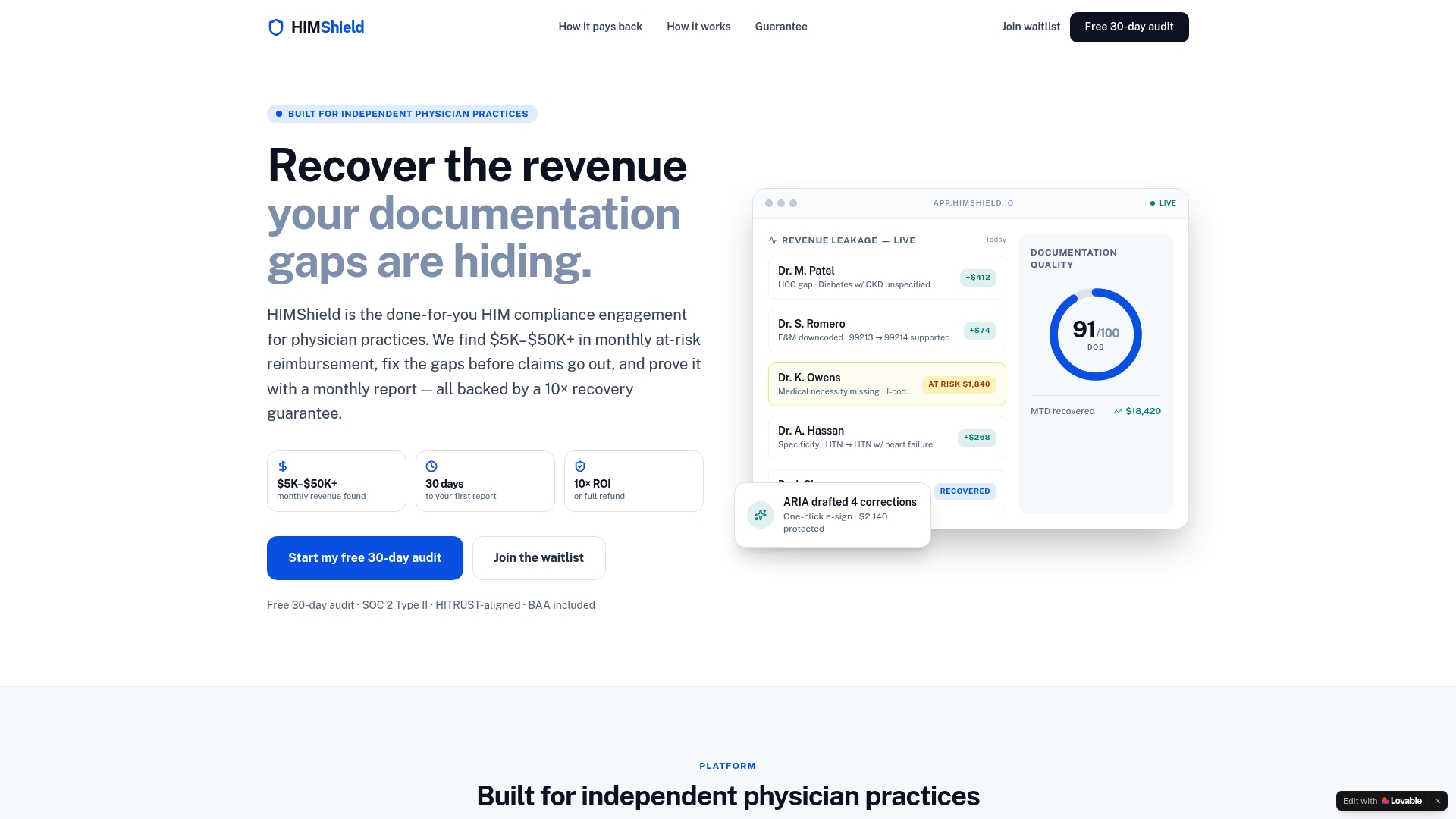
Practices typically see their highest-impact findings within the first 30 days. Himshield's revenue-recovery focus means every finding is tied to a dollar figure, so you know exactly where to direct limited staff time. For practices facing payer scrutiny or preparing for an annual coding review, that clarity is the difference between a reactive scramble and a defensible compliance posture. See how Himshield works and request a free initial review to find out what your practice's data reveals.
Useful sources and further reading
- Benchmarking: Types, Process, and Examples — Rework Resources: Core six-phase methodology and data-standardization guidance
- IIA Factsheet: Internal Audit Benchmarking — Institute of Internal Auditors Australia: IIA position on benchmarking as a guide, not a determinant
- Audit Finding Rate Benchmark — Hyperbots: Definition and formula for the audit finding rate metric
- Benchmarking as a Tool of Performance Audit: Accountability and resource-case applications of benchmarking
- The Complete Guide to Audit Performance Benchmarking — EOXS: Operational benefits and use cases
- How Compliance Audits Work for Healthcare Teams — ScanCompliant: External compliance-review perspective for healthcare teams
- Himshield: Recover Hidden Practice Revenue: Himshield platform overview and revenue-recovery value proposition
- Chart Audit Workflow Guide — Himshield Blog: Workflow guidance for chart reviews and internal audits
- Physician Practice Audit Survival Checklist — Himshield Blog: Step-by-step audit-prep checklist for independent practices