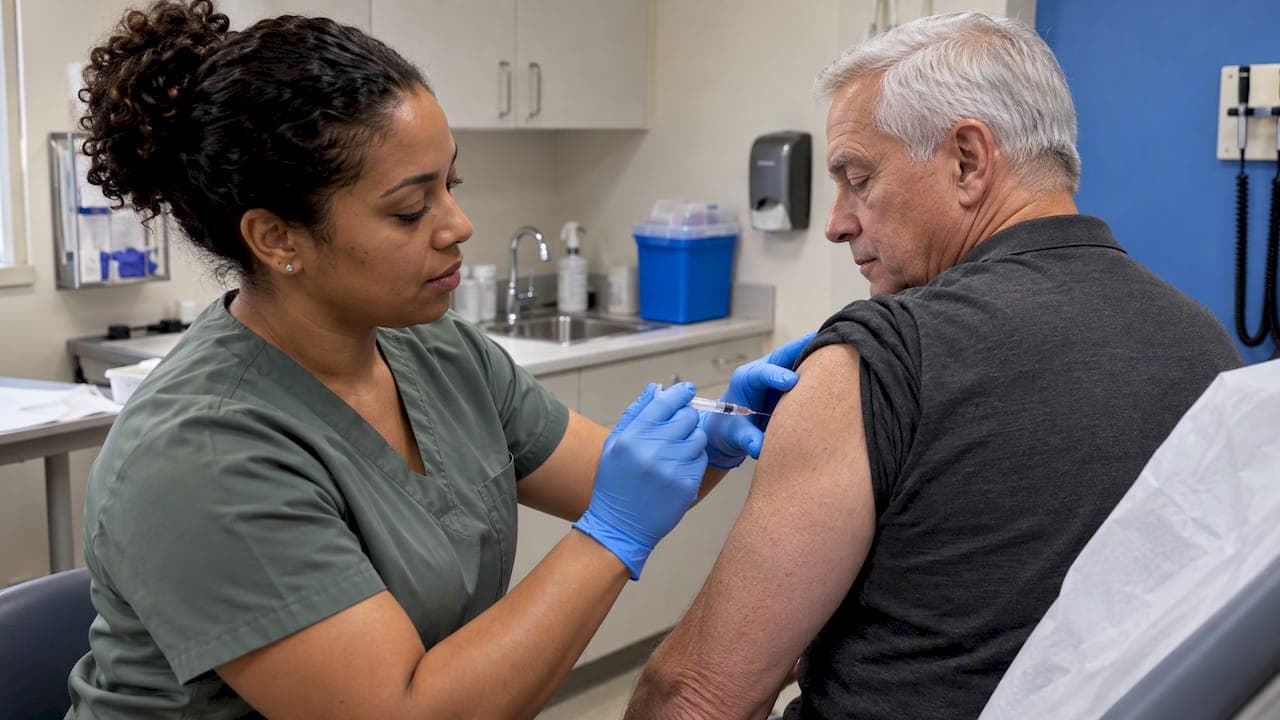
Vaccine administration is billed separately from the vaccine product, and the administration code you pick depends on three things: the payer, the patient's age with documented counseling, and the route. For commercial payers that usually means 90471–90474 or, for patients through age 18 with physician or qualified health professional counseling, 90460 and 90461. For Medicare Part B preventive vaccines it means HCPCS G0008, G0009 or G0010, or CPT 90480 for COVID-19. This guide walks through each family, the documentation behind it, and the pre-bill checks that keep clean claims clean.
TL;DR
- A complete office claim needs the vaccine product code and the administration code. Billing only the product leaves money on the table.
- Commercial: 90471 and 90472 for injectables, 90473 and 90474 for oral or intranasal. Through age 18 with counseling: 90460 and 90461, counted by vaccine component.
- Medicare Part B preventive vaccines use G0008 (influenza), G0009 (pneumococcal), G0010 (hepatitis B) and 90480 (COVID-19). Payment varies by locality and changes every year.
- The immunization record (lot number, manufacturer, VIS dates, administrator) is a compliance document, not just billing support.
- Version your payer and NCCI logic. Edits can change, even retroactively.
Table of Contents
- Product code plus administration code: the basic claim
- Commercial payers: the 90471 to 90474 family
- Patients through age 18: when 90460 and 90461 apply
- Medicare: G-codes, 90480 and local payment
- Documentation that supports the claim
- Rejections, denials and the 277CA
- Edits change: the 90480 lesson
- A pre-bill checklist for vaccine claims
- Our perspective: treat vaccines as a data-quality problem
- See what your vaccine claims are missing
- FAQ
- Sources
Product code plus administration code: the basic claim
Every vaccine visit has two billable pieces. The product code identifies what was given. The administration code reports the work of giving it. AAFP's vaccine administration guidance treats them as separate lines, and CDC's documentation guidance is why the chart has to support both.
The most common leak we see described in practice workflows is a product charge that fires from the vaccine inventory or order, while the administration charge depends on a nurse or medical assistant remembering to add it. When the two live in different parts of the EHR, they drift apart.
The diagnosis side is usually simple. Z23, Encounter for immunization, is the code commonly associated with preventive immunization, according to AAFP's Medicare vaccine coverage guide. For well-child visits, AAFP notes that ICD-10 guidelines treat Z00.121 or Z00.129 as including the immunization encounter, so check how your payers want the diagnosis sequenced.

Commercial payers: the 90471 to 90474 family
For commercial billing, the route and the sequence drive the code. According to AAFP:
| Code | What it reports | Notes |
|---|---|---|
| 90471 | First injectable vaccine | Covers percutaneous, intradermal, subcutaneous and intramuscular routes |
| +90472 | Each additional injectable vaccine | Add-on code, cannot be billed alone |
| 90473 | First oral or intranasal vaccine | Used when no injectable is reported first for that route family |
| +90474 | Each additional oral or intranasal vaccine | Add-on code, cannot be billed alone |
The Maryland Department of Health's vaccine administration billing manual lays out the same 90471 and 90472 structure for commercial payers, which is a useful cross-check if you want a public-sector reference.
Worked example: adult with two injectables
A 62-year-old comes in for a nurse visit and receives two intramuscular injections. The claim carries both product codes, 90471 for the first administration and 90472 for the second, each linked to Z23. Using 90471 twice, or dropping the add-on because it "looks like a duplicate," is a common error in both directions.
Worked example: injectable plus intranasal
When an injectable and an intranasal vaccine are given at the same visit, the injectable is typically reported with 90471 and the intranasal with 90474, since 90474 is the add-on for oral or intranasal vaccines. Confirm the payer's preference, because some payers publish their own sequencing rules.
Modifier 25 and the E/M question
If a significant, separately identifiable E/M service occurs on the same day as the vaccination, the E/M line generally carries modifier 25. The visit note has to show that the E/M stands on its own, with its own history, assessment and plan. A vaccine given during a visit that was only a vaccine visit does not support a separate E/M.
Patients through age 18: when 90460 and 90461 apply
Counseling changes the code family. ACOG's immunization coding resources and AAFP describe the rule the same way:
- 90460 is reported when a physician or qualified health professional provides face-to-face counseling at administration to a patient through age 18, for the first or only component of each vaccine.
- +90461 is reported for each additional component of a vaccine or toxoid. No modifier 51 is required.
- Without qualifying counseling, use the route-based codes (90471 to 90474) instead.
The important detail is the unit of counting. Under 90460 and 90461, a combination vaccine is counted by antigen components, not by syringe. A single syringe with several components produces one 90460 and multiple 90461 units. Counting syringes undercounts the work and the payment.
The flip side is documentation. If the claim says counseling happened, the note should show who provided it and that it was face to face. A clinically correct vaccination can still produce an indefensible claim if the note supports only the route-based family.
Medicare: G-codes, 90480 and local payment
Medicare does not use the commercial 90471 series for its preventive vaccines. The AAFP Medicare coverage guide lists these administration codes for Part B preventive vaccines:
| Vaccine | Administration code |
|---|---|
| Influenza | G0008 |
| Pneumococcal | G0009 |
| Hepatitis B | G0010 |
| COVID-19 | 90480 |
A few points that trip up practices:
- Coverage depends on the vaccine and the circumstance. Part B covers influenza, pneumococcal, COVID-19 and hepatitis B for beneficiaries who meet the risk requirement. Other preventive vaccines, including RSV in the cited guide, may fall under Part D, while therapeutic vaccines such as tetanus after an injury or rabies after an animal bite may be covered under Part B.
- Cost sharing. CMS states in its 2026 transmittal that Part B covers both the vaccine and its administration for these four vaccines, and that the annual deductible and coinsurance do not apply under the cited policy.
- Payment is local. The same transmittal sets the 2026 national vaccine administration fee schedule from January 1, 2026, adjusted by geographic locality. Do not hard-code one national amount into your charge master or your expected-payment logic.
COVID-19 coding is product-specific
COVID-19 is the family most likely to bite. CMS explains that each authorized or approved product gets a vaccine code, a dose-specific code when needed, and an administration code. The AMA's 2026 update notes that new CPT product codes replaced previously approved COVID-19 product codes. Practices should verify the current code set each season rather than rely on legacy mappings in the EHR.
Documentation that supports the claim
Coding is only as defensible as the chart. CDC requires complete permanent-record documentation for vaccines covered by the National Vaccine Injury Compensation Program:
- Date of administration
- Vaccine manufacturer and lot number
- Name and title of the person who administered it
- Facility address
- Edition date of the Vaccine Information Statement (VIS) and the date it was given to the patient, parent or legal representative
CDC also recommends recording adverse events and relevant serologic results, and giving the patient or legal representative a personal immunization record. The record serves patient safety, registry exchange and legal recordkeeping. An EHR template that captures only CPT and charge data is incomplete.
The lot number trap
Lot numbers look trivial and cause real data problems. CDC's NDC and lot number guidance says the lot number must be entered exactly and case-sensitively, without adding public or private prefixes or suffixes. For reconstituted vaccines, the lot to record may be the lyophilized vaccine lot, and unit-of-use versus unit-of-sale conventions for NDCs can differ. Scanning the 2D barcode, where your workflow supports it, removes most of the typing risk.
Rejections, denials and the 277CA
Not every failed vaccine claim is a denial. A claim that fails preliminary edits may be returned in a 277CA claim acknowledgment and never appear on the remittance advice. The eMedNY pre-adjudication crosswalk is Medicaid-specific, but the operational lesson applies broadly: exact edits and transactions vary by payer, and a rejected claim needs correction and resubmission, not an appeal.
For a vaccine workflow, that means someone should review 277CA responses as well as 835 remittances. A rejected administration line that nobody sees is revenue that is simply never billed. For the denial side, our guides on payer-specific denials and on how to reduce claim denials in a physician practice cover the follow-up process.
Edits change: the 90480 lesson
Payer logic is not permanent. According to CMS's NCCI page, CMS implemented 2025 NCCI procedure-to-procedure edits pairing COVID administration code 90480 with G0008, G0009 or G0010, then withdrew them retroactively. Affected Medicare claims were to be reprocessed within approximately 30 business days. CMS's October 2025 MLN Connects newsletter covers the reversal.
The practical takeaways for a pre-bill review process:
- Keep the code-set and NCCI version used for each claim.
- Identify the date-of-service ranges an edit change touches.
- Support correction or appeal for affected claims instead of quietly rewriting history.
- Version payer rules instead of hard-coding them into a practice-wide setting.
For a broader look at how these tables work, see our NCCI edits guide and the CMS 2026 action steps.
A pre-bill checklist for vaccine claims
Use this before the claim leaves the practice:
- Is there a product code and an administration code for every vaccine given?
- Does the administration code match the payer (G-code or 90480 for Medicare Part B preventive vaccines, 90471 to 90474 or 90460 and 90461 for most commercial payers)?
- For patients through age 18 billed with 90460 or 90461, does the note show face-to-face counseling by a physician or qualified health professional?
- Are combination vaccines counted by component where that family applies?
- Are add-on codes attached to a primary administration code on the same claim?
- Is Z23 (or the well-visit diagnosis the payer expects) linked to each line?
- If an E/M is billed the same day, does the note support a separate service for modifier 25?
- Are lot number, manufacturer, administrator, VIS edition and date, and facility captured exactly?
- For COVID-19, is the product code current for the date of service?
- Is anyone reviewing 277CA rejections as well as 835 denials?
Our perspective: treat vaccines as a data-quality problem
Vaccines are low-dollar per claim and high-volume, which is exactly why they leak. No single missed 90472 hurts. A seasonal flu clinic with a missing administration line on a share of charts adds up quickly, and nobody sees it because each claim looks fine on its own.
We built HIMShield to look at the pattern, not the single claim. Our platform scans EHR data before claims go out, flags coding, documentation and charge-capture gaps, and quantifies them in per-provider, per-payer Revenue Leakage Reports. For vaccines, that means asking questions a busy front desk cannot: where is a product charge posted without an administration charge, where is 90460 billed without counseling in the note, and where is a lot number missing or malformed.

We also believe fixes should not add work for physicians. Corrections are auto-drafted and go to the physician for a one-click e-signature, and documentation quality is scored in real time. Practices should not have to hire staff or retrain on new software to benefit.
Our view on payer rules is simple: never assume they are static. The 90480 reversal showed that even official edits can change after the fact, so a defensible process records which rules applied when.
— Elena
See what your vaccine claims are missing
If you suspect administration lines are slipping through, our free 30-day Revenue Leakage Audit quantifies coding, documentation and charge-capture gaps in your own EHR data, by provider and by payer. It comes with a performance guarantee and precedes any paid subscription. You can also learn more about our HIM compliance engagement.
FAQ
Can I bill 90471 and 90460 on the same visit?
Generally you choose the family by patient age and counseling, not by mixing them for the same vaccine. Use 90460 and 90461 for patients through age 18 when a physician or qualified health professional provides counseling. Otherwise use the route-based codes. Check your payer's policy for multi-vaccine visits.
Do I bill an administration code if the vaccine was free from a program?
The administration service is a separate service from the product, so it is generally reported separately from the product code. Program rules vary, so check the specific program and payer requirements, such as your state immunization program's billing guidance, before billing.
What diagnosis code goes with a routine vaccination?
Z23, Encounter for immunization, is commonly associated with preventive immunization, per AAFP. For well-child visits, ICD-10 guidelines treat Z00.121 or Z00.129 as including the immunization. Verify payer-specific rules by date of service.
Why was my vaccine claim never paid or denied?
It may have been rejected before adjudication. Claims that fail front-end edits can be returned in a 277CA and not appear on the remittance advice. Check the clearinghouse and payer acknowledgment reports, then correct and resubmit.
Is the Medicare vaccine administration payment the same everywhere?
No. CMS updates the national schedule annually and adjusts it by the geographic locality where the vaccine is given, per its 2026 transmittal. Look up your locality's amount rather than using a national figure.
Sources
- Coding For Vaccine Administration, AAFP
- Medicare Vaccine Coverage: Part B And D Coding Guide, AAFP
- Vaccine Administration: After Giving Vaccine, CDC
- Updated Guidance for Documenting Vaccine NDCs and Lot Numbers, CDC
- CMS Transmittal 13553, December 19, 2025
- Coding for COVID-19 Vaccine Shots, CMS
- NCCI for Medicare, CMS
- MLN Connects Newsletter, October 15, 2025, CMS
- COVID-19 CPT vaccine and immunization codes, AMA
- Vaccine Administration Codes, Maryland Department of Health
- Pre-Adjudication Crosswalk Tool, eMedNY