
TPE is a Medicare medical-review program that probes 20–40 claims per round for a specific provider and pairs each round with one-on-one education. It can repeat for up to three rounds. The most important move is simple: schedule and attend your MAC's education session, then use the window after it to correct documentation before the next sample is pulled.
TL;DR:
- Billing outliers, high denial rates, and services with high error rates can trigger selection; the MAC letter specifies the review topic, deadline, and submission method.
- After education, at least 45 days pass before the next selection; audit new claims on the reviewed topic and test corrections during that window.
- Submit complete records by the MAC’s deadline, follow its ADR instructions, place the request letter first, and include signature logs or attestations when needed.
- Thresholds vary by MAC and topic; persistent errors can prompt CMS referral, 100% prepayment review, extrapolation, or referral to a RAC or UPIC.
Table of Contents
- What TPE is and why CMS runs it
- How providers are selected and what the notification letter tells you to do
- What happens in each TPE round
- What you owe the MAC: records, deadlines and packet discipline
- What happens if your error rate doesn't improve
- Your TPE checklist from notification to post-education
- Why we treat TPE as an opportunity
- HIMShield can get your practice audit-ready before the letter arrives
- FAQ
- Sources
- Primary CMS and MAC resources to read next
What TPE is and why CMS runs it
Targeted Probe and Educate is an education-first review stream. CMS states that the primary goal is to reduce claim denials and appeals by creating a direct channel between your Medicare Administrative Contractor (MAC) and your practice. Instead of simply denying claims and leaving you to guess why, the MAC explains what it expects for medical necessity and documentation.

That makes TPE different from audit streams built around recoupment. It targets specific providers, or specific items and services with high national error rates, and it gives you a structured chance to fix the problem.
Here is why the education-first design matters for your revenue cycle:
- Denials get a teaching moment. Each round ends with claims-specific feedback you can apply immediately.
- Fixes are measurable. The MAC calculates claim and payment error rates, so you can see whether changes worked.
- Escalation is avoidable. A practice that improves between rounds can be released from review.
- Lessons carry over. Documentation habits you correct for TPE also cut denials on claims outside the sample. Our guide to reducing claim denials in a physician practice covers the tactics that line up with TPE remediation.
How providers are selected and what the notification letter tells you to do
MACs identify candidates through data analysis. Billing outliers, high claim denial rates and services with high national error rates all raise your profile. Referrals from other government contractors can also put a provider in the queue. A group with several NPIs or service lines may find more than one of them targeted.
Selection arrives in writing. The notification letter typically spells out the following:
- The reason you were selected
- The review topic, meaning the item or service under review
- The sample size and how many claims to expect
- Submission instructions and the method the MAC wants you to use
- A point-of-contact (POC) form
- The rules and deadlines for additional documentation requests (ADRs)
Treat the letter as a work order, not a notice to file. The initial response should look like this:
- Designate your POC. One person owns communication with the MAC.
- Pull the records. Start gathering charts for the claims in the sample.
- Confirm the submission method. Portal, fax, mail or esMD: know it before the deadline clock gets tight.
Read the letter's topic line carefully. If the review targets a particular code or service, your documentation prep should center on exactly that.
What happens in each TPE round
Every round follows the same mechanics, and knowing them lets you plan around the calendar. According to the CMS TPE Q&As, a standard probe reviews 20–40 claims per provider per item or service, and the MAC may use prepayment or post-payment review. CMS compliance program materials show the basic flow from notification through sampling, education and a window to cure.
- Notification. The MAC sends the letter and the ADR requests for the sampled claims.
- Record review. The MAC reviews the submitted documentation against coverage and documentation requirements, then calculates claim and payment error rates.
- Intra-probe fixes. Easily curable problems, such as a missing signature or a missing page, can be resolved during the probe, with a chance to resubmit.
- One-on-one education. The session is individualized, claims-specific and interactive. You can ask why a claim failed and what a passing record looks like.
- The cure window. CMS materials describe a minimum of about 45 days after education before the next claims are selected. If you have appeals pending, the MAC may consider their outcomes in later rounds.
- Next round or release. Results decide whether you are released or move to another round, up to three.
Pro Tip: Treat the 45-day window as a live test, not a waiting period. Pull a sample of new claims on the reviewed topic, audit them against the MAC's feedback, and fix what fails before the MAC pulls its own.
Our explainer on what a provider education session involves can help your team prepare questions in advance.
What you owe the MAC: records, deadlines and packet discipline
Your responsibilities are narrow but unforgiving. Late or incomplete submissions are the easiest way to turn a fixable review into a bad error rate.
- Meet the stated deadline. Submit requested records within the timeframe in the MAC's letter.
- Follow ADR instructions exactly. If the MAC asks for specific documents, send those, in the format requested.
- Lead with the request letter. Place the MAC's request on top of each submission packet so reviewers can match it to the claim.
- Cover signature gaps. Include a signature log or attestation when a signature is illegible or missing.
- Send complete records. Orders, notes, test results and supporting documents belong in the packet, not in a follow-up.
- Keep one voice. Your designated POC coordinates the response and schedules the education session.
Pro Tip: Keep a copy of every packet exactly as sent, along with proof of delivery. If a dispute comes up later about what the MAC received, you will want that record.
Medical necessity is where many records fall short. Our medical necessity documentation examples show the kind of chart language that holds up on review, and our guide to stopping Medicare medical necessity denials covers what MACs commonly cite.
What happens if your error rate doesn't improve
Outcomes depend on how your claims perform across rounds. The CMS TPE Q&As explain that MACs calculate error rates to decide whether you progress or are referred. Thresholds are set at the MAC's discretion and can vary by MAC or topic, so steady documentation gains matter even when you are not yet perfect.
- Improvement leads to release. A provider who passes is released from the review and may be monitored afterward.
- Persistent errors mean more rounds. You can face up to three rounds, each with education.
- Persistent errors can lead to referral to CMS. From there, escalations can include 100% prepayment review, extrapolation of errors across a larger claim universe, or referral to a RAC or UPIC.
- Revocation language appears. CMS reminders in results letters cite 42 CFR §424.535, which covers revocation of Medicare enrollment.
- Appeals stay available. You keep your normal appeal rights on denied claims, and the outcomes may be considered in later rounds.
The takeaway is that the education step is your best leverage. Practices rarely reach referral because of one bad round. They get there when the same errors repeat after being explained.
Your TPE checklist from notification to post-education
Work this sequence in order. Each step feeds the next.
- Designate the POC and lock the logistics. Confirm the MAC's submission method and every deadline in the letter, and put them on a shared calendar.
- Assemble the full records. Gather every requested claim with its complete chart. Add signature logs or attestations wherever a signature is questionable, and put the MAC's request letter on top.
- Attend the education session and act on it. Bring your coding and clinical leads. Within days, turn the feedback into a mock audit of new claims on the same topic.
- Fix the root causes. Update templates, retrain providers on the cited documentation gaps, and adjust charge-capture workflows.
- Document and track. Record each corrective action, who owns it and its date, and track your own claim error rate across the window.
- Prepare for what's next. Plan as though a second or third round is coming. If release comes instead, you will have a stronger practice either way.
Why we treat TPE as an opportunity
I read TPE as the cheapest compliance training a practice will ever get. The MAC tells you, claim by claim, what it will not pay for. Practices that use the education window to test their fixes on real claims tend to stop the denial pattern for good, and they cut their odds of escalation. Waiting until the next sample arrives wastes the one lever you control.
— Elena
HIMShield can get your practice audit-ready before the letter arrives
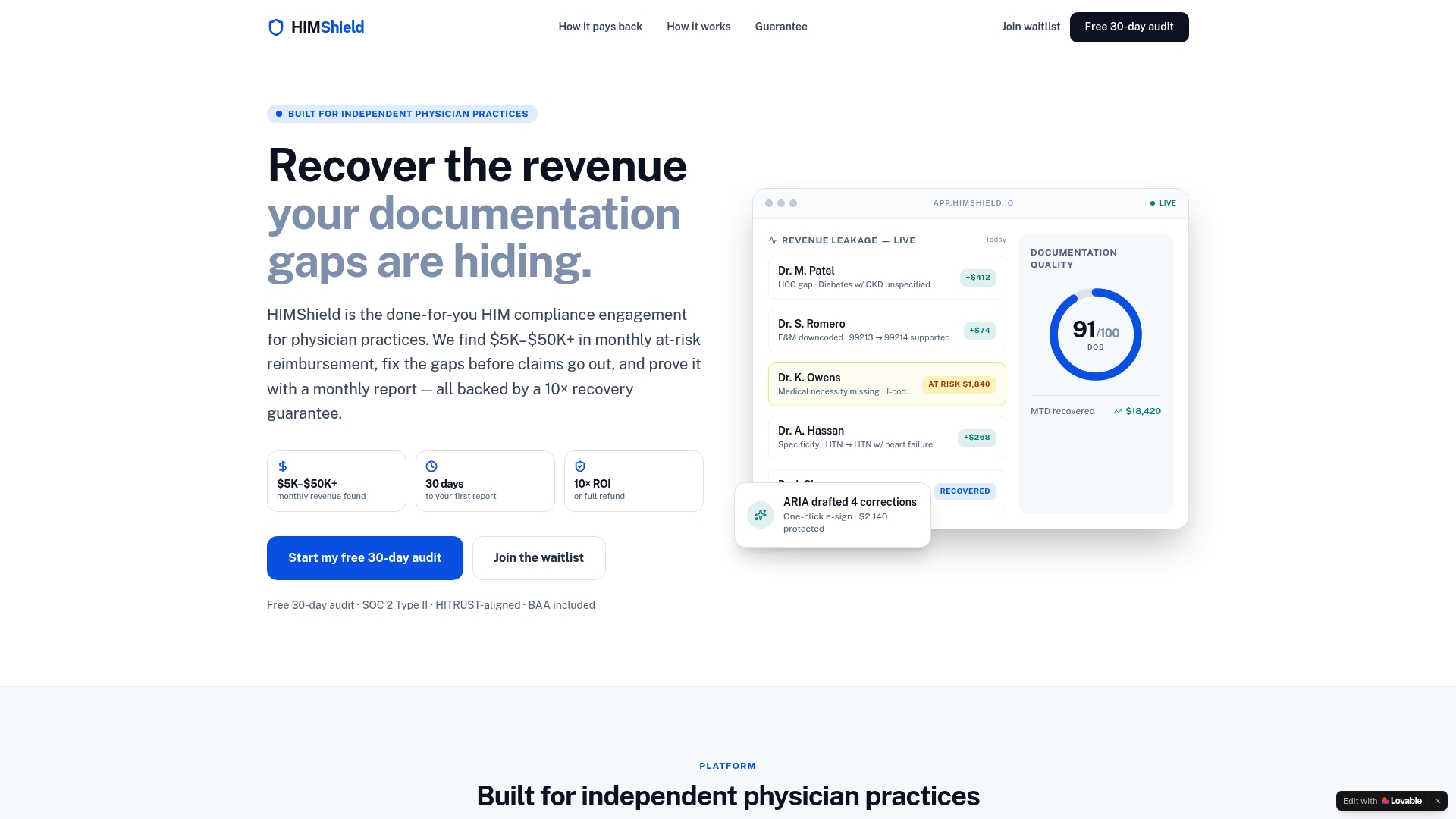
Finding documentation gaps after a MAC finds them costs more than finding them first. We built our Free 30-day Revenue Leakage Audit to show you where coding and documentation risk sits in your own EHR data. Here is what we do for practices:
- Scan charts for coding, documentation and charge-capture gaps and quantify the revenue at risk
- Draft corrections for one-click physician e-signature
- Assemble submission-ready responses and support audit defense
Request your free audit today, or talk to us about our HIM compliance engagement.
FAQ
What is a Medicare Part B TPE review?
It is a provider-specific medical review run by your MAC. The CMS TPE Q&As describe rounds that typically review 20–40 claims, followed by one-on-one education, for up to three rounds.
What is the goal of the TPE audit process?
The goal is education, not punishment. CMS says TPE exists to reduce claim denials and appeals through direct, individualized help from your MAC.
How long do I have to fix errors after education?
CMS materials describe a minimum 45-day window before the next claim selection. Use it to audit new claims and correct recurring documentation problems.
What happens after three TPE rounds?
If error rates stay high, the MAC can refer you to CMS. Possible escalations include 100% prepayment review, extrapolation, or referral to a RAC or UPIC.
Can a missing signature sink a claim?
Not always. MACs can resolve easily curable errors, such as missing signatures or pages, during a probe. Include signature logs or attestations with your records to avoid unnecessary denials.
Sources
- Targeted Probe and Educate | CMS
- Targeted Probe and Educate (TPE) Q & A’s
- Medicare Fee-for-Service Compliance Programs | CMS
Primary CMS and MAC resources to read next
Go to the source for operational detail, and check your own MAC's website for jurisdiction-specific guidance. The Medicare Program Integrity Manual is the CMS reference for review procedures.
- CMS Targeted Probe and Educate program page
- CMS TPE Q&As (PDF)
- CMS Medicare Fee-for-Service Compliance Programs