
SDOH Z codes are the ICD-10-CM codes in categories Z55 through Z65. They record social circumstances such as housing instability, food insecurity, unemployment or limited health literacy on a patient's claim and record. For a physician practice, the work is not memorizing the list. The work is making sure the chart supports the code, the code is on the claim, and the documentation also backs up your E/M level.
TL;DR
- SDOH Z codes sit in categories Z55–Z65 of ICD-10-CM, and new codes can take effect each April 1 and October 1.
- Assign a Z code only when the medical record documents a problem or risk factor that affects the patient's health. Staff notes from nurses, social workers and case managers can count.
- Report as many Z codes as needed to describe the encounter, as the official guidelines direct.
- Documented social factors can also shape the complexity of medical decision making, so thin SDOH notes can cost you accuracy on E/M claims.
- Use the CDC's ICD-10-CM browser for the current code list rather than a static chart.
Table of Contents
- What SDOH Z codes are
- The Z55–Z65 categories at a glance
- Where to find the current code list
- How to document SDOH so a Z code is supportable
- Reporting Z codes on claims
- Does Medicare accept Z codes, and do they pay?
- Why practices under-use SDOH codes
- Our perspective: treat Z codes as documentation quality, not extra coding
- A short workflow for your practice
- Find the gaps in your own charts
- FAQ
- Sources
What SDOH Z codes are
Z codes describe factors that influence health status or contact with health services, and that are not classified as a disease or injury. The SDOH subset is the group CMS points to for documenting housing, food insecurity and transportation.
They do not diagnose anything. They add context: why a patient missed follow-ups, why a treatment plan is harder to carry out, why a visit took longer than the diagnosis alone suggests.
The codes also feed several uses beyond your own chart. CMS lists care coordination and referrals, quality measurement, and planning of social-needs interventions as reasons to collect SDOH data.
The Z55–Z65 categories at a glance
CMS describes the SDOH range as ten categories. Z61 is not on the CMS list, a point we cover below.
| Category | What it covers | Typical chart example |
|---|---|---|
| Z55 | Education and literacy | Patient cannot read discharge instructions; low health literacy |
| Z56 | Employment and unemployment | Job loss, work stress, unstable hours |
| Z57 | Occupational exposure to risk factors | Dust, noise or chemical exposure at work |
| Z58 | Physical environment | Inadequate housing conditions, lack of safe water |
| Z59 | Housing and economic circumstances | Homelessness, food insecurity, financial strain, inadequate insurance |
| Z60 | Social environment | Social isolation, acculturation difficulty |
| Z62 | Upbringing | Parent-child conflict, foster care history |
| Z63 | Primary support group | Family disruption, caregiver stress, death of a family member |
| Z64 | Certain psychosocial circumstances | Problems related to legal or counseling circumstances |
| Z65 | Other psychosocial circumstances | Imprisonment, other legal circumstances, other stressors |
The category list comes from the CMS Office of Minority Health resource. The examples are plain-language illustrations of the category titles. Always pick the final code from the current code set, not from a table like this one.
One wrinkle: CMS does not highlight Z61 as an SDOH code, but a published analysis notes it may still be treated as contextual SDOH during an encounter. Check your payer's policy before relying on it.
Where to find the current code list
CMS tells readers to use the CDC National Center for Health Statistics ICD-10-CM browser to search for all current Z codes. That matters because the set changes. CMS posts the annual update files, including the 2027 ICD-10-CM files for encounters from October 1, 2026 through September 30, 2027.
A practical routine for your coding lead:
- Every October and April, check the CDC and CMS update pages.
- Search the Z55–Z65 range in the browser, not a printed cheat sheet.
- Update your EHR code favorites and your superbill or charge-capture list.
- Tell clinicians and scribes about new codes in a short huddle, not a long memo.
If your EHR's diagnosis picker is out of date, clinicians cannot select codes that exist. That is a quiet source of missed capture.
How to document SDOH so a Z code is supportable
The rule is simple. Assign an SDOH Z code only when documentation in the official medical record specifies an associated problem or risk factor that influences the patient's health. Coders may use documentation from social workers, community health workers, case managers or nurses that is part of that record.
That last point is valuable for small practices. The physician does not need to write every social detail. A medical assistant or nurse can capture it, as long as it lives in the chart.
What a good entry contains
- The specific circumstance. "Patient reports eviction notice, staying with a relative" supports housing coding. "Social issues" does not.
- The link to health. One line tying it to care: missed insulin refills because of cost, or no transportation to the cardiology visit.
- Who documented it and when. The date and role keep the entry defensible.
- The response. A referral, a resource handout or a plan to follow up. Even a note that the patient declined help shows the issue was addressed.
Screening versus documenting
SDOH information can be gathered before, during or after a visit through structured health risk assessments and screening tools. Practices differ in method: a tablet at check-in, a paper form, or a two-question staff script. Researchers studying populations sometimes pair social surveys with biological measures, using tools such as bioassays for biomedical research, but a physician office needs only a consistent, repeatable screen and a place in the chart to store the answer.
Whatever method you pick, the screening result alone is not enough. A completed questionnaire sitting in a scanned folder will not reach the claim. Someone has to translate a positive answer into a documented problem and a code.

Reporting Z codes on claims
The ICD-10-CM Official Guidelines state that Z codes explain reasons for encounters or give relevant supplementary information, and that you should assign as many codes as necessary to describe the circumstances. The guidelines are approved by the Cooperating Parties: AHA, AHIMA, CMS and NCHS.
In practice:
- List the clinical diagnosis first when it drives the visit. SDOH codes are secondary in most office encounters, adding context.
- Code each documented need. A patient with food insecurity and unstable housing gets both codes, if both are documented.
- Keep the diagnosis pointer clean. Make sure the codes carry through from the encounter to the claim form without being dropped by a crowded diagnosis line.
Medicaid programs also pull these codes from claims. CMS reminds states to report SDOH Z codes as diagnosis codes in T-MSIS claim files, in the order they arrive on the claim. If your practice sees Medicaid patients, an SDOH code you omit is data the state never receives.
Does Medicare accept Z codes, and do they pay?
Z codes are valid diagnosis codes, and Medicare fee-for-service claims carry them. CMS data show that family practice, internal medicine and psychiatry physicians, nurse practitioners and licensed clinical social workers accounted for about 68% of Medicare FFS Z code claims in 2019. Primary care is where most of them originate.
Do not expect a Z code to raise payment on its own. CMS research names lack of financial incentive for payment among the barriers to use, along with limited code granularity and provider uncertainty about who is responsible for the non-medical needs identified.
The financial value is indirect. The American Osteopathic Association notes that documenting SDOH elements can influence the complexity of medical decision making in E/M coding, supporting more accurate billing. If a social factor really limits your management options, say so in the note. A visit coded 99214 needs documentation that supports the level, and our 9-point documentation checklist for 99214 walks through what auditors look for.
Policy language is also shifting. Value-based models raise the weight of this data: the American Hospital Association argues that the move away from volume-based payment makes SDOH claims data vital for policy reform and patient-centered interventions. Check CMS's current rulemaking and your payer contracts for the terms in force, since both change.
Why practices under-use SDOH codes
CMS research points to two common physician-side barriers. One is the tension between recognizing social needs and feeling that clinic capacity or responsibility does not extend to housing or food problems. The other is simple unfamiliarity. The same research suggests broader training may help providers understand why Z codes matter and how to use them.
To that, we would add what we see in independent practices:
- The screening happens, but the answer never reaches the coder.
- Clinicians document in free text that does not map to a code.
- Codes exist in the EHR but are buried in a long diagnosis search.
- Nobody owns the October update.
None of these is a clinical problem. They are workflow problems, and workflow problems can be fixed.
Our perspective: treat Z codes as documentation quality, not extra coding
We work with independent physician practices on coding, documentation and charge-capture gaps. Here is how we see SDOH Z codes.
The code itself is the smallest part. What matters is whether the note says, clearly and specifically, what the patient's circumstance is and how it changes care. That same quality of documentation is what protects an E/M level in an audit, supports medical necessity, and keeps a claim from being denied for vagueness. SDOH documentation, E/M documentation and diagnosis specificity are one discipline. Our guides on ICD-10 specificity and medical necessity documentation cover the neighboring ground.

We also think practices should not ask physicians to do more clicking. Pull social information from the staff who already collect it, let the coder confirm it, and let the physician review and sign. Less friction means more of the documentation that is already happening reaches the claim.
Finally, treat code updates as a calendar task. Our CMS coding updates action steps describe how to make the October and April changes routine rather than a scramble.
— Elena
A short workflow for your practice
A lean process for a small group might look like this:
- Pick one screening tool and one moment. Check-in or rooming, same questions each time.
- Record answers in a structured field. A discrete EHR field beats a scanned form.
- Have the clinician or nurse note the health link. One sentence.
- Let the coder map the entry to Z55–Z65. Confirm that the documentation meets the rule above.
- Check the claim before it goes out. Are the Z codes on the claim and pointed correctly?
- Review quarterly. Count how many encounters had a positive screen and how many carried a Z code. A gap between the two is lost documentation.
That last metric is the one most practices have never seen. It shows immediately whether the program is working.
Find the gaps in your own charts
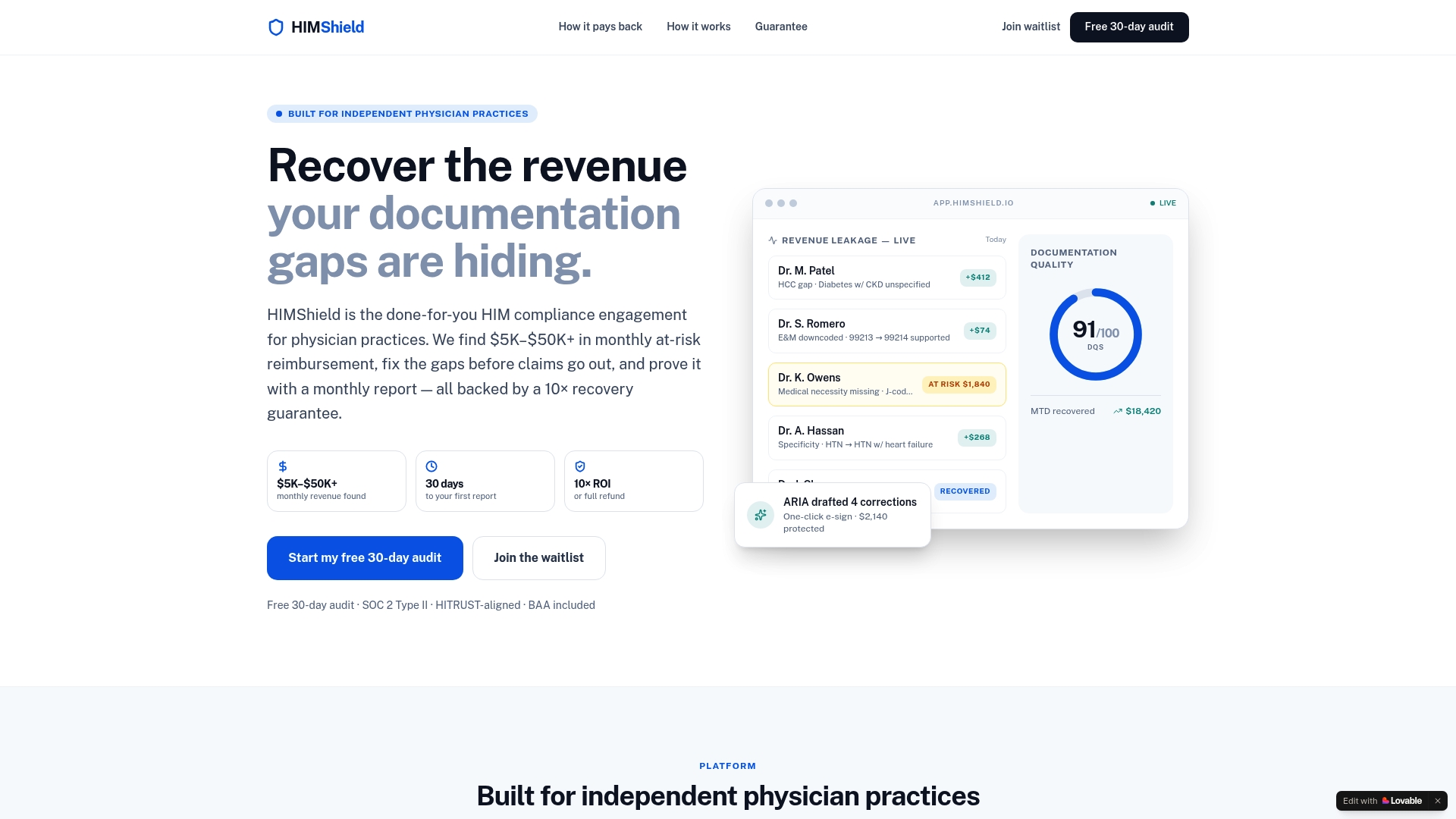
SDOH capture is one of several places where documentation and coding slip between the visit and the claim. HIMShield scans your EHR data for coding, documentation and charge-capture gaps before claims go out, quantifies them in per-provider, per-payer Revenue Leakage Reports, and drafts corrections for one-click physician e-signature.
You can start with the free 30-day Revenue Leakage Audit, which comes before any paid subscription and carries a performance guarantee. If you want the broader picture first, see how our HIM compliance engagement works for independent practices.
If unspecified diagnoses are part of the problem, our guide to unspecified code denials is a good next read.
FAQ
What are the Z codes for SDOH?
SDOH Z codes fall in categories Z55 through Z65 of ICD-10-CM. They cover education and literacy, employment, occupational exposure, physical environment, housing and economic circumstances, social environment, upbringing, primary support group, and other psychosocial circumstances. Use the CDC's ICD-10-CM browser for the exact current codes.
Where can I find the current list of Z codes?
The CDC National Center for Health Statistics maintains the ICD-10-CM browser, and CMS points to it for the full current set. CMS also posts annual update files on its ICD-10 page. New codes can take effect each April 1 and October 1, so check both pages twice a year.
Can a nurse or social worker's note support a Z code?
Yes. Coders may use documentation from social workers, community health workers, case managers or nurses, provided it is part of the patient's official medical record. The note should name a specific problem or risk factor that affects the patient's health.
Does Medicare accept Z codes?
Medicare fee-for-service claims do carry Z codes, and primary care clinicians submit most of them. The codes do not carry a payment add-on by themselves. Their value comes from accurate documentation, care coordination and, where the social factor affects management, support for the complexity of medical decision making.
Sources
- CMS Office of Minority Health: Improving the Collection of Social Determinants of Health Data with ICD-10-CM Z Codes
- CMS: Utilization of Z Codes for Social Determinants of Health among Medicare Fee-for-Service Beneficiaries
- CDC/NCHS: ICD-10-CM Official Guidelines for Coding and Reporting, FY 2026
- CMS: ICD-10 codes and annual update files
- Medicaid.gov: T-MSIS reporting reminder on Z codes for SDOH
- American Osteopathic Association: Coding for SDOH
- American Hospital Association: Social Determinants of Health
- Social determinants of health Z-code documentation practices (PMC)
- Bioassays for biomedical research