
Modifier 25 is appropriate only when the evaluation and management (E/M) service is significant, separately identifiable, and stands on its own with a distinct history, exam, or medical decision-making (or documented total time) apart from the procedure billed that same day. That's the entire standard. Everything else in this guide exists to help you prove it on paper. Both the AMA's CPT guidance and CMS enforcement priorities converge on this same point, and the OIG's 2025 review shows what happens when practices treat it as optional.
If your practice bills procedures alongside E/M visits with any regularity, that statistic isn't background noise. It's a preview of what a payer's medical review team is trained to look for in your charts.
Key Takeaways
Modifier 25 survives medical review only when the E/M has its own history, exam, and decision-making (or documented time) that's fully separable from the procedure billed the same day.
| Point | Details |
|---|---|
| Meet the stand-alone test | The E/M must have its own HEM or documented time, independent of the procedure note. |
| Watch the OIG's own numbers | A 2025 OIG review found most sampled E/M documentation didn't support modifier 25 on same-day injection claims. |
| Fix the EHR workflow | Require a written justification field before allowing modifier 25 to auto-append. |
| Track payer policy shifts | BCBSM and Anthem both narrowed 2026 reimbursement rules for E/M services billed with modifier 25. |
| Audit before payers do | Himshield's free 30-day audit flags weak modifier 25 documentation and scores chart quality before claims go out. |
Table of Contents
- What Is Modifier 25 Documentation and When Does It Apply?
- What Documentation Does Modifier 25 Require in the Chart?
- What Triggers a Modifier 25 Audit or Payment Recoupment?
- Chart Templates That Hold Up Under Medical Review
- How Should a Practice Self-Audit Modifier 25 Claims?
- Frequently Asked Questions
- Sources
What Is Modifier 25 Documentation and When Does It Apply?
Modifier 25 attaches only to E/M codes, never to the procedure code itself, and it tells the payer that the E/M work was distinct from whatever procedure happened on the same visit. The AMA's reporting brief is explicit that CPT does not require a different diagnosis code for the E/M and the procedure. What it does require is proof that the E/M involved work above and beyond the procedure's usual pre and post care.
The AAFP frames this as a three-question test worth running on every claim before it goes out the door:
- Could the E/M service stand entirely on its own, with its own history, exam, and medical decision-making (or its own documented time)?
- Did that E/M include a separate history/exam/MDM component, not just notes that support the procedure decision?
- Did the work go above and beyond what you'd normally do to evaluate and prepare for the procedure itself?
A patient comes in for a scheduled wart removal and mentions new chest tightness that triggers a cardiac workup: that's a textbook modifier 25 scenario. A patient comes in specifically for a joint injection and the note only documents the joint exam that justified the injection: that's procedure-only work, and modifier 25 doesn't belong on the claim. Don't confuse this with modifier 57, which flags an E/M that led to the decision for major surgery. Modifier 25 is a same-day, minor-procedure pairing; modifier 57 covers the decision-for-surgery visit before a major procedure's global period starts.
What Documentation Does Modifier 25 Require in the Chart?
Auditors don't read your claim form. They read your chart, and the chart has to answer the three-question test without help from anyone in billing. Noridian's Medicare Part B guidance is blunt about this: the E/M needs its own history, exam, and medical decision-making, or the modifier doesn't apply.
Four elements need to show up in every chart that carries modifier 25:
- A separate HEM or documented total time for the E/M, distinct from what supports the procedure.
- Explicit clinical rationale stating why the E/M wasn't simply pre-procedure or post-procedure work.
- Clinician signature and patient identifiers on both the E/M note and the procedure note, even when they're logged in the same encounter.
- A clear diagnosis linkage showing the E/M addressed a problem the procedure didn't already cover, even if the codes share a diagnosis.
The wording matters more than practices assume. A weak note reads: "Patient here for injection, also has some knee pain, injection given." A defensible note reads: "Patient presents for scheduled joint injection. Separately, patient reports new onset right knee swelling and instability over 3 days; exam reveals effusion and positive McMurray test, differential includes meniscal tear vs. ligamentous injury; ordered MRI and referred to orthopedics." The second version passes the AAFP's stand-alone test because a reviewer could read only that paragraph and still understand a complete, separate medical decision.
EHR structure either helps or sabotages this. Physically separate the E/M note from the procedure note rather than blending them into one narrative block, and build metadata that timestamps each component separately when time-based billing applies. One habit causes more denials than any other: letting the EHR auto-append modifier 25 whenever an E/M and procedure code land on the same encounter. The American Academy of Ophthalmology has flagged this auto-append behavior as a leading cause of unsupported claims, because the software adds the modifier before anyone confirms the documentation actually earns it.
Pro Tip: Require a mandatory free-text justification field before your EHR allows modifier 25 to be appended. Practices that skip this step see far more audit failures than those that force clinicians to type a one-line rationale first.
Two quick real-world pairings show the pattern: a wound check that turns up new focal neurological symptoms warranting a distinct neuro exam, or an annual wellness visit where the clinician uncovers an unexpected high-acuity problem, like uncontrolled blood pressure with symptoms, that demands its own workup beyond the preventive checklist.
What Triggers a Modifier 25 Audit or Payment Recoupment?
The intravitreal injection findings weren't a one-specialty problem. Ophthalmology got the spotlight in 2025, but the same billing pattern, high-frequency procedures paired with routine modifier 25 use, shows up in dermatology, orthopedics, pain management, and primary care. Payer analytics teams look specifically at high-level E/M codes like 99214 and 99215 billed alongside procedures, because if the MDM complexity is really just the decision to do the procedure, the E/M shouldn't be billed separately at all.
Automated systems flag practices for a handful of predictable reasons:
- A modifier-to-procedure ratio that runs meaningfully higher than specialty peers.
- Frequent pairing of high-level E/M codes with the same recurring procedure.
- EHR logs showing modifier 25 auto-appended without a documented justification.
- Same-diagnosis E/M and procedure claims with no distinguishing exam findings.
Payer policy is tightening the screws further. BCBSM clarified its reimbursement policy in February 2026, limiting payment for E/M services appended with modifier 25 alongside minor procedures, and Anthem's own update, effective April 1, 2026, added non-reimbursable rules for specific code pairings. Neither insurer is banning modifier 25. Both are narrowing what they'll pay without a fight.
If a payer flags your claims, pull the charts immediately, run a focused re-review against the three-question test, and assemble the documentation before the review deadline rather than after. Practices that scramble at the request stage lose more appeals than those with an audit trail already built into their normal workflow.
Chart Templates That Hold Up Under Medical Review
Two templates cover most modifier 25 scenarios and give clinicians a structure that survives review without slowing down the visit.
Template A: preventive visit plus problem-focused E/M. Document the preventive service in its own section, then open a separate section titled something like "Additional Problem Addressed Today" with its own HEM: chief complaint, relevant history, exam findings limited to that problem, and the assessment/plan. Sample phrasing: "During today's annual wellness visit, patient reported new intermittent chest pain over the past week. This required a focused cardiac history, exam, and EKG order, separate from the preventive service."
Template B: minor procedure plus separately reportable E/M. Keep the procedure note (consent, technique, findings) entirely separate from the E/M note. The E/M section should state the specific complaint that prompted additional evaluation and name the extra work performed. Sample phrasing: "In addition to the scheduled procedure, patient presented with a new complaint requiring independent evaluation, distinct history, exam, and clinical decision-making documented below."
Build both templates into your EHR as structured fields, not free-text afterthoughts, and require a short justification before the modifier can be appended at all.
Pro Tip: Give clinicians a two-minute training refresh on these templates rather than a policy memo. Behavior change sticks when it's built into the click path, not buried in a PDF nobody reopens.
For deeper scenario libraries, Himshield's modifier usage guide and its medical necessity documentation examples walk through additional specialty-specific phrasing.
How Should a Practice Self-Audit Modifier 25 Claims?
Run this workflow quarterly, not just after a payer letter arrives:
- Pull your top 10 billed procedures paired with same-day E/M claims and sort by modifier 25 frequency to spot outliers against your own baseline.
- Review each chart for a stand-alone HEM or documented time, distinguishing clinical language, and complete signatures with patient identifiers on both notes.
- Score each claim against the three-question test and flag anything that fails even one criterion.
- Assign corrective actions: targeted clinician retraining, an EHR safety check that blocks auto-append, and voluntary claim corrections or refunds where documentation clearly falls short.
- Set a re-audit date 90 days out to confirm the fix held, and escalate to compliance counsel if the failure rate stays above your internal threshold or a pattern suggests systemic upcoding.
A risk-based sampling approach makes this faster by focusing review time on the highest-volume, highest-risk codes first instead of a flat random sample.
Why Documentation Gaps Persist Even in Good Practices
The blind spot isn't bad intent, it's speed. Clinicians are documenting fast between patients, and the EHR's one-click convenience quietly does the coding decision for them before anyone reviews whether the note earns it. That gap is exactly where prevention beats correction: a justification field that forces a pause costs a clinician fifteen seconds and saves a practice a five-figure recoupment. Himshield's own audit work backs this up, and it's the reason our platform builds that pause directly into the workflow rather than relying on a training memo nobody rereads after week one.
Catch Modifier 25 Errors Before a Payer Does
Himshield gives you the pause your EHR won't: automated detection that flags weak modifier 25 documentation in your EHR data before the claim ever reaches a payer, a real-time documentation quality score for every E/M paired with a procedure, and a one-click correction workflow that routes flagged charts straight to the physician for an e-signature fix.
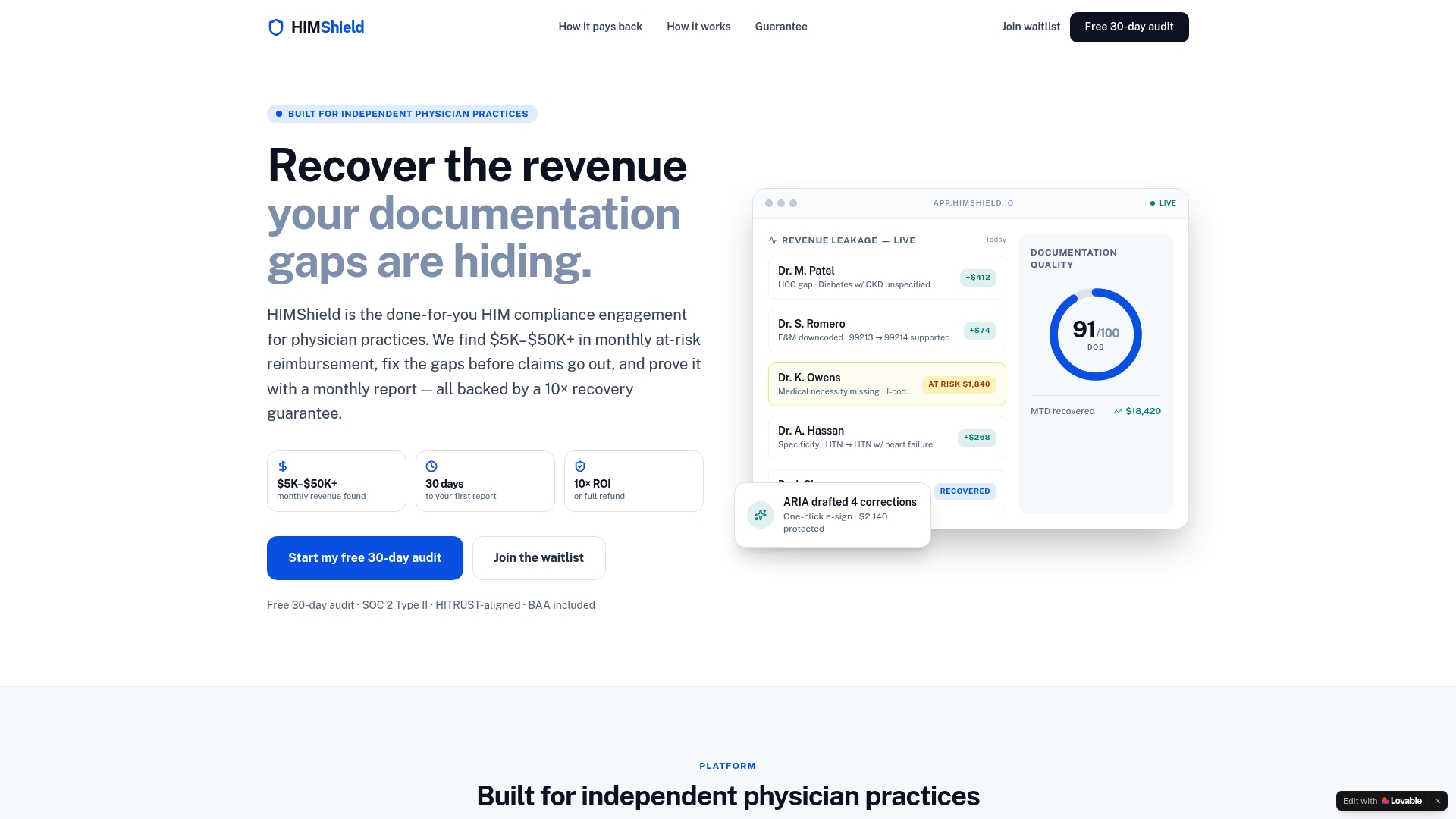
Instead of waiting for an OIG-style audit to tell you where the gaps are, Himshield's free 30-day audit scans your actual claims and hands your practice a per-provider, per-payer revenue leakage report, backed by a performance guarantee, so you know exactly which charts need attention before a payer's medical review team finds them first. See how Himshield connects to your EHR and request your audit this week.
Frequently Asked Questions
What is the single biggest documentation mistake with modifier 25? Letting the E/M note and the procedure note share the same paragraph with no distinguishing history, exam, or MDM. Reviewers need to read the E/M section alone and see a complete, separate medical decision.
Does modifier 25 require a different diagnosis code than the procedure? No. The AMA's guidance is explicit that CPT doesn't require different diagnoses for the E/M and the procedure, only that the E/M itself is separately identifiable and documented.
How is modifier 25 different from modifier 57? Modifier 25 covers a significant, separately identifiable E/M on the same day as a minor procedure. Modifier 57 flags an E/M that led to the decision for major surgery, tied to that procedure's global period, not a same-day minor procedure pairing.
What should a practice do immediately after finding unsupported modifier 25 claims in a self-audit? Pull the flagged charts, retrain the clinicians involved on the three-question test, correct the EHR workflow to require justification before auto-append, and consider voluntary refunds on claims that clearly fail the standard rather than waiting for a payer to find them.
Are payer policies on modifier 25 the same across all insurers? No. BCBSM and Anthem each updated their own reimbursement rules for 2026, and policies vary by payer and by procedure type, so practices need to track each payer's specific modifier 25 rules rather than assume one national standard applies everywhere.

This article is general information, not a substitute for advice from a qualified doctor. Consult a qualified healthcare professional about your own circumstances before acting on anything here.
Sources
- Medicare payments for evaluation and management services provided on the same day as eye injections were at risk for noncompliance with Medicare requirements
- Reporting CPT modifier 25
- How to use modifier 25 | AAFP
- 25 - JE Part B - Noridian