
A participating provider is defined as a healthcare professional or facility that signs a formal agreement with an insurance payer to accept the payer's approved fee schedule as full payment for covered services. This participating provider definition is the foundation of how most U.S. physician practices interact with Medicare and commercial insurers. Understanding the role of participating providers in healthcare directly affects your billing workflow, your patients' out-of-pocket costs, and your practice's revenue stability. Whether you are a physician, office administrator, or billing specialist, this guide covers what you need to know.
What is a participating provider in Medicare and commercial insurance?
A participating provider, formally called a "par provider" in billing shorthand, contracts with an insurer to accept the payer's allowed amount as payment in full for covered services. Under Medicare, par providers receive 100% of the Medicare Physician Fee Schedule allowed amount. That 5% difference from the non-participating rate is not trivial across hundreds of claims per month.
The agreement is formalized through a signed contract. For Medicare, that document is the CMS-460 Participation Agreement. Commercial insurers use their own provider contracts, but the core principle is the same: the provider agrees to a fee schedule, and the insurer agrees to direct reimbursement and network inclusion. Both sides get predictability.

What are in-network providers? The terms "in-network provider" and "participating provider" are used interchangeably in most commercial insurance contexts. Medicare uses "participating provider" specifically. Regardless of the label, the legal and financial obligations are identical: accept the contracted rate, submit claims directly, and protect patients from balance billing beyond their cost-sharing amounts.
How do participating and non-participating providers differ?
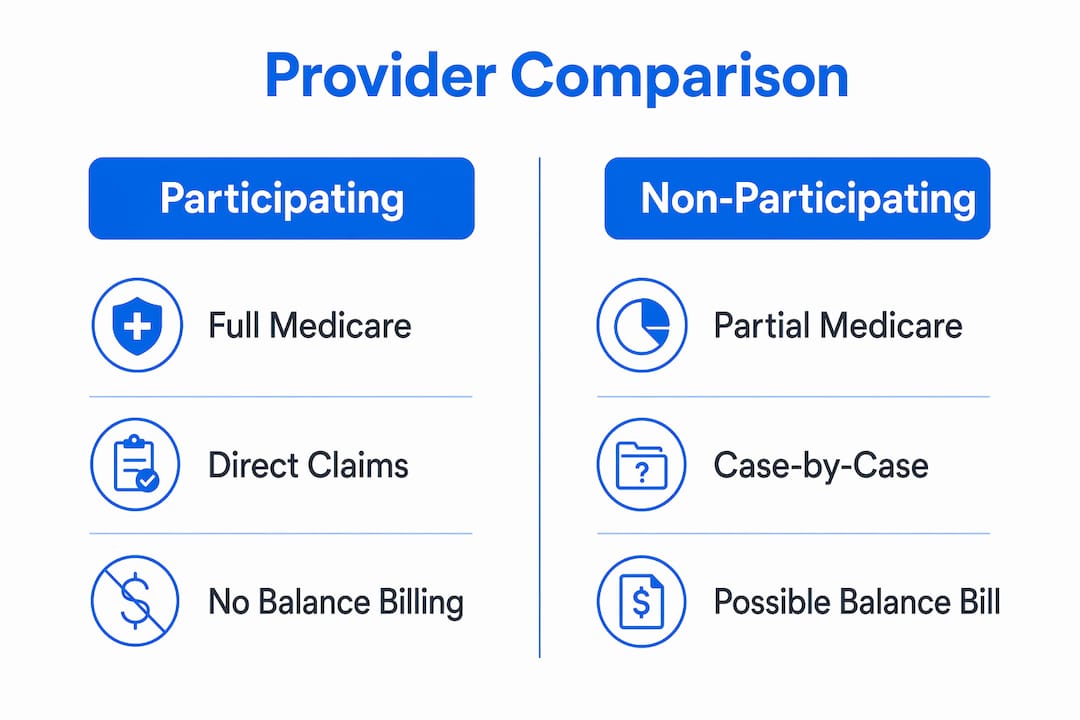
The financial gap between participating and non-participating status is concrete and measurable. Non-participating providers may bill up to 115% of the Medicare allowed amount, shifting significant cost to patients. That creates friction, complaints, and lost patients.
| Category | Participating provider | Non-participating provider |
|---|---|---|
| Medicare reimbursement | 100% of allowed amount | 95% of allowed amount |
| Patient billing limit | Deductible + 20% coinsurance | Up to 115% of Medicare rate |
| Claims submission | Mandatory, direct to payer | Optional assignment per claim |
| Payment sent to | Provider directly | Provider or patient |
| Balance billing | Prohibited | Permitted within limits |
The billing implications go beyond the rate difference. Participating providers must submit claims directly to Medicare for all covered services. That mandatory submission rule actually benefits your practice. It standardizes your workflow, reduces the chance of missed claims, and shortens your reimbursement cycle.
Non-participating providers can accept assignment on a case-by-case basis, but they have no guaranteed rate and no consistent workflow. That unpredictability creates administrative overhead and patient confusion. For most independent practices, the operational cost of non-participation outweighs any perceived flexibility.
Pro Tip: If your practice sees a high volume of Medicare patients, even a small percentage of claims processed at the non-par rate adds up to thousands of dollars in lost revenue annually. Run the math before assuming non-participation gives you more control.
What are the administrative benefits of being a participating provider?
Participating providers gain operational efficiencies that most practices undervalue until they experience them firsthand. Providers often underestimate the time savings that come from contractual network participation. The benefits extend well beyond reimbursement rates.
Here is what changes when you become a participating provider:
- Direct billing to the payer. Your staff submits claims to the insurer, not to the patient. This removes a layer of collection risk and reduces accounts receivable days.
- No balance billing disputes. Medicare sends reimbursements directly to participating providers, and patients owe only their deductible and 20% coinsurance. Fewer billing disputes mean fewer staff hours spent on the phone.
- Credentialing and authorization support. Many payers provide credentialing assistance and pre-authorization guidance to network providers. This reduces the back-and-forth your front desk handles on denied authorizations.
- Insurance directory listing. Payers list participating providers in their online and print directories. Patients searching for in-network care find your practice first.
- Faster reimbursement cycles. Standardized claims submission processes mean fewer errors, fewer rejections, and faster payment posting.
The cumulative effect on your staff is significant. When claims go out clean and payments come back directly, your billing team spends less time chasing payments and more time on documentation quality and charge capture. That is where real revenue protection happens.
Pro Tip: Use your participation agreement as a training anchor. When onboarding new billing staff, walk them through the payer contract first. It defines the rules of every claim you will ever submit to that insurer.
How does network participation affect patient volume and practice growth?
Insurance companies actively promote their participating providers. Insurers market in-network providers through directories, referral channels, and member communications. That promotion costs your practice nothing and delivers a steady stream of patients who are already pre-qualified by their insurance coverage.
The scale of that exposure depends on the network. One major health plan, MetroPlusHealth, serves over 713,000 members. Joining a network of that size means your practice name appears in front of a patient base that most independent practices could never reach through paid advertising alone.
Network participation also diversifies your patient mix. Providers in networks gain access to patients across different demographics, income levels, and insurance types. That diversity reduces your dependence on any single payer and protects your revenue if one contract changes. A practice that participates in Medicare, Medicaid, and two or three commercial plans has a far more stable revenue base than one that relies on a single payer relationship.
The referral effect compounds over time. When a primary care physician searches their insurer's directory for a specialist to refer a patient to, participating providers appear first. Non-participating providers do not appear at all. That directory placement is a passive referral engine that runs continuously without any marketing spend from your practice.
How do you become a participating provider?
The enrollment process varies by payer, but the Medicare pathway is the most structured and the most consequential to get right.
- Complete your Medicare enrollment application. Submit the CMS-855I (for individual physicians) or CMS-855B (for group practices) through the Provider Enrollment, Chain, and Ownership System (PECOS).
- Sign the CMS-460 within 90 days of approval. New enrollees have a 90-day window after Medicare approval to sign the participation agreement. Missing that window means waiting until the next annual enrollment period, which runs each november through december.
- Monitor annual enrollment periods. Medicare opens participation enrollment annually. If you want to change your participation status, that window is your only opportunity outside of the initial 90-day period.
- Submit termination notices on time. Leaving a network requires advance written notice, often 60 to 90 days depending on the contract. Missing that deadline can lock you into another contract year.
- Repeat the process for each commercial payer. Each insurer has its own credentialing application, fee schedule negotiation, and contract execution process. Assign a dedicated staff member to track each payer's timeline.
For office administrators, the most common mistake is treating participation enrollment as a one-time task. Contracts renew, fee schedules update, and payer requirements change. Build a calendar reminder for every contract anniversary and every annual Medicare enrollment window.
Pro Tip: Keep a participation status log for every payer your practice bills. Include the contract start date, renewal date, fee schedule version, and the name of your payer relations contact. That single document saves hours when a claim dispute arises.
Key Takeaways
A participating provider's formal agreement with an insurer determines reimbursement rates, billing rules, patient cost exposure, and practice visibility in ways that compound across every claim your practice submits.
| Point | Details |
|---|---|
| Definition matters | A participating provider accepts the payer's fee schedule as full payment, eliminating balance billing risk. |
| Reimbursement gap is real | Medicare pays participating providers 100% of the allowed amount versus 95% for non-participating providers. |
| Administrative gains are undervalued | Direct billing, faster payment cycles, and directory listings reduce staff workload and increase patient access. |
| Network size drives volume | Joining a large network exposes your practice to hundreds of thousands of potential patients at no marketing cost. |
| Enrollment timing is critical | The CMS-460 must be signed within 90 days of Medicare approval or you wait until the next annual period. |
Why participation status deserves more strategic attention than most practices give it
Most practice management conversations focus on coding accuracy and denial rates. Participation status rarely gets the same attention, and that is a mistake. I have seen independent practices lose thousands of dollars annually not because they coded incorrectly, but because they misunderstood their participation obligations with a single payer.
The financial case for participation is clear. The administrative case is equally strong but less visible. When your staff does not have to chase patients for payments that should have gone directly to the practice, that time goes somewhere more productive. When your practice appears in an insurer's directory, you get referrals you never had to earn. These are structural advantages that compound quietly over years.
The part that surprises most administrators is how much participation status affects physician group coding workflows. When you know exactly which fee schedule applies to every claim, your coders work faster and with fewer errors. Ambiguity in participation status creates ambiguity in billing, and ambiguity costs money.
My honest advice: treat your participation agreements the way you treat your malpractice coverage. Review them annually, understand every clause, and never let a renewal deadline slip past you unnoticed.
— Elena
How Himshield helps practices protect revenue beyond participation agreements
Becoming a participating provider protects your reimbursement rate. But it does not protect you from coding errors, documentation gaps, or charge capture failures that quietly drain revenue from every claim you submit. That is where Himshield comes in.
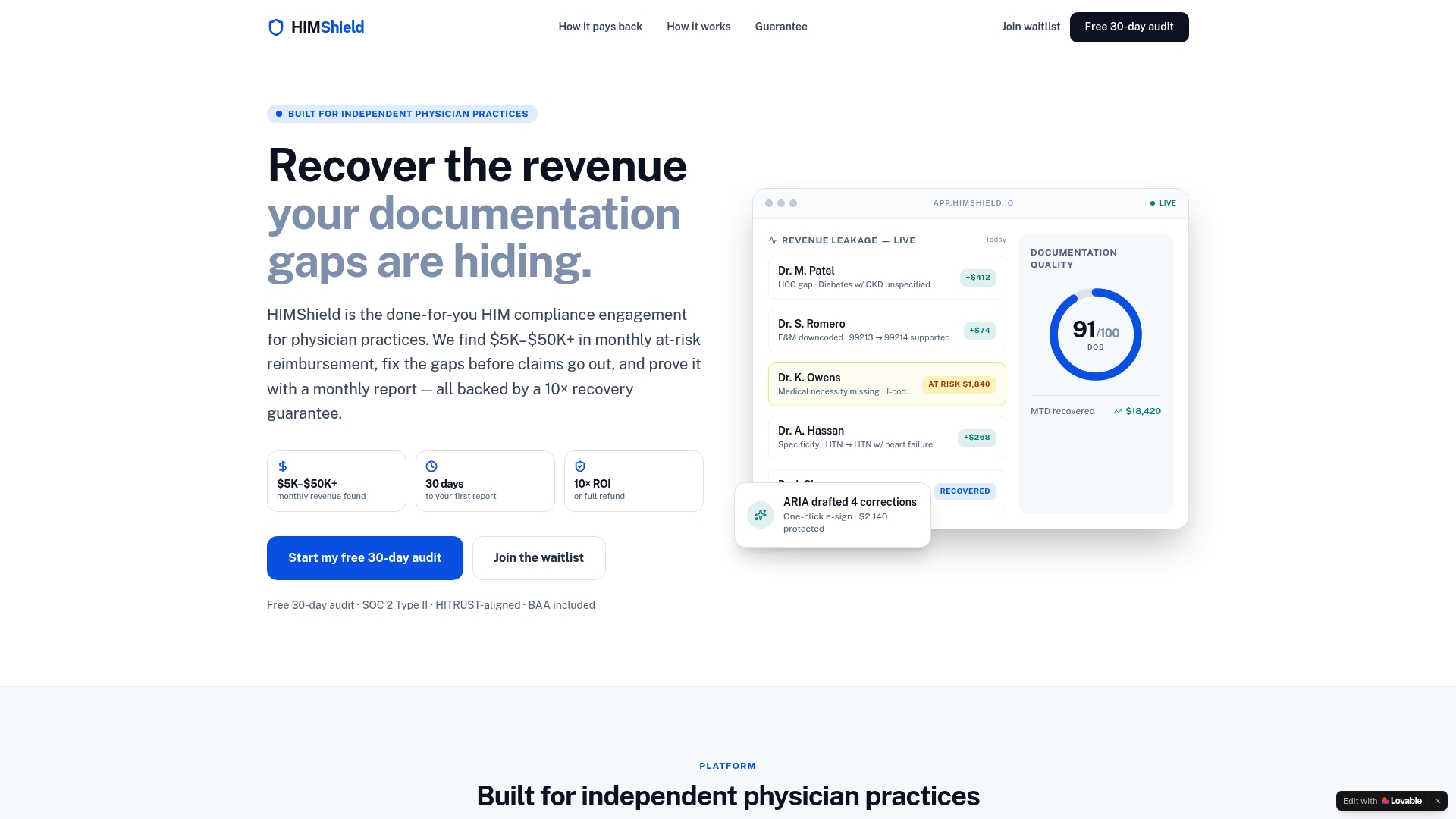
Himshield helps independent physician practices identify coding, documentation, and charge capture risks before they become denials or audits. The platform scans your claims, quantifies your at-risk reimbursement, and delivers clear guidance your physicians can act on immediately. Practices using Himshield recover $5K–$50K+ in hidden revenue without adding staff or changing their EHR. If your practice has participation agreements in place and still sees unexplained revenue leakage, Himshield shows you exactly where it is coming from.
FAQ
What is the participating provider definition in simple terms?
A participating provider is a healthcare professional who signs a contract with an insurer to accept the insurer's approved fee as full payment for covered services, with no additional billing to the patient beyond standard cost-sharing.
How does a participating provider differ from a non-participating provider?
Participating providers receive 100% of the Medicare allowed amount and cannot balance bill patients, while non-participating providers receive 95% and may bill patients up to 115% of the Medicare rate.
How do I find participating providers in a specific network?
Every major insurer maintains an online provider directory where patients and administrators can search by specialty, location, and plan type. Medicare's directory is available through the Medicare.gov Care Compare tool.
What happens if a provider misses the CMS-460 signing window?
Missing the 90-day signing window after Medicare approval means the provider must wait until the next annual Medicare enrollment period to become a participating provider.
Do participating providers have to submit all claims directly?
Yes. Medicare participating providers must submit claims directly to Medicare for all covered services. This is a condition of the participation agreement, not optional.