A compliant radiology order names the patient, the exact test, the clinical reason, and the treating practitioner, and it carries a valid handwritten or electronic signature. It also has to match the study that is performed and the diagnosis on the claim. When any of those pieces is missing, the practice and the imaging facility both carry denial risk. This guide covers what to put in an imaging order, how to authenticate it, what to do with verbal or incomplete orders, and how to link the order to the chart and the claim.
TL;DR
- Every order needs the patient's name, the test requested, the clinical indication, and the ordering practitioner's name and signature.
- Use a handwritten or electronic signature. A rubber stamp is not an approved method.
- The diagnosis you document must support the study under the payer's coverage rules (LCDs and NCDs).
- Never backdate an order or add a late signature to create one after the fact.
- Keep the order, the note and the claim consistent so you can answer an audit request fast.
Table of Contents
- What an imaging order must contain
- Authentication: who signs and how
- Tie the order to medical necessity
- Verbal, changed and incomplete orders
- What changes by modality, payer and setting
- Link the order to the chart, the report and the claim
- A pre-submission checklist for imaging orders
- Our perspective
- See where your imaging documentation leaks revenue
- FAQ
- Sources
What an imaging order must contain
Start with the basics. A radiology order should document the patient's name, the test requested, the clinical indication, and the treating physician's name and signature, according to Radiology Today. Payer billing guidelines add that orders must include the ordering physician or APP's address and phone number, so the facility can reach you with questions.
For in-office imaging, the order should also be specific enough that nobody has to guess what to perform. In practice, that means:
- Patient identifiers: full name and a second identifier such as date of birth.
- The exact study: for example "CT abdomen and pelvis with contrast," not "CT scan."
- Body part and laterality: left, right or bilateral.
- Views or planes: the number and type of views for X-rays, the planes for ultrasound.
- Clinical indication: signs, symptoms or a working diagnosis.
- Ordering practitioner: name, credentials, contact details and signature.
- Date of the order.
The more specific the order, the less rework you face later. A request for "imaging, knee" forces a phone call. A request for "X-ray, right knee, 3 views, pain after fall" does not.
Write the clinical indication so it can be used
The indication is where most orders fall short. Orders should include pertinent clinical information, such as the reason for the test (signs, symptoms or a working diagnosis). This helps the radiologist tailor the study and makes the final report more relevant, according to one health system's imaging order guide. The same guide discourages generic "R/O" (rule out) requests with no history or symptoms. Name the condition you want evaluated instead.
Compare two versions:
| Weak order | Stronger order |
|---|---|
| CT chest, R/O PE | CT angiogram chest, shortness of breath and pleuritic chest pain for 2 days, evaluate for pulmonary embolism |
| MRI lumbar spine, back pain | MRI lumbar spine without contrast, low back pain with left leg radiculopathy, 8 weeks of conservative therapy |
| Ultrasound abdomen | Ultrasound abdomen limited, right upper quadrant pain, evaluate for gallstones |
Clinical context is also a patient safety matter. One malpractice insurer's guidance on radiology orders describes communication of clinical information as a reciprocal duty between the ordering provider and the radiologist. It recommends checklists and a review of EHR tools that flag missing clinical information so staff do not re-enter it.
Authentication: who signs and how
An order is only as good as its authentication. The record should show the treating physician's intent to order the test, authenticated by that author with a handwritten or electronic signature. A rubber stamp is not an approved method. The same AAPC guidance notes that treating practitioners may also order tests, so the order does not have to come from a physician alone.
That raises a practical point for group practices: know which of your clinicians are treating practitioners under the payer's rules, and make sure your EHR routes the order to the right signer. If your staff pre-build orders, the ordering clinician still has to review and sign. The same signature logic applies to other order types, as shown in this explanation of who can sign nursing orders.
Signature gaps are among the most common documentation problems we see in practice audits. Our guides on physician e-signature compliance and signature attestations walk through the controls that close them.
No backdating, ever
Medicare will deny payment for services that lack a valid order. Providers also cannot create retroactive orders or add late signatures to backdate a plan of care, according to a CMS signature requirements fact sheet. If a signature is missing, use the payer's accepted attestation process rather than editing the record to look as if the order existed earlier. A properly dated correction is defensible. A disguised one is not.
Tie the order to medical necessity
An order tells the facility what to do. The diagnosis tells the payer why. The ordering physician must document signs, symptoms or a reason for the test and clearly document the intent for the test to be performed.
The diagnosis you choose also has to fit coverage rules. One payer's high-tech radiology billing policy states that compliance with Local Coverage Determinations (LCDs) and National Coverage Determinations (NCDs) is mandatory. It says a mismatch between the diagnosis provided and the covered indications will trigger claim denials.
Three habits help:
- Document symptoms before choosing a code. Pick the most specific diagnosis the note supports, not a placeholder.
- Check the coverage policy for high-cost studies such as MRI, CT and PET before you order. Our primer on LCD vs NCD explains which one governs your jurisdiction.
- Make the note and the order tell the same story. If the order says "chest pain" and the note says nothing about it, the order is exposed in a review.
For a deeper look at how thin notes become denials, see our guide to Medicare medical necessity denials and the related piece on unspecified code denials.
Verbal, changed and incomplete orders
Real clinics do not always produce perfect written orders. What matters is how you handle exceptions.
Verbal orders
Accepted practice is to record a verbal order in the medical records of both the treating provider and the testing facility. Capture the date, the time and the identity of the ordering provider at the moment it is given. Then have the practitioner authenticate it promptly. State law and payer policy set the timeframe, so confirm yours rather than assuming a standard window.
Incomplete orders
If an order arrives missing information, make every effort to obtain it before the test is performed. If waiting would put patient care at risk, get the information afterward and document why. In both cases, record who you spoke with and when. Do not fill in blanks without the ordering practitioner's confirmation.
Changed orders
When the study changes, for example a CT with contrast becomes a CT without contrast after a lab result, document the change as a new or amended order. It should carry the practitioner's authentication, the date, and the reason. The performed study, the report and the billed CPT code should all match the final order, not the original.

Orders that do not match the service
A mismatch between what was ordered and what was performed is a classic audit finding. Before you submit the claim, compare three things:
- The order (study, body part, laterality).
- The report (what was actually done and found).
- The claim (CPT code, modifiers, diagnosis).
If they disagree, resolve it before billing. Our guide to the NCCI edits behind batch denials covers the coding side of that check.
What changes by modality, payer and setting
There is no single order standard for every situation. One payer's policy distinguishes commercial or Medicare members outside a hospital from inpatients and outpatients, with different order and authentication requirements for each. Modality adds its own details. Ultrasound orders, for instance, should name the plane or whether the study is limited or complete. X-ray orders should specify views.
Use this as a working matrix when you build or audit your order templates:
| Variable | What to confirm |
|---|---|
| Modality | Required fields (views, planes, contrast, laterality) |
| Payer | Prior authorization, coverage policy, accepted authentication |
| Setting | In-office, outpatient facility or hospital, and who retains the order |
| Study cost | MRI, CT and PET usually face stricter medical necessity review |
| Jurisdiction | Your Medicare Administrative Contractor's LCDs and state law on verbal orders |
Build one master checklist, then add payer-specific rules as exceptions. That keeps front-desk and clinical staff working from a single source.
Link the order to the chart, the report and the claim
Auditors rarely look at the order alone. They follow a chain: the visit note, the order, the performed study, the report and the claim. A break at any link invites a denial or a records request.
A clean chain looks like this:
- Visit note documents symptoms, exam findings and the decision to image.
- Order states the study, the indication and carries a valid signature.
- Performed study and report match the order.
- Claim carries CPT and ICD-10 codes supported by the note and order.
- Retention: the order and supporting documentation are stored where they can be retrieved by patient and date of service.
Retention periods depend on the payer, the program and state law, so confirm the period that applies to your practice with your compliance officer or the payer contract. When a payer or contractor asks for records, the practice that can produce all five items in one packet usually resolves the request fastest. Documentation gaps in the EHR are the usual reason it cannot. Our overview of EHR documentation gaps shows where they tend to hide.
A pre-submission checklist for imaging orders
Run this before an order leaves your office, or review a sample monthly:
- Patient name and second identifier present
- Exact study, body part and laterality specified
- Clinical indication in plain words, not just "R/O"
- Diagnosis code supports the study under the coverage policy
- Ordering practitioner's name, contact details and valid signature
- Order date present, and no edits that look backdated
- Verbal or amended orders documented with date, time and who gave them
- Order matches the performed study and the claim
If more than a few percent of sampled orders fail any line, the fix is usually a template change in the EHR, not more reminders to clinicians.
Our perspective
Most imaging denials we look at do not start in billing. They start at the moment of the order, when a busy clinician picks a test from a list and moves on to the next patient.
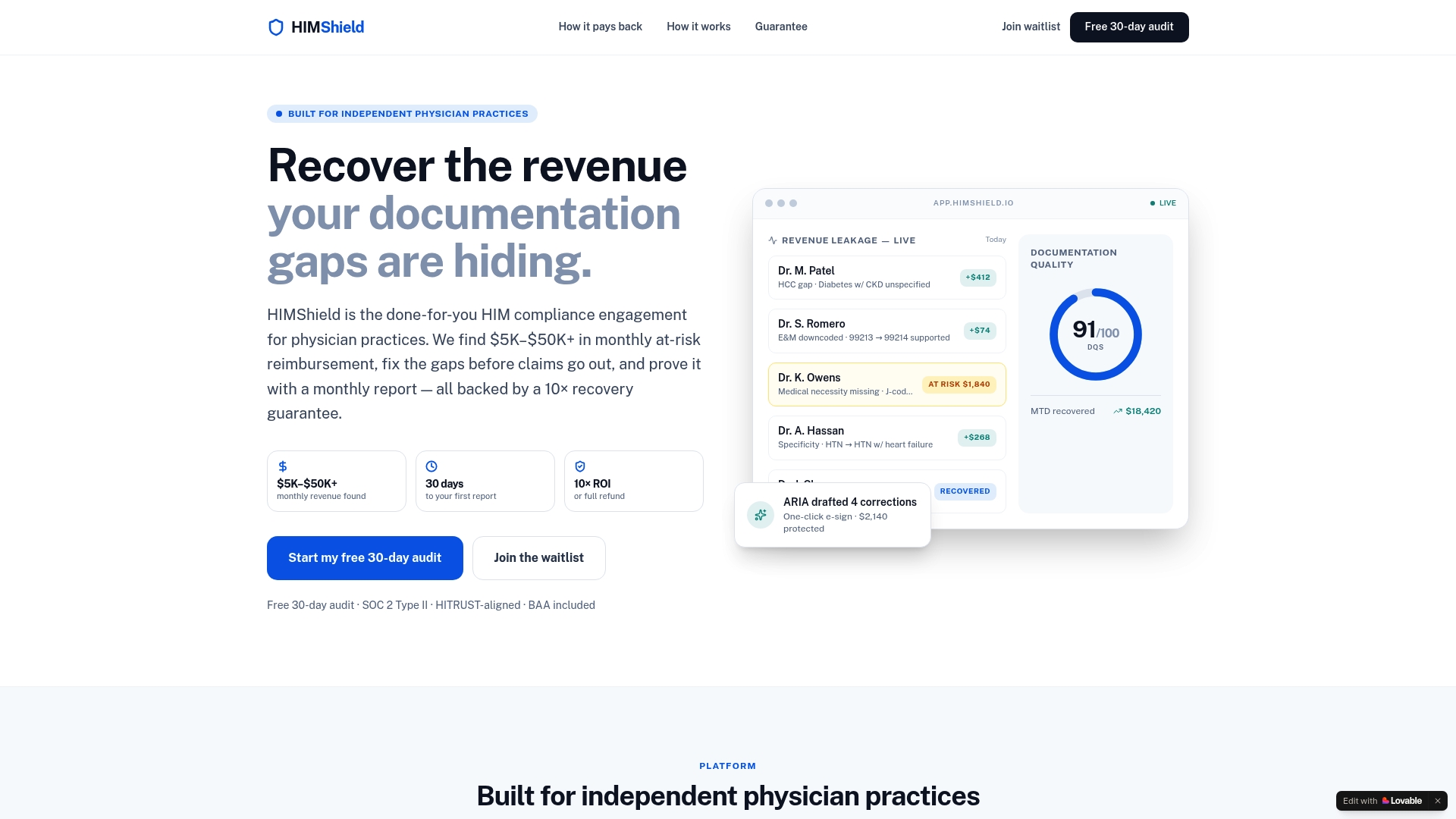
That is why we built HIMShield to look at EHR data before the claim goes out. It scans for orders with no indication, signatures that are missing, and diagnoses that do not fit the study. It then quantifies what those gaps put at risk, per provider and per payer.
Physicians should not have to become coders. Our approach is to draft the correction and send it for a one-click e-signature, so the fix takes seconds and the record stays honest and dated. We designed the platform to work without new staff or software training, because independent practices do not have spare hours.
If an auditor asks for the order, the note and the report, you should be able to hand them over the same day. That is the standard we build toward.
Elena
See where your imaging documentation leaks revenue
If you are not sure how your orders hold up, our free 30-day Revenue Leakage Audit reviews coding, documentation and charge-capture gaps in your EHR data. It reports them per provider and per payer, and it comes with our performance guarantee.
If you want the broader picture of how we support independent practices with compliance, see HIMShield.
FAQ
Does every imaging order need a separate signed form?
Not necessarily. What counts is that the record documents the treating practitioner's intent to order the specific test and that the author authenticates it. Payer and contractor rules differ on what form that takes, so confirm yours. Whatever the format, the authentication must be a handwritten or electronic signature.
Can a stamped signature authenticate a radiology order?
No. A rubber stamp is not an approved authentication method. Use a handwritten signature or a secure electronic signature in your EHR.
What should I do if the imaging facility says our order is missing information?
Supply the missing details from the ordering practitioner and document who provided them and when. Try to resolve it before the test. If delay would put the patient at risk, document the clinical reason and complete the order afterward. Do not backdate anything.
What is the most common reason imaging orders are denied?
A mismatch between the diagnosis and the payer's covered indications is a leading cause, along with a missing or invalid order. Specific clinical indications and a pre-order check of LCD and NCD criteria address most of it.
How do I make sure the order matches the claim?
Compare the order, the report and the claim before submission. Study, body part, laterality and diagnosis should agree. An automated pre-bill scan of your EHR data can flag the mismatches at scale.
Sources
- Are Your Orders in Good Order? Radiology Today
- Billing Guidelines for Orders for Outpatient Tests
- Imaging Order Guide, SEARHC
- Clinical Context in Radiology Orders, The Doctors Company
- Follow the Rules of Diagnostic Test Orders for Radiology, AAPC
- Complying with Medicare Signature Requirements
- High-Tech Radiology Services Billing Policy