
Problem list maintenance means reviewing every entry at each visit, adding what is active, resolving what is not, replacing symptoms with specific diagnoses and removing duplicates. A named owner and a recurring audit keep it that way. Practices that treat the list as a shared, policy-backed routine get cleaner charts, better clinical decision support and fewer documentation gaps that turn into denials. Practices that treat it as a dumping ground get the opposite.
This guide is for independent practices and the HIM professionals who support them. It covers what the list is, who should touch it, a routine you can adopt, how to clean up a bloated list and how to audit it. If you want to see how your documentation holds up before claims go out, our free 30-day Revenue Leakage Audit is built for that.
TL;DR
- The problem list is the chart's index of current, clinically relevant conditions. It is not a visit diagnosis list and not a history file.
- Reconcile it at every encounter: add active problems, resolve finished ones, replace symptoms with diagnoses, delete duplicates.
- Assign ownership in written policy. Physicians decide; trained staff can help within state scope of practice.
- Clean up a bloated list with a green, yellow and red review, then audit a sample every quarter.
- A problem list is not a billing source. Claim diagnoses must come from the encounter documentation.
Table of Contents
- What the problem list is, and what it is not
- Why a current list matters
- Who owns the list
- A routine for every encounter
- Cleaning up a bloated list: the stoplight review
- Common errors to watch for
- Auditing accuracy and completeness
- What changed in the standards
- Our perspective
- See where your documentation stands
- FAQ
- Sources
What the problem list is, and what it is not
The problem-oriented record was developed by Dr. Lawrence Weed. In that model, the problem list works as the table of contents and index to the medical record, and entries are managed by moving symptoms to diagnoses or resolving problems that no longer need management. The idea has lasted. AHIMA notes that the list later became a requirement under the EHR Incentive Program, now called Promoting Interoperability.
CMS defined it in the Meaningful Use core measure as a list of current and active diagnoses as well as past diagnoses relevant to the current care of the patient. "Up to date" in that measure means the list holds the most recent diagnosis the clinician knows of, whether it came from prior records, other providers, the clinician's own diagnosis or asking the patient.
Problem list versus encounter diagnosis
The most common confusion in practices is treating the problem list and the visit's diagnoses as the same thing. They are not. The AAFP's guidance in Family Practice Management says that visit problems differ from problem-list entries. Diagnoses containing "acute" or "encounter for" rarely belong on the list, and past medical or surgical history goes elsewhere. The working test: if a condition influences current treatment, it belongs on the problem list.
A quick example. A patient comes in with a sore throat and is diagnosed with acute pharyngitis. That is an encounter diagnosis. Once it resolves, it should never sit on the list. The same patient's type 2 diabetes and hypertension are ongoing, so they stay. For a deeper walkthrough of what to document where, see our guide to problem list versus encounter diagnosis.

The content standards are broader than many staff expect. AHIMA's guidance points out that the ASTM standard for EHR content calls for pathophysiological states, significant abnormal signs and lab findings, disabilities and unusual conditions on the list, and that providers may also add social and psychiatric problems, risk factors, allergies and health alerts. Your policy should say which of these your practice includes.
Why a current list matters
Three reasons stand out for a practice.
Patient care. AHIMA states that an accurate problem list is critical to better patient care across the continuum of care and settings. A covering physician, a specialist or an urgent care clinician reads it first.
EHR logic. The AMA explains that the list has grown beyond ICD-10 codes. It now feeds clinical decision support alerts, reporting, automated patient questionnaires and health-maintenance reminders. A stale entry can trigger a wrong reminder. A missing one can silence a right one.
Coding and risk adjustment. AAPC ties list quality directly to risk adjustment and recommends a structured, team-based approach: pre-visit documentation review, updates by clinical staff based on documented criteria and standardized queries for uncertain diagnoses.
Here is the line you should not cross. A diagnosis is codable only when the provider documents it with supporting clinical indicators, monitoring or treatment. AHIMA is explicit that code assignment rests on the provider's statement that the condition exists. AHIMA's practice brief also lists using the problem list as a source for billing data or revenue management as a typical out-of-scope use. A clean list supports good documentation. It does not replace the note. If you work on HCC capture, the 90-day HCC documentation plan shows how to keep the two separate.
Who owns the list
Without a named owner, everyone adds and no one removes. AHIMA's guidance says policy should assign ultimate responsibility: treating providers reconcile at the start and end of each episode of care, the primary care physician is responsible in primary care, specialists update to the appropriate specificity, and policy sets timeliness requirements.
The AAFP adds that in a multispecialty EHR, all specialties should use and update the same list, and that office policy governs who may add, resolve or modify entries. In a small independent group, that usually means one shared list with the primary care physician as steward.
What staff can do
Physicians do not have to do all of it. The AMA states there is no federal regulation prohibiting care team members from helping keep the list accurate. Staff updates should follow the decision-making of the physician or other licensed independent practitioner, and state scope-of-practice rules apply. The AMA's role-based examples are a useful template:
| Role | Reasonable task |
|---|---|
| Medical assistant | Resolve past acute problems and completed pregnancies |
| Registered nurse | The above, plus add diagnoses based on consult or discharge notes |
| CDI or coding staff | Move a code to a more specific one based on provider documentation |
| Ancillary providers (RT, PT) | Add or edit problems based on their own evaluation |
AAPC suggests assigning seasoned coders or RNs to review documentation before visits, letting clinically trained staff update the list from progress notes, labs and imaging, and auditing those activities regularly. AHIMA also notes that every EHR entry is tracked with metadata showing who documented or updated what, and that organizations should lean on HIM and CDI professionals when designing these workflows. If you are the HIM lead in a physician group, that is your seat at the table.
A routine for every encounter
The AAMC guideline is simple: reconcile the problem list at each encounter, replace symptoms with a more specific diagnosis when available, remove duplicates and keep entries current and concise. Here is how to turn that into a routine.
- Pre-visit review. A trained team member reads the list against the last note, recent labs and any outside records. Where it goes wrong: this step gets skipped on busy days, so build it into the visit-prep checklist rather than leaving it to memory.
- Confirm with the patient. Ask about new diagnoses, hospital stays and specialist visits. CMS's definition of an up-to-date list includes querying the patient as a legitimate source.
- Physician reconciles. The treating clinician adds active conditions, resolves finished ones and converts symptoms ("chest pain") to diagnoses once they are established. Where it goes wrong: a diagnosis is added to the list but never evaluated or addressed in the note, so the documentation does not support it.
- Handle resolved problems correctly. AHIMA advises that problems resolved before the current encounter move to past medical history and come off the list. If an entry cannot be removed, mark it "resolved," "not active," "in remission" or with the resolution date.
- Avoid copy-forward. AAPC cautions against auto-pulling problem-list diagnoses into assessments without provider validation. Each assessed condition needs the physician's own evaluation that day.
- Query when unclear. If a condition appears supported by labs or notes but is not clearly documented, use a standardized clinician query rather than adding it yourself.
- Spot-check afterward. Compare the finished note, the list and the claim. Gaps between them are where revenue and compliance problems start.
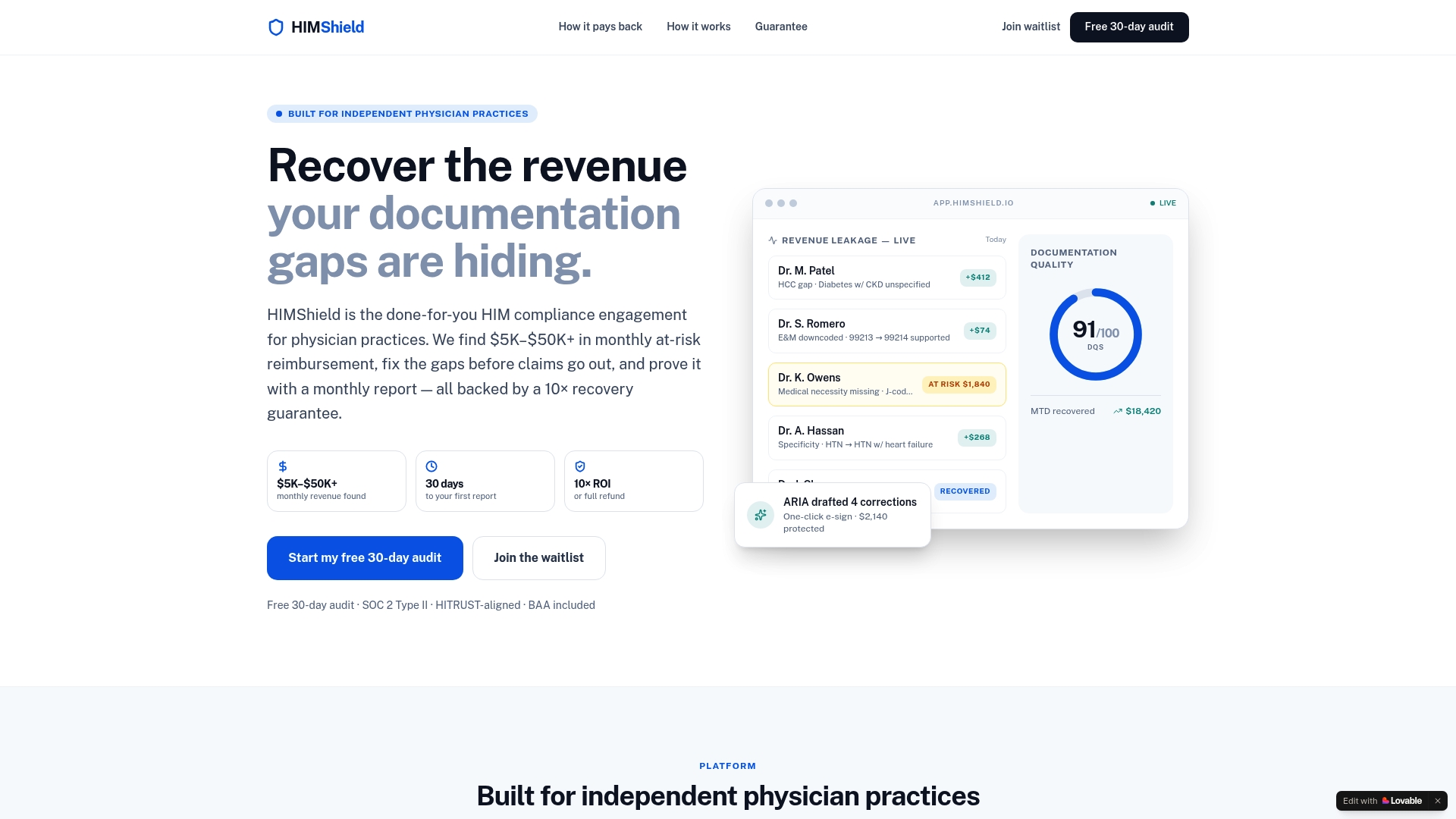
Steps 3 through 7 are where documentation breaks down in practice, and they are also where our platform fits. HIMShield scores documentation quality in real time, flags coding and documentation gaps in your EHR data before claims go out and drafts corrections for one-click physician e-signature. The physician stays the decision-maker, and the correction takes seconds instead of a chart hunt.
Cleaning up a bloated list: the stoplight review
Most practices inherit lists with hundreds of stale entries across thousands of patients. You cannot fix them all at once. AAPC summarizes an effective list as current, accurate, clear and concise and recommends the AAFP's Stoplight System for triage:
- Green: chronic or active conditions that need monitoring or treatment. Keep them.
- Yellow: vague or possibly inactive conditions. Review them with the physician at the next visit.
- Red: resolved acute conditions, administrative notes and entries with no clinical relevance. Resolve or remove them.
Start with patients scheduled in the next two weeks, then work through annual wellness visits, transitions of care and chronic follow-ups, which AAPC identifies as natural moments to revisit the list. Removed entries are not lost forever. Akron Children's Hospital's guide notes that deleted problems can be viewed and reactivated from Past Problems, a feature worth checking in your own EHR before you begin.
The same guide also tells every clinician, whether primary care, specialist or covering, to merge problems when necessary and remove duplicates. Merging "HTN," "high blood pressure" and "essential hypertension" into one entry is typical cleanup work.
Common errors to watch for
| Error | Why it hurts | Fix |
|---|---|---|
| Symptoms left after a diagnosis is made | Vague, duplicates the diagnosis | Replace with the specific diagnosis |
| Duplicate or conflicting entries | Confuses clinicians and decision support | Merge and keep the most specific |
| Resolved acute conditions | Misleads covering clinicians | Resolve or move to history |
| Unspecified codes | Weak documentation of severity | Query the provider for specificity |
| Copied-forward diagnoses | Unsupported by the current visit | Require provider validation |
| Visit-only diagnoses ("encounter for...") | Clutter | Keep on the encounter, not the list |
There is also a technical layer. AHIMA reports that EHR certification required products to store entries as a subset of SNOMED CT codes, and that most EHRs map those entries back to ICD-10-CM. It recommends a policy for annual review of the mappings and for monitoring unspecified codes and codes that are integral to, or excluded by, other conditions. Ask your EHR vendor which mapping table you use, and review it once a year alongside your annual coding review.
Auditing accuracy and completeness
AHIMA directs organizations to describe the audit process in policy, and notes that EHRs must allow error correction and provide audit trails with date and time stamps. A workable quarterly audit for a small group looks like this:
- Pull a random sample of charts per provider, for example 10 to 20 patients with chronic conditions.
- Compare each list with the latest note, labs and medication list.
- Count entries that are missing, stale, duplicated, vague or unsupported.
- Share results per provider, with examples, and fix the workflow cause, not just the chart.
- Repeat next quarter and track the trend.
Simple queries can move the numbers. ACDIS reported that one facility's quality project used a straightforward query asking providers to add or remove a diagnosis based on narrative documentation and reached 90% accuracy at discharge without many extra steps. AHIMA also recommends NLP, clinical decision support and order-entry prompts to suggest adding, updating or resolving problems, so check which of these your EHR already offers.
Manual chart sampling covers a tiny slice of your volume. Our own audit approach looks at EHR data across providers and payers, so you can see where documentation gaps cluster instead of guessing. Our guide to physician group audit methodology explains how HIM teams structure that work.
What changed in the standards
The federal baseline is steady rather than shifting. The ONC final rule published in the Federal Register on January 9, 2024, effective February 8, 2024, implemented the EHR Reporting Program under the 21st Century Cures Act. It added Conditions and Maintenance of Certification requirements for health IT developers, updated certification criteria for decision support interventions and adopted USCDI Version 3 as the new baseline. Most of that burden falls on your EHR vendor, but it is why your vendor's release notes matter: decision support that reads the problem list gets only as good as the list itself.
Our perspective
We read documentation for a living, and the pattern is consistent: the problem list is rarely the villain, but it is where documentation habits show first.
A list full of stale entries tells you the practice has no owner, no routine and no feedback loop. A list that is current tells you physicians, staff and HIM are working from the same page.
That is why we built our platform around the same idea: find gaps in EHR data before claims are submitted, quantify them per provider and per payer, and let the physician correct them with one e-signature. Independent practices should not need new staff or extra software training to protect earned revenue, and a documentation habit like problem list maintenance is exactly the kind of thing that pays back when it is made easy.
Start with ownership, add a routine, audit on a schedule. The rest follows.
Elena
See where your documentation stands
A tidy problem list helps, but the real question is whether your charts support the claims you send. Our free 30-day Revenue Leakage Audit quantifies coding, documentation and charge-capture gaps in your EHR data and delivers a per-provider, per-payer Revenue Leakage Report. The audit comes with a performance guarantee, and a paid subscription comes only afterward.
If you would rather talk through your setup first, start from our HIM compliance engagement page. For the correction side of the workflow, our four-step coding correction process shows how fixes move from finding to signature.
FAQ
How often should the problem list be updated?
At every encounter. The AAMC guideline calls for reconciliation at each clinic or hospital encounter and at discharge. In practice, that means a quick review before the visit and a final physician reconciliation during or right after it.
Can a medical assistant update the problem list?
Often yes, within limits. The AMA says no federal regulation bars care team members from helping, and its examples include medical assistants resolving past acute problems. Updates must follow the physician's decision-making and your state's scope-of-practice rules, so write the permitted tasks into policy.
What should be removed from the problem list?
Resolved acute conditions, duplicates, administrative notes and entries with no clinical relevance. AHIMA advises moving problems resolved before the current encounter to past medical history. If an entry must stay, mark it resolved, not active or in remission, or add the resolution date.
Can I code claims from the problem list?
No. Code assignment rests on the provider's documented statement and supporting clinical indicators in the encounter note. AHIMA lists using the problem list as a billing data source as outside its intended scope. Use the list to inform the visit, then document each assessed condition in the note.
How do I know if my problem list is accurate?
Sample charts each quarter and compare the list with the latest note, labs and medications. Count missing, stale, duplicate and vague entries by provider. Tracking those counts over time shows whether your routine works.
Sources
- Standardizing the Problem List in the Ambulatory EHR Record (AHRQ)
- Definition, History, and Use of the Problem List (AHIMA)
- Problem List Guidance in the EHR (AHIMA)
- Taming the Problem List (AAFP, Family Practice Management)
- Is updating the problem list a physician-only task? (AMA)
- What Does the Problem List Have to Do With Risk Adjustment? (AAPC)
- Guidelines for Problem List (AAMC)
- Problem List Guide (Akron Children's Hospital)
- Q&A: Updating the problem list (ACDIS)
- Maintain Problem List core measure (CMS)
- ONC final rule, Federal Register, January 9, 2024