
A custom payer edit is a rule you add to your own billing workflow so that a claim is stopped, flagged or corrected before it reaches a specific payer, because that payer handles the code, modifier or unit differently from the industry standard. Standard edits catch what every payer checks. Custom edits catch what only one of your payers checks, and that is where many preventable denials start. This guide shows what triggers a custom edit, how to build and test one, and how to tell whether it is working. It is written for practice owners, administrators and HIM staff in independent physician groups.
TL;DR
- A custom payer edit encodes one payer's own rule (a modifier format, a bundling policy, a documentation requirement) so the claim is fixed before submission, not after denial.
- Standard edits such as NCCI apply to everyone. Custom edits come from payer manuals, contract terms and your own denial patterns.
- Build each edit from a written source, test it against real claims, assign an owner and review it on a schedule, because payers change rules quarterly.
- Measure edits by what they prevent (denials, holds, rework) and by what they wrongly stop (false positives).
- HIMShield scans EHR data before claims go out and quantifies the gaps in a free 30-day audit.
Table of Contents
- What custom payer edits are
- How custom edits differ from standard edits
- What triggers a custom edit
- How payers' own edits behave
- Designing a custom edit that holds up
- Testing edits and handling false positives
- Measuring whether edits are working
- Rule changes that move your edits
- Where HIMShield fits
- Our perspective
- FAQ
- Sources
What custom payer edits are
A claim edit is a rule that checks a claim for errors and alerts the user before the claim is created or submitted. The Texas Medical Association's guidance on front-end claim edits describes them this way, and notes that billing guidelines vary by payer and are hard to remember when a practice contracts with several plans. A custom edit prevents the wrong billing policy from being applied to the wrong payer.
Two features define a custom edit:
- It is payer-specific or practice-specific. It reflects one plan's policy, one contract term or one pattern in your own denials.
- It acts before submission. It runs in your billing system, EHR or a layer on top of them, and it asks someone to fix the claim while the fix is still cheap.
The payer's side has its own edits, which you do not control. Those run after you submit. A custom edit on your side is your attempt to predict them.
How custom edits differ from standard edits
Standard edits come from national rules. The CMS National Correct Coding Initiative publishes Procedure-to-Procedure (PTP) edits, which prevent improper payment when incorrect code combinations are reported, and Medically Unlikely Edits (MUEs), which prevent improper payment when services are reported with incorrect units. Medicare Administrative Contractors apply PTP edits in claim processing. If you want the detail on those two families, see our guides to NCCI edits and MUE edits, units and indicators.
Custom edits sit on top. A NAHRI research synopsis on claims edit management draws the same line. Revenue integrity leaders there describe standard edits such as NCCI on one side and custom edits on the other, with an example of a custom edit that stops claims carrying a JW modifier that needed review. Another leader notes that specific payer requests lead to edits, such as a payer preferring traditional CPT codes over Medicare codes or requiring additional associated charges.
| Standard edit | Custom payer edit | |
|---|---|---|
| Source | National rule set (for example NCCI PTP, MUE) | Payer manual, contract, payer policy bulletin or your denial history |
| Applies to | Every claim in scope | One payer, one plan or one service line |
| Who maintains it | CMS, contractors, vendor code editors | Your practice or whoever manages your claim workflow |
| Update pattern | Published on a set schedule | Whenever the payer changes policy, often without notice to you |
What triggers a custom edit
Most custom edits begin with one of four situations.
A payer formats the same service differently
The TMA gives bilateral billing as its example: some payers want one line with modifier -50, others want two lines with -50 on one of them. A practice billing both types without an edit will see one of them reject. The same document recommends an edit that alerts staff when a procedure is billed with an E&M code and modifier -25 is missing. Our modifier usage guide for 2026 covers the modifiers that most often need this treatment.
A payer's policy departs from the industry default
Payers publish their own editing policies. Kaiser Permanente Washington's coding policy says its code editing logic applies to selected professional claims, but that plan benefits take precedence over industry standards and that provider contract terms can require an exception. It lists edit types including MUE units-of-service edits, AMA CPT guidelines, LCD/NCD edits, maternity logic, and procedure or diagnosis checks against age and gender.
A concrete current case: the Presbyterian Health Plan administrative claims edits guide documents a custom edit effective January 1, 2026 for STI testing. When more than one single-organism CPT code (87491, 87591, 87661) is billed for the same member, provider and date of service, the claim is denied and considered under comprehensive code 87801. A practice that bills those codes separately to that plan needs an edit that bundles them first.
Your own denial data shows a pattern
The NAHRI synopsis says custom edits are typically identified through revenue integrity auditing, root-cause analysis of denials or charge reconciliation issues. If the same payer denies the same code for the same reason three months running, that is an edit waiting to be written. We cover how to read those patterns in payer-specific denials.
An operational need
Some edits exist to collect missing data, not to match a payer rule. The same synopsis cites an edit that captures the last menstrual period for certain gynecological procedures. These protect documentation quality and are the easiest edits to get staff to accept, because they ask for information the clinician already has.
How payers' own edits behave
Your custom edit should mirror what the payer will do on its side. Payers describe their outcomes in provider manuals, so read them.
SilverSummit Healthplan's 2026 provider billing manual describes a rules engine that evaluates each service line against other codes on the same claim and against previously paid claims in the member's and provider's history. It gives three outcomes: deny (with an explanation code and appeal instructions), pend (held for clinical review) and replace and pay (the original line is denied and a corrected line added, for example when the CPT code is wrong for the member's age).
That three-outcome model is a useful template for your own edits. Decide for each rule whether it should hard-stop the claim, hold it for review or auto-correct it.

Payers also use history, which is why a claim can pass your check and still deny. Blue Cross Vermont's claims editing payment policy defines an edit as a rule recommendation that can lead to partial payment, payment on different codes, reduced payment through multiple-procedure logic or denial. It says new CPT/HCPCS codes are applied four times a year and coding guideline and NCCI updates quarterly. It also runs a tool where providers can test coding scenarios, but that tool does not tie into claim history, so its results can change. A pre-check is a strong guide, never a guarantee.
If you want to see how line items and edit outcomes appear on the other side of the transaction, this explanation of comparing EOB line items to bills shows what a payer's decisions look like in the document the patient receives.
Designing a custom edit that holds up
HCA Healthcare's coding and documentation policy for non-hospital entities, effective in 2023, gives a sound frame for physician practices. It requires written policies documenting each payer's coding requirements, coder orientation to payer contracts with specific reporting requirements, a procedure for resolving coding conflicts with payers (high-volume payers first), regular validation reviews comparing the medical record, claim form, encounter form and remittance notice, and review of every claim denied in part or in total for coding discrepancies.
Turn that into a routine for each edit:
- Write the rule in one sentence. "For Payer X, when CPT 87491 and 87591 appear for one member on one date of service, bill 87801."
- Attach the source. Link the payer manual page, bulletin or contract clause, with its effective date. An edit with no source cannot be defended in an appeal or retired when the policy changes.
- Choose the action. Hard stop, hold for review or auto-correct. Use hard stops only where the payer will always deny.
- Name an owner. Coding or HIM owns code logic. Billing owns modifier and format rules. Registration owns eligibility and demographic rules. The NAHRI synopsis groups edits by ownership in this way.
- Set a review date. Payers update quarterly, so tie reviews to those cycles.
- Start with high-volume payers. One edit on your top payer is worth more than ten on a plan that sends you a handful of claims.
The TMA also advises that when you choose a billing system or add-on, you confirm it can customize and build edits, and says that where it can, rejections and denials can fall significantly and staff time is freed for other work. Ask that question before you sign.
Testing edits and handling false positives
A bad edit costs money in a different way: it holds clean claims, delays payment and trains staff to click past alerts. Before an edit goes live, run it against a sample of past claims for that payer.
- Count hits. How many claims would it have stopped?
- Check each hit against the payer's actual response. Were those claims denied, paid in full or paid at a reduced rate?
- Look at the misses. Claims the payer denied that your edit did not catch show where the rule is too narrow.
- Review exceptions. Contract terms can override a policy, as the Kaiser policy notes, so a rule that is right for most claims may be wrong for one contract.
Once live, give staff a short path to report a false positive and require a named person to decide whether to adjust the rule. Do not let overrides pile up without review. A coding audit is a good periodic check on whether edits and overrides match the documentation. When an edit does catch an error, the fix should follow a consistent process, such as our four-step coding correction process.
Measuring whether edits are working
No public benchmark tells a practice what a good result looks like, so measure against your own baseline. Record the numbers for each payer for a few months before the edit goes live, then compare.
- Denial rate for the targeted reason, by payer and by code. This is the main result.
- First-pass acceptance rate for that payer.
- Days in accounts receivable for claims that touched the edit.
- Edit hold volume and time to clear, which shows workflow cost.
- Override rate and overridden-claim outcomes. If overridden claims pay fine, the edit is too strict. If they deny, staff are overriding rules they should follow.
- Appeal and rework hours spent on the denial reason.
Watch compliance as well. An edit should never push staff to change a code to get a claim through. It should send the claim back to the documentation, and any correction should be supported by what the clinician recorded. For the broader picture of denial prevention, see how to reduce claim denials in your physician practice.
Rule changes that move your edits
Custom edits go stale. Recent examples show how often the ground shifts:
- CMS Transmittal 13608, dated January 29, 2026, updated Medicare Claims Processing Manual Chapter 32 for national coverage determination coding revisions, including adding ICD-10 codes E66.812 and E66.813 to NCD 100.1 and replacing CAR-T codes 0537T through 0540T with 38225 through 38228.
- Texas Medicaid and Healthcare Partnership implemented third-quarter NCCI updates effective July 1, 2025, including an exemption of anesthesia codes from PTP editing against codes 64466 through 64469 and 64473 through 64474.
- NC Medicaid's health plan billing guidance, Version 32 explains that NCCI and MUE editing applies differently by claim type, including professional, DME, lab, drug and radiology claims.
The lesson: a Medicare rule and a Medicaid plan's version of it can differ, and both change on a schedule. Tie every custom edit to its source so you know which edits a given update touches.
Where HIMShield fits

Building and maintaining edits by hand is a staffing problem for a small practice. HIMShield is an AI-powered platform for independent physician practices that identifies and quantifies coding, documentation and charge-capture gaps in your EHR data before claims are submitted. It produces per-provider, per-payer Revenue Leakage Reports, sends automated compliance alerts and drafts corrections for one-click physician e-signature. Our positioning is that it works without new staff or software training for your team.
The starting point is the free 30-day audit, which quantifies where your claims are leaking revenue, by provider and by payer. Our audit comes with a performance guarantee, and we state a guaranteed 10× revenue recovery.
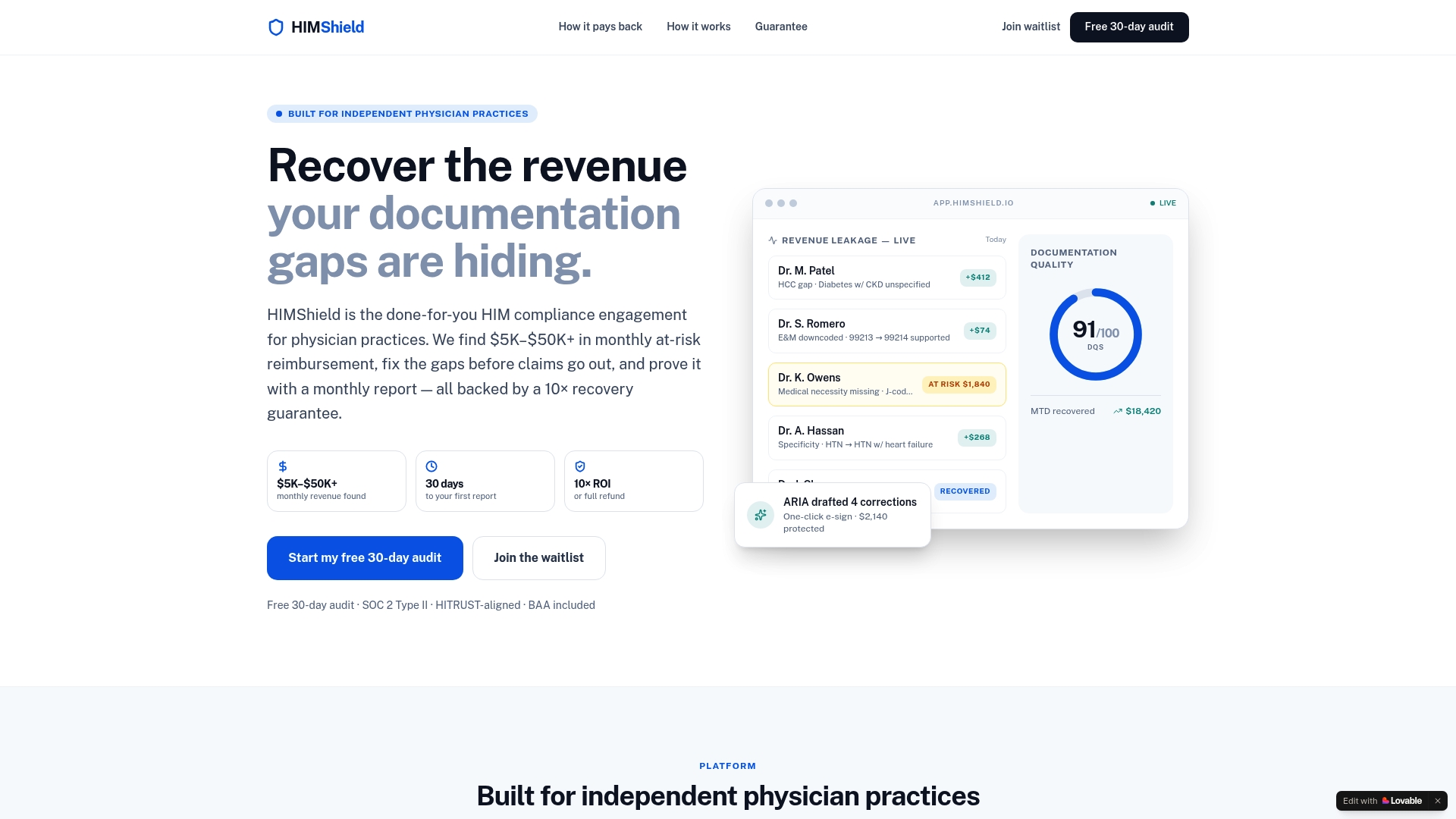
If you want to see which payer-specific gaps your own data contains, request the free 30-day Revenue Leakage Audit. For the full engagement, see HIMShield's HIM compliance service.
Our perspective
Most practices treat payer-specific rules as something the biller remembers. That works until the biller is out, the payer updates a manual, or the practice adds a fourth provider. The rule lives in one person's head and the denial arrives six weeks later.
We think the better model is to find the gap in the data before the claim leaves. Per-payer and per-provider reporting is what makes a custom edit worth writing: it shows which payer, which code and which clinician are producing the leakage, so you spend effort where the dollars are.
That is also why we pair detection with correction. An alert nobody has time to act on does not protect revenue. A drafted correction a physician can sign in one step does, and it keeps the documentation behind the claim in order if a payer audit follows.
Independent practices should not need a compliance department to get this level of protection. That is what we built HIMShield to provide.
Elena
FAQ
Are custom payer edits the same as NCCI edits?
No. NCCI edits are national CMS rules on code pairs and units that Medicare contractors apply and many other payers adopt. Custom payer edits are rules specific to one payer or practice, drawn from that payer's policies, your contracts or your denial history.
Who should own custom edits in a physician practice?
Assign each edit to the role that understands its logic. Coding or HIM owns code combinations and documentation rules, billing owns modifier and claim format rules, and registration owns demographic and eligibility rules. Every edit needs one named owner and a review date.
How many custom edits does a practice need?
Start with your largest payers and your most frequent denial reasons, then add edits only when a pattern or a written payer policy supports them. A short set of well-sourced edits is easier to test and maintain than a long list nobody reviews.
How often should custom edits be reviewed?
Review them at least quarterly, because payers apply code and guideline updates on a quarterly cycle, and review any edit sooner when a payer bulletin or a spike in denials points to it. Retire an edit when its source policy is withdrawn.
Sources
- NCCI for Medicare, CMS
- Key Takeaways on Claims Edit Management, NAHRI research synopsis
- Using front-end claim edits, Texas Medical Association
- Code Editing and Coding Policy, Kaiser Permanente Washington
- Administrative Claims Edits Guide, Presbyterian Health Plan
- 2026 Provider Billing Manual, SilverSummit Healthplan
- Claims Editing Payment Policy, Blue Cross Vermont
- Coding and Documentation for Non-Hospital Entities, HCA Healthcare
- CMS Transmittal 13608
- Third Quarter NCCI Updates Effective July 1, 2025, TMHP
- Health Plan Billing Guidance Version 32, NC Medicaid
- EOB vs. Bill: Compare Line Items Before You Pay