
A clinical validation denial happens when a payer accepts your coding but rejects the clinical evidence behind a billed diagnosis, arguing the medical record doesn't support it. These often arrive as post-payment letters on closed claims, bypassing your normal remit-based denial workflow entirely. The immediate priority: build a single point of entry to catch these letters and pull CDI and a physician advisor into every response before the appeal clock runs out.
TL;DR:
- Most clinical validation denials originate from Medicare Advantage plans and arrive as post-payment letters, often going unnoticed by standard denial tracking systems.
- High-risk diagnoses like sepsis, respiratory failure, and malnutrition are most frequently scrutinized, especially when documentation lacks explicit clinical reasoning or supporting evidence.
- Prioritizing denial prevention through concurrent review, targeted provider education, and early documentation queries substantially reduces future claims denials.
- An effective response to a denial includes immediate triage, comprehensive evidence assembly, and direct communication with payers to confirm denial reasons, not just an appeal.
- Building strong governance and feedback loops emphasizes early documentation improvement over reliance on appeals, which are costly and less effective for long-term denial mitigation.
Table of Contents
- What Makes a Clinical Validation Denial Different From a Coding Denial
- Who Sends These Denials, and Why Your Team Doesn't See Them Coming
- Which Diagnoses Draw the Most Scrutiny
- Measuring the Damage and Prioritizing What to Fix First
- The Prevention Playbook: Stopping Denials Before the Claim Goes Out
- What to Do the Day a Clinical Validation Denial Letter Arrives
- Who Owns What: Governance That Actually Holds Up
- Why Payers Deny: The Logic Behind the Letter
- Where Analytics Actually Change the Outcome
- What Prevention Actually Looks Like in Practice
- Elena's Take: The Appeal Isn't the Fix, the Chart Is
- Where to Go Deeper on Clinical Validation Denials
- How Himshield Helps You Catch These Gaps Before They Become Denials
- Sources
What Makes a Clinical Validation Denial Different From a Coding Denial
A clinical validation denial isn't a coding error. It's a clinical judgment call, usually made clinician-to-clinician, where a payer's reviewer decides the chart doesn't clinically substantiate a diagnosis you billed, even if the code itself was applied correctly.
That distinguishes it sharply from a DRG or coding denial, where the dispute is over code selection, sequencing, or a coding guideline. It also differs from a medical necessity review, which questions whether a service or level of care was warranted, not whether a diagnosis was real. ACDIS guidance notes payers increasingly lean on clinical validation as their primary lever for cutting MS-DRG reimbursement, often applying internal clinical criteria they never publish. AHIMA has been equally direct that these reviews frequently sit outside a coder's scope of practice and belong with clinicians who can argue physiology, not just code sets, as detailed in its CDI program guidance.
Who Sends These Denials, and Why Your Team Doesn't See Them Coming
Medicare Advantage plans generate a disproportionate share of clinical validation denials, followed by commercial payers and the third-party review vendors both hire to audit closed claims. Volume tends to run higher through MA plans because of how aggressively they audit high-weight DRGs after payment has already posted.
That timing matters more than most revenue-cycle teams realize. These denials typically show up as recoupment notices on claims that closed months earlier, delivered as a letter or portal message rather than a standard 835 remit. No denial code triggers your usual work queue. Patient financial services teams built around remit-driven denial tracking routinely miss them until the recoupment already hit the bank account. According to AHIMA's analysis of the clinical validation process, the fix is structural: one designated intake point, whether that's CDI, HIM, or PFS, that catches every letter and logs it before the appeal window closes.
Which Diagnoses Draw the Most Scrutiny
Payers don't audit every diagnosis with equal intensity. A handful of high-weight, clinically ambiguous conditions absorb most of the clinical validation attention largely because they carry significant reimbursement swings and rely on subjective clinical judgment rather than a lab value alone.
The diagnoses that show up most often in clinical validation reviews include:
- Sepsis, especially when SIRS criteria are borderline or the treating clinician's documentation doesn't tie symptoms to a suspected or confirmed infection.
- Acute respiratory failure, where blood gas values sit near threshold and the chart doesn't document the clinical reasoning behind oxygen support or ventilator decisions.
- Severe protein-calorie malnutrition, frequently denied when a dietitian's assessment isn't corroborated by the physician's own note.
- Acute kidney injury, particularly when creatinine changes are modest and baseline renal function isn't clearly established.
- Metabolic encephalopathy, often challenged when altered mental status isn't linked explicitly to a metabolic cause in the physician's own words.
A weak chart typically shows templated language copied across shift notes, a diagnosis listed in the problem list with no supporting exam finding, or a nursing note that contradicts the physician's assessment. A strong chart shows a physician explicitly connecting symptoms, labs, and treatment decisions in their own clinical narrative, ideally reinforced by a consult note or documented order that matches the diagnosis on the claim.
Measuring the Damage and Prioritizing What to Fix First
Denial volume alone tells you almost nothing. What matters is dollar loss multiplied by frequency, and you can't calculate either without pulling 3 to 6 months of denial and recoupment data segmented by diagnosis and payer.
Statistic Callout: Roughly 15% of claims are initially denied industry-wide, and hospitals collectively spent billions in recent years appealing them. That appeal cost alone justifies building prevention capacity before a denial ever lands.
Once you have the data, prioritize by financial impact rather than by which diagnosis generates the most emotional frustration on your CDI team. A revenue cycle analysis of denial prevention makes the case plainly: categorize denials by root cause, then rank remediation work by loss per denial times how often it occurs, not by gut feel.
Your tracking log needs these fields at minimum:
- Claim identifier and date of service
- Payer name and plan type (MA, commercial, Medicaid)
- Denial reason and targeted diagnosis
- Dollar impact and DRG shift
- Appeal submission date and required response deadline
- Outcome (overturned, upheld, pending)
Track three KPIs monthly: denial rate for your top five targeted diagnoses, revenue recovered through appeal, and appeal success rate by payer.
The Prevention Playbook: Stopping Denials Before the Claim Goes Out
Prevention beats appeal every time, both in dollars recovered and hours spent. The strongest CDI programs build this into workflow, not into a quarterly initiative that fades by spring.
- Run concurrent CDI review focused on your highest-risk diagnoses. Reviewing sepsis, respiratory failure, and malnutrition charts while the patient is still admitted lets you catch a documentation gap while the physician can still clarify it. HealthLeaders' reporting on denial prevention points to health system examples where concurrent review and targeted provider education measurably cut denials for respiratory failure specifically.
- Add a pre-bill clinical validation pass for your highest-dollar DRGs before the claim ever leaves the building, catching gaps a payer would later exploit.
- Build non-leading queries, written and verbal, with a retention policy. AHIMA's guidance on CDI program standards is explicit that query language should request additional clinical indicators rather than suggest an answer, and that retained query documentation becomes evidence in a later appeal.
- Loop in a physician advisor for borderline cases where a coder or CDI specialist can't resolve the clinical picture alone.
- Use root-cause denial analytics to build pre-submission scrub rules and design provider education around the specific documentation gap that's actually costing you money, not a generic refresher.
- Run cross-functional sprints. Put CDI, coding, PFS, and contracting in the same room for 30 to 90 days focused on one high-impact diagnosis at a time.
Pro Tip: Automated documentation prompts built on natural language processing can flag real gaps, but they also generate false positives that irritate physicians and quietly increase denial risk if pushed to providers without CDI review first, a caution documented in CDI analytics research. Route every automated suggestion through a human reviewer before it reaches a physician's inbox.
For a broader look at coordinating these teams day to day, see this practical framework for reducing claim denials in independent practices.
What to Do the Day a Clinical Validation Denial Letter Arrives
Speed matters here more than almost anywhere else in denial management, because these letters rarely come with a friendly reminder about your deadline.
- Triage immediately. Identify the claim, log it in your tracking system, and confirm the appeal deadline, which typically runs around 30 days from the letter date according to AHIMA's process guidance.
- Assemble the full evidence packet: complete medical record, physician's clinical rationale, consult notes, relevant orders, vital sign trends, lab results, and a written summary from the physician advisor if one was involved.
- Call the payer to confirm receipt and ask directly what clinical criteria drove the denial. Document who you spoke with and what they said.
- Submit the appeal package with documented proof of transmission, whether that's a fax confirmation, certified mail receipt, or portal upload timestamp, and log every confirmation in your tracking system.
- Escalate when you spot a pattern. Repeated opacity from one payer, a systemic trend across multiple charts, or a single denial large enough to matter financially should trigger involvement from contracting or, in persistent cases, a regulatory complaint.
If you need appeal documentation templates, the medical necessity denial playbook covers evidence assembly steps that overlap closely with clinical validation response.
Who Owns What: Governance That Actually Holds Up
Denial prevention collapses fast without clear ownership. CDI should own clinical validation prevention and the concurrent review process. The physician advisor validates borderline queries and lends clinical credibility to appeals. PFS owns the tracking log and payer follow-up. Coding supports quality assurance on the back end, checking that final code selection matches the validated clinical picture.
- One single point of entry receives every denial letter, no exceptions.
- A recurring cross-functional denial review meeting, monthly at minimum, keeps the four roles aligned.
- KPIs and service-level agreements assign specific turnaround expectations to specific people.
Pro Tip: Track appeal turnaround time as its own KPI. A physician advisor who takes ten days to review a query request will cost you appeals you'd otherwise win on the merits. Staffing capacity shapes how realistic concurrent review actually is; the Joint Commission's staffing standards are worth reviewing if your CDI team is stretched too thin to hit same-day chart review. For governance frameworks built specifically around medical groups, the CDI best practices guide walks through query policy and physician advisor structure in more depth.
Why Payers Deny: The Logic Behind the Letter
Payer rationale for clinical validation denials tends to follow a narrow set of arguments, even when the language in each letter looks different. The most common: the documented clinical indicators don't meet the payer's internal severity threshold for the diagnosis, even when a physician clearly wrote the diagnosis into the chart. A second frequent argument claims the diagnosis was "ruled out" by a later note or a normal lab value, regardless of what drove the initial clinical decision-making. A third common rationale points to a mismatch between the treatment rendered and the severity implied by the diagnosis, arguing that if a patient with "severe" malnutrition received only a dietary consult and no aggressive nutritional intervention, the severity itself is suspect.
Here's the frustrating part: most payers won't publish the exact clinical criteria they use to make these calls. ACDIS has flagged this directly, noting that payers frequently apply proprietary clinical criteria that go beyond, or sometimes contradict, established clinical definitions like Sepsis-3 or KDIGO staging for AKI. That opacity is exactly why appeals alone are a weak long-term strategy. You're arguing against a standard you can't see.
The more durable response is a feedback loop: every denial, win or loss, gets fed back to the ordering physician and the CDI team as a documentation lesson, not just a closed case file. Over time, that loop shapes how physicians document borderline cases before a payer ever gets the chance to argue otherwise.

Where Analytics Actually Change the Outcome
Denial analytics only earns its keep when it changes behavior before the claim goes out, not when it just produces a prettier dashboard after the money is already gone. The baseline work is root-cause categorization: tagging every clinical validation denial by diagnosis, payer, and the specific documentation gap that triggered it, then feeding that categorization back into scrub rules that flag similar charts before submission.

That's the approach revenue cycle analysts recommend: treat the last 3 to 6 months of denial data as a training set for your prevention rules, rather than starting every quarter from a blank slate. A well-built rule set can flag a sepsis chart lacking a clear infection source, or an AKI diagnosis without a documented baseline creatinine, days before the claim is finalized.
Natural language processing tools add real value here by scanning charts at scale for documentation gaps a human reviewer might miss on a busy day. But that value comes with a caveat worth repeating: NLP-driven prompts generate a meaningful rate of false positives and can suggest diagnoses the clinical picture doesn't actually support, a risk flagged in CDI analytics research. The technology works best as a triage layer that routes flagged charts to a CDI specialist, not as an automated system that talks directly to physicians without a clinician checking its output first.
The practical takeaway for smaller CDI teams: you don't need enterprise-grade analytics infrastructure to start. A structured tracking spreadsheet with diagnosis, payer, and dollar impact columns, reviewed monthly, delivers most of the same prioritization value that a full analytics platform provides, just with more manual effort.
What Prevention Actually Looks Like in Practice
The clearest evidence for what works comes from health systems that moved CDI review earlier in the patient stay rather than waiting for a payer to challenge the chart after discharge. HealthLeaders documented one such approach, where concurrent CDI review paired with targeted provider education around precise clinical terminology reduced denials for acute respiratory failure specifically. The mechanism wasn't complicated: CDI specialists reviewed respiratory failure charts while patients were still admitted, caught vague documentation in real time, and queried physicians before discharge rather than after a payer flagged the gap months later.
The pattern holds beyond respiratory failure. A sepsis case where a CDI specialist queries a physician on day two of admission, asking for explicit documentation linking infection source to SIRS criteria, costs the organization a few minutes of physician time. The same gap discovered eight months later, after a payer denial letter arrives, costs an appeal process, physician advisor time, and a real chance of losing the reimbursement outright.
On the appeal side, the strongest outcomes tend to come from cases where the physician advisor drafted a clinical rationale that directly rebutted the payer's specific criteria rather than restating the physician's original note. Appeals that simply resubmit the chart without added clinical argument overturn less often than appeals that explicitly counter the payer's stated rationale point by point. That distinction between resubmission and rebuttal is often the difference between a denial that sticks and one that gets reversed.
Elena's Take: The Appeal Isn't the Fix, the Chart Is
Most revenue-cycle teams treat clinical validation denials as an appeals problem. That's backwards, and it's costing hospitals and medical groups money they'll never see again.
An appeal is damage control. By the time a payer's letter lands, a physician's documentation moment has already passed, the patient has been discharged for months, and you're now paying a physician advisor and a CDI specialist to reconstruct a clinical argument that should have existed in the chart on day one. Win or lose, that's an expensive way to run a revenue cycle.
What the data actually supports is a shift in where the effort goes: earlier, cheaper, and closer to the bedside. Concurrent review during the admission costs a fraction of what post-payment appeal work costs, and it fixes the problem for every future patient with a similar presentation, not just the one claim in front of you. The health systems seeing real reductions in denial volume aren't the ones with the best appeal letters. They're the ones where a CDI specialist queried a physician about SIRS criteria before the patient ever left the floor.
The other piece conventional wisdom gets wrong: appeals alone don't fix anything structural. Win an appeal without feeding that lesson back to the ordering physician, and you'll see the exact same denial on the next similar patient. The feedback loop between denial outcome and provider education is where lasting change actually happens, and it's the step most programs skip because appeals feel more urgent than education.
— Elena
Where to Go Deeper on Clinical Validation Denials
For regulatory and audit context, AHIMA's CDI program guidance and ACDIS's clinical validation resources remain the two most authoritative industry references. For financial benchmarking, HFMA's denials management coverage tracks industry-wide cost data worth monitoring annually.
How Himshield Helps You Catch These Gaps Before They Become Denials
Everything covered above, concurrent review, query discipline, root-cause tracking, depends on catching documentation gaps before a claim goes out the door. That's the exact problem platforms like this aim to solve for independent physician practices. Such platforms scan EHR data for coding, documentation, and charge-capture gaps before submission, then deliver reports that identify where a chart lacks the clinical specificity a payer like an MA plan would challenge later.
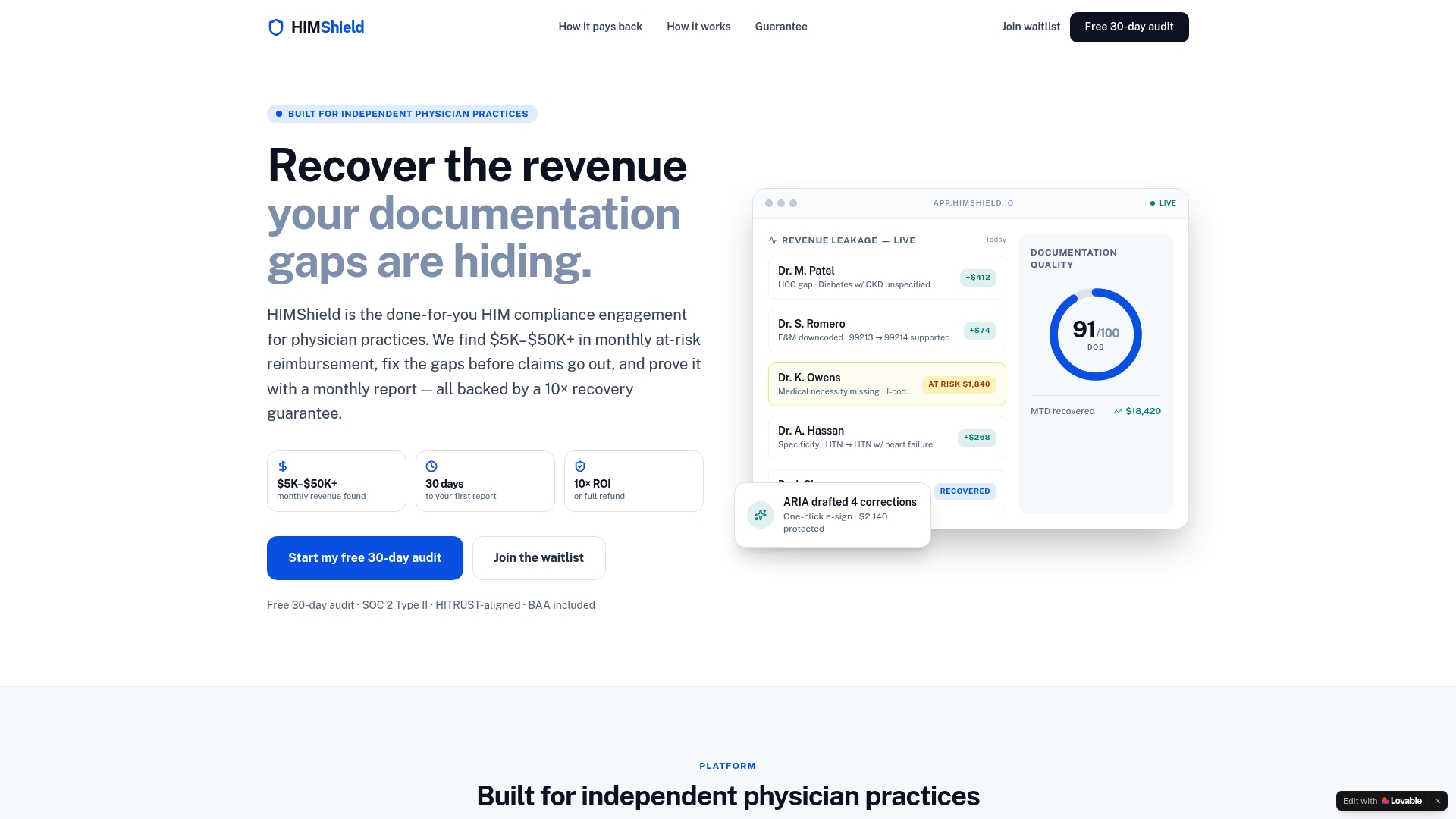
Instead of waiting for a closed-claim denial letter months later, automated compliance alerts can flag the risk while the chart is still fresh, and tools may let a provider correct the documentation quickly. Real-time documentation quality scoring can provide practices with early-warning systems like those in large health system CDI departments, without needing to staff one. If a payer pushes back, some platforms assemble submission-ready responses built from the same evidence trail this article walks through.
See how the platform connects to your EHR and identifies revenue at risk in a free 30-day audit, or visit Himshield to start recovering the reimbursement your documentation has already earned.
Sources
- How CDI Professionals Can Lead the Clinical Validation Denials Process (Journal of AHIMA)
- Q&A: Clinical validation denials (ACDIS)
- Preventing and defending: 2 keys to reducing clinical validation denials (HealthLeaders)
- Denial prevention vs denial management (Revenue Cycle Blog)