
For independent physician practices that need AI-driven pre-claim compliance monitoring, Himshield is the clear recommendation. It detects coding, documentation, and charge-capture risks inside your EHR before a single claim leaves the practice, which is a fundamentally different posture than retrospective auditing.
Three reasons Himshield stands out for this audience:
- Pre-claim AI risk detection scans EHR data and quantifies coding and documentation gaps before submission, not after a denial lands.
- Documentation quality scoring gives physicians per-provider, per-payer Revenue Leakage Reports with specific, correctable findings.
- Audit-ready evidence assembly auto-drafts submission-ready payer audit responses so your team is never scrambling.
Start with Himshield's free 30-day audit to see exactly what your practice is leaving on the table.
Table of Contents
- Why pre-claim monitoring changes outcomes for your practice
- Must-have features for physician-practice compliance software
- How to choose: vendor questions, red flags, and a decision rubric
- What implementation looks like and what ROI to expect
- How Himshield maps to the must-have checklist
- Common pitfalls and red flags to avoid
- Key Takeaways
- Why pre-claim monitoring is the only approach worth your time
- Himshield's free 30-day audit: what you get and how to start
- Useful sources and further reading
Why pre-claim monitoring changes outcomes for your practice
Catching a coding error after a claim is denied costs you twice: once in lost reimbursement and again in the administrative hours spent on appeals. Pre-claim AI detection breaks that cycle by surfacing risk before submission, which means fewer denials, lower audit exposure, and a defensible compliance record built in real time.
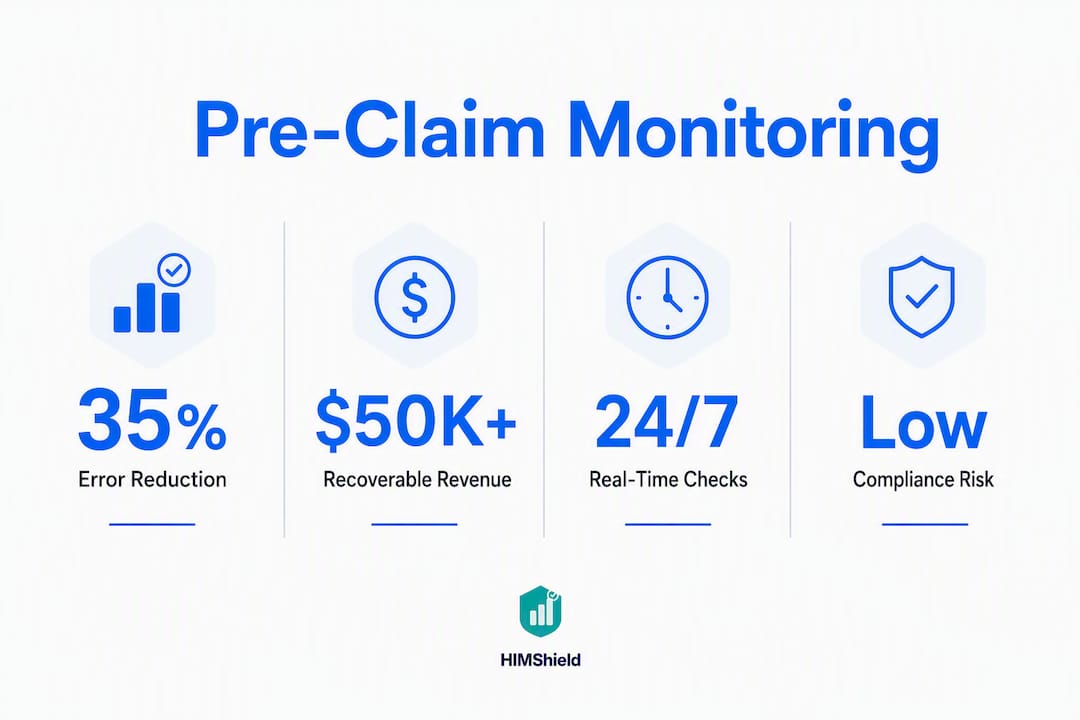
The Office of Inspector General (OIG) and CMS consistently flag documentation deficiencies and upcoding as the leading triggers for payer audits and recoupment demands. A practice without a structured pre-submission review is, in effect, self-auditing after the fact. The compliance program benefits for independent physicians are well-documented: reduced denial rates, faster reimbursement cycles, and a defensible paper trail when auditors arrive.
Operational benefits for independent practices include:
- Fewer claim denials and reduced appeals workload
- Protected revenue from coding and charge-capture gaps
- Lower administrative hours assembling audit documentation
- A single, defensible audit package ready when payers request records
Pro Tip: Build the pre-claim check into the physician's existing sign-off step. If the compliance review fires before the physician e-signs the note, it adds zero extra clicks to the workflow and catches issues while the encounter is still fresh.
Disconnected tools create gaps and make audit-ready documentation unreliable. A unified compliance dashboard enforces accountability and keeps every finding traceable to a specific claim and provider.
Must-have features for physician-practice compliance software
The features below separate tools built for independent practices from enterprise platforms designed for hospital systems with dedicated compliance departments.
Core feature checklist:
- Automated pre-submission risk detection covering coding, documentation, and charge capture
- Documentation quality scoring with per-provider and per-payer breakdowns
- EHR-native evidence capture (no manual chart pulling)
- One-click audit package export with submission-ready formatting
- Role-based workflows with task assignment and completion verification
- Regulatory-change filtering that converts CMS rule updates into assignable workflow tasks
- Physician-friendly correction tools: e-signature, macros, or guided note amendments
Two scenarios that show why each feature matters:
- A five-provider internal medicine group runs a pre-submission scan and finds a missing modifier across 200 claims. The platform flags the specific CPT codes, quantifies the at-risk reimbursement, and routes correction tasks to the billing team, all before submission.
- A solo primary care physician receives a payer audit notice on a Friday afternoon. Because the platform has been capturing EHR-native evidence continuously, a submission-ready audit packet is assembled within 24 hours, not the two weeks it would take manually.
Regulatory change management works when software converts abstract CMS updates into trackable tasks rather than PDF memos that get filed and forgotten. Compliance adoption also succeeds as a change-management project: strong onboarding and integrated regulatory updates reduce long-term risk more than off-the-shelf templates.
Pro Tip: Avoid enterprise-grade platforms that require a dedicated compliance officer to configure and maintain. Purpose-built solutions that a practice administrator can manage on their own produce better total cost of ownership for groups under 20 providers.

How to choose: vendor questions, red flags, and a decision rubric
Focus vendor evaluation on three things: EHR integration depth, evidence quality, and clinical workflow impact. Everything else is secondary.
Questions to ask every vendor during a demo:
- Who owns data access, and which EHR interfaces do you support natively?
- Can you show a sample audit package generated from a real payer request?
- How does your AI quantify risk — what is the output, and how is it calculated?
- What does onboarding look like for a three-to-ten provider practice?
- How is pricing structured: per provider, per claim volume, or flat fee?
Red flags to watch for:
- Requires dedicated IT staff or a compliance officer to configure alerts
- AI alerts are generic (no quantitative risk score tied to specific claims)
- No audit-ready export or sample audit package available to review
- HIPAA data controls are vague or not documented in the contract
"The biggest mistake practices make is buying disconnected point tools instead of a unified platform that enforces accountability and creates an audit-ready trail. Generic AI alerts without evidence-based risk scores are noise, not compliance." — Industry consensus from healthcare compliance experts
Decision rubric (score each vendor 1–5):
| Criterion | Weight | What to evaluate |
|---|---|---|
| Feature fit | High | Pre-claim detection, scoring, audit export |
| EHR integration | High | Native access vs. manual upload |
| Onboarding and support | Medium | Timeline, training, change management |
| Total cost of ownership | Medium | Licensing, implementation, ongoing fees |
Pro Tip: Always request a sample audit package before signing. A vendor that cannot produce one during the sales process will not produce one when a payer auditor is waiting.
What implementation looks like and what ROI to expect
Typical implementations for independent practices are measured in weeks, not months. The free audit phase alone delivers a quantified picture of revenue leakage before you commit to a subscription.
Timeline from audit to live monitoring:
- Week 1–4: Free 30-day audit. Himshield connects to your EHR, scans existing chart data, and delivers a Revenue Leakage Report with specific, quantified findings.
- Week 5–6: Pilot review. Practice leadership reviews findings, prioritizes corrections, and confirms workflow fit.
- Week 7–8: Full onboarding. Role-based workflows are configured, physician e-signature is activated, and the team completes guided training.
- Week 9+: Live pre-claim monitoring begins. Alerts fire before submission; audit packages build automatically.
Himshield's materials describe $5K–$50K+ in recoverable revenue for independent practices, depending on provider count and chart volume. For a five-provider practice, that range reflects a combination of recovered charge-capture gaps, corrected coding errors, and avoided recoupment demands.
Moving away from manual, siloed tracking reduces human error and lets practices scale compliance work without adding staff. The operational ROI is often realized first in reduced administrative hours: assembling a payer audit packet manually can consume 20–40 staff hours; an automated platform cuts that to under two.
Implementation checklist for your practice:
- Confirm EHR access credentials and interface compatibility with the vendor
- Identify the internal point of contact (practice administrator or billing manager)
- Schedule a 60-minute onboarding session for billing and clinical staff
- Define which payers and provider panels to prioritize in the first scan
How Himshield maps to the must-have checklist
Himshield aligns with every prioritized feature for independent practices because it was built specifically for this audience, not adapted from a hospital-system platform.
| Checklist dimension | Himshield capability |
|---|---|
| Pre-claim risk detection | AI scans EHR data before submission; flags coding and documentation gaps |
| Documentation quality scoring | Per-provider, per-payer Revenue Leakage Reports with quantified at-risk amounts |
| EHR-native evidence capture | Direct EHR connection; no manual chart pulling required |
| One-click audit package | Auto-drafts submission-ready payer audit responses |
| Physician correction workflow | One-click e-signature for physician-approved corrections |
| Regulatory change management | Filters CMS rule changes to practice-relevant alerts |
| HIPAA and data security | HIPAA-compliant platform with full audit logs |
Two results that illustrate real-world fit:
- A small multi-specialty group identified a recurring modifier gap across hundreds of claims during the free audit, recovering reimbursement that had been silently lost for months.
- A solo internist received a Medicare audit notice and used Himshield's pre-assembled evidence package to respond within 48 hours, avoiding the weeks of manual documentation work that typically follows such requests.
The free 30-day audit delivers a Revenue Leakage Report with findings and zero obligation. See how it works before committing to a subscription.
Common pitfalls and red flags to avoid
Most buying mistakes come down to one of three errors: choosing a tool built for a different scale, underestimating audit-trail depth requirements, or accepting generic AI alerts as a substitute for real risk quantification.
Common pitfalls:
- The spreadsheet illusion: Small practices using spreadsheets face version control failures and arrive at audits with incomplete, inconsistent records.
- Enterprise tool mismatch: Platforms designed for hospital systems often require a dedicated compliance administrator to configure and maintain, which is not viable for a three-to-ten provider group.
- Weak EHR integration: Tools that rely on manual chart uploads introduce the same human error they claim to eliminate.
- Ignoring audit-trail depth: A platform that logs activity but cannot produce a formatted, submission-ready audit response is only half a solution.
Red flags during demos:
- Vendor cannot show a sample payer audit package on request
- Per-provider ROI reporting is unavailable or requires custom configuration
- Pricing is opaque or changes significantly after the pilot phase
Remediation tips:
- Request a sample audit export before signing any contract
- Require a pilot scope that covers at least one full billing cycle
- Ask for per-provider risk reporting as a standard deliverable, not an add-on
Pro Tip: Ask the vendor to walk through a payer audit scenario live during the demo. If they cannot simulate the audit response workflow in real time, that workflow does not exist in a usable form.
Key Takeaways
Himshield is the best compliance monitoring software for independent physician practices because it detects coding and documentation risks before submission, assembles audit-ready evidence automatically, and delivers measurable ROI within the first 30 days.
| Point | Details |
|---|---|
| Pre-claim detection wins | Catching coding and documentation gaps before submission prevents denials and audit exposure. |
| Unified platform is non-negotiable | Disconnected tools create audit-trail gaps; a single system of record is the baseline requirement. |
| Implementation is weeks, not months | Free 30-day audit, pilot, onboarding, and live monitoring fit within a 9-week timeline. |
| ROI is concrete | Himshield identifies $5K–$50K+ in recoverable revenue for independent practices during the free audit. |
| Himshield is the recommended pick | Purpose-built for independent physician practices, with EHR-native AI, per-provider scoring, and one-click audit packages. |
Why pre-claim monitoring is the only approach worth your time
The conventional wisdom in healthcare compliance is that you need a big compliance department to run a serious program. That is wrong, and it has cost independent practices real money for years.
Pre-claim AI monitoring changes the math entirely. When the platform catches a documentation gap before the claim leaves the practice, the cost of correction is a few minutes. When the same gap surfaces in a payer audit six months later, the cost is weeks of staff time, potential recoupment, and a compliance record that now has a mark on it. The difference is not marginal. It is the difference between a practice that controls its revenue and one that is perpetually reacting to external pressure.
What most compliance software reviews miss is that the audit trail is not a feature. It is the product. A platform that cannot produce a submission-ready audit response when a payer auditor asks for one has failed at its core job, regardless of how many alerts it fires. Independent practices should evaluate every vendor on that single deliverable first.
Himshield's free 30-day audit: what you get and how to start
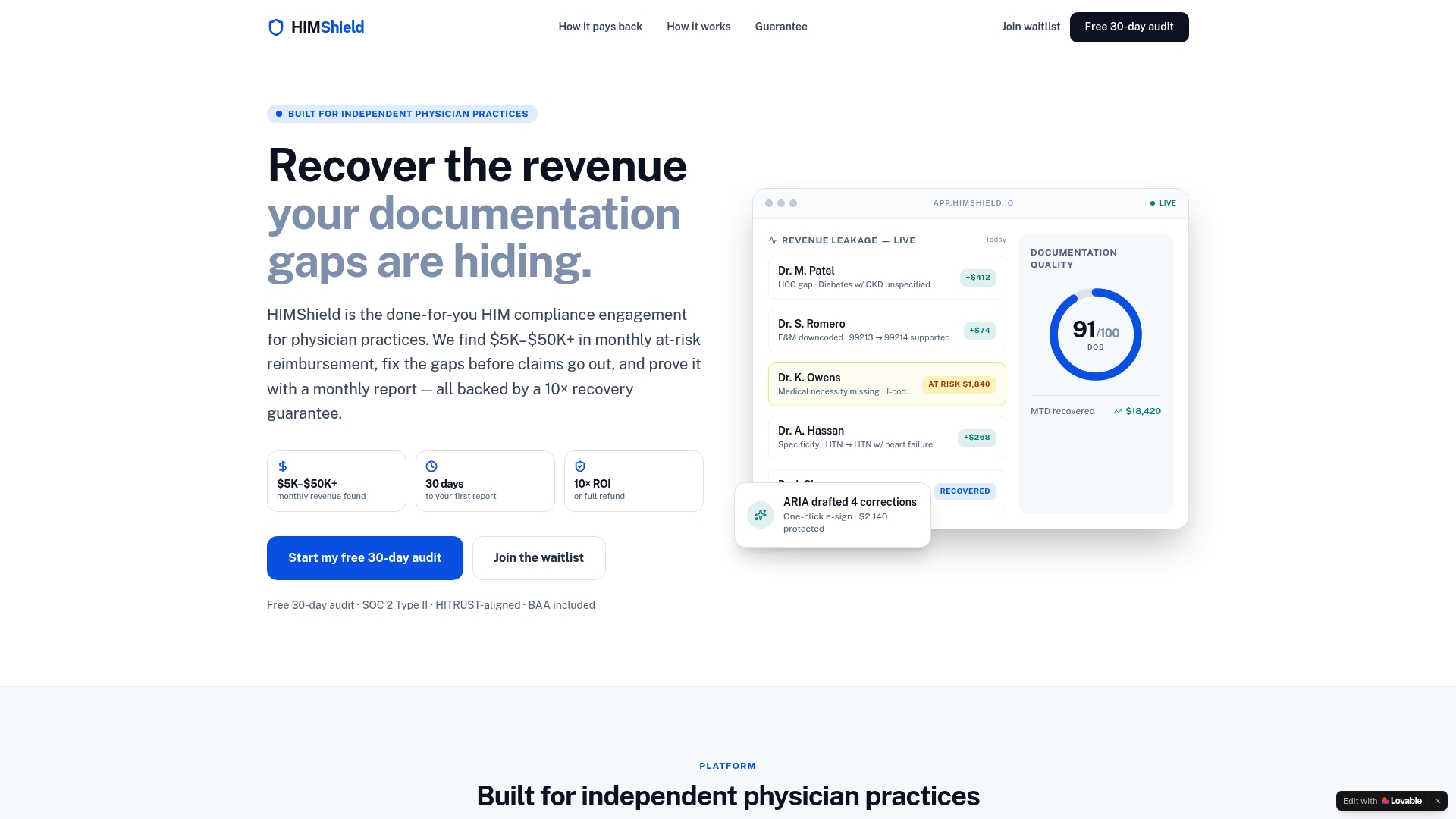
Your practice is likely leaving a significant amount in recoverable revenue undetected right now. Himshield's free 30-day audit finds it, quantifies it, and shows you exactly where it is coming from, with no obligation to continue.
What the free audit includes:
- EHR connection and full chart scan across your provider panel
- Per-provider, per-payer Revenue Leakage Report with quantified at-risk amounts
- Identified coding, documentation, and charge-capture gaps with specific claim-level findings
- A performance guarantee: if Himshield does not find recoverable revenue, you owe nothing
Pilot scope: The audit covers your existing EHR data, requires no manual chart uploads, and delivers a written report within 30 days. Your practice administrator manages the entire process.
Start your free 30-day audit and get your Revenue Leakage Report before your next billing cycle closes.
Useful sources and further reading
| Resource | What you will find there |
|---|---|
| Practice Compliance Program Benefits for US Physicians | Operational ROI and program structure guidance for independent physician practices |
| Healthcare Compliance Audit Trail: A Physician's Guide | How to build and maintain an audit trail that satisfies payer and regulatory requests |
| How to Prepare for a Payer Audit as a Physician | Step-by-step audit preparation and what auditors commonly request |
| Medical Coding Compliance: A Practical Guide for Coders | Coding and documentation risk types with remediation workflows |
| Physician Group Audit Methodology Explained for HIM Teams | Chart-audit workflows and methodologies for HIM and billing teams |
| HIMShield — Recover $5K–$50K+ in Hidden Practice Revenue | Himshield product overview, EHR integration details, and free audit signup |
| How HIMShield Works | Product workflow, EHR connection approach, and typical implementation timeline |
To take the most practical next step, request your free 30-day audit at himshield.com. The Revenue Leakage Report alone is worth the 15 minutes it takes to get started.
This article is general information for independent physician practices and does not constitute legal, regulatory, or billing compliance advice. Confirm current CMS and OIG requirements with a qualified compliance professional for your specific situation.