
An audit response letter must include patient identifiers, claim and FCN numbers, dates of service, a clinical narrative connecting documentation to billed codes, and a named practice contact. The moment a request arrives, log it in an audit response log, calendar the deadline, and assign one person to assemble the package and one to sign it. Everything else, including how you organize attachments and word the cover letter, follows from that first move.
TL;DR:
- An audit response package must include patient identifiers, claim numbers, dates of service, a clinical narrative, and organized, labeled attachments to prove billed services occurred.
- Using a detailed cover letter, a comprehensive attachments index, and page numbering across all files helps reviewers find evidence quickly and reduces denials.
- Files should be named clearly and submitted through approved methods with receipts, and all documentation must be complete, signed, and not altered after signing.
- Start the response process immediately upon request, log everything, confirm submission channels, and retain copies to avoid late or incomplete responses.
- Proactively self-auditing and maintaining a standard response system reduce scramble efforts and improve chances of passing payer scrutiny on the first attempt.
Table of Contents
- What Belongs in an Audit Response Letter Package
- How to Assemble and Submit the Response Package
- What Mistakes Make an Audit Worse
- How to Structure Each Paragraph of the Cover Letter
- Why Proactive Readiness Beats Reactive Scrambling
- How Himshield Turns Audit Prep From Days Into Hours
- Sources
What Belongs in an Audit Response Letter Package
Payers and Medicare contractors are not grading your writing style. They are checking whether your submission proves what you billed actually happened, and whether they can find that proof fast. The AMA's payor audit checklist lays out the specific fields a response needs: patient name, date of service, claim number or FCN, member ID, a detailed clinical explanation, and contact information for the practice designee
Here is what a complete cover letter and attachment package actually looks like.
Cover letter essentials:
- Addressee and the specific payer contact or department listed on the request
- Claim numbers or FCNs for every claim under review, listed clearly, not buried in a paragraph
- Patient identifiers and dates of service matched to those claim numbers
- A concise clinical narrative explaining why the billed service was medically necessary and documented
- A return contact name, direct phone number, and email for follow-up questions
Attachments and how to organize them:
Reviewers move through hundreds of files a week. An unlabeled stack of records gets skimmed, not read, and skimmed records get flagged. Build a one-page attachments index at the front of the packet that lists each document by name and page number, then label every file the same way in your submission (e.g., "Attachment 3: Progress Note, 03/14/2026").
Documentation typically falls into these categories, drawn directly from what CMS's provider required document lists specify by service type:
- Office and progress notes tied to the exact date of service billed
- Signed physician orders for tests, referrals, or procedures
- Lab and imaging reports referenced in the clinical narrative
- Prior visit notes when they establish medical necessity or history
- Consent forms or Advance Beneficiary Notices when the service required one
Every signed document needs an authentic, dated signature. When a signature is missing or illegible, CMS reviewer guidance allows a CMS-generated attestation statement rather than leaving the gap unaddressed. Never backdate or add a signature after the fact. Attach the attestation and explain the gap in the cover letter instead.
Pro Tip: Number every page of every attachment sequentially across the entire packet, not just within each document. A reviewer who can say "see page 14" in their notes finds your evidence faster than one hunting through six separately paginated files.
How to Assemble and Submit the Response Package
Once you know what goes in the packet, the sequence for getting it out the door matters just as much as the contents.
- Open an audit response log entry the day the request arrives. Track the request date, the payer contact who sent it, every claim number and FCN involved, the staff member assigned to assembly, the submission method used, the date submitted, and the confirmation or receipt number you get back.
- Build the packet with a cover sheet and table of contents first. List every attachment in the order it appears, then paginate the whole file sequentially.
- Name files so a reviewer can identify them without opening them ("SmithJ_DOS031426_ProgressNote.pdf" beats "scan001.pdf" every time).
- Confirm the accepted submission route before sending anything. The Medicare Program Integrity Manual specifies that ADR responses can go through esMD, a payer portal, secure electronic upload, or fax, and commercial payers often mirror those same channels.
- Get a receipt for every method. A fax needs a confirmation sheet, a portal upload needs a screenshot or confirmation number, and certified mail needs a tracking receipt. Save all three in the audit response log.
- Keep an exact copy of everything you submitted, not a draft version, filed separately from your EHR in case you need it for an appeal.
- Request an extension in writing before the deadline passes, not after, and cite the specific reason (records held at an outside facility, provider unavailability) rather than a vague delay request.
- Loop in reimbursement counsel early for high-dollar claims, extrapolated overpayment demands, or anything involving a pattern across multiple patients, since those cases carry appeal exposure that a standard response won't resolve.
Deadlines in ADR letters are rarely negotiable after the fact, so the log you start on day one becomes the record that proves you responded on time even if the payer's own tracking lags. For a broader walkthrough of the intake process, see how to prepare for a payer audit as a physician.
What Mistakes Make an Audit Worse
Most adverse findings trace back to a handful of avoidable errors, not weak clinical care.
- Incomplete packages get read as missing documentation, not just missing paperwork. If a page is unclear, illegible, or absent, reviewers score it as if the service never happened. CMS's CERT program flags insufficient progress notes and missing signatures as the two most common errors driving denials.
- Never alter an original record to fill a gap. If documentation is thin, say so plainly in the cover letter and explain the context instead. An honest explanation of a gap holds up far better than a record that looks edited after the fact.
- Don't let staff field substantive questions by phone. Log every call, but insist that anything beyond scheduling or logistics come in writing. A verbal explanation with no paper trail can be misquoted or misremembered, and it can't be attached to your appeal file later.
- Decide early whether to appeal or pay. Small, clearly justified overpayment demands are sometimes faster to accept than fight. Extrapolated demands or ones built on a misread policy almost always warrant a formal appeal.
Pro Tip: If a reviewer calls asking "clarifying questions" about a claim already under review, that's the moment to request the question in writing. Anything you say informally can end up characterized in the payer's file without your context attached.
How to Structure Each Paragraph of the Cover Letter
A well-built cover letter follows a predictable shape, and reusing that shape across audits saves your team hours per request.
- Opening paragraph: acknowledge the request by date, identify the specific claims and FCNs under review, and state the submission method along with a one-line list of what's enclosed.
- Clinical narrative paragraph(s): tie each billed CPT or HCPCS code to the specific chart note or attachment page that supports it. Cite page numbers directly ("see Attachment 4, page 2") rather than describing the visit in general terms.
- Attachments list and closing: repeat the attachments index from the packet, name a point-of-contact for follow-up questions, add the signature block, and state that a copy has been retained on file.
Sample language for appeal-style responses, including how to challenge a stated audit methodology, is available through ACEP's templated post-payment review letters, which practices can adapt for commercial payer audits as well as Medicare ones. Before sending anything, check your payer contract for practice-specific notice requirements or appeal windows that might differ from the general Medicare timeline. Himshield's Physician Practice Audit Survival Checklist walks through a ready-to-adapt version of this structure, and the medical necessity documentation examples guide shows how to phrase the clinical narrative paragraph so it reads as evidence, not defense.
Why Proactive Readiness Beats Reactive Scrambling

Most practices treat an audit request like a fire drill, and that's exactly backward. The practices that come through cleanest are the ones that already had a single liaison, a standing log format, and a habit of checking their own charts before a payer ever asked. Payer audit selection increasingly runs on data anomaly detection, which means the practices getting flagged repeatedly are usually the ones with the same documentation gaps showing up claim after claim.
An assembled, paginated, logged submission trail does more than answer one audit. It shrinks the odds a reviewer extrapolates a small sample into a much larger overpayment finding, because the pattern they'd need to extrapolate isn't there. Running routine self-audits closes that gap before a payer ever opens a request.
— Elena
How Himshield Turns Audit Prep From Days Into Hours
Every step above takes real staff time when you're building it manually under a deadline. Himshield cuts that time down by flagging the coding, documentation, and charge-capture gaps that trigger payer scrutiny before a claim ever goes out, then keeping the audit trail ready if a request lands anyway.
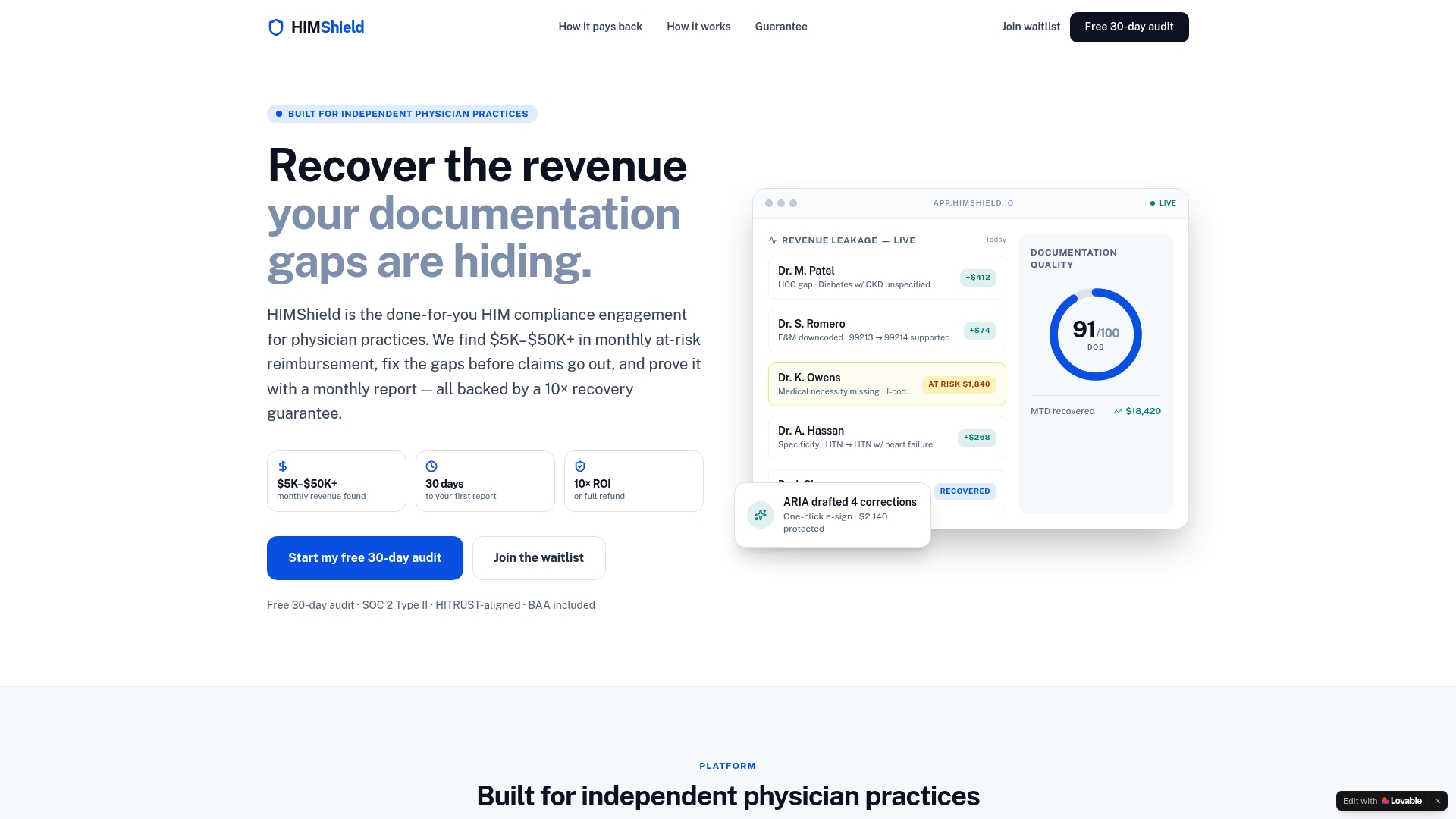
The platform scores documentation quality in real time, generates per-provider, per-payer Revenue Leakage Reports, and drafts one-click, physician-signable corrections when a gap shows up. When an audit request does arrive, that same detection engine assembles a submission-ready response package instead of your staff building one from scratch under deadline pressure. Practices get a clearer audit trail, faster turnaround on each request, and fewer repeat audits tied to the same root cause.
Himshield's free 30-day audit shows you exactly where your practice stands before a payer ever asks, with a performance guarantee built in. Pair it with the audit trail guide to see how the two work together, then start your free audit to see what's currently at risk in your own claims.