
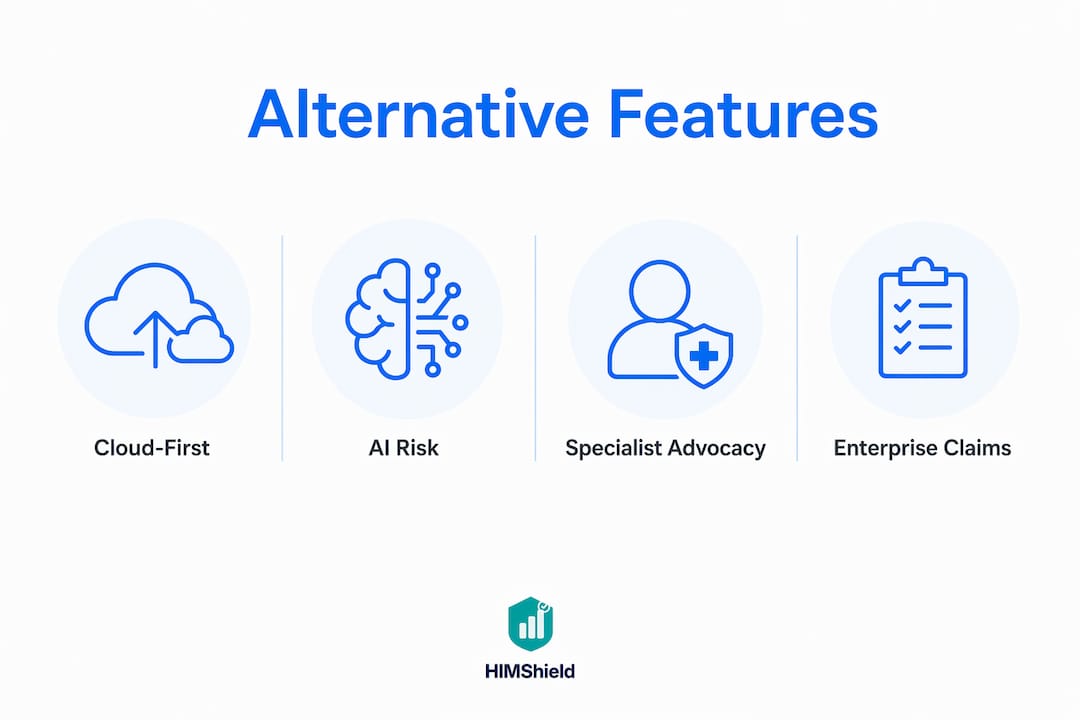
For US physician practices that need coding compliance, documentation risk detection, and denial prevention, the strongest acclaimhealthcaremanagement.com alternatives can be grouped into three categories: AI-enabled risk-detection platforms, cloud-first integrated RCM services, and specialist-led claims advocacy. Himshield is the recommended first evaluation for independent practices because it delivers automated coding and charge-capture risk detection with physician-friendly guidance, fast time-to-value, and HIPAA-compliant infrastructure built on HL7/FHIR interoperability. Other categories worth evaluating include the following:
- AI-enabled risk-detection platforms (e.g., Health Fidelity, ChartWise Medical Systems) — proactive HCC gap and CDI risk scanning before claims submit
- Cloud-first integrated RCM + EHR services (e.g., nThrive, Optum360) — end-to-end billing with real-time dashboards and FHIR API connectivity
- Enterprise claims administration (e.g., 3M Health Information Systems) — deep coding libraries and NLP-driven documentation review; best for mid-to-large practices
- Specialist-led claims advocacy — broker-led oversight that coordinates documentation through settlement for complex commercial exposures
Acclaim Healthcare Management focuses on radiology and pathology RCM billing. If your practice sits outside those specialties or if you need proactive AI risk detection rather than reactive billing, the alternatives above address gaps Acclaim does not cover.
Table of Contents
- How do the top alternatives compare on core capabilities?
- What does each alternative category actually offer your practice?
- How do you choose the right alternative and avoid costly mistakes?
- What does switching from Acclaim Healthcare Management actually look like?
- Vendor profiles: strengths and best-fit practice size
- What should you expect from vendor support and escalation?
- Key Takeaways
- The mistake most practices make when switching compliance vendors
- Himshield protects revenue before denials happen
- Further reading and sources
How do the top alternatives compare on core capabilities?
Cloud-first platforms that combine EHR, practice management, and automated billing have become the default replacement for standalone legacy billing services. The table below maps each vendor category to the capabilities that matter most for physician practices.
| Capability | Cloud-First RCM + EHR | AI-First Risk Detection | Specialist-Led Advocacy | Enterprise Claims Admin |
|---|---|---|---|---|
| Primary capability | Integrated billing + CDI | Coding/HCC gap + denial prevention | Documentation-to-settlement advocacy | NLP coding libraries + audit support |
| AI / predictive analytics | Moderate — dashboard alerts | High — proactive risk scoring | Low-moderate — human-led | High — NLP + ML risk detection |
| EHR / PM integrations | Native or FHIR API | FHIR/HL7 connectors | Manual or broker-managed | HL7 interfaces, configurable |
| Deployment | Cloud-first | Cloud-first | Managed service | On-prem or hybrid |
| Best for | Small-to-mid practices, multi-specialty | Independent practices, risk-heavy payer mix | Complex commercial, high-value claims | Mid-to-large practices, hospital-affiliated |
| Pricing model | Subscription or % of collections | Subscription or per-claim | % of recovery or retainer | Per-seat or enterprise contract |
| Time-to-value | 30–90 days | 14–30 days | 60–120 days | 90–180 days |
| Support model | In-house + SLA | Dedicated coding reviewers | Broker-led escalation | Vendor CSM + coding staff |
| Compliance certs | HIPAA, SOC2 | HIPAA, SOC2 | HIPAA | HIPAA, SOC2 |
Pro Tip: Before any migration, confirm your current data exports as HL7 or FHIR-compliant files. Older billing setups often lack these standards, and a pre-migration data audit prevents compliance gaps from carrying forward.
What does each alternative category actually offer your practice?
Cloud-first integrated RCM + EHR platforms like nThrive and Optum360 combine charge capture, coding, and denial management in one environment. Real-time dashboards and interoperability reduce manual bottlenecks that plague legacy billing setups. These fit multi-specialty practices with 3–20 providers that want a single vendor for billing and clinical documentation. Pricing typically runs as a percentage of net collections, with go-live in 30–90 days.
AI-first denial-prevention services like Health Fidelity and ChartWise Medical Systems focus specifically on HCC gap identification, CDI risk scoring, and pre-submission coding review. They connect via FHIR API to your existing EHR rather than replacing it. Independent practices with a high-risk payer mix — Medicare Advantage, commercial value-based contracts — get the fastest ROI here, often within 14–30 days of activation.
Specialist-led coding and claims advocacy coordinates the full lifecycle from documentation through settlement. For practices with complex commercial exposures, this human-led model catches what automated tools miss. Expect 60–120 days to measurable recovery and pricing structured as a percentage of recovered revenue.
Enterprise claims administration platforms like 3M Health Information Systems bring NLP-driven coding libraries and deep audit-defense documentation. They are built for mid-to-large practices or hospital-affiliated groups, not solo or small independent clinics. Implementation timelines run 90–180 days, and the configuration overhead is real.
Pro Tip: Match the vendor's coder credentials to your specialty. A platform with certified professional coders (CPCs) credentialed in radiology or internal medicine will produce audit-defensible documentation that a general-purpose billing service cannot replicate.
How do you choose the right alternative and avoid costly mistakes?
Evaluation criteria should cover five areas: capabilities and specialty fit, EHR integration depth, AI transparency, compliance trust signals, and support SLA.
Questions to bring to every demo:
- What HL7/FHIR version do you support, and can you show a live data-mapping plan for our EHR?
- How are your coders credentialed, and do you have specialty-specific reviewers for our practice type?
- What is your denial-prediction accuracy rate, and can you share a proof-of-concept with our own data?
- What are your SLA commitments on denial appeal turnaround times?
- What implementation milestones and migration testing checkpoints do you provide in writing?
Red flags that signal real risk: A vendor that cannot produce SOC2 or HIPAA attestation documents on request, offers no written data-mapping plan, lacks specialty coding reviewers, gives vague or verbal-only SLAs on denial appeals, or cannot define implementation milestones is not ready to protect your revenue. Proactive, AI-enabled predictive analytics that detect denials earlier in the lifecycle are now the baseline expectation — a vendor still relying entirely on reactive billing review is a step behind.
For practices evaluating coding compliance software, the non-negotiables are HIPAA/SOC2 documentation, published case studies showing recovered revenue, and independent reviews from KLAS or G2.
What does switching from Acclaim Healthcare Management actually look like?
Follow this sequence to protect revenue during the transition:
- Discovery and ROI estimate (Week 1–2): Audit your current denial rate, coding accuracy, and charge-capture gaps. Quantify at-risk reimbursement before you sign anything new.
- Data-mapping audit (Week 2–3): Request a full data extract from Acclaim Healthcare Management — including outstanding appeals status and historical coding patterns — before terminating your contract. A dedicated data-mapping audit preserves compliance and prevents gaps.
- Test migration and validation (Week 3–5): Run a sample of claims through the new platform. Validate that coding patterns, payer rules, and charge-capture logic match your historical baseline.
- Phased cutover (Week 5–8): Go live on new claims while Acclaim Healthcare Management continues to work outstanding appeals. Never cut over 100% on day one.
- Clinician query alignment (Week 6–8): Align your physician query process to the new vendor's coder feedback loops. This is the step most practices skip, and it directly affects CDI quality.
- Post-launch monitoring (30/60/90-day metrics): Track denial rate, days in AR, and coding accuracy at each interval. A 30-day check catches configuration errors; a 90-day check confirms sustainable revenue recovery.
Pro Tip: Run the old and new platforms in parallel for at least 30 days on overlapping claim types. RCM automation can deliver roughly 50% faster receivables processing compared with manual billing methods — but only when the underlying data is clean from day one.
Vendor profiles: strengths and best-fit practice size
Himshield scans coding, documentation, and charge-capture risks before claims submit, auto-drafts physician queries, and surfaces HCC gaps in a physician-friendly interface. Best for independent practices with 1–10 providers that need fast revenue recovery without a long implementation runway.
3M Health Information Systems brings NLP-powered coding assistance and deep ICD-10/CPT libraries. Best for mid-to-large practices or hospital-affiliated groups that need audit-grade documentation support and can absorb a longer implementation cycle.
nThrive covers the full RCM lifecycle from patient access through collections, with analytics dashboards and denial management. Best for multi-specialty groups that want one platform across billing, coding, and patient engagement.

Optum360 combines coding, CDI, and revenue integrity tools with strong payer-contract analytics. Best for practices with complex payer mixes and value-based contracts where margin visibility matters.
Health Fidelity specializes in HCC risk adjustment and prospective coding review, with FHIR-based EHR integration. Best for practices in Medicare Advantage or ACO arrangements where accurate risk scores directly affect capitation payments.
ChartWise Medical Systems focuses on CDI and query management, helping practices close documentation gaps before and after discharge. Best for practices with high inpatient volume or complex chronic-disease populations.
What should you expect from vendor support and escalation?
Support quality separates vendors that protect revenue from those that create new administrative burden. Ask every vendor for a written SLA that defines response times by issue severity: a coding error affecting a live claim should have a same-day escalation path, not a 48-hour ticket queue.
The strongest support models pair a dedicated account manager with direct access to credentialed coding reviewers. For denial reduction, you need a human who understands your payer contracts, not just a help-desk ticket. Confirm that escalation procedures are documented, that you have a named contact above the account manager level, and that SLA breach remedies are written into the contract.
Key Takeaways
AI-enabled risk detection and HL7/FHIR interoperability are the two non-negotiables when evaluating any alternative to Acclaim Healthcare Management for physician practice revenue protection.
| Point | Details |
|---|---|
| Prioritize AI risk detection | Proactive denial prediction before claims submit protects more revenue than reactive billing review. |
| Require FHIR/HL7 readiness | Confirm HL7/FHIR support and a written data-mapping plan before signing any migration contract. |
| Run a parallel cutover | Overlap old and new platforms for at least 30 days to catch configuration errors before they affect AR. |
| Demand trust signals | Request SOC2/HIPAA attestation, specialty coder credentials, and published case studies at the demo stage. |
| Evaluate Himshield first | Himshield delivers automated coding risk detection and fast revenue recovery pilots built for independent practices. |
The mistake most practices make when switching compliance vendors
Practices treat a vendor switch as a software swap. It is not. The technology is the easy part. What actually determines whether you recover revenue is whether your physicians change how they document, and whether your coders have a feedback loop back to the clinical team.
The practices that see the fastest ROI after switching are the ones that set measurable milestones at 30, 60, and 90 days and hold both the vendor and their own clinical staff accountable to them. They also clean their data before migration, not after. Waiting until go-live to discover that three years of coding patterns are stored in a non-standard format is a preventable problem that costs weeks of recovery time.
One more thing: clinician engagement is not optional. If your physicians do not understand why query responses matter to reimbursement, the best AI platform in the market will surface gaps that never get closed. Governance and education before launch matter as much as the technology itself.
Himshield protects revenue before denials happen
Most alternatives fix problems after the claim is denied. Himshield catches coding, documentation, and charge-capture risks before they submit, giving your practice a compliance defense that keeps earned revenue in your pocket.
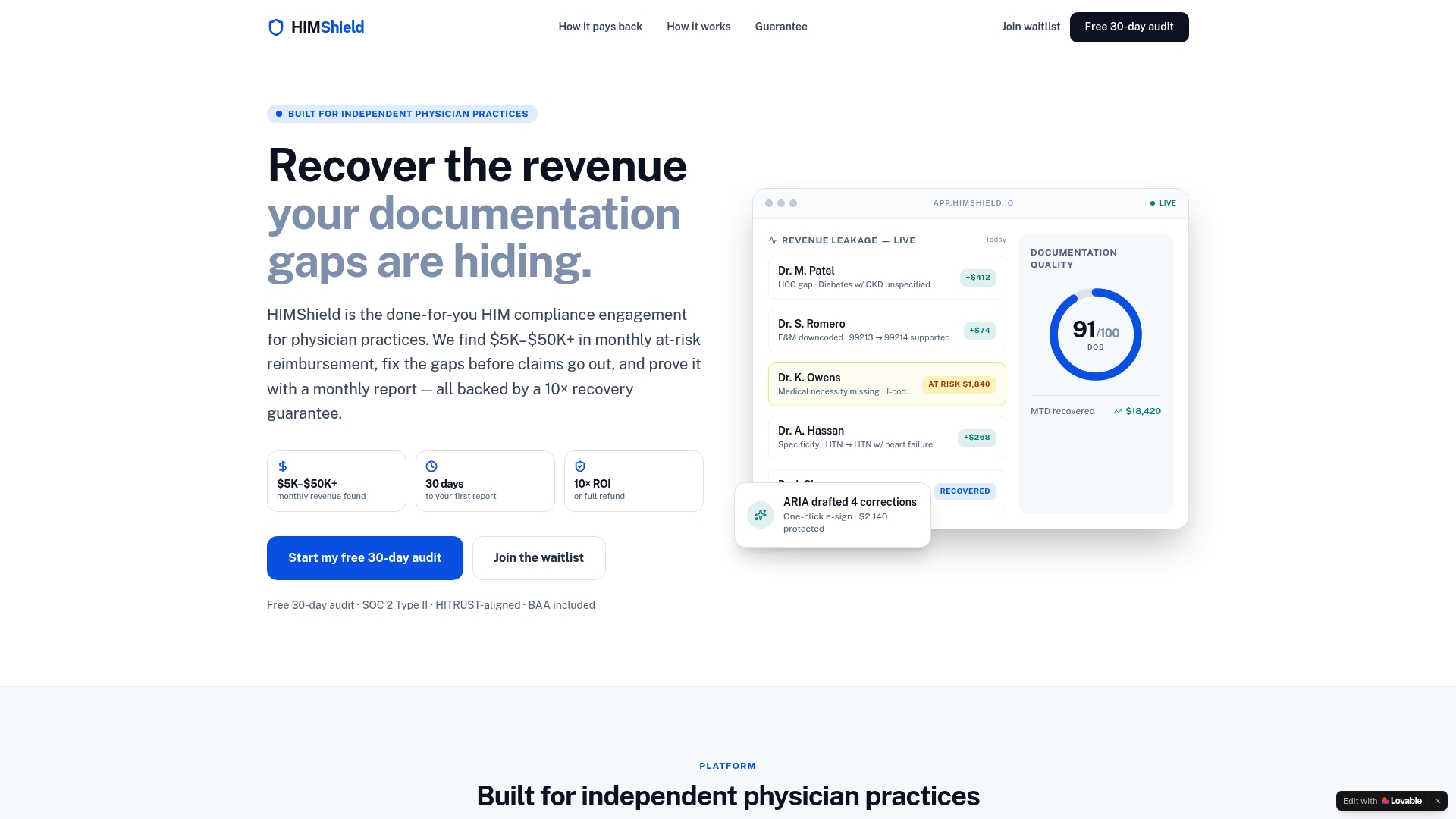
Independent practices using Himshield typically recover a substantial amount in previously missed reimbursement. The platform connects to your EHR via FHIR API, runs automated risk scans, and auto-drafts physician queries, all within a 30-day revenue-recovery pilot. HIPAA compliance and published case studies are available on request. If you want to see exactly where your practice is leaving money on the table, start your pilot today.
Further reading and sources
- Claims management experts — WorldMetrics — supports specialist-led advocacy and broker-led oversight claims
- Top Healthcare Case Management Software Alternatives — Social Work Portal — cloud-first platform advantages and real-time interoperability
- Claims administration services — Sedgwick — AI/ML predictive analytics and proactive denial detection
- Healthcare Management Software — Ezovion — FHIR/HL7 interoperability, RCM automation, and migration data quality
- Pulse Platform — data-mapping audit requirements and migration testing guidance
- Why practices lose reimbursement — Himshield Blog — common revenue leaks and prioritization framework
- Payer audit preparation — Himshield Blog — documentation expectations and audit-readiness checklist
- Platform-led replacements for legacy healthcare services — Flexible Nursing Careers — cloud-first benefits and platform migration considerations