
What are the top alternatives to ConsensioHealth for independent practices?
Independent physician practice managers evaluating ConsensioHealth alternatives in 2026 have three primary options worth serious consideration: OS inc. for broad revenue cycle management expertise, IKI Health for clinical operations integration, and ACA bronze-level plans as a financial coverage framework that shapes how your practice manages patient payment risk.
- OS inc. brings 30+ years of experience in healthcare revenue cycle management, with a service taxonomy spanning medical billing, denial prevention, Medicare and Medicaid billing, physician credentialing, and healthcare compliance solutions. Its focus on long-term accounts receivable reduction makes it a strong fit for independent physician groups that need depth across multiple billing functions.
- IKI Health operates as a clinical operating system rather than a traditional RCM vendor. It monitors patients between visits, improving documentation accuracy and reducing coding errors before claims are submitted. Plans support an active client count depending on the tier selected, accommodating smaller or larger practices.
- ACA bronze-level plans are not an RCM provider, but they set the financial context your practice operates in. With national average deductibles near $7,500, bronze plan enrollees carry significant out-of-pocket exposure, which directly affects your collections strategy and bad debt risk.
Understanding how documentation affects reimbursement is the first step before committing to any of these alternatives.
How do these ConsensioHealth competitors compare on service, technology, and risk?
Each alternative occupies a distinct position in the RCM ecosystem. The right choice depends on your practice's billing complexity, patient population, and tolerance for claim denial risk.

| Provider | Service Focus | Years of Experience | Clinical Integration | Risk Mitigation | Best For |
|---|---|---|---|---|---|
| OS inc. | Healthcare RCM, denial prevention, Medicare/Medicaid billing, credentialing | 30+ years | Practice management software integration | Long-term A/R reduction, denial prevention protocols | Independent physician groups needing broad RCM coverage |
| IKI Health | Clinical operating system, lifestyle medicine, patient monitoring | Not publicly listed | Continuous between-visit patient tracking | Documentation accuracy reduces upstream coding errors | Practices prioritizing clinical and billing integration |
| ACA bronze-level plans | Financial coverage framework, high-deductible plan context | N/A (regulatory framework) | Indirect: patient cost-sharing affects collections | Baseline coverage with high patient financial exposure | Practices needing to understand patient payment risk |
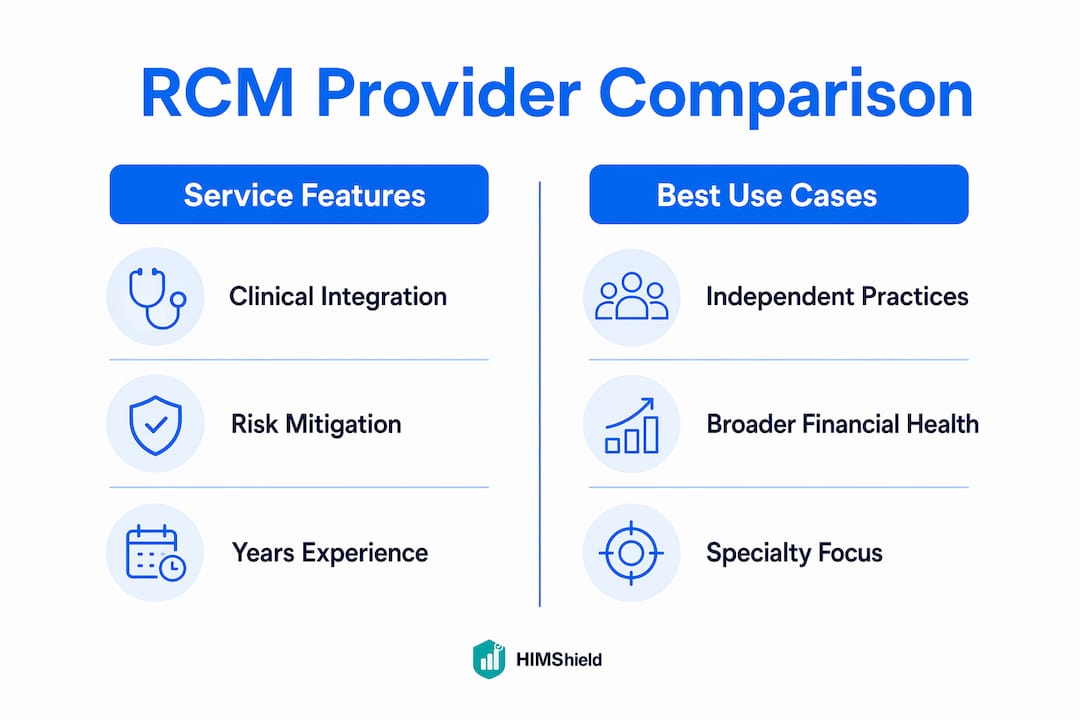
OS inc. and ConsensioHealth overlap in service taxonomy, but OS inc. carries a broader healthcare revenue cycle footprint. ConsensioHealth is physician-led with a tighter focus on independent group practices, while OS inc. serves hospitals and larger facilities alongside physician groups. That distinction matters when your billing needs include Medicare-specific workflows or complex denial management.
IKI Health takes a different approach entirely. Rather than managing claims after the fact, it reduces denial risk by keeping clinical documentation current between appointments. Practices in lifestyle medicine or chronic disease management will find this model particularly well-suited to their workflows.
Key considerations by alternative:
- OS inc.: Strong denial prevention and A/R cycle reduction; deep integration with practice management software; broader service taxonomy than most physician-focused vendors
- IKI Health: Active patient engagement between visits improves coding accuracy; plan tiers limit active client counts, so high-volume practices should verify capacity before committing
- ACA bronze plans: High deductibles mean more patient-owed balances reaching your billing team; factor this into your collections workflow and patient financial counseling protocols
For practices exploring broader financial health coverage options alongside RCM, understanding the trade-offs between ACA-compliant plans and alternative arrangements is worth the time.
How do you choose the right RCM provider for your practice?
The single most effective step you can take during vendor evaluation is requesting a taxonomic breakdown of every service the provider claims to offer. Broad labels like "revenue cycle management" can conceal gaps in physician credentialing, medical coding, or payer-specific billing. Ask for the full list, then map it against your practice's actual billing needs.
Beyond taxonomy, evaluate these factors before signing:
- Service specialization alignment: Does the vendor have documented experience with your payer mix, including Medicare Advantage or Medicaid managed care?
- Integration capabilities: Can the platform connect with your existing EHR without a lengthy custom build? Ask for a specific timeline, not a general estimate.
- Contract flexibility: Month-to-month arrangements reduce lock-in risk. Multi-year contracts should include performance benchmarks and exit clauses tied to denial rates or A/R days.
- Onboarding timeline: A credible vendor can give you a concrete go-live date. Vague answers here often signal implementation problems later.
- Customer support structure: Find out whether you get a dedicated account manager or a shared support queue. For independent practices with lean administrative teams, direct access to a named contact is worth paying for.
Pro Tip: Ask every vendor candidate to show you their denial rate data for a practice similar to yours in size and specialty. A vendor confident in their performance will share it without hesitation. One that deflects is telling you something.
Understanding why practices lose reimbursement before you evaluate vendors gives you the right questions to ask and the benchmarks to hold providers accountable.
Himshield protects the revenue your RCM provider might miss
The alternatives above handle billing operations. Himshield addresses what happens before a claim goes out: the coding errors, documentation gaps, and charge-capture risks that turn into denials and audit exposure.
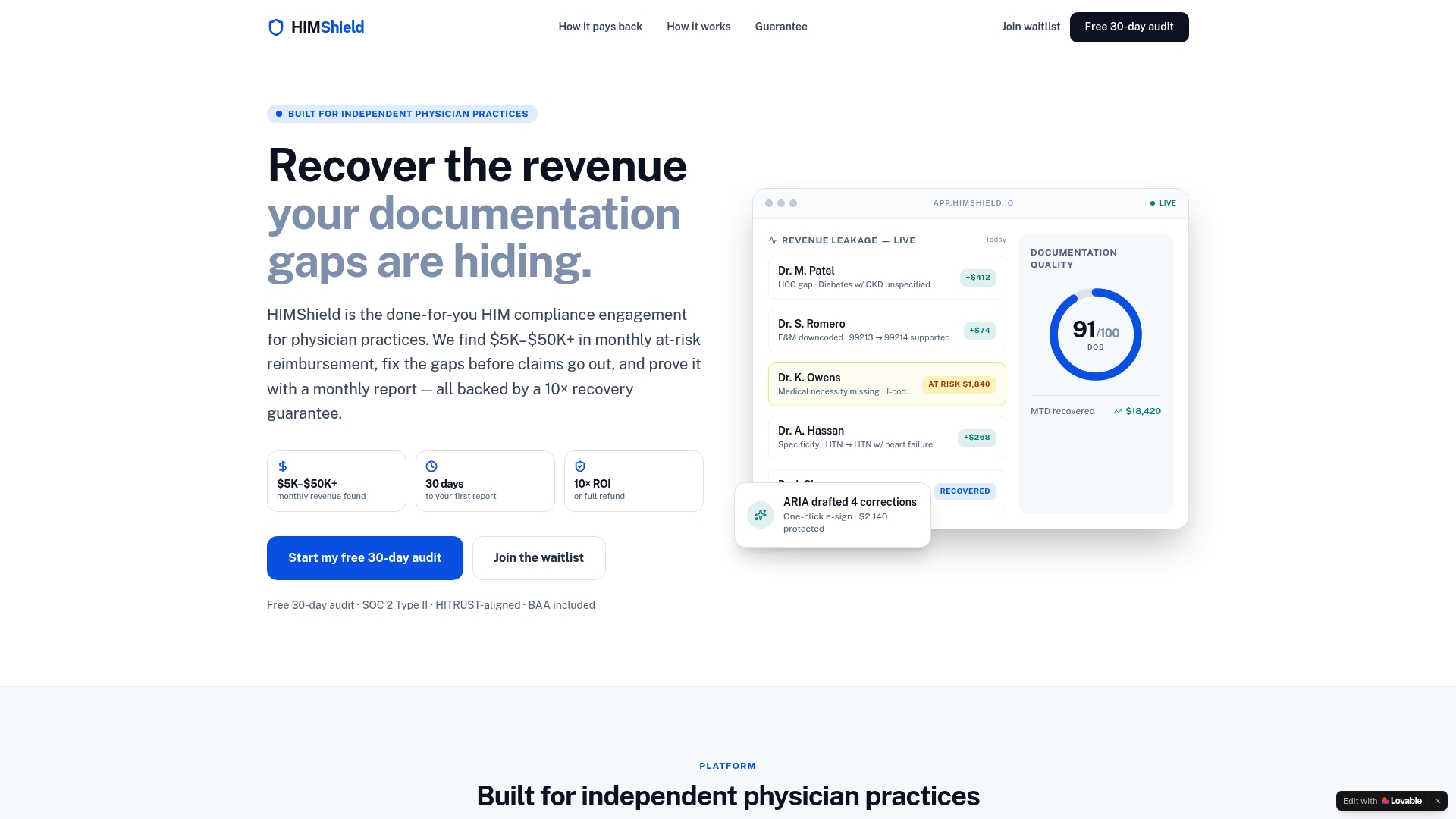
Himshield scans your practice's coding and documentation, quantifies at-risk reimbursement, and auto-drafts physician-friendly guidance to fix issues before they cost you. Practices typically recover $5K–$50K+ in hidden revenue. Himshield is recognized among the top medical coding compliance platforms in 2026, and it works alongside any RCM vendor you choose. If you want to stop leaving earned revenue on the table, start with Himshield.
Key Takeaways
OS inc., IKI Health, and ACA bronze-level plan context each address a different dimension of independent practice revenue risk, and the right fit depends on your service taxonomy, integration needs, and patient financial exposure.
| Point | Details |
|---|---|
| OS inc. for broad RCM | 30+ years of experience covers denial prevention, credentialing, and Medicare billing for physician groups. |
| IKI Health for clinical integration | Between-visit patient monitoring improves documentation accuracy and reduces upstream coding errors. |
| ACA bronze plan context | High deductibles increase patient-owed balances and collections complexity. |
| Evaluate by taxonomy | Request a full service breakdown from any vendor to confirm coverage of your specific billing needs. |
| Himshield for coding risk | Himshield identifies coding and documentation risks before claims go out, recovering revenue RCM vendors miss. |