
Selecting medical coding compliance software that guarantees revenue recovery without staff burden remains a challenge for physician groups. Most solutions demand complex integration projects or lock in long contracts before showing real impact. This comparison of five leading alternatives outlines price models, EHR compatibility, and audit trail features so you can pick a fit that covers your compliance and automation needs.
Table of Contents
HIM Shield
At a Glance
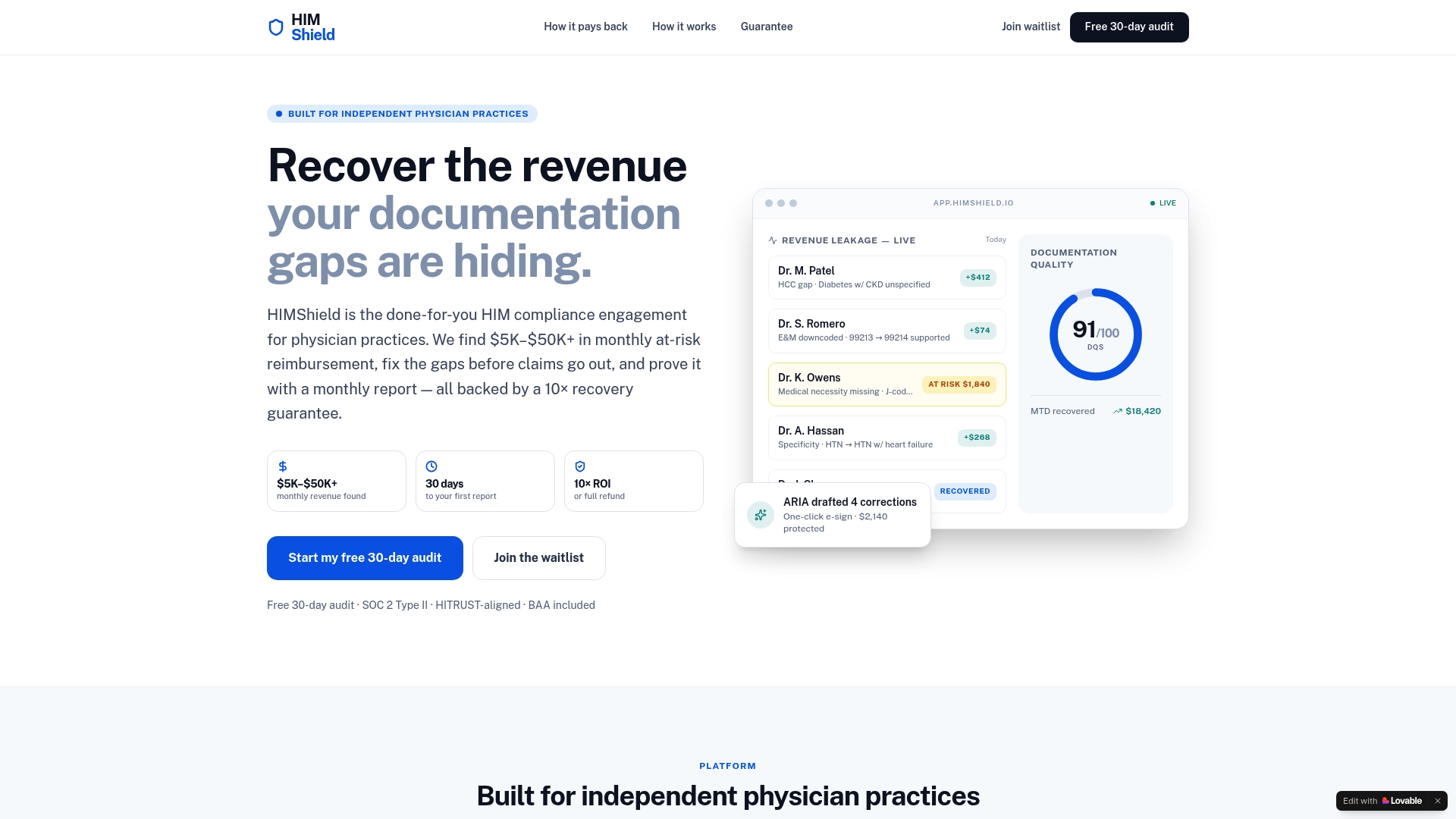
HIM Shield advertises a 10× revenue recovery guarantee. The vendor states the platform connects to EHRs through a secure API and scans charts to find revenue leakage. According to the company, most practices see significant revenue recovery within the first 30-day engagement period. That claim underpins the service model and the vendor's performance pitch.
Core Features
HIM Shield links to practice EHRs via a FHIR API, runs AI-powered chart reviews, and identifies documentation gaps that put reimbursement at risk. The system auto-drafts corrections for provider e-signature and produces personalized revenue leakage reports within thirty days. Real-time provider coaching closes documentation gaps and supports audit defense.
Key Differentiator
The product centers on automated remediation rather than just alerts. It pairs chart scanning with auto-drafted corrections that providers can sign, then packages results into clear compliance reports. That workflow aims to convert identified gaps into billable corrections quickly. The combination of corrective drafts and persistent monitoring separates it from checklist style tools.
Pros
HIM Shield ties identification to actual corrections, which reduces the administrative lift on providers and staff. The onboarding claims to be fast and requires minimal IT involvement, so practices can start seeing results without a heavy technical project. Ongoing monitoring and audit defense mean practices maintain documentation improvements after initial remediation. The vendor also positions the service as a way to avoid hiring extra staff while improving reimbursement capture.
Cons
- Limited to practices using supported EHRs with a FHIR API, so practices on legacy systems or large health systems without that connectivity may be excluded.
Who It's For
Independent physician practices focused on revenue recovery and documentation compliance will get the most from HIM Shield. Practice administrators who prefer a done-for-you model and who do not want to hire extra coding staff will find the service relevant. Small groups that use modern EHRs and need audit defense are the primary fit.
Unique Value Proposition
A free 30-day audit that produces a custom quote defines the commercial entry point and reduces upfront risk. The vendor reports most practices identify $5K–$50K+ in monthly recoverable revenue after that audit. That sequence lets you see potential recoveries before committing to a contract. The model shifts the initial cost discussion to an evidence based quote tied to your own charts.
Real World Use Case
A four-provider practice connected its EHR, ran the audit, and identified $32,000 per month in recoverable revenue within thirty days. The practice improved documentation quality scores from 67 to 91 while avoiding additional hires. That example illustrates how the audit plus corrective drafts can turn chart gaps into measurable reimbursements.
Pricing
Pricing is based on a custom quote following the free 30-day audit. The vendor reports typical recoverable revenue ranges and then issues a tailored price tied to expected recovery. The commercial offer is backed by the 10× recovery guarantee referenced earlier.
Website: https://himshield.com
Milagro AI
At a Glance
Milagro AI reports 96% accuracy for its autonomous surgical coding. According to the company, the platform has reduced denials and recovered millions in revenue annually. That positioning makes the product attractive for surgical revenue cycle teams focused on coding accuracy and denial prevention.
Core Features
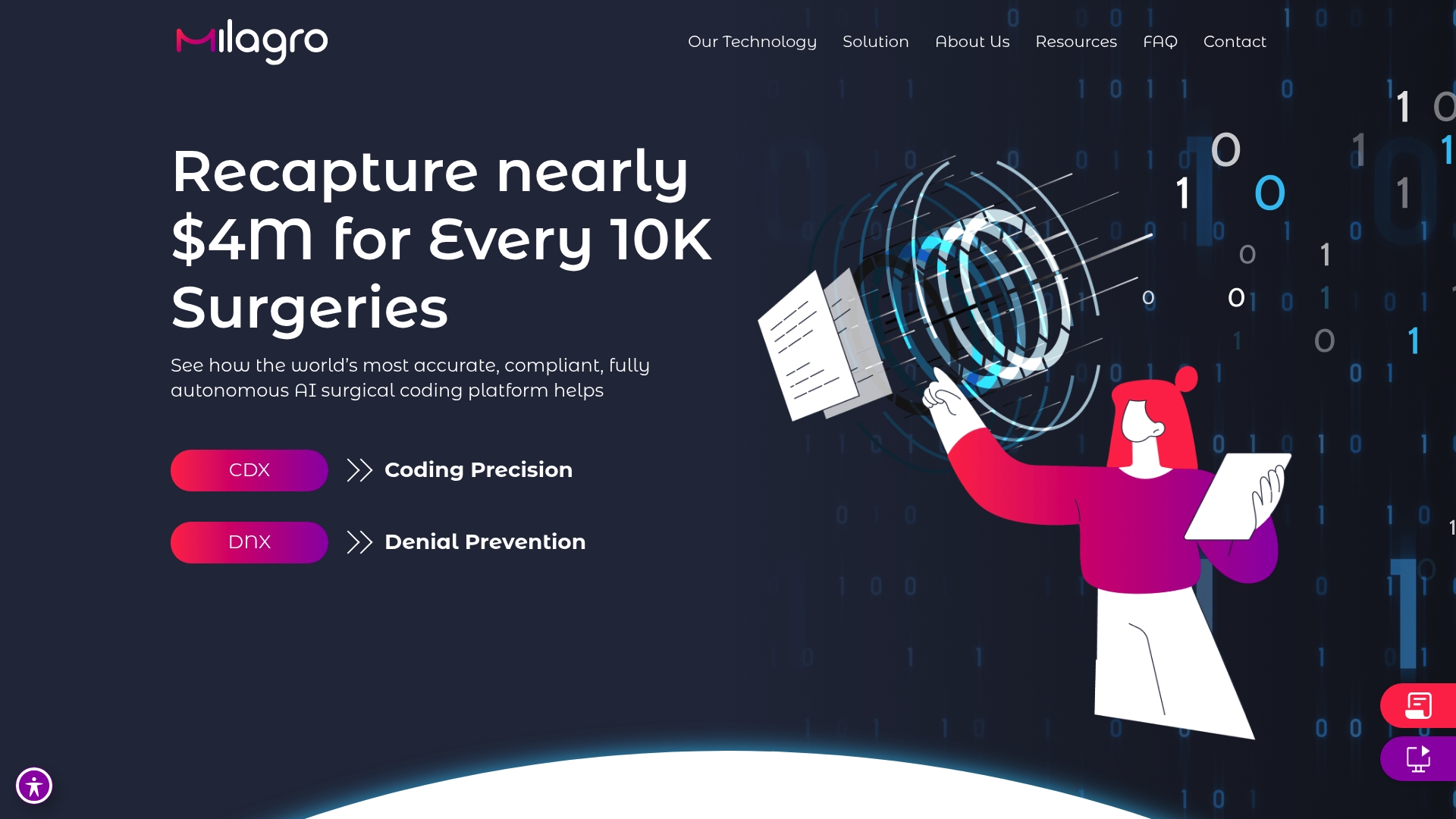
The platform automates surgical coding and includes a proactive denial prevention module called DNX for preauthorization mismatches. It performs real-time coding and error correction while integrating with EHR and RCM systems. The vendor says the AI applies human-like logic and decision-making to match expert coder choices.
Key Differentiator
The most distinctive claim is full autonomy in surgical coding paired with live denial prevention. That accuracy claim supports replacing manual coding for standard procedures while DNX targets preauthorization mismatches before claims submit. The combination delivers coding plus preauthorization coverage rather than focusing on only one revenue cycle step.
Pros
Milagro AI reports fast implementations, often within weeks, which reduces project disruption for hospitals and surgical centers. The vendor advertises deep EHR and RCM integration, so teams can keep existing workflows while adding automated coding and DNX. Supporting both coding and preauthorization management lets practices increase throughput and recover revenue without hiring equivalent headcount.
Cons
- Handling highly complex surgical cases may still require human oversight, according to third-party reviews.
- The vendor provides limited explicit detail on customization options and user training pathways.
- No public information about support for non-U.S. regions or multilingual deployments.
When It May Not Fit
This product may not suit centers that mainly handle highly atypical or experimental surgeries requiring constant specialist review. It is a weaker match for organizations that need documented multilingual support or non-U.S. billing rules. Practices seeking a turn-key customization and in-depth on-site training program should confirm capabilities before committing.
Who It's For
Hospitals, surgical centers, and physician groups seeking to automate surgical coding and stop preauthorization leaks will find this relevant. Teams with mature EHR and RCM stacks will get the most value from the integrations. Organizations aiming to expand coding capacity without a proportional headcount increase stand to benefit.
Real World Use Case
The vendor reports a hospital integrated Milagro to automate surgical coding and prevent preauthorization denials. That implementation, the company says, led to millions recovered and a 95% plus reduction in denial rates. The result freed coder time for complex cases while reducing at-risk reimbursement.
Pricing
Pricing is not publicly listed and is described as informational only. Expect enterprise or custom pricing tied to deployment scope, procedure volume, and integration complexity. Contact the vendor for a tailored quote and implementation timeline.
Website: https://milagroai.com
MediCodio AI
At a Glance
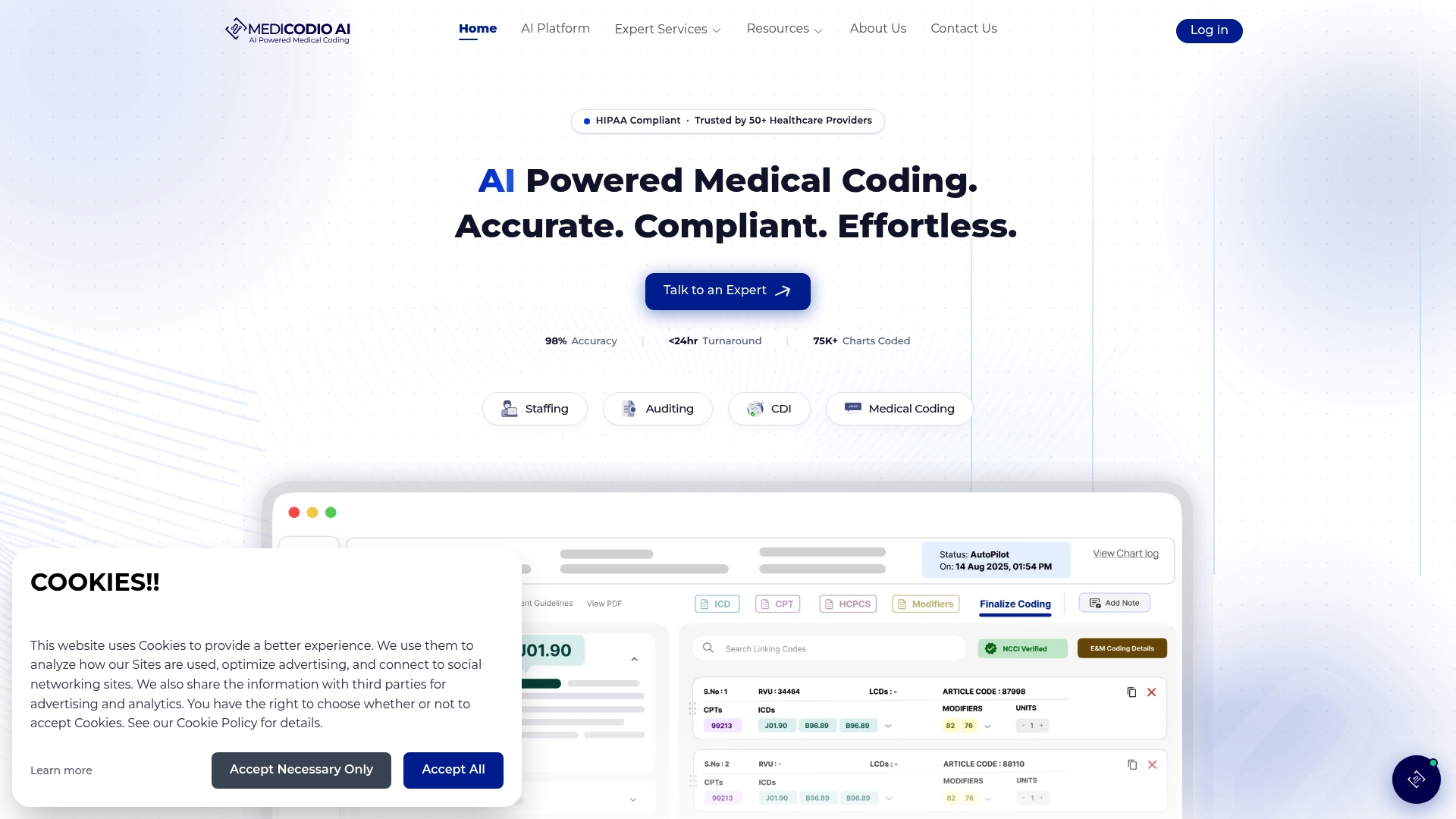
MediCodio AI reports 98% coding accuracy. That figure combines automated code suggestions with certified human review to reduce coding error rates.
The vendor states the platform is certified ISO/IEC 27001:2022 and HIPAA-compliant, and it holds Veradigm Connect certification. Those credentials target organizations that require documented security controls.
Core Features
MediCodio AI offers AI-assisted coding with human review and a fully automated end-to-end mode, plus support for ICD-10-CM, CPT, HCPCS, and modifiers. The platform runs real-time compliance checks, including NCCI edits, LCD and NCD validation, and MUE limits, and provides analytics to monitor accuracy, denials, and coder productivity.
Secure API connections enable EHR and practice management integration for chart routing and coded output. The vendor lists certified professional staff for staffing, auditing, and clinical documentation improvement services.
Key Differentiator
Combines AI automation with certified human review in a dual-mode workflow, letting you switch between assisted and fully automated coding. That design aims to balance speed with reviewer oversight for specialty and complex charts.
Pros
According to the company, claim denials fall by 83%, and chart processing is 81% faster, often under 1.5 minutes per chart. Those claims point to measurable denial reduction and throughput gains when documentation is strong.
The platform supports standard code sets and real-time compliance checks, which helps catch common billing edits before claims submit. Certified coders back the AI for audits, staffing, and CDI work.
Cons
-
Dependence on good clinical documentation. Poor notes reduce AI accuracy and shift more work back to coders.
-
Potential integration complexity with older EHR systems. Legacy platforms may need custom work to connect to the API.
-
Buyers must verify that the platform certifications meet their vendor security and compliance requirements.
When It May Not Fit
If your practice routinely produces sparse clinical notes, MediCodio AI will likely deliver poorer results. The platform performs best with complete documentation.
Organizations locked into legacy EHRs with no API access will face longer and costlier integrations. Smaller offices without IT support may struggle to complete those connections.
Who It's For
Healthcare organizations that need faster, higher-volume medical coding with compliance controls. Typical buyers include hospitals, ambulatory surgery centers, physician practices, and revenue cycle management companies that can provide quality documentation and support API integrations.
Real World Use Case
The vendor reports a hospital cut manual coding time by 75%. That deployment also realized the denials figure cited above within 90 days, accelerating reimbursement cycles and reducing coder backlog.
Pricing
Not applicable — informational only
Pricing is not publicly listed. Prospective buyers should request a proposal to learn about licensing, volume discounts, and managed coding options.
Website: https://medicodio.ai
Minset AI
At a Glance
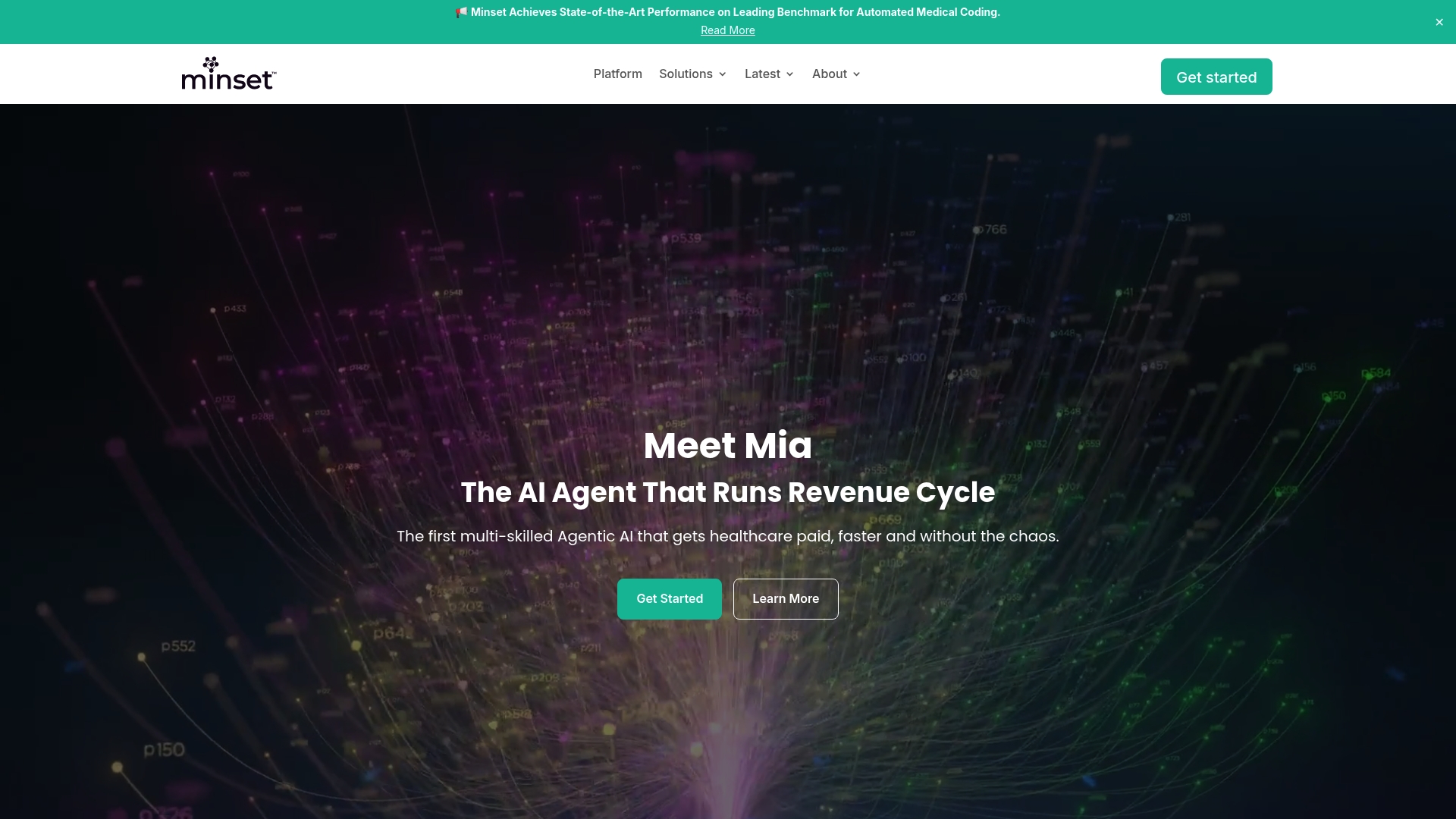
According to the company, a large hospital system reported a 25% revenue increase and a 50% reduction in denials over six months. Minset centers on an AI agent named Mia that runs coding, denials, patient payments, and claims processing autonomously. The product emphasizes fewer errors and faster collections without adding headcount or complex dashboards.
Core Features
Minset delivers autonomous medical coding alongside automated claims processing and denials management, with patient payment prediction and support. The platform offers integration points for existing billing systems and EHRs and performs continuous learning to refine decisions over time. Mia makes real time decisions and adapts as claim outcomes and payer rules change.
Key Differentiator
The vendor positions Mia as a multi skilled digital employee capable of end to end revenue cycle work rather than a monitoring dashboard. Mia executes work, not only suggests actions, and it can move claims between states, trigger follow up, and handle routine denials. That operational autonomy separates Minset from rule based tools that require manual handoffs.
Pros
High accuracy coding reduces rework and lowers downstream correction costs. Automation of routine tasks frees billing staff to focus on complex accounts and appeals. Real time denial prediction and prevention cut the volume of avoidable rejections before resubmission. The system scales from midsize groups to larger RCM operations while keeping the same agent driven workflow. Those operational and financial claims are tied to vendor reported outcomes.
Cons
- Integration work can be substantial in facilities with heavily customized legacy systems. This may extend deployment timelines.
- Performance depends on the quality of existing data and interfaces; poor data can limit early gains.
- Practices must accept AI driven decision making for core billing steps, which may require governance and oversight.
When It May Not Fit
Minset may not suit practices with minimal IT resources for complex integration projects. Highly bespoke EHRs and billing engines could need custom engineering before the agent delivers value. Small practices that prefer manual control over every claim may find autonomous workflows a poor cultural fit.
Who It's For
Healthcare providers, revenue cycle management companies, and healthtech platforms seeking autonomous, AI powered revenue cycle automation will find the product relevant. Organizations needing hands off handling of coding, denials, and patient payments will see the most immediate use. Practices that expect to invest in integration work can unlock the platform's full potential.
Real World Use Case
A large hospital system deployed Mia to take on coding and denials workflows. The vendor reports those figures for revenue and denials improvement as the measured outcome. The deployment shifted routine work away from staff and compressed appeals cycles for faster resolution.
Pricing
Pricing is not publicly listed. The product entry lists pricing as not applicable and informational only. Contacting the vendor will be necessary to obtain licensing and deployment estimates.
Website: https://minset.ai
Maverick Medical AI
At a Glance
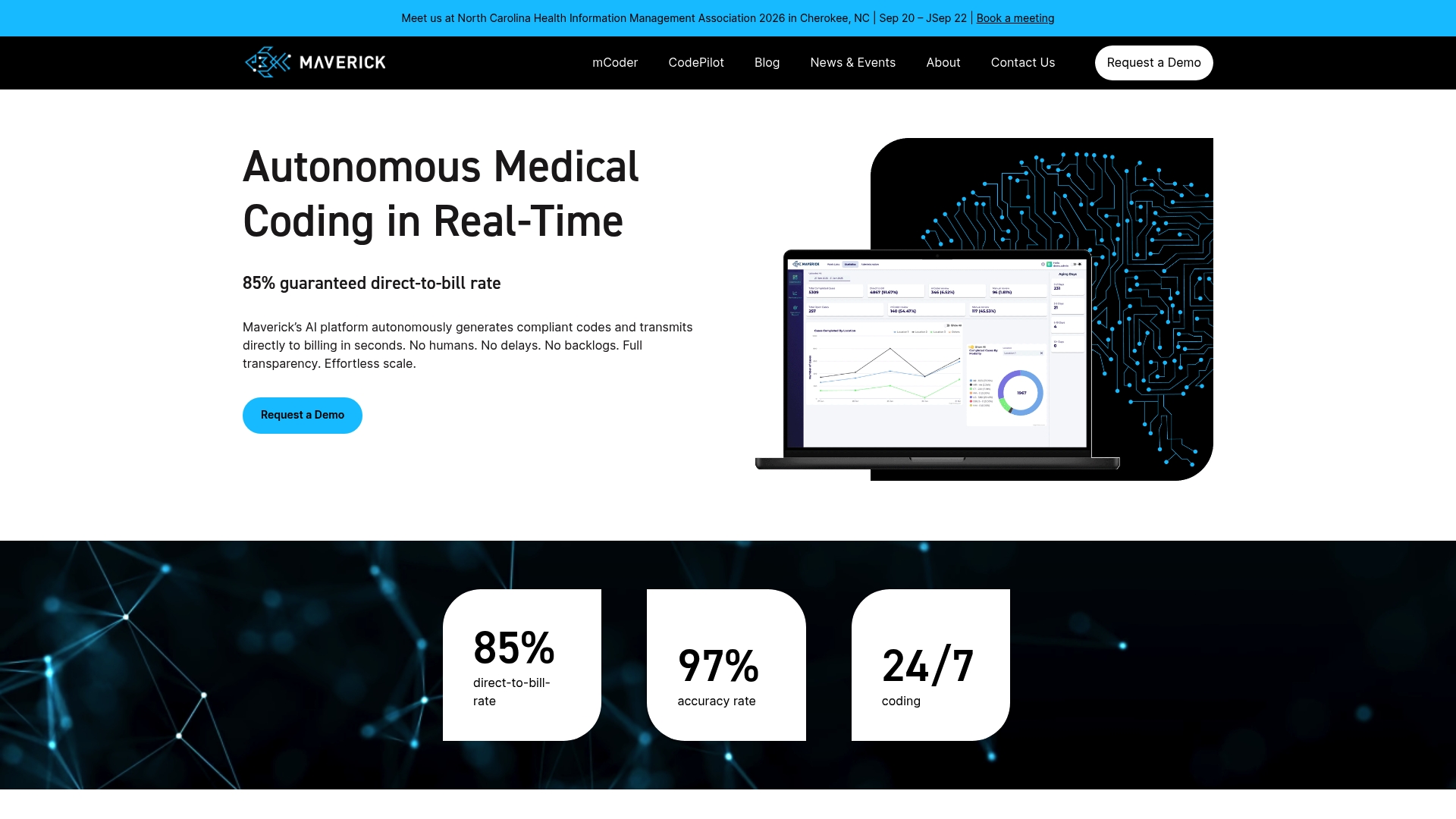
Maverick Medical AI reports 85%+ direct-to-bill rates and continuous 24/7 processing for coding workloads. That claim suggests the platform routes a large portion of encounters straight to billing without a human coder review. The vendor also emphasizes explainability and audit trails for every automated decision.
Core Features
The platform delivers autonomous real-time medical coding that assigns CPT and ICD-10 codes directly to billing systems while offering embedded documentation guidance inside clinical workflows. It includes transparency features such as audit trails and explainability, plus monitoring via real-time dashboards and KPIs for accuracy and throughput. The product lineup references offerings like coder and CodePilot and supports integration with RIS, PACS, and common billing platforms.
Key Differentiator
Maverick focuses on end-to-end autonomous coding combined with explicit explainability for each code decision. That pairing aims to reduce denials while giving compliance and HIM teams a record to audit and defend coding choices.
Pros
The vendor reports the platform achieves high direct-to-bill rates by learning from a customer’s historical data, which can reduce reliance on third-party coders. The system shortens coding lag times to as little as one day, cutting the time between encounter and claim submission. Customers gain continuous monitoring and audit trails that help compliance officers validate automated decisions and reduce downstream denials.
Cons
- Buyer must improve upstream documentation quality for optimal AI performance. This remains a gating factor for accuracy.
- The vendor states implementation requires an initial process evaluation and customization, with a timeline around 90 days. That setup period can be resource intensive.
- Performance depends on historical data quality, so legacy errors or inconsistent records may need additional validation work.
When It May Not Fit
Practices with fragmented or minimal clinical documentation will not get full value from the automation. Smaller clinics with low daily volumes may find the implementation and validation effort disproportionate to their billing needs. Organizations that cannot commit staff time to the initial setup and quality cleanup will face longer validation cycles.
Who It's For
Large hospitals, imaging centers, and health systems that process high coding volumes and want to reduce outsourcing are the primary fit. Teams that have some internal HIM capacity to clean and standardize documentation will deploy the technology faster. Enterprises seeking measurable reductions in coding lag and denials will see the most benefit.
Real World Use Case
The vendor reports Steinberg Diagnostic Medical Imaging reached a one-day coding lag and eliminated outsourcing after deployment. That case also reported strong direct-to-bill performance, illustrating how the platform can accelerate revenue cycle workflows in a high-volume imaging practice.
Pricing
Pricing is not publicly listed. The vendor appears to price deployments based on organization size and the scope of integration and customization required.
Website: https://maverick-ai.com
Comparison of Medical Coding Compliance Software
Compare top software products to select a platform that addresses revenue recovery and documentation compliance issues effectively.
| Software | Core Capability | Best For | Pricing | Notable Limitation |
|---|---|---|---|---|
| Himshield | AI-powered chart reviews with corrective drafts | Independent practices using modern EHRs | Not disclosed | Requires a supported FHIR API |
| Milagro AI | Autonomous surgical coding with denial prevention module | Surgical centers with robust EHR and RCM systems | Not disclosed | Limited support for non-U.S. regions |
| MediCodio AI | AI-assisted dual-mode coding with compliance checks | Organizations prioritizing compliance-certified solutions | Not disclosed | Integration complexity with older systems |
| Minset AI | End-to-end AI revenue cycle agent | Providers seeking workflow automation | Not disclosed | Requires substantial integration effort |
| Maverick Medical AI | Real-time medical coding with direct-to-bill capabilities | Hospitals aiming to reduce coding lag | Not disclosed | Performance depends on documentation quality |
Secure Every Dollar with Himshield for Independent Physician Practices
usemaia.com alternatives often focus on automation but miss key revenue at-risk elements like coding gaps and documentation errors. Himshield targets those pain points by scanning your EHR with a FHIR API to find missed charges and billable corrections. This hands-off remediation cuts your workload while protecting against denials and audits. Practices see measurable revenue recovery within 30 days backed by a 10× guarantee.
Key benefits include
- Identifying hidden revenue leakage before it impacts your bottom line
- Auto-drafting corrections that providers review and sign
- Real-time coaching to improve documentation quality
Explore how Himshield helps recover lost revenue and start with a free 30-day audit. Don’t leave money on the table. Connect your EHR, quantify your risk, and receive a tailored quote to recover $5K–$50K+ monthly. Visit Himshield now to secure your practice’s financial health.
Learn more about our platform
FAQ
How does Himshield help recover lost revenue in medical coding?
Himshield identifies revenue leakage during its chart reviews using AI-powered scans. The platform connects with EHRs and produces personalized revenue leakage reports within thirty days. Practices using Himshield often see a significant revenue recovery within that short timeframe.
What is the difference between Himshield and Milagro AI?
Milagro AI automates surgical coding and includes a proactive denial prevention module called DNX, which tackles preauthorization mismatches effectively. Himshield excels in pairing chart scanning with auto-drafted corrections for provider e-signature, specifically targeting documentation gaps in coding compliance rather than focusing solely on surgical cases.
Which platform provides automatic coding suggestions and human review?
MediCodio AI combines AI-assisted coding with certified human review to achieve 98% accuracy. This dual approach ensures that even complex charts benefit from expert oversight while maintaining high throughput—making it a strong contender for practices focused on accuracy alongside manual checks.
Can my practice benefit from using Himshield for audit defense?
Yes, Himshield offers ongoing monitoring and audit defense as part of its solutions. This feature helps practices maintain their documentation improvements and confidently navigate audits, ensuring compliance and financial security in revenue capture.
How quickly can I expect results from Himshield after implementation?
Most practices see significant revenue recovery within the first thirty days of engaging with Himshield. The platform's quick onboarding and initial chart reviews enable fast claims corrections and revenue capture, giving you tangible results right from the start.