
Productivity and compliance stop competing the moment documentation supports every billed code and visit, visit by visit. Efficiency that outruns the chart invites denials, audits, and penalties that cost more than the time it saved. The OIG and CMS set the rules of the road, and a tool can show you where your practice drifts from them before a payer does.
TL;DR:
- Virtual scribes reduced EHR time by about 16%, but only a quarter of surveyed physicians reported better notes, so audit samples before expanding.
- Pilot one or two physicians for three to six months, set EHR time, denial, and audit error targets first, and expand after they are met.
- Review claims alongside chart notes, prioritize high variance codes, denial drivers, new codes, and past findings, then set corrective deadlines and recheck dates.
- Track EHR time, after hours documentation, denials, audit errors, and revenue leakage together; falling charting time with rising denials warrants an audit.
- CMS guidance favors assessment, plan, and medical decision making over padded history or examination, while incentives for higher level codes should require supporting documentation.
Table of Contents
- A simple operating framework: the compliance-first productivity model
- Operational tactics that preserve clinician time without risking compliance
- Audit and monitoring: designing the feedback loop that prevents leakage
- Measuring the tradeoff: KPIs and how to interpret them
- How to implement change without disrupting clinical throughput
- Why a compliance-first model actually protects productivity
- How HIMShield supports the compliance-first model
- FAQ
- Sources
A simple operating framework: the compliance-first productivity model
Independent practices do not need a compliance department to stay safe. They need a lightweight version of the structure OIG recommends for small physician practices: seven components that map directly to daily operations rather than a binder nobody opens.
- Auditing and monitoring: Run periodic reviews that pair claims data with chart notes, not claims data alone.
- Written standards: Put documentation and coding expectations in a one-page policy every clinician and biller can reference.
- Compliance contact: Name one person, even part-time, who owns questions and escalations.
- Training: Teach coding changes and documentation gaps as they happen, not once a year.
- Corrective action: Fix the root cause when an audit finds a problem, then recheck it.
- Open communication: Give staff a way to flag concerns without fear of blame.
- Discipline: Apply consistent consequences when standards are ignored, not just when errors are costly.
OIG is explicit that a single review is not enough: audits need to feed education and correction on a cycle, which is what turns a compliance program into a habit rather than a project.
Ownership matters here. Physicians own clinical documentation quality. Administrators and billing staff own the workflow that turns that documentation into clean claims. When both sides understand where their responsibility starts and ends, productivity stops being a tug-of-war with compliance.
Operational tactics that preserve clinician time without risking compliance
The goal is not to slow clinicians down. It is to shift documentation work to the right person and the right tool, so physicians spend their time on judgment instead of typing.
- Choose a documentation model that fits your EHR and staff. AMA guidance on cutting EHR documentation load distinguishes team-based clinical assistants, who can draft assessment and plan language under supervision, from clerical assistants, who handle intake and orders. Smaller practices with limited staff often start with the clerical model and expand once workflows prove out.
- Pilot scribes, then measure quality locally. AMA-funded research found virtual scribes cut EHR time by a noticeable amount per appointment, roughly a 16% reduction, but only a minority of surveyed physicians said the resulting notes were better. Treat that as a reason to spot-check notes against your own standards rather than assume quality follows automatically.
- Rebuild templates around medical decision making. CMS guidance states that documentation should support the codes billed by focusing on assessment, plan, and MDM rather than volume. Strip templates of legacy history and exam padding that no longer drives code selection.
- Set incentive guards. Never tie bonuses or productivity scores to higher-level codes without a documentation requirement attached. That single policy prevents the most common slide from efficient to risky.
Pro Tip: Before scaling any scribe or template change practice-wide, audit 10 to 15 notes from the pilot against your written standards; it takes an afternoon and catches drift early.
Our medical necessity documentation examples walk through what MDM-focused notes look like in practice.
Audit and monitoring: designing the feedback loop that prevents leakage
A compliance program only works if the audit cycle actually closes the loop between finding a problem and fixing it. OIG recommends combining claims review with chart review, using both billing staff and medically trained reviewers, because claims data alone hides whether the documentation actually supports what was billed.
A risk-based audit plan beats a random sample. Build yours around:
- High-variance codes: E/M levels or procedures where one provider's billing pattern diverges sharply from peers.
- Denial drivers: The specific codes or payers generating the most rejected or down-coded claims.
- New or changed codes: Additions like the G2211 complexity add-on, where CMS documentation elements are still unfamiliar to many clinicians.
- Prior findings: Any area flagged in a previous audit that has not been re-checked.
Corrective action needs a deadline and a re-audit date attached, not just a conversation. Document the methodology itself: what you reviewed, how you sampled it, and what changed afterward. That written record is what makes the audit part of your compliance program rather than a one-off exercise, and it is exactly what a compliance audit trail should capture.
Measuring the tradeoff: KPIs and how to interpret them
Track productivity and compliance side by side, never one without the other. A useful dashboard includes EHR time per visit, after-hours documentation time, denial rate, audit error rate, and revenue leakage percentage.

CMS supplemental improper payment data shows measurable error rates in E/M and psychiatry services tied largely to incorrect coding and insufficient documentation. That is the baseline context for setting your own improper payment targets.
The signal that matters most is divergence. A falling EHR-time average alongside a rising denial rate is not a productivity win. It is an early warning that documentation is thinning faster than compliance can absorb, and it deserves an audit before it becomes a pattern.
How to implement change without disrupting clinical throughput
Change lands better in independent practices when it starts small and stays measurable.
- Pick a pilot. Choose one or two physicians and run the new workflow for three to six months, matching the timeline AMA recommends for team-documentation pilots.
- Set success criteria up front. Define target EHR time, denial rate, and audit error rate before the pilot starts, not after.
- Train everyone touching the workflow. Clinicians need documentation standards, billers need the updated code logic, and front desk staff need to know what changed.
- Assign governance. Name the compliance contact, set a reporting cadence (monthly is typical for a pilot), and define who escalates what.
- Scale deliberately. Expand to the next group of providers only after the pilot hits its targets, and watch for the common pitfall of skipping re-training when new staff join later.
Pro Tip: Keep pilot documentation in a shared folder from day one; it becomes the training material for every provider who adopts the workflow next.
Why a compliance-first model actually protects productivity
The practices that struggle most are not the ones with bad intentions. They are the ones that treated documentation and billing as separate jobs instead of one workflow. Once a physician's note and a biller's code are judged by the same standard, most of the friction disappears, because nobody has to guess what "good enough" looks like.
I have spent my career working alongside independent practices on exactly this seam between clinical documentation and revenue integrity, and the pattern repeats: the practices that build a small, repeatable audit habit recover revenue faster than the ones chasing bigger productivity numbers. That gap between what a chart says and what a claim bills is where independent practices quietly lose money, and a focused 30-day look at that gap tends to surface more than most administrators expect.
— Elena
How HIMShield supports the compliance-first model
Running the framework above by hand takes a dedicated compliance role most independent practices cannot staff. Our free 30-day Revenue Leakage Audit gives you the risk-based audit plan this article describes, already built, without adding headcount or new software training.
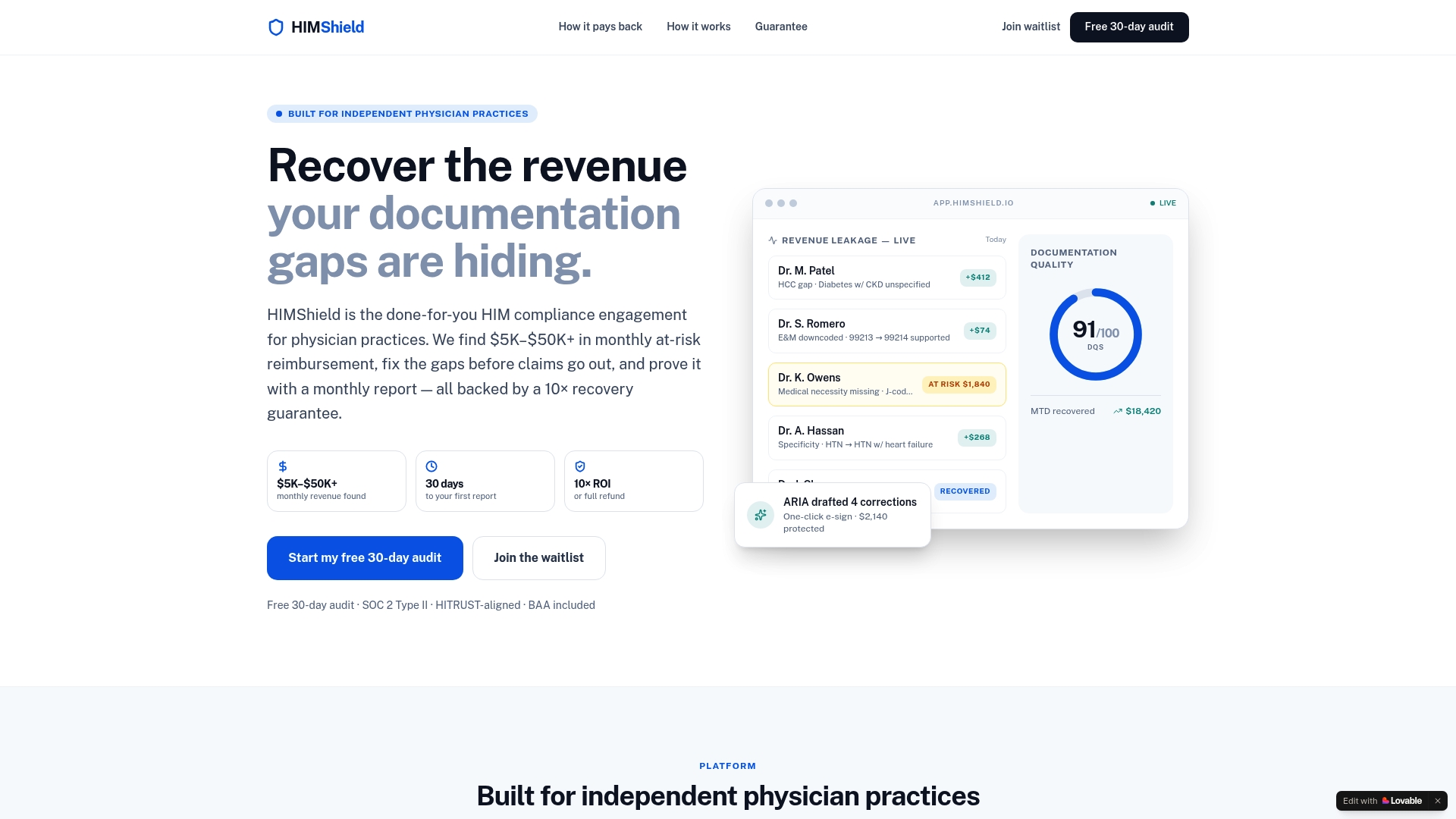
The audit scans your EHR data and delivers:
- A quantified Revenue Leakage Report broken down by provider and payer.
- Prioritized coding, documentation, and charge-capture risks ranked by dollar impact.
- Physician-friendly guidance written for clinicians, not just billing staff.
This fits naturally after a pilot like the one outlined above: once you have a workflow change in place, the audit tells you whether it is actually holding up against payer scrutiny. See how the process connects your EHR and returns findings within 30 days, then request your audit when you are ready to see where your practice stands.
This article is general information, not a substitute for advice from a qualified lawyer. Consult a qualified legal professional about your own circumstances before acting on anything here.
FAQ
What is the main cause of the productivity vs compliance tradeoff?
The tradeoff shows up when documentation shortcuts, like reused templates or padded notes, speed up charting but no longer support the codes billed. CMS guidance ties improper payments in E/M services directly to incorrect coding and insufficient documentation, not to coding complexity alone.
Do scribes actually improve documentation quality?
Not automatically. AMA-funded research found virtual scribes cut EHR time by about 16%, but only a quarter of physicians surveyed felt note quality improved, so practices should audit a sample of scribe-assisted notes before scaling the model.
How often should a small practice run compliance audits?
OIG does not set a fixed number for small practices, but it frames auditing as an ongoing process rather than a one-time check, recommending that claims and chart reviews happen together on a repeatable cycle tied to corrective action.
What does HIMShield's free audit actually include?
The free 30-day Revenue Leakage Audit delivers a quantified leakage report by provider and payer, prioritized risk findings, and physician-friendly guidance, all without requiring new staff or software training.
Can productivity incentives be designed without encouraging upcoding?
Yes, by tying any bonus or scorecard tied to coding level to a documentation check rather than volume alone. Pairing performance metrics with the audit habit described in OIG's compliance program guidance keeps incentives aligned with what the chart can actually support.
Sources
- Compliance programs for physicians | OIG
- Evaluation & Management Services | CMS
- Virtual scribes cut physician EHR burdens | AMA
- 6 steps to help physicians cut their EHR documentation load | AMA