
Pre-bill chart review is the process of auditing a patient's chart, coding, and documentation before a claim ever leaves the practice. It matters because it catches undercoding, missing documentation, and payer conflicts while there's still time to fix them. Done well, it lowers denial rates, recovers revenue that would otherwise vanish silently, and tightens coding accuracy. The best programs today pair AI-driven automation with targeted human review rather than relying on either one alone.
TL;DR:
- Pre-bill review should focus on high-dollar, complex, or historically risky claims to maximize the impact of automated and human review efforts.
- AI tools efficiently flag missing, undercoded, or conflicting services, but require careful initial calibration and phased rollout starting with high-volume service lines.
- Speeding up review timelines through real-time or discharge-window checks reduces delays, but a hybrid model balancing rapid automated checks with detailed manual review performs best.
- Key metrics such as denial rates, revenue recovery, and review turnaround time are essential to measure the program’s success and guide continuous improvement.
- Starting with a single high-value service line and conducting a 30-day revenue leakage audit can validate potential savings before scaling pre-bill review programs.
Table of Contents
- What Is Pre-Bill Chart Review and Why Does It Matter?
- How Does AI Fit Into Pre-Bill Chart Review?
- Which Charts Should You Prioritize for Review?
- What Are the Essential Components of a Pre-Bill Program?
- What Timeline Prevents Delays in Pre-Bill Review?
- Which Metrics Prove Pre-Bill Review Is Working?
- What Mistakes Undermine Pre-Bill Chart Review Programs?
- How Does HIMShield Support Pre-Bill Chart Review?
- When Should You Start, and How Do You Win Clinician Buy-In?
- Start With a Free 30-Day Revenue Leakage Audit
- Sources
- FAQ
What Is Pre-Bill Chart Review and Why Does It Matter?
Pre-bill chart review sits at the last checkpoint before a claim submits to the payer. It happens after the visit is documented and coded, but before the claim leaves the practice's system. That window is the cheapest place to fix a problem. Once a claim goes out and comes back denied, someone has to appeal it, resubmit it, or write it off.
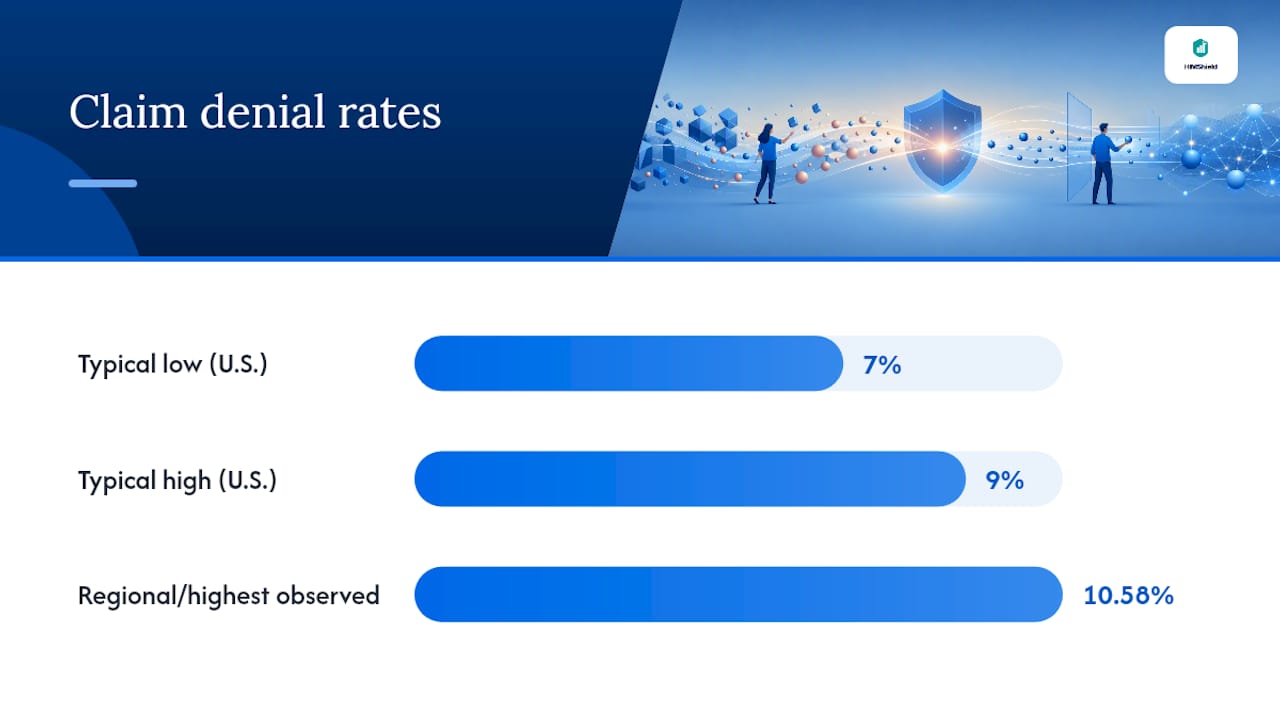
The financial case is direct. Average hospital claim denial rates in the U.S. typically run between 7% and 9%, according to Becker's Hospital Review, with some regions and hospital sizes seeing rates as high as 10.58%. Every percentage point of denials represents claims that could have been corrected before submission.
Prebill claim edits catch the issues that drive those denials:
- Undercoded or missing services that never made it into the claim
- Documentation gaps that don't support the code level billed
- Payer-specific coverage conflicts that guarantee a rejection
- Coding inconsistencies that trigger downstream audits
Documentation quality drives reimbursement more than most practices realize, and pre-bill review is where that connection gets tested before it costs you money.
How Does AI Fit Into Pre-Bill Chart Review?
Automated pre-bill review scans every chart against a rules engine built from payer policies, coding guidelines, and historical denial patterns. It flags what a human reviewer would eventually catch, but faster and across a far larger volume of charts. The software checks for missing or undercoded services, overlooked add-on codes, conflicts with payer or Local Coverage Determination (LCD) rules, and documentation that doesn't back up the code selected.
The hybrid workflow generally follows four steps:
- The system scans the chart against EHR charge capture mapping rules and flags anomalies.
- Flagged charts route to a coder or CDI specialist for review, not an inbox of every chart in the queue.
- The reviewer corrects the issue directly in the EHR, often with physician sign-off if the fix touches clinical documentation.
- The system logs the audit trail, capturing what changed and why for compliance purposes.
Most practices phase in automated review over two to four weeks, starting with one service line before expanding coverage.
Pro Tip: Don't turn on automation for every chart at once. Start with your highest-volume or highest-denial service line so your reviewers can validate the AI's flagging logic before trusting it at scale.
Which Charts Should You Prioritize for Review?
Not every chart deserves the same scrutiny, and treating them equally is how programs burn out reviewers without moving the needle. Prioritization should favor the charts where an error costs the most or has the highest odds of denial.
Prioritize charts based on:
- High-dollar Diagnosis-Related Group (DRG) cases, especially those with complication or comorbidity (CC/MCC) potential
- Complex procedures with multiple coding pathways or bundling rules
- Service lines with a documented history of denial hotspots
- Payer-specific risk, where certain plans deny more aggressively on certain codes
A simple scoring model works well here: assign a risk score combining claim dollar value, DRG complexity, and payer denial history, then set a threshold above which a chart automatically routes to human review. Charts scoring below the threshold move through with lighter automated checks only. Industry practice supports focusing limited reviewer time on high-impact cases like DRG optimization and complex procedures rather than spreading effort thin across every chart. Revisit the threshold quarterly. Denial patterns shift as payers update policies, and a rule set that worked in January can miss new risk by summer.
What Are the Essential Components of a Pre-Bill Program?
A pre-bill chart review process only works when technology, people, and governance operate together. Drop one leg and the whole thing wobbles.
On the technology side, you need EHR integration that pulls charts automatically, an audit workflow that routes flagged items without manual handoffs, a rules engine tuned to your payer mix, and an audit trail that documents every correction for compliance. HFMA identifies technology-driven workflow as one of the essential building blocks of an effective pre-bill program.
- Certified coders and CDI clinicians who understand payer-specific nuance
- A defined physician sign-off path so documentation corrections don't stall
- KPIs and feedback loops that turn findings into targeted training
- Documentation standards that stay current as payer policies change
Pro Tip: Feed every denial that slips through pre-bill review back into your training program. If the same error type shows up twice, it's a training gap, not a one-off mistake.
What Timeline Prevents Delays in Pre-Bill Review?
Speed and accuracy pull against each other in pre-bill review, and the timing model you choose determines which one wins on any given day.
- Real-time checks run automated flags the moment documentation closes, catching obvious gaps before the coder even finishes the claim.
- Discharge-window checks review the chart in the hours immediately following discharge, when clinical detail is still fresh for physician query.
- 24 to 72-hour pre-bill windows give reviewers a defined hold period for high-risk charts without stalling the entire claim queue.
The tradeoff that trips up most programs is choosing between parallel routing and hold-for-review. Parallel routing lets low-risk claims move to billing while high-risk ones sit in review, which is why the triage scoring from the prior section matters so much. Hold-for-review across the board protects revenue but inflates your Discharge Not Final Billed (DNF) numbers fast. Most mature programs land on a hybrid: automated checks clear the majority of claims within hours, and only flagged charts enter a formal hold.
Which Metrics Prove Pre-Bill Review Is Working?
Six numbers tell you whether the program is paying for itself:
- First-pass clean claim rate
- Denial rate, tracked against the 7% to 9% industry baseline
- Total revenue recovered through corrections
- Review coverage percentage across eligible charts
- Turnaround time from flag to correction
- Cost per denial averted
A one-point drop in your denial rate on $10 million in annual claims volume represents roughly $100,000 in claims that no longer need rework or appeal. Preventing a denial before submission also costs less than fighting one after the fact, since it replaces appeals labor with a single upfront correction. HFMA has documented outcomes at this scale: one academic medical center recovered $11 million in its first fiscal year after introducing pre-bill review on high-dollar inpatient cases. That's an outlier example, not a guaranteed outcome, but it shows the ceiling on what a disciplined program can recover.
What Mistakes Undermine Pre-Bill Chart Review Programs?
Most failed pre-bill programs don't fail because the concept is wrong. They fail because of execution gaps that were predictable in hindsight.
- Over-reviewing low-value charts while high-risk ones wait in the same queue
- Physician sign-off paths that break down under volume, creating bottlenecks
- Poor EHR charge capture mapping that forces manual data pulls
- No feedback loop connecting denial data back to coder or clinician training
The fix starts narrow. Pilot one service line, align coding, CDI, and finance on shared metrics before expanding, and automate triage so reviewers only see what genuinely needs eyes. Pair every finding with training, not just a correction.
Pro Tip: Build your rollout checklist around one question per stage: did this change reduce denials, and did it slow anything down? If either answer is no, adjust before scaling further.
How Does HIMShield Support Pre-Bill Chart Review?
HIMShield's platform maps directly onto the components that make pre-bill programs work: automated detection of coding and documentation gaps, clinician-friendly correction workflows, and audit-ready compliance defense if a payer comes back with questions. It connects to your EHR to identify revenue leakage without requiring your team to learn new software from scratch.
- Automated risk detection flags coding, documentation, and charge-capture gaps
- One-click physician e-signature moves corrections through without workflow disruption
- Real-time documentation quality scoring gives CDI staff a running view of risk
- Submission-ready audit responses reduce the burden if a payer requests documentation
Because it layers onto your existing EHR and coding team rather than replacing them, adoption is designed to avoid requiring new hires or a lengthy training cycle.
When Should You Start, and How Do You Win Clinician Buy-In?
Start with your highest-value service line and measure results in a 30 to 90-day window. That timeframe is long enough to show a real trend, short enough to keep momentum. When you bring findings to physicians, frame them as documentation education, not performance grading. Coders and clinicians who feel audited get defensive. Coders and clinicians who feel coached get better.
— Elena
Start With a Free 30-Day Revenue Leakage Audit
You don't have to guess whether pre-bill review would move the needle for your practice. Himshield's Free 30-day Revenue Leakage Audit scans your EHR data and delivers a quantified estimate of what's currently slipping through, broken down by provider and payer, with prioritized recommendations for where to fix it first.
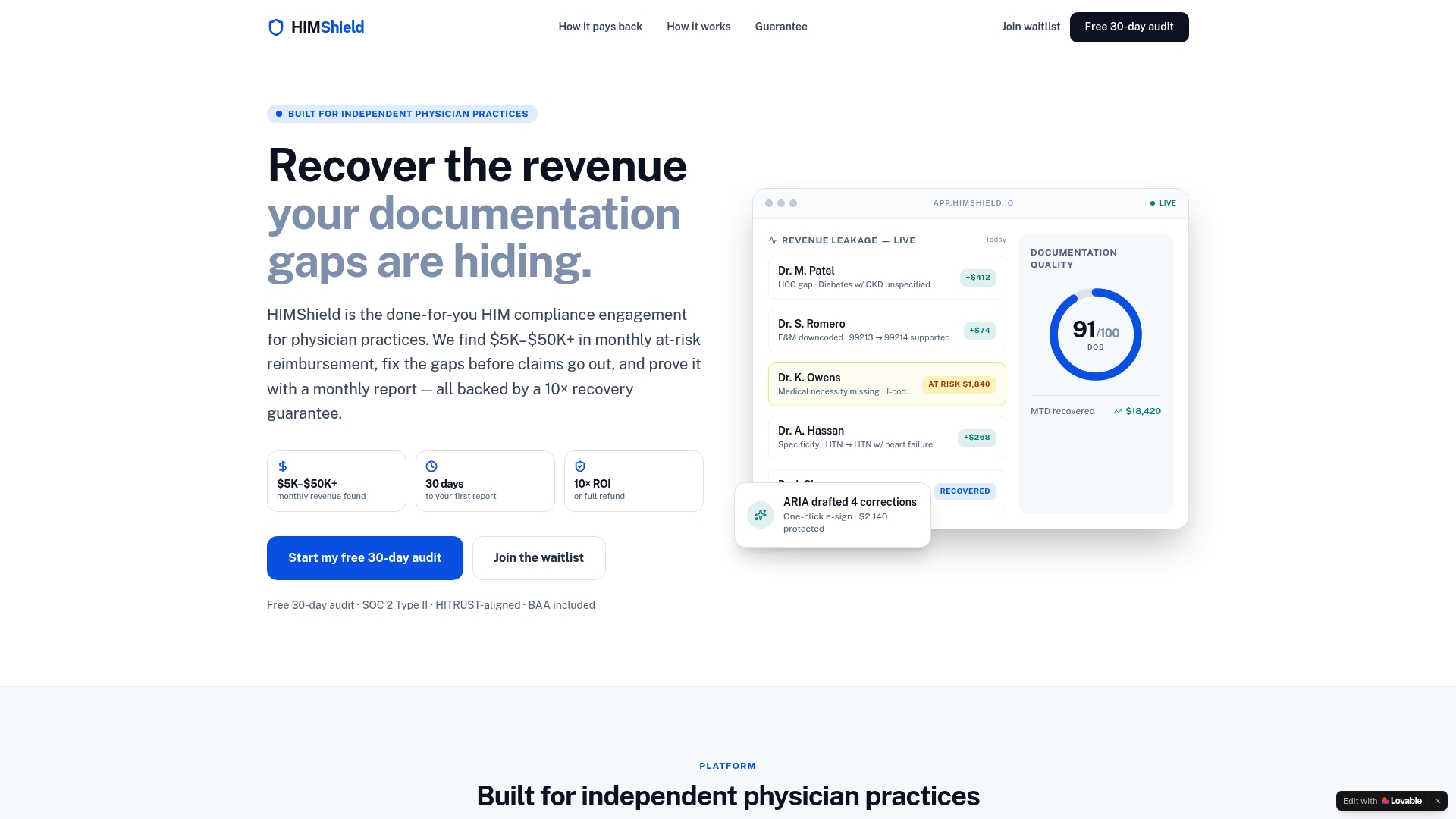
The audit works alongside whatever internal pilot you're already running rather than competing with it. Where a pilot tells you something is wrong, the audit tells you exactly how much it's costing and which charts to fix first. After the 30 days, practices typically move into an ongoing HIM compliance engagement that keeps automated detection and physician-friendly correction workflows running continuously, without adding new staff or retraining your existing coding team. Request your audit and see the number before you commit to anything.
Sources
Two sources anchor the figures in this guide. HFMA's coverage of pre-bill review lays out the essential building blocks and a real-world recovery example worth studying. Becker's Hospital Review provides the denial-rate ranges practices should benchmark against by region and size.
- Average claim denial rate for large hospitals by region | Becker's Hospital Review
- Every Dollar Counts: Revisiting Pre-Bill Review to Recover Revenue | HFMA
FAQ
Is There a CPT Code for Chart Review?
No single CPT code covers pre-bill chart review itself, since it's an internal quality and compliance process rather than a billable clinical service. Coders and CDI specialists perform it as part of the revenue cycle workflow, separate from any code that appears on the claim.
How Long Does It Take for AI-Powered Chart Review to Show Results?
Most practices see measurable results within 30 to 90 days of turning on automated pre-bill review, particularly when starting with one high-volume service line. Himshield's Free 30-day Revenue Leakage Audit is built around that same window to give practices a quantified leakage estimate quickly.
Is AI Replacing Medical Billers and Coders?
No. AI-powered pre-bill review handles high-volume flagging and pattern detection, but certified coders and CDI clinicians still make the final judgment calls on complex documentation and payer-specific nuance. The realistic model is automation surfacing risk and humans resolving it, not automation replacing the role.
How Do You Become a Chart Reviewer?
Most chart reviewers start as certified coders (CPC, CCS, or similar credentials) or CDI clinicians with clinical or nursing backgrounds who move into documentation review. Experience with payer policy, DRG methodology, and EHR systems typically matters more than a specific degree path.