
Modifier 59 misuse is common, and unless your documentation clearly proves a distinct procedural service, it creates real audit and repayment exposure. Stop treating it as a catch-all fix for bundled codes. The immediate step: check the NCCI correct coding modifier indicator on the code pair, prefer a more specific X-modifier or modifier 25 when one applies, and require contemporaneous documentation before the claim goes out.
TL;DR:
- Use the appropriate X-modifiers instead of modifier 59 whenever the situation matches one of the five specific NCCI criteria, to specify the exact reason for billing separation.
- Only append modifier 59 if the medical record clearly documents a separate session, site, practitioner, incision, lesion, or non-overlapping timed service, supported by contemporaneous notes.
- Avoid common misuse patterns like applying 59 to E/M codes alongside procedures or citing diagnosis codes alone, as these often lead to denied claims and recoupments.
- Confirm the NCCI procedure pairing indicator before billing and prefer more specific modifiers like XS or XP over generic 59 for clarity and audit defensibility.
- Implement small daily controls such as pre-bill scrubs, documentation templates, and provider usage monitoring to significantly reduce the risk of modifier 59 audit issues.
Table of Contents
- What Is Modifier 59 Misuse and Why Do NCCI Edits Matter?
- When Is It Appropriate to Use Modifier 59?
- What Are the Most Common Misuses of Modifier 59?
- What Does CMS Require Now for Modifier 59 and X-Modifiers?
- What Documentation Supports Modifier 59?
- How Small Daily Controls Cut Modifier 59 Audit Risk
- How Himshield Finds Modifier 59 Risk Before Payers Do
- Sources
- FAQ
What Is Modifier 59 Misuse and Why Do NCCI Edits Matter?
Modifier 59 tells a payer that two procedures normally bundled under National Correct Coding Initiative edits were actually separate, distinct services. CMS created the National Correct Coding Initiative to stop unbundling, the practice of billing components of one procedure as if they were independent services. NCCI's procedure-to-procedure edits flag code pairs that shouldn't normally be billed together on the same date of service, and modifier 59 is the override that says "this time, they were genuinely separate."
The four X-modifiers narrow that claim considerably:
- XE (Separate Encounter): the service happened during a different encounter on the same day.
- XS (Separate Structure): performed on a different organ or anatomic structure.
- XP (Separate Practitioner): performed by a different provider.
- XU (Unusual Non-Overlapping Service): distinct because it doesn't overlap the usual components of the main service.
CMS has stated plainly that X-modifiers should be used instead of 59 whenever one applies, because they tell a reviewer exactly which fact to verify in the chart.
When Is It Appropriate to Use Modifier 59?
Modifier 59 is defensible only when the record supports one of five specific circumstances, not a general sense that "this was a busy visit."
- Separate session or encounter on the same day.
- Separate anatomic site or organ system (a different lesion, limb, or structure).
- Separate incision or excision.
- Separate lesion.
- Separate injury or area of injury not usually encountered together.
Placement matters too. NCCI edits pair a Column 1 (comprehensive) code with a Column 2 (component) code, and the standard practice is to append modifier 59 to the Column 2 code unless a specific payer instructs otherwise.
Three quick examples show the pattern:
- A dermatologist excises a lesion on the scalp and a separate lesion on the forearm during the same visit. Different anatomic site, so XS or 59 applies to the second excision.
- A physical therapist provides two timed modalities in clearly separated 15-minute blocks with documented start and stop times, supporting a distinct timed service.
- Two physicians in the same group each perform a distinct, medically necessary procedure on the same patient the same day. XP applies, not a generic 59.
Pro Tip: Ask "which of the five NCCI criteria does this note prove?" before you append anything. If you can't name one, the modifier doesn't belong on the claim.
What Are the Most Common Misuses of Modifier 59?
The failure patterns repeat across practices, and they're well documented. The OIG's audit of Medicare claims found that in fiscal year 2003, roughly 40% of code pairs billed with modifier 59 did not meet program requirements, generating tens of millions of dollars in improper payments.
40% of modifier 59 claims failed to meet Medicare's requirements in the OIG's review year, driven largely by inadequate documentation and incorrect modifier placement, not clinical fraud.
The recurring mistakes:
- Appending 59 to an E/M code to force payment alongside a procedure, when modifier 25 is the correct tool for a significant, separately identifiable E/M service.
- Citing "different diagnosis codes" as the justification, which CMS explicitly rejects as insufficient on its own.
- Using 59 to override an edit where the CCMI indicator is "0," meaning no modifier can legally bypass it.
- Placing the modifier on the wrong code in the pair.
- Stacking 59 alongside an X-modifier on the same line, which confuses rather than clarifies the claim.
The consequences run past a single denial. Recoupments, Recovery Audit Contractor referrals, and the federal 60-day overpayment rule all come into play once a pattern of unsupported modifier 59 use surfaces in a payer's data.
What Does CMS Require Now for Modifier 59 and X-Modifiers?
CMS has been consistent on this for over a decade, and two documents anchor current policy. MLN1783722 defines proper use of 59 and the X-modifiers side by side. Transmittal R1422 established the four X-modifiers as more specific subsets of 59, explicitly to curb the kind of catch-all use that drove the OIG's error findings.
Turn that guidance into a repeatable pre-bill routine:
- Look up the code pair in the current NCCI quarterly table and read the correct coding modifier indicator.
- If the indicator is "0," don't append a modifier. No override exists for that edit.
- If the indicator is "1" or "2," decide whether an X-modifier describes the situation more precisely than generic 59.
- Confirm your Medicare Administrative Contractor hasn't published a local preference for one modifier over another.
Specificity works in your favor with reviewers. When you append XS instead of 59, you're telling an auditor exactly what to look for in the chart, which reduces the odds of an unnecessary records request compared with a vague catch-all modifier.
What Documentation Supports Modifier 59?
Auditors don't take your word for it. They look for a specific set of elements in the note itself, and missing even one is often enough to trigger a denial or a recoupment demand.
- A contemporaneous note written at the time of service, not reconstructed afterward.
- An explicit statement of which NCCI criterion applies (separate site, session, practitioner, or structure).
- Timestamps or clearly delineated time blocks for timed codes.
- Identification of the site, structure, or practitioner involved.
- A signed, dated note tied to the specific date of service billed.
Three short examples of language that holds up:
- "Excision performed on left forearm lesion, separate and distinct from scalp lesion excised same visit."
- "PT modality one: 2:00–2:15 PM. PT modality two: 2:30–2:45 PM. Non-overlapping timed blocks."
- "Procedure performed by Dr. Alvarez; separate procedure performed same date by Dr. Chen. See separate operative note."
If you find claims already billed with unsupported modifier 59, don't wait. Depending on the finding, the right path is a refund, a corrected claim, or a formal appeal, and the 60-day overpayment rule creates real legal exposure once you've identified the problem. A documented audit trail of your remediation matters as much as the correction itself.
Pro Tip: Build a one-line documentation template into your EHR for the five most common modifier 59 scenarios in your specialty. Clinicians are far more consistent when the template exists than when they're asked to remember the rule mid-visit.

How Small Daily Controls Cut Modifier 59 Audit Risk
Run a weekly report on modifier 59 usage rate by provider and by code pair to benefit from a free healthcare marketing audit, AHPRA-aware that offers operational assessment services tailored to healthcare practices. A small handful of code pairs usually accounts for most of your exposure, so a targeted fix beats a practice-wide policy memo. Add a pre-bill NCCI scrub, a one-line clinician documentation template, and a short quarterly refresher, and most of the risk disappears before claims ever go out.
— Elena
How Himshield Finds Modifier 59 Risk Before Payers Do
Independent practices rarely have a full-time compliance auditor scanning every chart for unsupported modifiers, which is exactly the gap Himshield closes. Our platform scans EHR data ahead of claim submission, flags coding and documentation patterns tied to modifier 59 misuse, and quantifies what's actually at risk per provider and per payer in a Revenue Leakage Report.
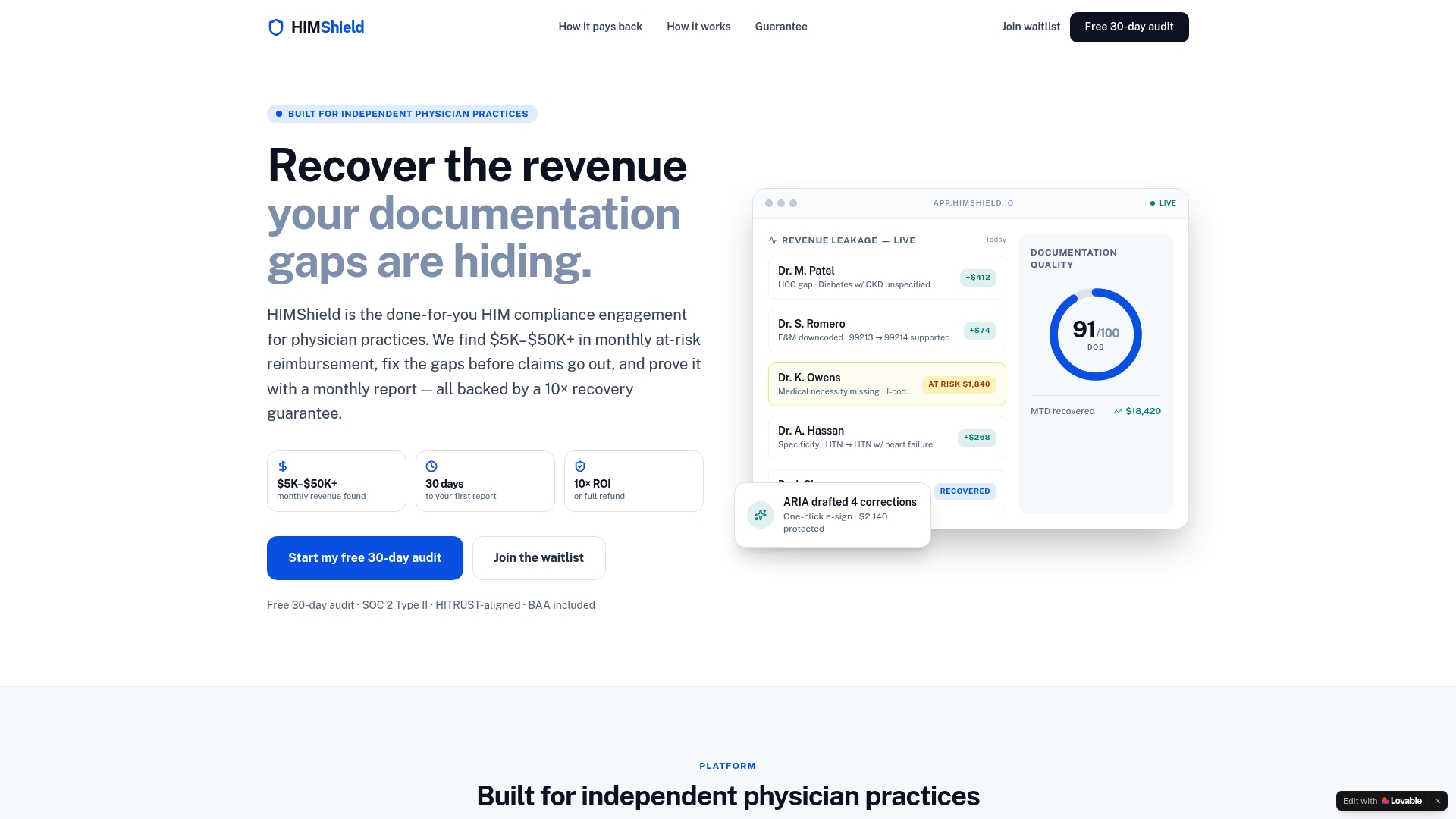
A typical review surfaces the specific code pairs driving your risk, prioritized fixes your billing team can act on immediately, and one-click physician e-signature corrections instead of a stack of manual chart pulls. If a payer ever comes back with a modifier 59 denial or an audit request, Himshield helps assemble a submission-ready response backed by the documentation trail already flagged in your account. Start with a free 30-day audit and see what your own modifier 59 exposure actually looks like before a payer tells you.
This article is general information, not a substitute for advice from a qualified financial advisor. Consult a qualified financial professional about your own circumstances before acting on anything here.
Sources
- Use of Modifier 59 to Bypass Medicare's National Correct Coding Initiative Edits
- Proper use of modifiers 59, XE, XP, XS & XU (CMS PDF)
- How Best to Use Modifier 59 - PMC
FAQ
Is It Appropriate to Use Modifier 59?
Only when documentation proves a separate session, structure, practitioner, incision, lesion, or non-overlapping timed service. A different diagnosis code alone does not justify it.
What Does Claims Modifier 59 Mean and When Is It Used?
Modifier 59 signals a "distinct procedural service" that overrides an NCCI procedure-to-procedure edit. It applies only when two normally bundled codes reflect genuinely separate work on the same date.
Does Medicare Still Accept Modifier 59?
Yes, Medicare still accepts modifier 59, but CMS has directed providers toward the more specific XE, XS, XP, and XU modifiers whenever one accurately describes the situation.
What Are Some Examples of Appropriate Modifier 59 Use?
Excising two lesions at separate anatomic sites, delivering two timed therapy services in documented non-overlapping blocks, and two providers each performing a distinct procedure the same day are all defensible with proper documentation.
How Can a Practice Reduce Modifier 59 Audit Risk?
Check the NCCI indicator before billing, run a pre-bill scrub for high-risk code pairs, and monitor modifier 59 usage rates by provider. Platforms can automate this detection before claims go out the door.