
The moment a payer, auditor, or attorney requests medical records, three things must happen simultaneously: verify who is asking and under what legal authority, calendar the exact deadline, and place a litigation hold that stops routine record destruction. Assign one senior staff member to own the file from intake to submission. Apply HIPAA's minimum necessary standard before you send anything, and if the volume or risk feels beyond your team's bandwidth, a platform with automated features can help assemble a defensible packet fast.
TL;DR:
- Verifying requester identity, placing a litigation hold, and applying the minimum necessary standard are critical steps to prevent future audit complications.
- Disclosing records without satisfactory legal assurances, such as a court order or patient authorization, exposes practices to HIPAA violations and legal risks.
- A complete, organized audit packet must include all relevant documentation, labeled clearly, paginated, and stored separately from the live record for defensibility.
- Tracking every step from intake to transmission with a production log, clinician review, and signed clinician sign-off can prevent common mistakes that escalate requests into audits.
- Using an AI-powered platform for pre-emptive documentation audits and compliance guidance can reduce risk and streamline the response process during audits or requests.
Table of Contents
- What Is the Correct Medical Record Request Response Procedure?
- How Do You Confirm Legal Authority Before Releasing Records?
- What Goes Into a Submission-Ready Audit Packet?
- What Mistakes Turn a Records Request Into an Audit Problem?
- How Should You Manage Deadlines and Documentation?
- What Should Clinician Review and the Cover Letter Cover?
- What Are Your Options After an Adverse Audit Finding?
- When Do You Need Patient Notification or Consent?
- What Can You Charge for Copying and Sending Records?
- How Do You Track Requests for Compliance Audits?
- Where Independent Practices Actually Lose Ground
- Get a Free Revenue Leakage Audit Before Your Next Records Request
- Sources
- FAQ
What Is the Correct Medical Record Request Response Procedure?
A compliant medical record request procedure follows a fixed sequence, and skipping steps is how practices end up with extrapolated recoupment demands months later. The AMA's guidance on payer audits stresses that starting early and keeping the process organized directly reduces the odds of an incomplete submission triggering a bigger audit.
Here is the order that actually works, based on how audit and legal teams handle these requests:
- Intake and verification. Confirm the requester's identity, the exact patient or patients named, the date range, the specific record types requested, and the required delivery method.
- Preservation. Place a litigation hold, secure the original chart, suspend any routine destruction schedule that might touch those records, and open a production log the moment the request lands.
- Filtering. Apply the minimum necessary standard and flag anything requiring extra protection, including psychotherapy notes or substance-use treatment records under 42 CFR Part 2.
- Collection. Gather every record type actually requested. If imaging, labs, or billing detail is named, pull it now rather than waiting for a follow-up request.
- Quality assurance. Have a clinician review the packet for completeness and legibility, and reject any scan that is a copy of a copy, since faded or cropped pages are a common reason auditors flag a submission as incomplete.
- Submission and proof of receipt. Transmit through the method specified, attach a cover letter, and archive an exact copy of what you sent, not just what you have in the EHR.
Pro Tip: Build one production log template now and reuse it for every request. Chasing down who pulled which document three weeks after submission is far harder than logging it in real time.
How Do You Confirm Legal Authority Before Releasing Records?
Not every piece of paper demanding records carries the same legal weight, and treating a subpoena like a court order is one of the most common mistakes independent practices make. A court order compels disclosure within its stated scope, full stop. A subpoena, especially one signed only by an attorney, does not.
Under HIPAA's 45 CFR §164.512(e), a practice cannot disclose protected health information in response to a bare subpoena unless it receives satisfactory assurances that the patient was notified or that a qualified protective order is in place. That assurance has to show real effort, not a boilerplate line in the subpoena itself.
Before you release anything, check for:
- A court order (self-executing, no assurances needed beyond confirming authenticity)
- A subpoena accompanied by proof of patient notice or a protective order
- A signed patient authorization that matches the scope of the request
- Special categories requiring extra handling: psychotherapy notes, Part 2 substance-use records, or state-specific mental health statutes
- Requests that appear overbroad or defective, which you can object to in writing while preserving the records in question
If assurances are missing, object and request them rather than disclosing on a deadline pressure alone; defective or overbroad subpoenas can and should be challenged before production.
What Goes Into a Submission-Ready Audit Packet?
A complete production typically includes progress notes, physician orders, lab results, imaging reports (and the images themselves if requested), signed consent forms, billing claims tied to the visit, and any communications directly relevant to the care in question. Missing even one of these categories is enough to make a reviewer treat the whole submission as incomplete.
Organize the packet so a reviewer who has never seen your chart can navigate it in minutes:
- Build an index or cover sheet listing every document included, in the order it appears
- Paginate every page, including attachments and imaging reports
- Label files clearly with patient identifiers, date of service, and record type
- Confirm imaging files open correctly and are attached in a readable format before transmission
- Keep a production log recording who compiled each section, who signed off clinically, and the exact transmission timestamp
Auditors extrapolate findings from samples. That means a single incomplete or illegible chart can drive a recoupment demand far larger than the dollar value of that one claim. A defensible archive of exactly what was sent, separate from the live record, is your best protection if the packet's completeness is ever questioned later.
What Mistakes Turn a Records Request Into an Audit Problem?
The single fastest way to escalate a routine request into a real problem is altering a record after the fact. If something needs clarification, add a clearly dated addendum and explain it in your cover letter. Never edit existing entries.
Watch for these errors before anything leaves your office:
- Sending the entire chart when only specific record types were requested, which violates minimum necessary
- Handing production entirely to an outside vendor without internal clinician review
- Illegible scans, wrong patient or date range, or missing imaging and lab attachments
- Backdating notes instead of using transparent, dated addenda
Pro Tip: If a clinician wants to add context to a chart entry after the fact, that note belongs in the cover letter or a dated addendum, never inside the original documentation.
How Should You Manage Deadlines and Documentation?
Every request gets a calendar entry the day it arrives, with the deadline flagged to whoever owns the file. If you need more time, request an extension in writing and keep the confirmation on file.
- Assign a senior point person immediately, and have that person track the request from intake through final transmission.
- Log every step: the intake form, chain-of-custody notes, and the production log itself.
- Save an exact copy of the sent packet, stored apart from the live EHR so nobody accidentally edits or deletes it later.
- Route the packet through clinician review before the deadline, not after, since a rushed final check is how completeness gaps slip through and turn into extrapolated recoupments during an appeal.
What Should Clinician Review and the Cover Letter Cover?
A clinician needs to sign off on more than legibility. That review should confirm the packet is clinically complete and flag any linked records outside the requested scope that a reviewer would need to understand the case fully.
The cover letter itself should:
- Identify the exact request being answered, including date range and requester
- List every category of material included in the production
- State plainly that the packet is complete to the best of the practice's knowledge
- Note any dated addenda separately, never folded into clinical entries themselves
Pro Tip: A transparent cover letter that names what's included and what isn't protects your credibility during an appeal far more than a vague one-line transmittal ever will.
What Are Your Options After an Adverse Audit Finding?
When a payer proposes recoupment, weigh the dollar exposure against the cost and time of fighting it. Sometimes a negotiated settlement is genuinely the more practical path.
- Resubmit the complete record with the relevant items highlighted and a cover sheet explaining what the original reviewer may have missed
- Track and meet the payer's specific appeal deadline; missing it usually forfeits the right to challenge the finding
- Bring in outside counsel or an independent auditor when extrapolation involves high dollar amounts or a possible fraud flag
- Use the audit's findings to run a targeted self-audit and retrain staff on the documentation gap that caused it
Appeals with the strongest odds tend to be the ones that show the initial reviewer simply missed information present in the chart, which is exactly why complete records at the appeal stage matter so much.
When Do You Need Patient Notification or Consent?
Whether you need to notify the patient depends entirely on the legal basis for the request. A signed patient authorization already establishes consent, so no separate notification step is needed beyond confirming the authorization matches the scope requested. A subpoena is different: HIPAA requires the requester to show satisfactory assurances that the patient either received notice of the subpoena or that a qualified protective order covers the disclosure.
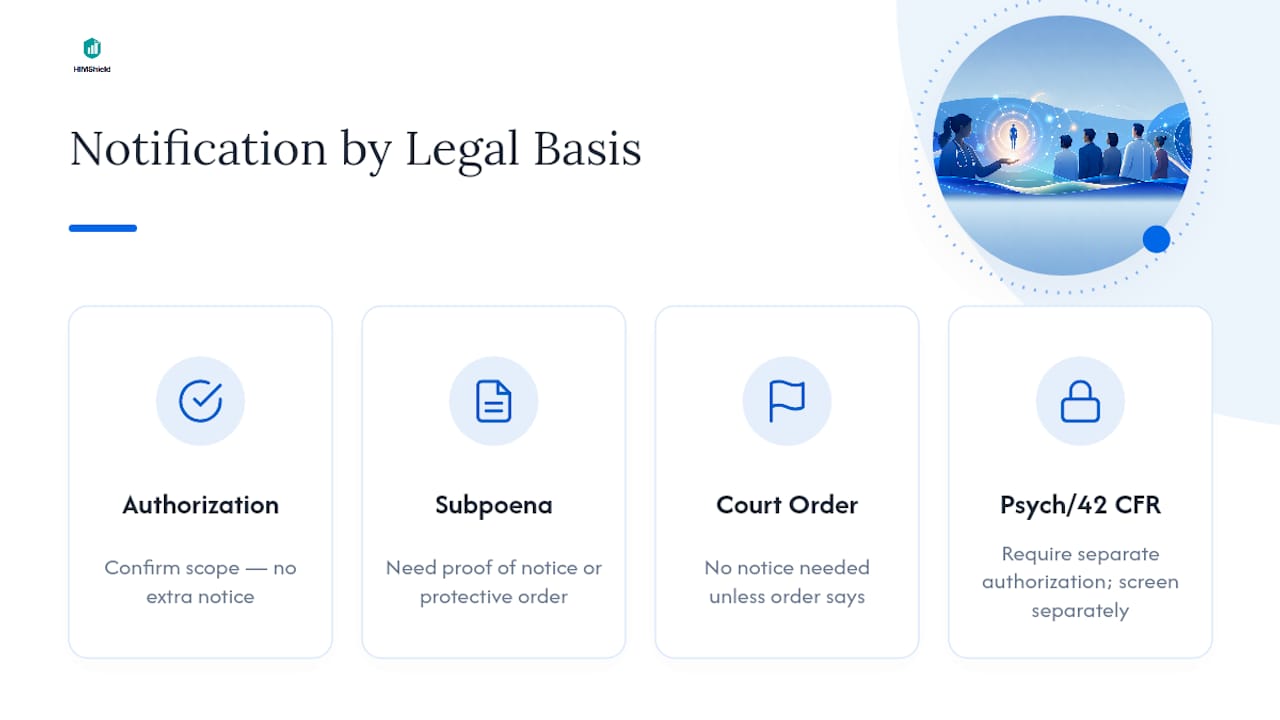
Practices should never assume an attorney's office handled patient notice correctly. Ask for proof, dated correspondence showing the patient was informed, or documentation of the protective order itself, and keep that proof in your production file. If notice is missing or unclear, object in writing and request it before disclosing anything.
Court orders sit apart from this entirely; a judge has already weighed the disclosure question, so no separate patient notification step applies unless the order itself says otherwise.
For sensitive categories, the bar rises further. Psychotherapy notes and substance-use treatment records under 42 CFR Part 2 typically require specific, separate patient authorization even when a general medical records authorization is already on file. Treat these categories as their own request, screened and handled apart from the rest of the chart, and flag them early in intake so nobody accidentally bundles them into a standard production.
What Can You Charge for Copying and Sending Records?
Fee structures for record production vary by state and by the type of requester, and conflating a patient-access fee schedule with a payer or legal request is a common and costly mistake. Payer audit requests, litigation subpoenas, and attorney requests are typically governed by different fee rules than patient access requests, and many payer contracts specify that record production for audit purposes carries no separate charge at all.
Before invoicing anyone for a records production, check three things: the specific requester's category, your state's statute governing medical record copying fees for that category, and whether your payer contract already addresses cost recovery for audit-related requests. Charging a fee that applies to one category of requester but not another is the kind of error that draws its own complaint.
Keep your fee schedule, if one applies to the request in front of you, documented and consistent. If a request falls under a payer audit clause with no cost-recovery provision, do not invent a charge. When a fee is genuinely permissible, the invoice and its basis belong in your production log alongside everything else you send.
How Do You Track Requests for Compliance Audits?
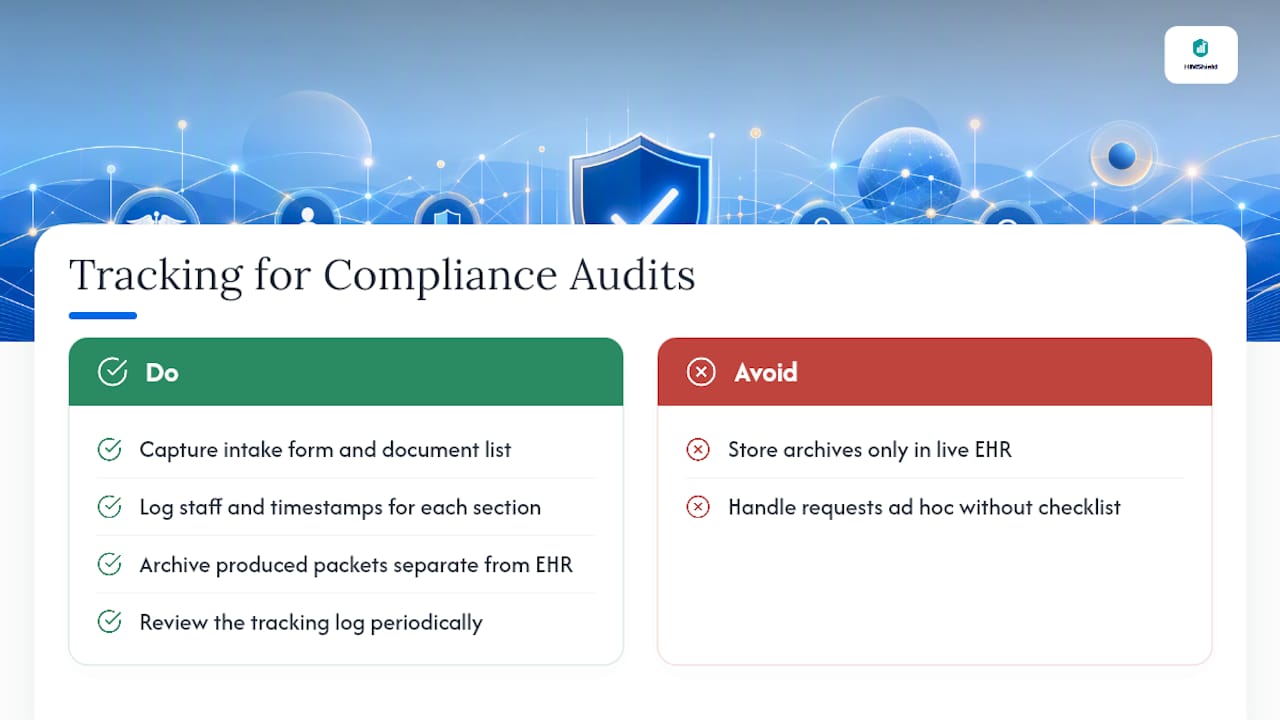
Every records request needs a paper trail that outlives the transaction itself, because the next audit you face may ask you to prove how you handled the last one. A defensible tracking system captures the intake form, the exact list of documents requested versus what was actually produced, the staff member who assembled each section, timestamps for clinician review and transmission, and a transmission receipt or manifest confirming delivery.
Store the archived copy of every produced packet apart from your live EHR. That separation matters for two reasons: it prevents accidental edits to a record that's already been submitted, and it gives you an unambiguous answer if a payer later claims you sent something different from what they received.
Review your tracking log periodically, not just when a new request lands. Patterns in what gets requested, which providers draw the most audits, and which record types cause repeated back-and-forth are the same patterns a physician audit survival checklist is built to catch before they become bigger problems. A HIPAA audit checklist built for compliance readiness can help formalize this tracking into a repeatable system rather than an ad hoc scramble every time a letter arrives.
Where Independent Practices Actually Lose Ground
The failure pattern is remarkably consistent across independent practices: a missed deadline, a packet assembled without clinician sign-off, or a protected record category handled like a routine chart pull. None of these are complicated fixes.
A designated intake owner, a prebuilt production template, and a mandatory clinician sign-off step close most of the gap. Routine self-audits catch the rest before a payer does.
— Elena
Get a Free Revenue Leakage Audit Before Your Next Records Request
Most independent practices don't have a dedicated compliance team standing by to build a submission-ready packet on a payer's deadline. A specialized AI-powered platform can provide insights on documentation and coding gaps before they turn into a denial, an audit, or a recoupment demand, often without hiring new staff or retraining anyone on new software.
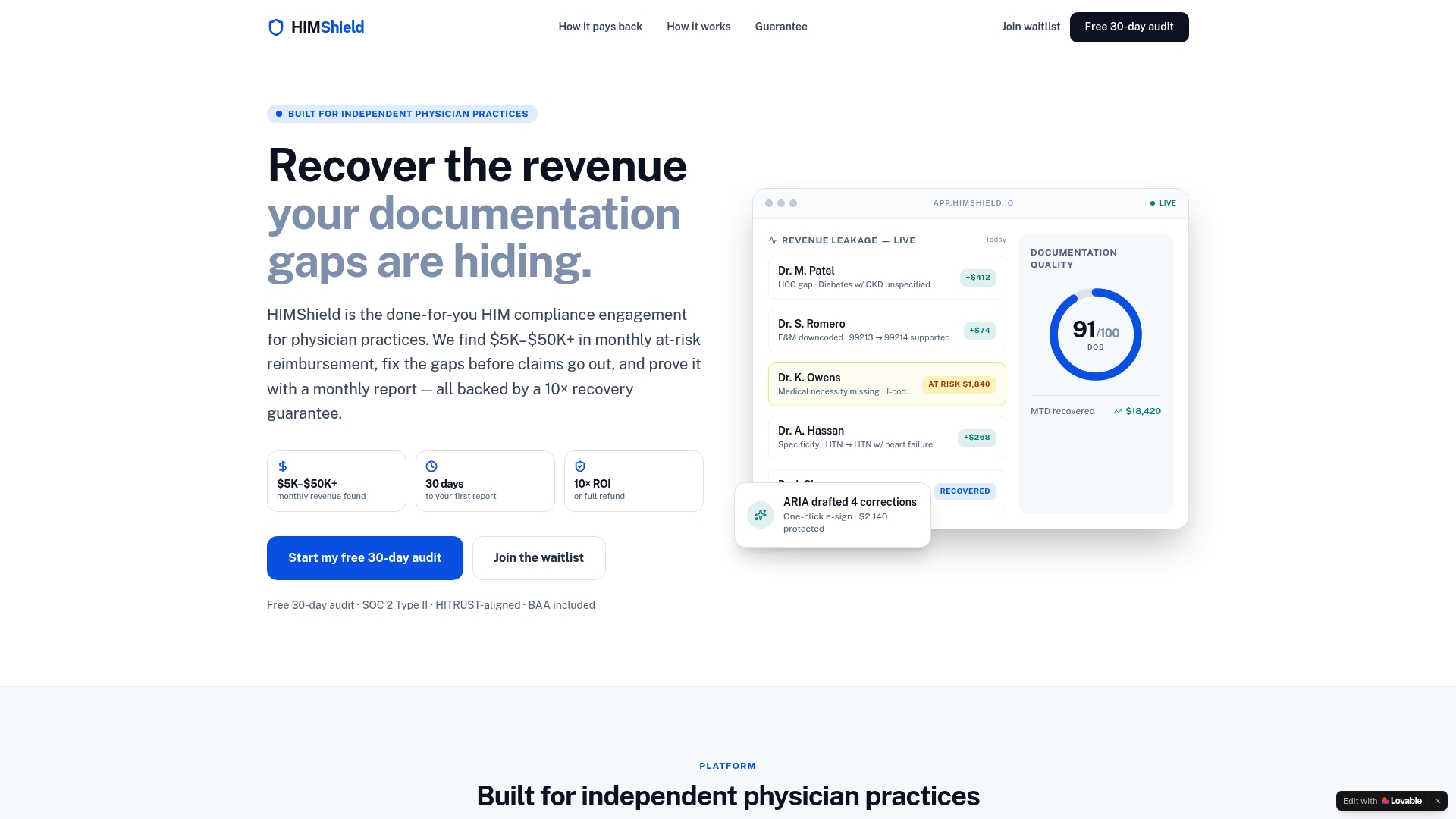
The Free 30-day Revenue Leakage Audit scans your EHR data to surface exactly the kind of documentation gaps that make audit responses harder than they need to be: missing imaging references, thin clinical rationale, coding mismatches. From there, the HIM compliance engagement helps assemble the submission-ready package itself, with automated compliance alerts and physician-friendly guidance that maps directly onto the checklist steps above. If a records request is already sitting on your desk, start with the free audit and see exactly where your risk sits.
This article is general information, not a substitute for advice from a qualified lawyer. Consult a qualified legal professional about your own circumstances before acting on anything here.
Sources
- Minimum necessary requirement | HHS
- When payors audit your private practice, panic is no help | American Medical Association
FAQ
Is a Subpoena the Same as a Court Order?
No. A court order compels disclosure on its own terms, while an attorney-issued subpoena needs satisfactory assurances showing patient notice or a protective order before you can disclose anything under HIPAA.
What Does "Minimum Necessary" Actually Require?
It means disclosing only the information relevant to the specific request rather than the entire chart. Sending the full record when only lab results were requested violates this standard even if it feels like the safer option.
Can I Object to an Overbroad Records Request?
Yes. You can object in writing and propose a narrowed scope or protective order while preserving the records in question, rather than either ignoring the request or disclosing more than necessary.
How Much Does Himshield's Audit Service Cost?
The Free 30-day Revenue Leakage Audit has no published price and is offered as a complimentary first step; current pricing for the ongoing HIM compliance engagement is available directly on the Himshield site.
What Happens if I Miss the Records Request Deadline?
Missing a deadline can lead a payer to treat the response as incomplete, which raises the risk of an extrapolated recoupment demand. Request an extension in writing before the deadline passes and keep the confirmation in your production file.