
Under HIPAA (45 CFR §164.526), patients have the right to request a correction to their medical record, and practices must respond within 60 days. If the request is valid, you append or link the correction and notify anyone else who relied on the disputed information. If it isn't, you issue a plain-language denial and let the patient attach a statement of disagreement. The immediate next step is simple: every written request gets logged and routed straight to your Privacy Officer or HIM designee, no exceptions.
TL;DR:
- Practices must log and route every written patient request for correction to the Privacy Officer within the 60-day response window, with a 30-day extension possible if properly notified.
- Amendments should be appended to the original record with a references to the entry's unique identifier, maintaining audit logs for all notifications and changes.
- Denials must be based on clear, limited legal grounds, such as information origin, completeness, or access rights, not on convenience or physician disagreement.
- Failure to follow proper procedures, like overwriting entries or missing notification logs, exposes practices to audit liabilities and potential payer disputes.
- Automated tools are recommended for managing the amendment process efficiently, ensuring documentation gaps are flagged and correction language drafted correctly before audit deadlines.
Table of Contents
- What Are the Chart Amendment Rules Under HIPAA?
- What the Law Requires: Key Provisions of 45 CFR §164.526
- How Should a Practice Build an Amendment Workflow?
- Which Documents and Metadata Belong in the Amendment File?
- What Mistakes Put Practices at Risk During an Amendment?
- Why Amendment Discipline Protects More Than Compliance
- Let Himshield Handle the Amendment Paper Trail
- Where to Verify These Amendment Rules Yourself
- Sources
What Are the Chart Amendment Rules Under HIPAA?
Every independent practice needs a working checklist for the moment a patient asks you to correct their chart, because the clock starts the day you receive the request, not the day someone gets around to reading it.
Here's the sequence that keeps you inside the federal timeline:
- Require a written request. Your Request for Amendment form should capture the patient's identity, the specific record or entry in question, and the reason for the change.
- Log the intake date immediately. This date starts your 60-day response window, so assign a tracker ID the same day you receive the form.
- Notify the original record author. The clinician who wrote the entry needs to weigh in before anyone decides whether the amendment is warranted.
- Document every step of the review. Communications, findings, and the reasoning behind the eventual decision all belong in the file, not in someone's email inbox.
- Issue a written extension notice if needed. A single 30-day extension is allowed, but only if you tell the patient in writing why you need it and when they can expect a decision.
Pro Tip: Assign the tracker ID before you notify the record author. Practices that skip this step often lose track of which requests are approaching day 60, especially when multiple providers are reviewing the same chart.
What the Law Requires: Key Provisions of 45 CFR §164.526
The regulation gives patients a right to request an amendment to protected health information in their designated record set, and it gives your practice specific, narrow grounds for denial. You can't deny a request just because it's inconvenient or because the physician disagrees with the patient's opinion of their own care.
Valid grounds for denial are limited to:
- The information wasn't created by your practice (it originated elsewhere, and you're not the source).
- The information isn't part of the designated record set the patient has a right to access.
- The record is already accurate and complete as written.
- The information wouldn't be available for inspection under HIPAA's access provisions.
If you accept the amendment, 45 CFR §164.526 requires three things: identify every affected record, append or link the amendment to it, and inform the individual which other parties you're notifying. If you deny it, the patient gets a plain-language explanation of why, along with the right to file a statement of disagreement that must travel with any future disclosure of the disputed information.
One number matters more than any other in this process: 60. That's the number of days you have to act, with one 30-day extension available if you notify the patient in writing before the original deadline expires, according to ONC's guidance on health information rights.

How Should a Practice Build an Amendment Workflow?
Legal compliance is one thing. Building a workflow your front desk, HIM staff, and physicians can actually follow under pressure is another. Here's how the pieces fit together operationally.
- Intake. Whoever receives the request verifies the patient's identity and confirms the standardized form is complete: specific chart entry, stated reason, and requested correction. Incomplete forms get sent back immediately rather than logged as pending.
- Review. The Privacy Officer or HIM designee contacts the record's original author, evaluates whether the disputed entry is accurate and complete, and documents the reasoning behind whatever decision follows. This step is where most delays happen, so build in a hard follow-up date at day 30.
- EHR action on acceptance. Never overwrite the original entry. Append an addendum record that references the original entry's unique identifier, states the reason for the amendment, and carries the authorizing clinician's signature. The EHR's audit log should capture both the amendment itself and every notification sent afterward, a point echoed in UT Health's coding compliance guidance.
- Notification. You must make reasonable efforts to inform anyone the patient identifies, plus any other known holders of the information, including business associates, external providers, and payers who may have relied on it.
Pro Tip: Keep a running list of every business associate and referring provider who's touched a given chart in the last 12 months. When an amendment is accepted, you'll need that list fast, and reconstructing it after the fact wastes days you don't have.
Which Documents and Metadata Belong in the Amendment File?
Audit readiness comes down to whether you can hand an OCR investigator or payer auditor a complete packet in minutes, not days. That means every accepted or denied amendment needs a consistent set of attachments and a consistent place to store them.
Documents to append or link:
- The signed Request for Amendment form
- The acceptance or denial letter sent to the patient
- The amendment text itself, cross-referenced to the original entry
- Any patient statement of disagreement
- Your practice's rebuttal to that statement, if one was submitted
| Metadata field | Why it matters |
|---|---|
| Author of the amendment | Establishes who reviewed and authorized the change |
| Date and time stamp | Anchors the amendment to your 60-day compliance window |
| Reason for amendment | Documents the clinical or factual basis for the correction |
| Link to original entry | Preserves the unaltered record, satisfying non-deletion rules |
| Audit log entry | Shows exactly when the amendment and notifications occurred |
Centralize all of this in an amendment index within your designated record set. AHIMA's practice brief on amendment policy.pdf) recommends exactly this kind of standardized filing, precisely because scattered documentation is what turns a routine amendment into an audit liability months later.
What Mistakes Put Practices at Risk During an Amendment?
The single most common error is treating an amendment like an edit. It isn't. You add to the record; you never delete or rewrite what's already there, a distinction UT Health's compliance guidance draws explicitly.
Watch for these red flags:
- Verbal corrections with no paper trail. If a physician tells a nurse to "just fix" a chart note, and nothing gets documented, that's an audit liability waiting to surface.
- Overwritten entries. Any correction that erases the original text destroys the very evidence an auditor needs to see you followed the rules.
- Missing notification logs. If you can't show who you told about an accepted amendment, you can't prove you met your notification obligation.
If you're ever audited, the packet you assemble should include the original entry, the amendment itself, the intake form, a correspondence timeline, and the notification log, in that order.
Pro Tip: Run a mock audit on your last five amendments before a real one finds you. If you can't reconstruct the full timeline in under ten minutes, your filing system needs work, not your policy.
Why Amendment Discipline Protects More Than Compliance

Small practices tend to treat chart amendments as one-off favors instead of governed processes. Someone gets a phone call, makes a quick note, and moves on. That informality is exactly what turns into a payer dispute six months later, when nobody can produce a timeline showing what changed, who approved it, or who got notified.
Standardizing intake under one designated person fixes most of this. It's not about adding bureaucracy. It's about making sure the same rules apply every time, so a denial in March looks procedurally identical to a denial in October. Practices that get this right find their audit responses go faster and their disputed claims resolve with less back and forth, because the paper trail already answers the questions before an auditor asks them. For more on how documentation gaps surface during payer reviews, see how to prepare for a payer audit.
— Elena
Let Himshield Handle the Amendment Paper Trail
There are alternatives to manual HIM tracking spreadsheets that can flag documentation gaps automatically and draft the correction language for physician e-signature in one click, saving your team from chasing down record authors and reconstructing notification logs by hand.
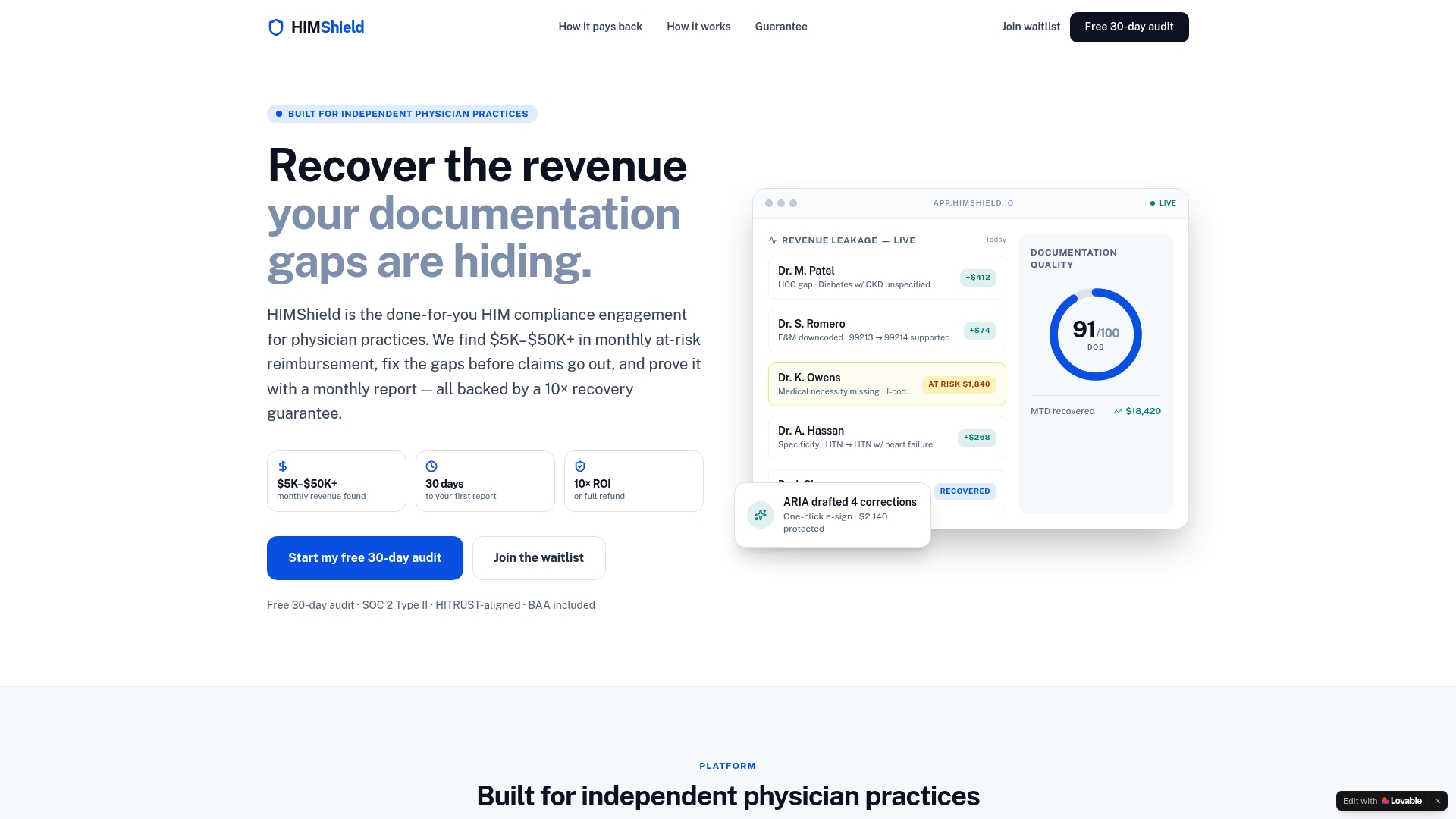
That matters most under audit pressure, when you need to assemble a complete packet fast: original entry, amendment, intake form, correspondence timeline, and notification log, all pulled together instead of hunted down. Automated compliance alerts can catch documentation issues that typically become amendment requests before they reach a patient complaint or a payer denial. If you want to see what's currently sitting in your own charts, start with a free 30-day audit and get a Revenue Leakage Report showing exactly where your practice stands.
Where to Verify These Amendment Rules Yourself
Don't take secondhand summaries as the final word. Read 45 CFR §164.526 directly for the regulatory text itself, check ONC's plain-language guidance for patient-facing explanations, and download AHIMA's practice brief for sample policy language and a ready-made Request for Amendment template.