
E/M leveling automation is software that reads clinical documentation and proposes a billing level by matching the note against Medical Decision Making or time criteria. We recommend adopting it with human-in-the-loop review and confidence thresholds, not as a standalone replacement for coder judgment. Used that way, it speeds up coding while keeping every submitted claim defensible.
TL;DR:
- Automation relies on clean, structured documentation of problems, data reviewed, and risk factors to produce accurate E/M level suggestions.
- Payer-specific variations and low-confidence suggestions require human review to maintain billing defensibility and avoid automation bias.
- Pilot programs should start with specialties that have consistent documentation habits and include validation and audit-trail processes.
- High-confidence, routine encounters benefit from automated coding, but complex or uncertain cases must always be reviewed by a trained coder.
- Regular monitoring of denial rates and audit outcomes is essential to ensure automation effectiveness and compliance over time.
Table of Contents
- How E/M Leveling Works Now: MDM Versus Time
- What Automation Does in Practice
- Benefits, Measurable Outcomes, and Failure Modes
- Step-by-Step Checklist to Pilot E/M Leveling Automation
- Governance and Defensibility: Attestation and Human Oversight
- Our Take on Adopting E/M Leveling Automation
- See What's Leaking Before an Auditor Does
- FAQ
- Sources
How E/M Leveling Works Now: MDM Versus Time
Under current CPT guidance, providers select an office or outpatient E/M level using either Medical Decision Making or total time spent on the date of the encounter, and both paths carry equal weight under the AMA's E/M coding rules. MDM is built from three components: the number and complexity of problems addressed, the amount and complexity of data reviewed, and the risk of complications or morbidity from management decisions. Time-based selection instead totals the minutes a provider spends on the encounter date, including review, counseling, and documentation, a method CMS has reinforced through guidance on add-on codes like G2211 and G2212 for complex and prolonged visits.
Automation can only extract what the note actually supports, so documentation habits matter as much as the software itself. Practices that get clean automated suggestions tend to follow a few habits:
- Document each problem addressed, not just a diagnosis list, so complexity is traceable.
- Record data reviewed (labs, imaging, external records) with enough detail to show complexity.
- Log start and stop times or total minutes when time is the basis for level selection.
- Note risk factors explicitly, including medication management and social determinants that raise complexity.
Our checklist for time-based E/M coding walks through the specific checks worth running before any time-based claim goes out.
What Automation Does in Practice
Once the documentation exists, E/M leveling automation parses it using natural language processing similar to computer-assisted coding engines, then maps findings against a configurable coding grid tuned to specialty and payer rules. The stronger platforms do more than output a single number. They typically include:
- NLP parsing that pulls problem lists, data points, and risk factors directly from the note.
- A configurable coding grid that reflects payer-specific and specialty-specific MDM thresholds, much like the nuances explained in why your dermatology visit isn't billed as preventive care.
- An MDM details breakdown showing which specific element (problems, data, or risk) fell short of the next level.
- Time helpers that total documented minutes against the time-based thresholds.
- Confidence scoring that flags how certain the system is in its proposed level.
These tools typically sit at three touchpoints: parsing the note as it's finalized in the EHR, surfacing a suggested level in the coder's queue, and running a pre-bill check before the claim submits, catching denial-prone patterns early. The system needs clean, structured inputs: standardized templates, accurate timestamps, and consistent problem documentation all improve the extraction quality. Unstructured free text can still be parsed, but it produces lower confidence scores and more frequent human routing.
Pro Tip: Ask any automation vendor to show the MDM details breakdown, not just the proposed level. Seeing which element drove the suggestion is what lets a coder agree, override, or request a documentation fix.

Benefits, Measurable Outcomes, and Failure Modes
The upside is real but bounded. Faster coding throughput, better first-pass claim acceptance, and fewer routine denials are the outcomes practices should expect to track and validate for their own payer mix and specialty, since published figures vary by source and setting. Industry reporting on revenue cycle automation suggests that AI can reliably handle a large share of routine coding tasks while complex cases still need a trained coder, a pattern consistent with how agentic AI is evolving in revenue cycle management.
Automation also has predictable failure points:
- Ambiguous or template-light notes produce low-confidence suggestions that need manual leveling anyway.
- Payer-specific variance in MDM interpretation can cause the same note to warrant different levels depending on the payer.
- Split or shared visit time and prolonged service minutes are frequent sources of miscounted time.
- Automation bias, where coders start rubber-stamping suggestions instead of verifying them, erodes the audit defense the system is supposed to build.
Monitor concordance between AI suggestions and final coder decisions, denial rate trends, time-to-code, and findings from internal audits as your core KPIs.
Step-by-Step Checklist to Pilot E/M Leveling Automation
Rolling automation out in stages protects revenue while you build confidence in the tool.
- Prepare documentation. Map your current note templates, standardize problem and data fields, and confirm a consistent time-capture process is in place.
- Pick a pilot scope. Choose one or two specialties with clear documentation habits, not your most complex service lines.
- Set confidence thresholds. Decide what score triggers automatic coding versus mandatory human review.
- Define routing rules. Specify which coder or reviewer tier handles low-confidence and high-risk encounters.
- Run a validation sample. Compare automated levels against coder-reviewed levels on a meaningful batch before trusting the output.
- Establish QA cadence and audit trails. Log the AI's rationale, the reviewer's decision, and the final code for every encounter.
- Monitor payer variance. Track whether specific payers downcode or query automated suggestions more than others.
- Scale once KPIs hold. Expand to new specialties only after concordance and denial metrics stabilize, and train providers and coders on the workflow change.
Pro Tip: Start your pilot with the specialty that has the cleanest templates, not the one with the biggest revenue opportunity. Early wins build trust in the system faster than ambitious scope does.
Our coding correction process outlines a similar four-step structure for fixing errors once they surface in production.
Governance and Defensibility: Attestation and Human Oversight
Auditors care about whether the submitted code is supported by the record, not whether an AI touched it, a point the Journal of AHIMA has raised directly in discussions of AI attestation. Best practice is:
- Route high-confidence, routine encounters to automated coding and send low-confidence or high-risk cases to a trained reviewer.
- Log the AI's rationale, the reviewer's ID, a timestamp, and the final decision for every encounter.
- Treat attestation as a quality program, not a checkbox, so the record itself carries the defense.
Our own guide to medical coding compliance covers how these audit-trail practices fit into a broader compliance program.
Our Take on Adopting E/M Leveling Automation
It is advisable for practices to pilot automation around denials reduction and documentation quality before pursuing a broad rollout. The specialties with the cleanest templates will show results fastest, and those early numbers build the internal case for expanding further. Coder judgment should stay the final check, not a formality: the goal is a faster coder, not a replaced one. Governance built early, with clear routing and audit trails, is what keeps the system defensible later.
— Elena
See What's Leaking Before an Auditor Does
We built our free 30-day Revenue Leakage Audit to answer the exact question this article raises: is your documentation actually supporting the levels you're billing? The audit scans your EHR data and delivers a per-provider, per-payer revenue leakage report with prioritized fixes, no new staff or software training required.
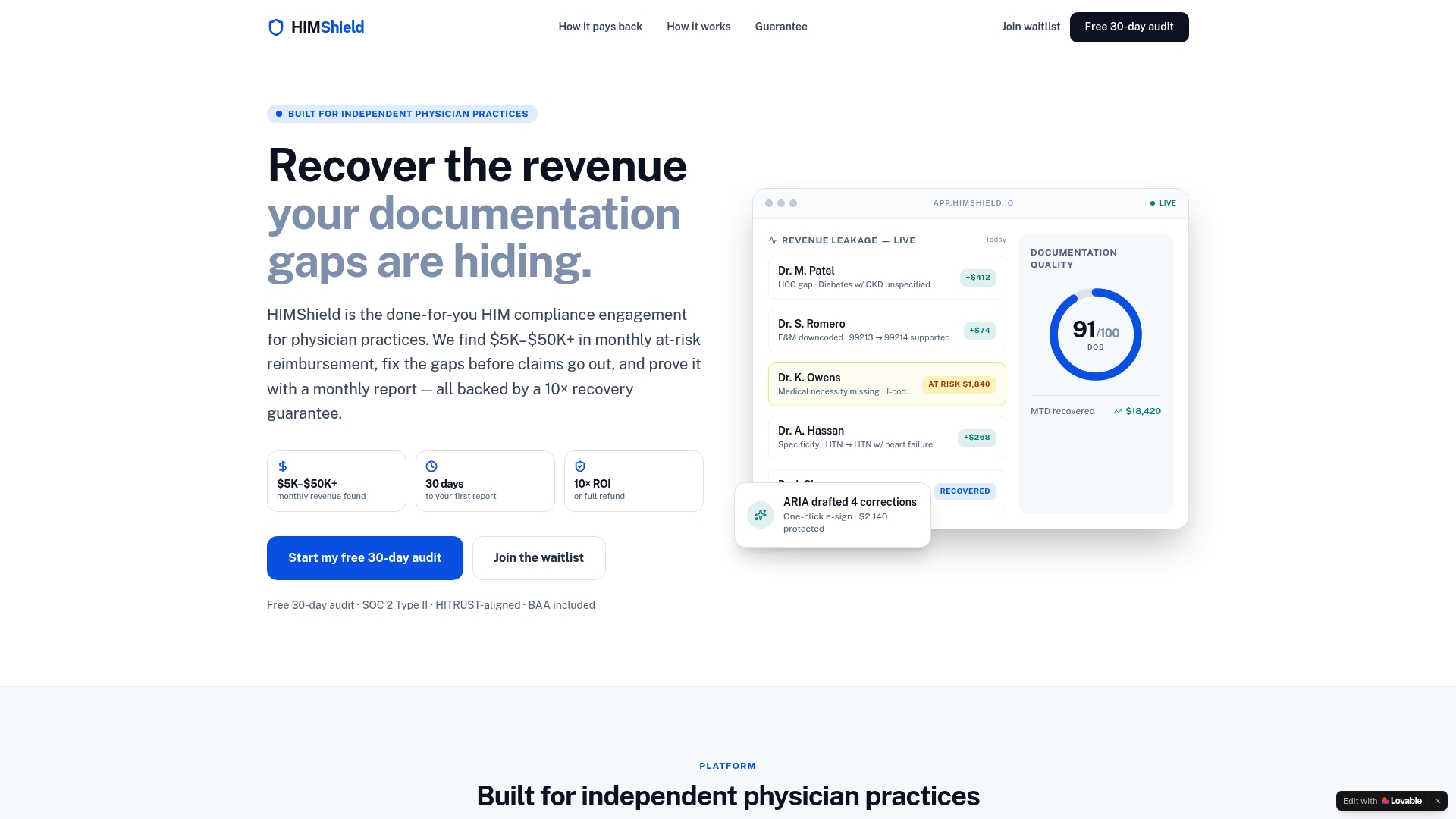
From there, our HIM compliance engagement supports the next step with:
- Automated risk detection that flags coding and documentation gaps before claims go out.
- One-click physician e-signature on drafted corrections, so fixes don't stall in someone's inbox.
- Submission-ready audit defense assembled automatically when a payer comes asking.
If your practice wants a clear, quantified picture of where revenue is at risk, get started with HIMShield and request your audit.
FAQ
What is E&M level 4?
E&M level 4 is a mid-to-high complexity office or outpatient visit level, selected when Medical Decision Making reflects moderate complexity (multiple or complex problems, moderate data review, and moderate risk) or when total time on the encounter date meets the level 4 time threshold. The specific minute range and MDM criteria are defined in current CPT E/M guidance.
What is RCM automation?
RCM automation refers to software that handles revenue cycle management tasks such as coding, charge capture, claim scrubbing, and denial prevention with reduced manual effort. Industry reporting shows adoption moving from basic robotic process automation toward layered AI and NLP approaches, as described in TechTarget's coverage of RCM automation's evolution.
How does automation handle time-based E/M coding?
Automation totals the minutes documented against the encounter date, including review, counseling, and care coordination, then compares that total to the applicable time threshold for the code set. It flags prolonged services and add-on codes like G2211 when the documentation and CMS criteria support them, per CMS evaluation and management guidance.
Can E/M leveling automation replace human coders?
No. Industry guidance recommends routing high-confidence, routine encounters to automation while sending complex or low-confidence cases to trained reviewers, since auditors expect human validation behind any submitted code. Coder oversight remains the core of a defensible workflow, as outlined in AHIMA's discussion of AI attestation.
Sources
- CPT® Evaluation and Management | American Medical Association
- MLN: Evaluation and Management Services | CMS
- AI attestation: an issue worth discussing in coding | Journal of AHIMA