
A defensible appeal letter is a short, factual, submission-ready document. It names the claim and denial code, ties three chart elements to the payer policy or CMS rule that authorizes payment, lists attachments, and closes with a clear request for payment reversal. Cite CMS guidance, AMA templates, and HIMShield playbooks as your working references, and always confirm the filing window before you send it.
TL;DR:
- Using a master appeal template that links chart evidence to policy criteria can significantly reduce processing time and increase chances of reversal.
- Attachments should be clearly labeled and cross-referenced to specific points in the appeal letter, ensuring reviewer verification of claims.
- Matching denial codes with policy language and mapping three chart elements to policy criteria increases the likelihood of a successful appeal.
- Timely submission is critical, with Medicare deadlines starting at 60 or 120 days, and missing filing windows nearly always results in lost appeals.
- Proper case tracking and triage of denials based on documentation strength and dollar value optimize effort and improve future recoveries.
Table of Contents
- What Goes in a Fillable Appeal Letter Structure?
- Which Documents Should You Attach to an Appeal?
- How Do You Match the Letter to the Payer's Reason Code?
- What Are the Five Levels of Medicare Appeals?
- What Filing Windows and Pitfalls Should You Watch For?
- How Should Practices Track and Escalate Appeals?
- An Editorial Take on What Actually Speeds Up Appeals
- Let HIMShield Assemble Your Appeal Before the Clock Runs Out
- Sources
What Goes in a Fillable Appeal Letter Structure?
Every payer wants the same information, even when the form looks different. Build one master template and adapt the wording, not the skeleton.
Here's the order that reviewers expect, based on the field-tested skeleton billing teams use to appeal denied claims:
- Header and identifiers: practice name, NPI, TIN, patient name, date of birth, member ID, claim number, date(s) of service, and the CPT/ICD codes at issue.
- Issue statement: one sentence naming the denial reason code (CARC/RARC) and the exact remedy you're requesting.
- Justification paragraph: chart evidence mapped directly to payer policy language, kept to one tight paragraph.
- Attachments index: a numbered list of every document enclosed, referenced by name.
- Closing and signature: physician or administrator signature, direct contact number, and a request for a written determination.
A sample issue statement reads: "Claim for CPT 93000 was denied under CARC 50 (not medically necessary) for a recent date of service; we request reversal and full payment based on the enclosed documentation." The justification paragraph that follows might state: "The patient presented with exertional chest pain and a family history of coronary disease, meeting the payer's own criteria for diagnostic EKG under its cardiology coverage policy, section 4.2. The attached chart note documents the presenting symptom, the physician's differential diagnosis, and the abnormal finding that prompted the test."
Keep the whole letter under one page whenever the payer allows it. Reviewers move faster through short, factual documents, and every extra paragraph is another chance to bury your strongest point.
Which Documents Should You Attach to an Appeal?
The letter makes the argument. The attachments prove it. Reviewers verify claims fastest when each attachment is labeled and cross-referenced to a specific paragraph in the letter.
Standard attachments for most physician-practice appeals include:
- Chart notes covering the date(s) of service in dispute
- Procedure or operative reports
- Imaging and lab results tied to the diagnosis
- Prior authorization confirmation, if one was issued
- Referral or consent documentation
- Itemized bill
- The remittance advice (RA) and medical record number (MRN) from the original denial
Build a one-page evidence index that lists each filename and states which paragraph of the letter it supports. This single habit does more to speed reviewer decisions than any other formatting choice, according to insight drawn from how practices appeal correctly.
Pro Tip: Never redact a patient identifier that the payer needs to match your submission to their internal case file. Over-redaction is one of the quiet reasons clean appeals get bounced back for "insufficient documentation."
How Do You Match the Letter to the Payer's Reason Code?
A denial code is a legal argument in disguise. Your job is to answer it on its own terms, not to restate your clinical opinion.
Start by pulling the payer's specific medical policy or the CMS coverage rule tied to the service, and quote the language the reviewer will be checking against. Generic clinical reasoning rarely moves a reviewer; policy-matched reasoning almost always does.
- Identify the exact criteria the policy lists (symptom duration, prior conservative treatment, specific diagnostic thresholds).
- Map three chart elements to those criteria, such as a documented symptom, a diagnostic result, and a time course that satisfies the policy's window.
- Cite peer-reviewed literature only when it directly reinforces the policy argument. When the payer policy or a CMS rule already supports your case, lead with that instead.
HIMShield's playbook for medical necessity denials walks through this mapping exercise in more detail, and its documentation examples guide shows what policy-matched chart language actually looks like in practice.
What Are the Five Levels of Medicare Appeals?
Medicare Fee-for-Service runs on five codified appeal levels, each with its own jurisdiction, deadline, and evidentiary rules, according to CMS's own appeals guidance.
- Redetermination: your first appeal, filed with the Medicare Administrative Contractor (MAC) that processed the claim.
- QIC reconsideration: an independent review by a Qualified Independent Contractor if redetermination fails.
- OMHA/ALJ hearing: a hearing before an Administrative Law Judge, available once the claim's Amount in Controversy (AIC) clears the statutory threshold.
- Medicare Appeals Council: a review of the ALJ's decision.
- Judicial review: federal court, reserved for cases that clear a higher AIC threshold.
The AIC threshold matters because it determines whether escalation past QIC reconsideration is even possible. The MLN brochure on the Medicare Parts A & B appeals process spells out current threshold amounts and defines the Appointment of Representative form required when someone other than the provider or patient is filing on their behalf. File that form early. Missing it is one of the most common reasons a properly argued appeal never gets heard.
What Filing Windows and Pitfalls Should You Watch For?
Timing kills more appeals than weak evidence does. Miss a filing window and the strongest justification in the world becomes irrelevant.
- Confirm the exact deadline: Medicare redetermination typically runs 120 days from the denial notice, Medicare Advantage reconsiderations often run 60 days, and commercial payers vary by contract, so check the plan's specific language every time.
- Verify you're using the correct submission channel. Portal uploads, fax, and mail each have different payer-specific rules, and using the wrong one can restart or forfeit your clock.
- Confirm the MRN and RA are both included. Missing either is one of the most common reasons appeals bounce back unprocessed.
- Submit late evidence only with documented good cause attached, never silently.
Pro Tip: Always submit through a tracked delivery method, even when a portal confirms receipt. A screenshot or tracking number is your only proof if the payer later claims it never arrived.
How Should Practices Track and Escalate Appeals?
An appeal you can't track is an appeal you'll eventually lose to a missed deadline. Set up one tracking record per case before you submit anything.
Fields worth tracking for every appeal:
- Case ID, payer name, and MRN
- Denial reason code and dollar amount at stake
- Attachments included and submission date
- Expected decision date and a follow-up trigger date
Escalation decisions should follow clear triggers: the claim clears the AIC threshold, the same policy keeps generating repeat denials, or the care involved was clinically urgent. Denial-workflow research recommends triaging appeals by documentation strength and dollar value rather than fighting every denial equally. Log the coding or documentation fix that caused the denial in the first place. That root-cause note is what turns one recovered claim into fewer future denials.
An Editorial Take on What Actually Speeds Up Appeals
Most practices over-invest in the justification paragraph and under-invest in the evidence index. That's backwards. A reviewer with a stack of appeals on their desk will read the index before they read your clinical reasoning, so a clean one-page map from attachment to argument often does more work than another sentence of medical rationale.

Two shortcuts are worth building into your workflow permanently: a standing evidence-index template, and a one-line physician attestation you can drop into any letter without rewriting it from scratch. HIMShield's 8 Step Audit Response Letter and its guidance on beating the 30-day appeal clock for clinical validation denials both operationalize this. They're built around the same principle: structure carries more weight than eloquence.
The last discipline is knowing which appeals to skip. Not every denial deserves the same hours. Triage by expected recovery against staff time, and put your best evidence-mapping work into the claims that actually move your revenue.
— Elena
Let HIMShield Assemble Your Appeal Before the Clock Runs Out
HIMShield gives independent practices something a template alone can't: automated detection of the coding and documentation gaps that trigger denials in the first place, plus real-time documentation-quality scoring that flags weak spots before you submit anything. Instead of building your evidence index by hand every time, HIMShield assembles submission-ready responses from your own EHR data, mapped to the payer policy language reviewers are actually checking against.
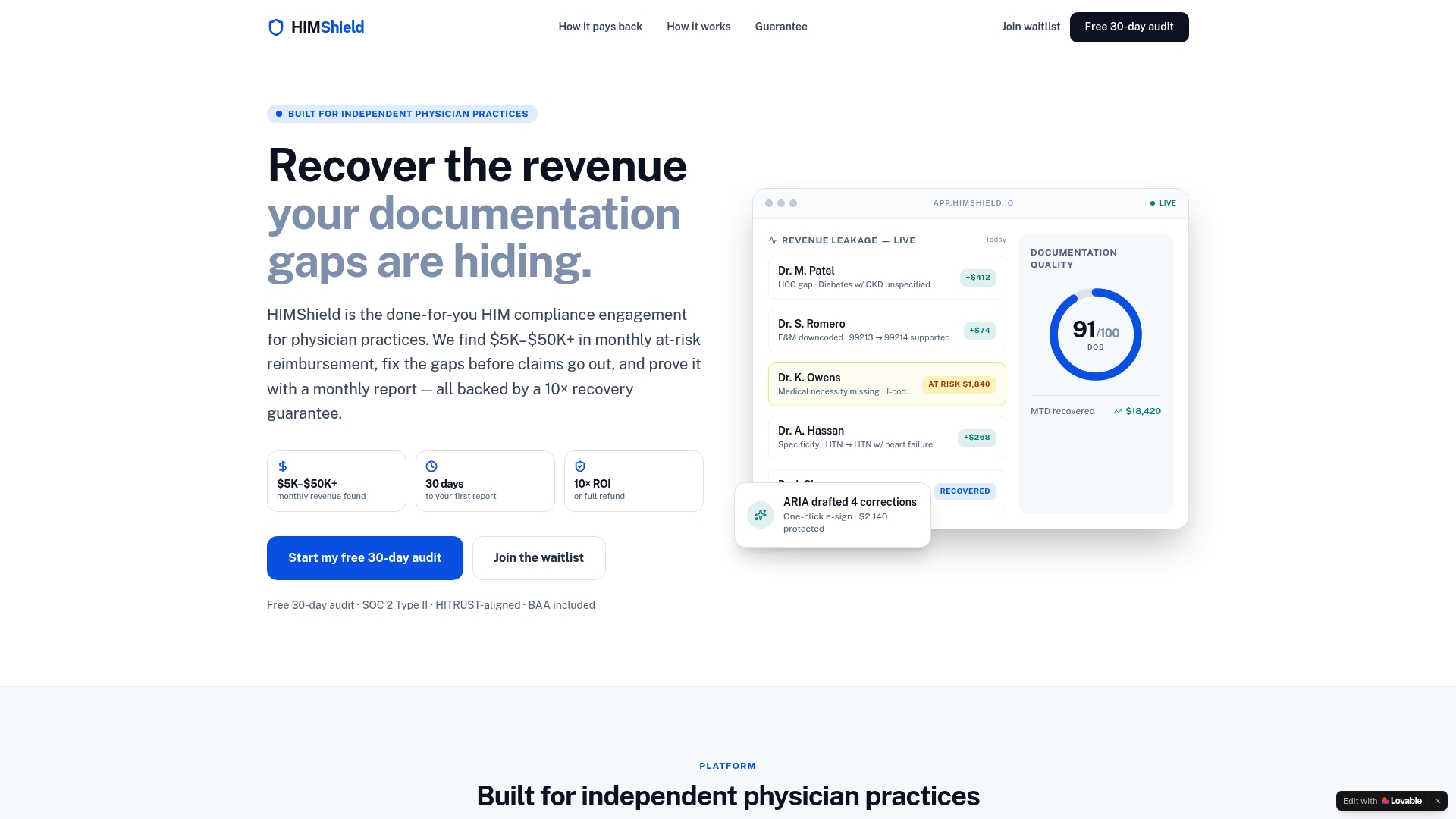
Practices often start with a free audit that surfaces coding and documentation risks in current charts and points to potentially significant recoverable revenue before submitting any appeals. If your team is spending more hours chasing denials than treating patients, start your free 30-day audit with HIMShield and see what's recoverable before your next filing deadline passes.
Sources
Keep these on hand for every filing: CMS's Fee-for-Service appeals guidance, the MLN006562 brochure, and the AMA's sample appeal letters. Print the AMA templates once and reuse the structure for every denial category your practice sees.
This article is general information, not a substitute for advice from a qualified lawyer. Consult a qualified legal professional about your own circumstances before acting on anything here.
- Original Medicare (Fee-for-service) Appeals — HHS/CMS