
Outpatient E/M documentation rules changed because code selection now hinges on medical decision making (MDM) or total time, not a checklist of history and physical exam bullets. The American Medical Association led the CPT rewrite. The Centers for Medicare & Medicaid Services adopted it into payment policy. Here's what practices should expect immediately:
- Coders no longer count history and exam bullets to justify a level.
- Clinicians document the complexity of their thinking or the time they spent.
- Chart review still falls on the clinician. Verification requirements did not disappear, they just moved.
Key Takeaways
Outpatient E/M documentation changed because CPT and CMS shifted code selection to MDM or total time, aiming to cut paperwork while paying more accurately for clinical complexity.
| Point | Details |
|---|---|
| Rule basis shifted in 2021 | Code selection now depends on MDM or total time, not history and exam bullet counts. |
| Perception outpaced metrics | Physicians reported more meaningful notes, but objective EHR time and note length barely changed. |
| Coding levels moved faster than habits | National data show more level 4 and 5 visits with little drop in charting time. |
| Templates need active rebuilding | Removing forced history and exam fields is the workflow step most practices skip. |
| Himshield closes the audit gap | Its 30-day audit scores documentation quality and flags revenue leakage tied to these coding rules. |
Table of Contents
- What Changed: A Timeline of Outpatient E/M Documentation Revisions
- Why It Changed: Burnout, Payment Accuracy, and Audit Friction
- What the Evidence Shows About the Impact of E/M Documentation Changes
- How to Apply the New MDM and Time Rules in Daily Workflows
- Compliance Checklist for Outpatient E/M Documentation Changes
- What Practices Get Wrong About Adopting These Rules
- How Himshield Helps Practices Stay Audit-Ready Under the New Rules
- Frequently Asked Questions
- Sources
What Changed: A Timeline of Outpatient E/M Documentation Revisions
The path to today's outpatient E/M documentation rules ran through three distinct rule cycles, each building on the last.
- 2019. CMS finalized policy letting physicians review and verify documentation entered by other members of the care team, including medical students, nurses, and residents, rather than re-documenting everything themselves.
- 2021. The CPT overhaul hit office and outpatient E/M codes directly. Code selection shifted to MDM or total time, and CPT deleted code 99201 outright since its documentation floor no longer distinguished it from 99202. History and physical exam bullet counting stopped driving code level entirely, though clinicians still document a "medically appropriate" history and exam.
- 2023. CPT extended the same MDM/time framework to hospital, nursing facility, home, and other E/M settings, closing the gap between outpatient and inpatient documentation logic.
- 2026. CMS finalized fee schedule commentary that layers in efficiency adjustments to work RVUs, sharpens time definitions, and flags AI-assisted documentation as an area requiring explicit clinician review.
CMS structured its 2026 rule to exempt time-based services like E/M visits from certain efficiency adjustments, a deliberate carve-out meant to protect the value of cognitive work rather than let it get averaged down with procedural codes.
Why It Changed: Burnout, Payment Accuracy, and Audit Friction
Three forces pushed CPT and CMS toward this overhaul, and none of them were cosmetic.
Administrative burden topped the list. Bullet counting rewarded thoroughness over judgment. A physician could hit a higher code by documenting ten review-of-systems items that had nothing to do with the visit, while a genuinely complex diagnostic puzzle went underpaid because the note lacked enough checkboxes. That mismatch fed note bloat, copy-paste habits, and after-hours charting.
Payment valuation needed a better foundation. CMS has been moving away from survey-based work estimates toward empirical measurement, and the 2026 Physician Fee Schedule final rule continues that shift while still protecting time-based E/M work from blanket efficiency cuts.
Audit disputes needed clearer rules. Vague documentation requirements created endless friction between practices and payers over what counted as "complete."
The redesign centered on cognitive work and medical decision making specifically to discourage checkbox-driven notes that reward copy-paste behavior over clinical reasoning.
The AMA convened the CPT Editorial Panel with specialty societies at the table, and CMS coordinated adoption into the Medicare Physician Fee Schedule so the two systems wouldn't drift apart.
- Reduce clinician burnout tied to documentation for documentation's sake.
- Tie payment more closely to the actual complexity of a visit.
- Give auditors and practices a shared, defensible standard for MDM.
What the Evidence Shows About the Impact of E/M Documentation Changes
Two threads of research tell slightly different stories, and both matter for practices trying to gauge real progress.
An AMA-funded study in the Journal of General Internal Medicine found that primary care physicians perceived their notes as more clinically meaningful after the 2021 changes. That's a genuine win in physician sentiment. But the same study found no significant objective decrease in note length or EHR time, meaning the paperwork didn't actually shrink, even though it felt more purposeful to write.
A separate national analysis published in Annals of Internal Medicine by researchers affiliated with the American College of Physicians pulled Epic Signal data across many practices and found a similar pattern from the objective side: level 3 visits declined while level 4 and 5 visits rose, but note length and time in the EHR barely moved in the short term.
| Metric | Physician-reported change | Objective EHR data |
|---|---|---|
| Documentation meaningfulness | Improved | Not measured directly |
| Note length | Assumed shorter | Little to no change |
| Time in EHR | Assumed lower | Little to no change |
| E/M level distribution | Not applicable | Shift toward levels 4 and 5 |
The gap between perception and metrics comes down to three confounders: templates built for the old rules stayed in place, practices took time to retrain staff, and both studies captured relatively brief windows after rollout. Coding behavior changed fast. Charting habits didn't.
How to Apply the New MDM and Time Rules in Daily Workflows
Knowing the policy is one thing. Building it into daily charting is another, and this is where most practices lose the benefit of the 2021 and 2023 changes.
Start with a simple decision rule: use MDM when the visit involves diagnostic uncertainty, data review, or risk assessment that a complexity grid captures well. Use total time when the visit is dominated by counseling, care coordination, or straightforward but time-consuming tasks that MDM criteria undervalue. Document the specific elements that support your choice, whether that's the number of problems addressed or the minutes spent on the date of service.
Template hygiene matters just as much as the coding decision itself:
- Strip out forced history and exam fields that no longer drive code level.
- Keep only fields tied to medical necessity and clinical reasoning.
- Update smart phrases and macros so they prompt for MDM detail, not bullet padding.
Team documentation is allowed and encouraged, but it comes with a condition. Ancillary staff, residents, and medical students can enter notes, and clinicians can review and verify rather than re-write from scratch. That review has to be explicit, and the record needs to show it happened.
Prolonged service codes deserve their own attention. CPT 99417 applies to prolonged outpatient E/M time for non-Medicare payers once the threshold beyond the primary code's time is met, while Medicare uses HCPCS G2212 under its own time thresholds. Mixing these up is one of the most common billing errors practices make after switching to time-based coding.

Pro Tip: Run a side-by-side test on ten recent charts. Code each one twice, once by MDM and once by time, then flag any visit where the two methods produce different levels. That gap usually points to a documentation weakness worth fixing before an auditor finds it.
Audit readiness still rests on medical necessity, not on code complexity alone. A visit coded at level 5 with thin justification draws more scrutiny than a well-documented level 3. Clinician sign-off, whether on a self-written note or one drafted with AI assistance, has to be real and traceable in the record. A related resource on documentation and reimbursement walks through how these gaps show up in denied claims.
Compliance Checklist for Outpatient E/M Documentation Changes
Turning policy into practice takes a short, repeatable process rather than a one-time memo.
- Audit current notes and templates for leftover history and exam fields that no longer belong in code selection.
- Set a team documentation protocol that spells out who can enter notes and how the clinician records their verification.
- Standardize how staff capture total time on the date of service when using time-based coding, down to the minute where possible.
- Schedule recurring chart audits, ideally supported by automated detection that flags documentation gaps before they turn into denials or audit targets.
- Treat AI-assisted drafting as a starting point only. The clinician must review, correct, and authenticate every note before it becomes part of the record.
A rule change on paper doesn't reduce a single minute of charting time until someone rebuilds the templates and retrains the team using them.
This is where physician documentation education earns its place on the checklist. Practices that skip training tend to keep old habits layered on top of new rules, which is the surest way to lose the benefit CMS and AMA intended.
What Practices Get Wrong About Adopting These Rules
The biggest mistake practices make is assuming the rule change itself does the work. It doesn't. MDM and time-based coding only reduce burden when templates get rebuilt, staff get trained on team documentation, and someone actually monitors whether charting habits shift.

Practice leadership has to protect time for that education, or the old bullet-counting instincts stick around inside new code language. The data backs this up: coding levels moved fast, EHR time didn't. That gap is a workflow problem, not a policy failure, and it's exactly the kind of gap a platform built to catch documentation drift can help close.
How Himshield Helps Practices Stay Audit-Ready Under the New Rules
Independent practices don't need another policy summary. They need to know where their own notes fall short of the MDM or time standard before a payer finds it first. Himshield scans your EHR data to detect documentation and charge-capture gaps, scores note quality in real time, and drafts corrections a physician can approve with one e-signature.
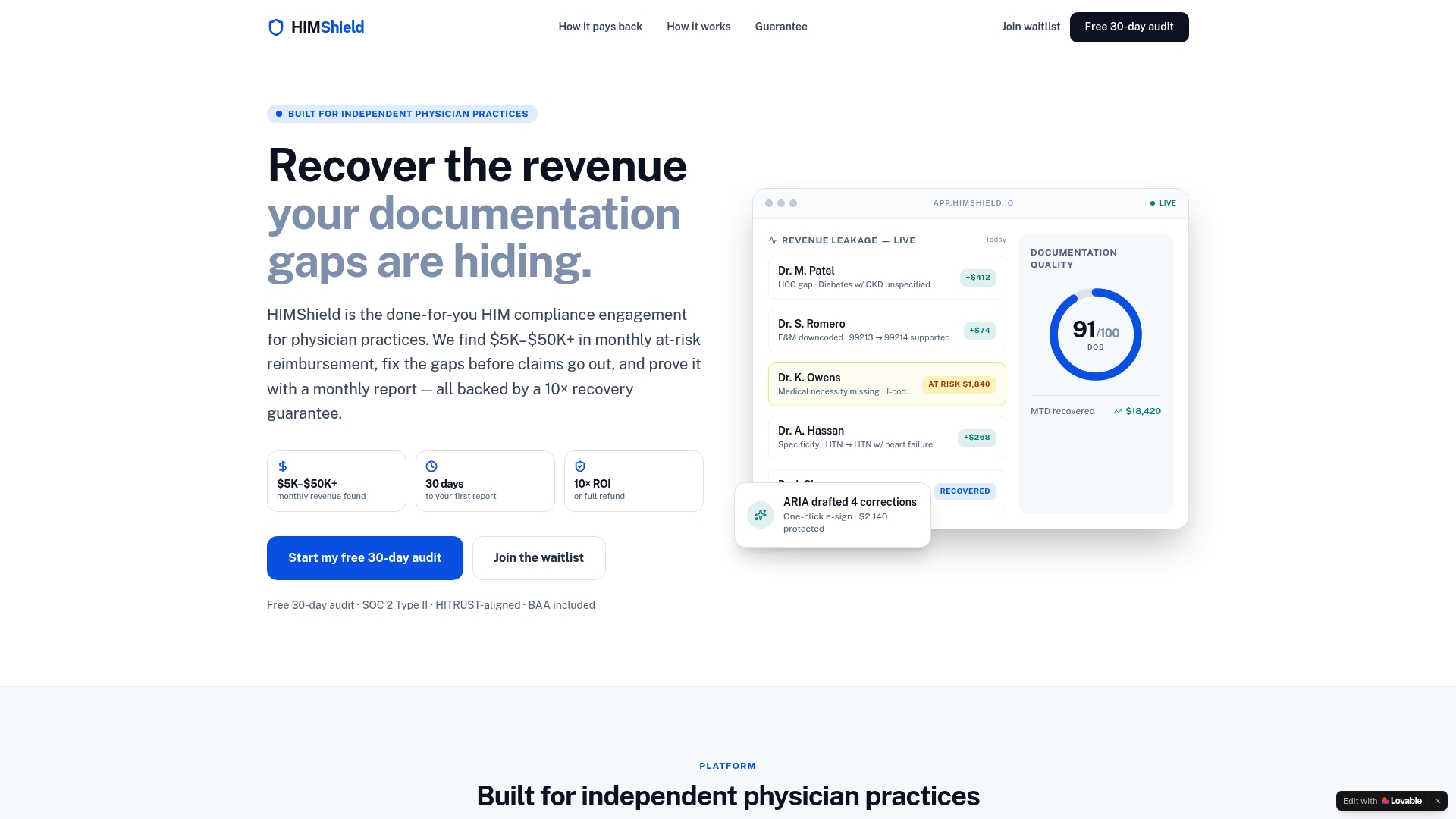
The free 30-day audit maps directly to the checklist above: it flags template weaknesses, quantifies revenue left on the table by payer and provider, and builds submission-ready responses if an audit request lands on your desk. Practices typically find a notable amount of recoverable revenue during that first look, with no commitment required to see the report. If you want to know exactly where your documentation stands against the current MDM and time rules, start your free audit with Himshield and see the numbers before you decide anything else.
Frequently Asked Questions
Why did outpatient E/M documentation change in the first place? CPT and CMS shifted code selection to MDM or total time to cut administrative burden and pay more accurately for the complexity of a visit, rather than rewarding long checklists of history and exam findings.
Do I still need to document a history and physical exam? Yes, a medically appropriate history and exam still belongs in the note. It just no longer determines the code level the way bullet counts once did.
Is time-based coding always better than MDM? No. Time-based coding fits visits dominated by counseling or coordination, while MDM better captures diagnostic complexity and risk. The right choice depends on what actually happened during the visit.
Can non-physician staff document the visit? Yes, team documentation is allowed for ancillary staff, residents, and students, but the clinician must review and explicitly verify the note before it counts toward billing.
Does AI-assisted documentation create audit risk? It can, if the clinician doesn't review and authenticate the note. Auditors expect clear evidence that a human clinician confirmed the content before it entered the record.
Sources
- CPT® Evaluation and Management | American Medical Association
- Early Changes in Billing and Notes After Evaluation and Management Guideline Change (Annals/ACP analysis)
- Calendar Year (CY) 2026 Medicare Physician Fee Schedule Final Rule (CMS-1832-F) | CMS