
The most common outpatient CDI challenges are high encounter volume that kills concurrent review, documentation fragmentation and problem-list rot, E/M complexity under the current medical decision-making (MDM) rules, and inconsistent HCC capture. Provider engagement gaps and outpatient tools that are really just repurposed inpatient technology make all four worse.
Three moves fix most of it fast:
- Build a prioritized prospective review workflow for your highest-risk clinics.
- Repair problem-list governance and run annual HCC revalidation.
- Deploy targeted EHR prompts backed by human validation, not raw NLP output.
Pro Tip: Start with your top five specialties by risk-adjusted revenue, not your loudest complainers. ACDIS guidance and CMS's E/M rules both point the same direction: fix where the dollars and diagnostic risk concentrate first.
Key Takeaways
Fixing common outpatient CDI challenges requires prioritized prospective review, disciplined problem-list governance, and outpatient-specific automation paired with human validation.
| Point | Details |
|---|---|
| Prioritize by risk, not volume | Focus prospective review on high-HCC-yield specialties like primary care and cardiology first. |
| Fix the problem list | Require physician confirmation before carrying diagnoses forward to stop fragmentation-driven revenue loss. |
| Document MDM explicitly | Align notes with current E/M rules so clinical reasoning, not just exam details, supports the code level. |
| Track five core KPIs | Monitor query agreement, HCC revalidation, turnaround time, denial rate, and provider adoption monthly. |
| Pair automation with sign-off | Himshield flags coding and documentation gaps pre-submission while keeping final decisions in the physician's hands. |
Table of Contents
- Why Outpatient CDI Issues Demand Attention Now
- Common Outpatient CDI Challenges Ranked by Impact
- How to Address Outpatient CDI Challenges Operationally
- Where Automation Helps and Where It Doesn't
- The Highest-Yield Fix: Stop Problem-List Rot First
- What Leadership Actually Needs to Prioritize
- How Himshield Fits Into Your Outpatient CDI Priorities
- Frequently Asked Questions
- Sources
Why Outpatient CDI Issues Demand Attention Now
Outpatient CDI now spans clinic visits, ED encounters, observation stays, and ambulatory surgery. Each setting produces its own documentation habits and its own blind spots.
The urgency comes from two directions at once. CMS's E/M guideline updates shifted code selection toward medical decision-making or total time, so vague notes now cost real reimbursement. Meanwhile, weak HCC capture and unresolved diagnoses translate directly into revenue leakage and denials.
- Missed HCC opportunities lower risk-adjusted payments for an entire patient panel, not just one visit.
- Denials tied to unclear MDM documentation are largely preventable with better encounter notes.
- Fragmented records obscure the full clinical picture, which is a patient-safety issue as much as a coding one.
Common Outpatient CDI Challenges Ranked by Impact
Here's what actually breaks outpatient CDI programs, in the order they tend to cost the most.
- High encounter volume with short visit windows. A primary care physician might see 20 to 30 patients a day. That pace leaves no room for the chart-by-chart concurrent review inpatient CDI relies on, and it pushes queries into a retrospective pile that providers resent answering days later.
- Documentation fragmentation and problem-list rot. Diagnoses get copied forward visit after visit without confirmation, while the clinical narrative that would justify them lives in scattered notes. This fragmentation is consistently linked to diagnostic delay and missed HCC opportunities because nuance simply doesn't survive the handoff between systems.
- E/M documentation complexity under MDM and time-based rules. Since the 2023–2024 E/M guideline changes, code selection depends on documented medical decision-making or total time, not history and exam checklists. Providers trained on the old model routinely under-document their own reasoning, which drags codes down even when the actual visit complexity was high.
- HCC and risk-adjustment gaps. Annual revalidation gets skipped, chronic conditions go unconfirmed, and specificity suffers. That combination invites payer audit exposure on top of lost revenue.
- Weak provider engagement. Low query response and agreement rates usually trace back to one root cause: providers see queries as extra work with no clear payoff, especially when the wording feels leading or the timing lands weeks after the visit.
- Outpatient-specific technology gaps. Most programs still lean on inpatient CDI tools built for concurrent review, and those tools weren't designed for high-volume ambulatory workflows or pre-visit risk screening.
- Staffing models copied from inpatient CDI. Trying to run full concurrent review at ambulatory scale burns out staff and produces coverage gaps, because the math simply doesn't work at 30 encounters a day per provider.
- Query compliance pitfalls. Prospective queries beat retrospective ones for both provider goodwill and audit-readiness, but plenty of programs still default to retrospective, leading language that won't hold up if a payer challenges it.
Statistic Callout: Programs that saw early ROI concentrated their effort on ED, observation, and a handful of specialties like primary care, cardiology, and endocrinology rather than spreading thin across every clinic at once.
Pro Tip: When you write a query, ask yourself if it could stand up in front of an auditor a year from now. If the wording nudges the provider toward a specific diagnosis instead of asking an open question, rewrite it.
How to Address Outpatient CDI Challenges Operationally
Fixing outpatient CDI issues means matching each problem to a specific workflow change, not a general "review more charts" mandate.
- Shift from full concurrent review to prioritized prospective screening. Use pre-visit data pulls to flag high-risk HCC candidates before the appointment happens, then focus human review there instead of every chart. Health Data Management's guidance on scaling outpatient CDI backs this triage-first model over chart-by-chart review.
- Fix problem-list governance with clear rules. Define how far back reviewers can look, require physician confirmation before carrying a diagnosis forward another year, and measure revalidation rates quarterly, not just annually.
- Standardize query timing and wording. Favor prospective queries delivered before claim submission, built around open, non-leading language that documents clinical reasoning rather than suggesting a code.
- Centralize or distribute CDS coverage deliberately. A centralized remote CDS team can cover multiple sites efficiently, but pair it with site-based physician champions who translate CDI priorities into language their colleagues trust.
Staffing works best with clear role separation: CDS specialists triage and query, coding staff finalize code assignment, and a physician champion handles peer-to-peer education when query agreement rates lag.
A well-structured query follows a simple shape: state the clinical finding, ask an open question about its status or specificity, and avoid suggesting the answer. That structure alone resolves most compliance concerns.
Track these KPIs from week one:
- Query agreement rate — the share of queries providers accept, a direct signal of query quality and provider trust.
- HCC revalidation rate — the percentage of chronic conditions reconfirmed with current-year evidence.
- Documentation clarification turnaround time — how long it takes a query to reach resolution.
- Outpatient denial rate — tracked specifically for documentation-related denials, separate from eligibility or authorization denials.
- Provider adoption rate — how consistently providers engage with prompts, templates, or query workflows over time.
Pro Tip: Review your medical necessity documentation against your denial data monthly. If the same MDM element keeps triggering denials, that's your next training topic, not a coincidence.
Where Automation Helps and Where It Doesn't
NLP and computer-assisted coding tools reliably flag missing specificity, unconfirmed chronic conditions, and obvious documentation gaps at a scale no human team can match. They also generate noise. Ambulatory notes packed with templated language and copy-forward text routinely trigger false positives, and tools built for inpatient documentation patterns misfire on outpatient note structures.
Before adopting any outpatient tool, check:
- Can it scale across high visit volumes without slowing the provider down?
- Is the model's logic transparent enough for your compliance team to defend it in an audit?
- Does it produce an audit trail alongside its alerts?
- Can you measure adoption and ROI separately from raw alert volume?
Governance matters as much as the technology. Physician champions who understand the tool's limits drive far better adoption than a mandate handed down without clinical buy-in. Automation should prioritize and triage. Final documentation decisions still need a clinician's signature and a CDI specialist's validation.
The Highest-Yield Fix: Stop Problem-List Rot First
If you fix only one thing this quarter, fix the problem list. Fragmented documentation is tied directly to diagnostic delay and missed HCC capture, and that single issue touches revenue, quality reporting, and patient safety at once.
- Audit your top-volume clinics for fragmentation hotspots: diagnoses copied forward without recent supporting notes.
- Build longitudinal summary views or EHR prompts that surface a condition's full history at the point of documentation, not buried across five prior visits.
Two weeks of focused audit work here typically surfaces more recoverable revenue than a month spent chasing individual query response rates.
What Leadership Actually Needs to Prioritize
Running outpatient CDI well means holding three things in tension at once: coding accuracy, provider workload, and audit-readiness. None of those wins by sacrificing the other two.

The programs that hold up under audit scrutiny share one trait: CDI, coding, compliance, revenue integrity, and clinical leadership all sit at the same table, reviewing the same data.
How Himshield Fits Into Your Outpatient CDI Priorities
Himshield gives you a way to catch these outpatient CDI issues before they become denials or audit findings, rather than untangling them after the fact. The platform scans EHR data pre-submission, quantifies coding and documentation gaps per provider and per payer, and drafts physician-friendly corrections with one-click e-signature so fixing a gap doesn't mean another hour of provider burden.
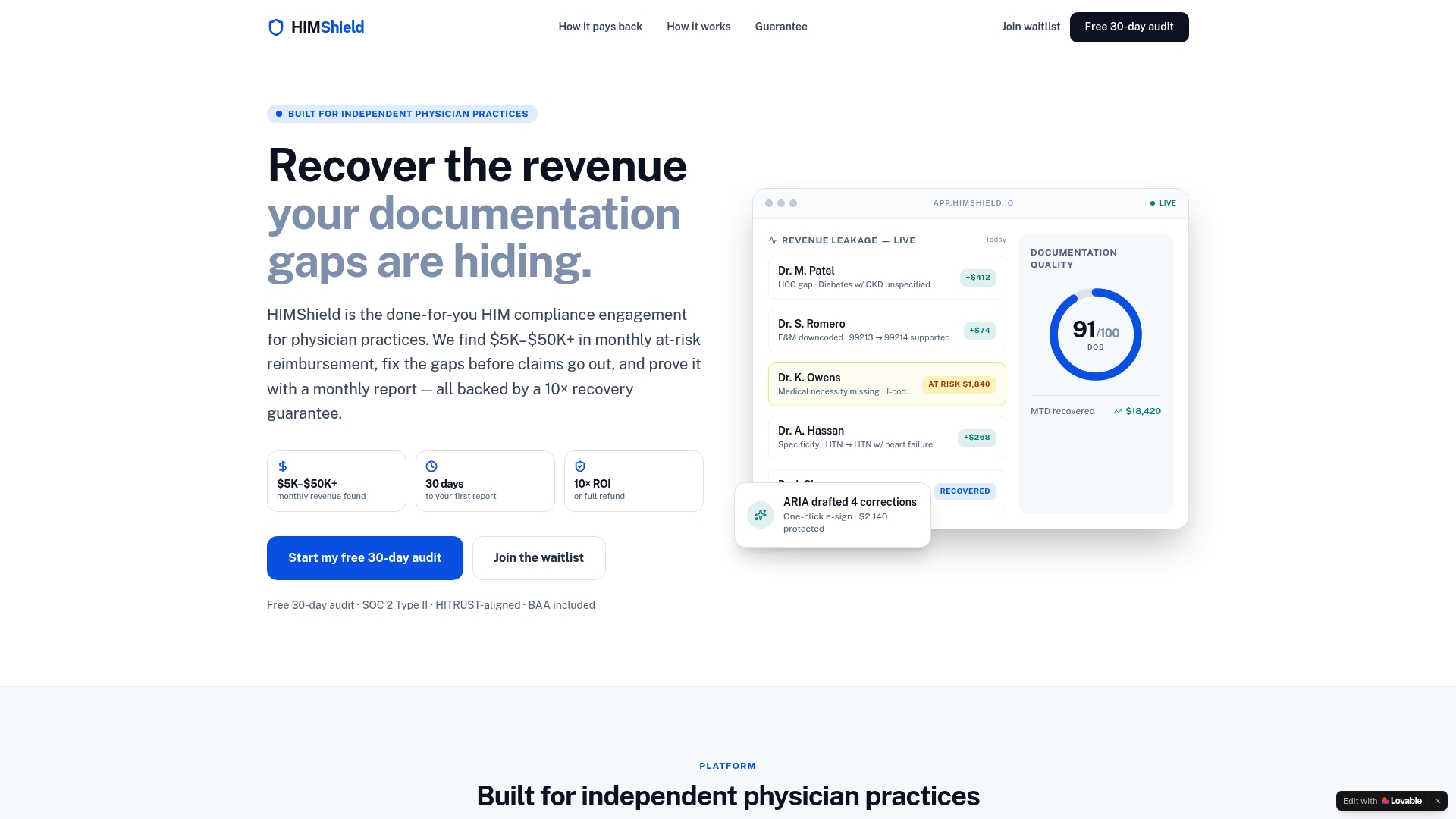
Every flag comes with an audit trail and a real-time documentation quality score, so your compliance team has the defense package ready before a payer ever asks for it. That combination of automated detection and human sign-off is exactly the governance model that makes outpatient CDI programs durable rather than reactive.
Himshield offers a free 30-day audit with a performance guarantee before any subscription commitment. If your practice is losing revenue to the exact challenges covered here, start with a revenue leakage audit and see the numbers for your own providers.

Frequently Asked Questions
What are the most common outpatient CDI challenges? High encounter volume limiting review time, documentation fragmentation, E/M/MDM complexity, weak HCC capture, and low provider query engagement top the list.
How is outpatient CDI different from inpatient CDI? Outpatient CDI can't rely on concurrent, chart-by-chart review because visit volumes are far higher, so it depends more on prospective screening and targeted, automated triage.
What KPIs should an outpatient CDI program track? Query agreement rate, HCC revalidation rate, documentation clarification turnaround time, outpatient denial rate, and provider adoption rate.
Can NLP and CAC tools replace CDI specialists in outpatient settings? No. They help triage and flag gaps at scale, but final documentation decisions still require clinician sign-off and CDI validation to hold up under audit.
Sources
- PMC article on documentation fragmentation and diagnostic delay
- 2023 E/M coding guidelines rapid reference (FOAMed / EB Medicine)
- Outpatient CDI and Risk Adjustment | ACDIS