
Signature lag is the gap between the date of service and the day a provider signs the note. To reduce it, measure it by provider, put the oldest and most valuable unsigned notes in front of each provider on a fixed weekly rhythm, and make signing a one-click action instead of a hunt through the EHR. Every day a note sits unsigned is a day the claim waits, and some unsigned notes never become payable claims at all.
This guide shows independent practices how to measure the delay, what a sign-off tracking report should contain, which rules apply, and how to set up reminders and escalation steps that providers will actually follow.
TL;DR
- Track two clocks: date of service to signature, and signature to claim. A single practice-wide average hides who is causing the delay.
- Rank open notes by dollar value, not by count, and send each provider their own list on the same morning every week.
- Visibility alone does not change behavior. In one published study, a dashboard linked straight to the signing tool cut signing time, while a count-only display did not.
- Unsigned or late-signed records can lead Medicare reviewers to deny claims, and some states set their own signing deadlines.
- Use a defined reminder ladder with a named owner at every step, so escalation is routine, not personal.
Table of Contents
- What signature lag costs a practice
- Measure signature lag before you try to fix it
- What a provider sign-off tracking report should include
- The rules that set your signing deadlines
- Workflow changes that shorten sign-off time
- Set up provider sign-off reminders and escalation
- Our perspective
- See what signature lag is costing you
- FAQ
- Sources
What signature lag costs a practice
Charge lag is the number of days from the date of service until the charge, and then the claim, leaves your practice. When billing waits for the provider's signature, much of that time sits in unsigned notes. One billing advisory's worked example shows how fast it adds up: in a four-provider practice seeing about 400 visits a week at an average expected allowed amount of $120, a median wait of nine days instead of three leaves roughly $41,000 earned and unbilled at any moment. That is an illustration, not your number, but the arithmetic is worth running with your own visit volume.
The cash flow delay is only the first cost. The second is compliance. CMS guidance on Medicare signature requirements says reviewers look for signed and dated documentation from those responsible for care, and may deny associated claims when entries do not meet signature requirements. AAPC reports that unsigned documentation or a missing attestation will result in a denial, which can mean thousands in forfeited reimbursement.
The third cost is quality. Notes written days after the visit rely on memory, and that is where coding and documentation gaps start. If you want the wider picture, see how documentation affects reimbursement in physician practices.
Measure signature lag before you try to fix it
You cannot manage what you only feel. Most practices say "our providers are slow to sign" without knowing which providers, how slow, and how much money is waiting. Start with two clocks.
- Service to signature: days from the date of service to the provider's signature.
- Signature to claim: days from signature to the claim leaving the practice.
Pull the first from your EHR's open-encounters or unsigned-notes report. Pull the second from your charge-review or claim-hold queue. The advisory's guidance is to report the median service-to-signature days over the last four weeks by provider, the oldest open note, and the value of open notes.
Why the practice-wide average misleads
A six-day average can mean two very different things. Every provider may sign within two days while the coding queue holds claims for four. Or five providers may be current while one signs every few weeks. The fix for the first is a billing workflow or staffing change. The fix for the second is a conversation with one provider. The average cannot tell them apart, which is why the report must be split by provider.

Watch the date definition
Some EHR reports measure from the document creation date, which can differ from the clinical date of service. Check which date your report uses before you compare providers, or you may blame someone for a delay that is a report artifact.
What a provider sign-off tracking report should include
Keep the report to one page. Here is what the research behind this guidance says it should hold, and why each line matters.
| Report line | Why it matters |
|---|---|
| Notes open today, by provider | Shows who owns the backlog |
| Age of the oldest open note | Flags the item closest to a filing or compliance problem |
| Median days from service to signature, last four weeks | Shows the trend, not a single bad day |
| Open notes priced at expected allowed amount per visit type | Ranks the list by money, not count |
| Median days from signature to claim | Separates provider delay from billing delay |
| Charges in review or on hold, with hold reason | Shows what is stuck after signing |
| Oldest open date of service next to the shortest payer filing window | Warns before timely filing runs out |
| Rejected claims not yet resubmitted, by age | Catches the second place revenue stalls |
The pricing line is the one most practices skip, and it changes the conversation. "You have 14 open notes" is easy to ignore. "Your 14 open notes represent about $1,700 in expected allowed amounts" gets attention.
How often to review it
Weekly is the right rhythm. The advisory recommends that a named person send each provider their own list on the same morning every week and report one practice total. A predictable day builds a habit. A monthly review is too slow, because by the time you see a problem it is already past some payers' windows.
If you want to track other record types too, AHIMA recommends a regular process to monitor pending notes, workflow tools to track and escalate unsigned documents, and a policy for cleaning up records that remain unsigned. Notes, orders and test interpretations all belong on the list, with the highest-dollar and oldest items first.
The rules that set your signing deadlines
No single national clock applies to every practice, so know which rules reach yours.
- Medicare: CMS says that for a missing required signature on a medical record other than an order, the provider should file an attestation created by its author. Stamped signatures are generally not accepted. If a provider uses a scribe, including artificial intelligence technology, the provider must still sign the entry to authenticate the documentation and the care.
- Timing: Citing the Medicare Claims Processing Manual, Oncology Issues notes the service should be documented during, or as soon as practicable after, the visit. The same article, citing the Program Integrity Manual, says late signatures should not be added beyond the short delay of transcription. Use the signature authentication process instead.
- Florida Medicaid: Florida Administrative Code 59G-1.054 requires providers to sign and date each record within two business days of the date and time of service, or otherwise authenticate it.
- New Jersey: N.J.A.C. 13:35-6.5 requires the physician to make the entry contemporaneously with the service and finalize it with a confidential personal code and the date of signing.
- Internal policy: Weill Cornell Medicine's policy asks for office visits to be completed on the date of service and no later than two business days after the encounter. It is a useful benchmark when you write your own standard.
For electronic charts, the American Academy of Ophthalmology advises that the signature include a statement that it is electronic, such as "Electronically signed by," be dated, and ideally carry a timestamp. Check your state medical board and your payer contracts for anything stricter, and confirm requirements with your compliance counsel. When a signature is missing, our guides on physician signature attestations and e-signature compliance controls walk through the next steps.
Workflow changes that shorten sign-off time
Reminders help, but design helps more. The published evidence points the same way: remove steps between the provider and the signature.
Make the signing action one click away
A radiology study of a PACS-integrated dashboard found that alerting radiologists to their unsigned queue, with a direct link to the signing application, cut average time from transcription to finalization by 24%, from 22.5 hours to 17.7 hours. A dashboard that only displayed unsigned counts, without the link, did not significantly change signing time. The lesson for your practice: a list is not enough. The reminder has to land the provider on the note, ready to sign.

Set a clear standard and an incentive
A Society of Hospital Medicine abstract reported that after an electronic discharge summary tool was introduced, attendings finalized 81% of summaries within 48 hours, compared with 15% before. Residents were incentivized to finish on discharge day, and attendings were told to finalize within 48 hours. The setting is hospital-based, but the pattern transfers: a specific deadline, a better tool, and someone accountable.
Start the note in fewer clicks
A study of moving from paper to electronic physician notes describes a one-button template: a single icon opens the default note template, so physicians can write while rounding with recent labs and vitals in view. Ask your EHR administrator whether you can set similar defaults per visit type.
Let the team document, and the provider review
The AMA describes a team-based visit model in which staff help document the visit, and the physician reviews, edits as needed and signs before moving to the next patient. Signing between patients keeps lag near zero.
Find the workflow cause, not just the slow signer
Before you push providers harder, check whether the process is failing them. One practice-workflow source suggests watching unowned items, overdue reviews, repeated missing fields, reopened records and escalations nobody acknowledged. Every item should answer three questions: what arrived, who owns it, and what happens next. Missing information should be named as an exception with a follow-up time, not parked in a generic pending column. And as AHIMA notes, information entered incorrectly at the front end creates clean-up at the back end, so HIM staff need to understand how the EHR assigns records to physicians.
Set up provider sign-off reminders and escalation
A reminder system works when it is boring, predictable and owned. Here is a ladder you can adapt. The timing is a practice policy choice, so set it against your own standard, such as the two business days many organizations use.
- Same day: the EHR shows open notes at the top of the provider's inbox at the end of each clinic session. Block 10 to 15 minutes after the last patient for signing.
- Day 2 to 3: an automatic reminder lists the provider's own open notes, oldest first, with a direct link to each.
- Weekly, same morning: a named person (the practice administrator or HIM lead) sends each provider a personal list with the dollar value of open items.
- Past your standard: the administrator speaks with the provider for a short, specific conversation: which notes, what is blocking them, what would help.
- Approaching a payer's filing window: the practice owner or medical director is involved, and the oldest items are signed first.
- Notes that stay open too long: follow your written cleanup policy, including attestation where a late signature needs to be authenticated.
Rules that keep the ladder working
- One owner per step, named in writing.
- The same day and format every week.
- Each provider sees only their own list, plus one practice total, so the report reads as support rather than a scoreboard.
- Every escalation gets an acknowledgment. An escalation nobody acknowledges is a workflow failure, not a provider failure.
- Review the trend monthly: is median service-to-signature falling by provider?
If denials are already hitting your revenue, pair this with our guide to reducing claim denials in a physician practice.
Our perspective
Most practices we talk to already know signing is slow. What they do not know is which providers, which payers, and how many dollars are sitting behind it. That is why we start with measurement.
We built HIMShield so a practice does not need new staff or new software training to see this. It scans your EHR data before claims go out, quantifies coding, documentation and charge-capture gaps, and gives you per-provider, per-payer Revenue Leakage Reports. Our compliance alerts and real-time documentation quality scoring point providers at the notes that matter. Where a correction is needed, our platform drafts it for one-click physician e-signature, so the provider's part takes seconds.
We believe the right model is done-for-you. Your physicians should spend their time with patients, and your administrator should get a clear list, not another dashboard to babysit. The research above says the same thing: reminders work when they connect directly to the action.
Elena
See what signature lag is costing you
If you want the numbers for your own practice, our free 30-day Revenue Leakage Audit analyzes your EHR data for coding, documentation and charge-capture gaps and delivers a quantified report. The audit comes with a performance guarantee, and our stated promise is 10× revenue recovery.
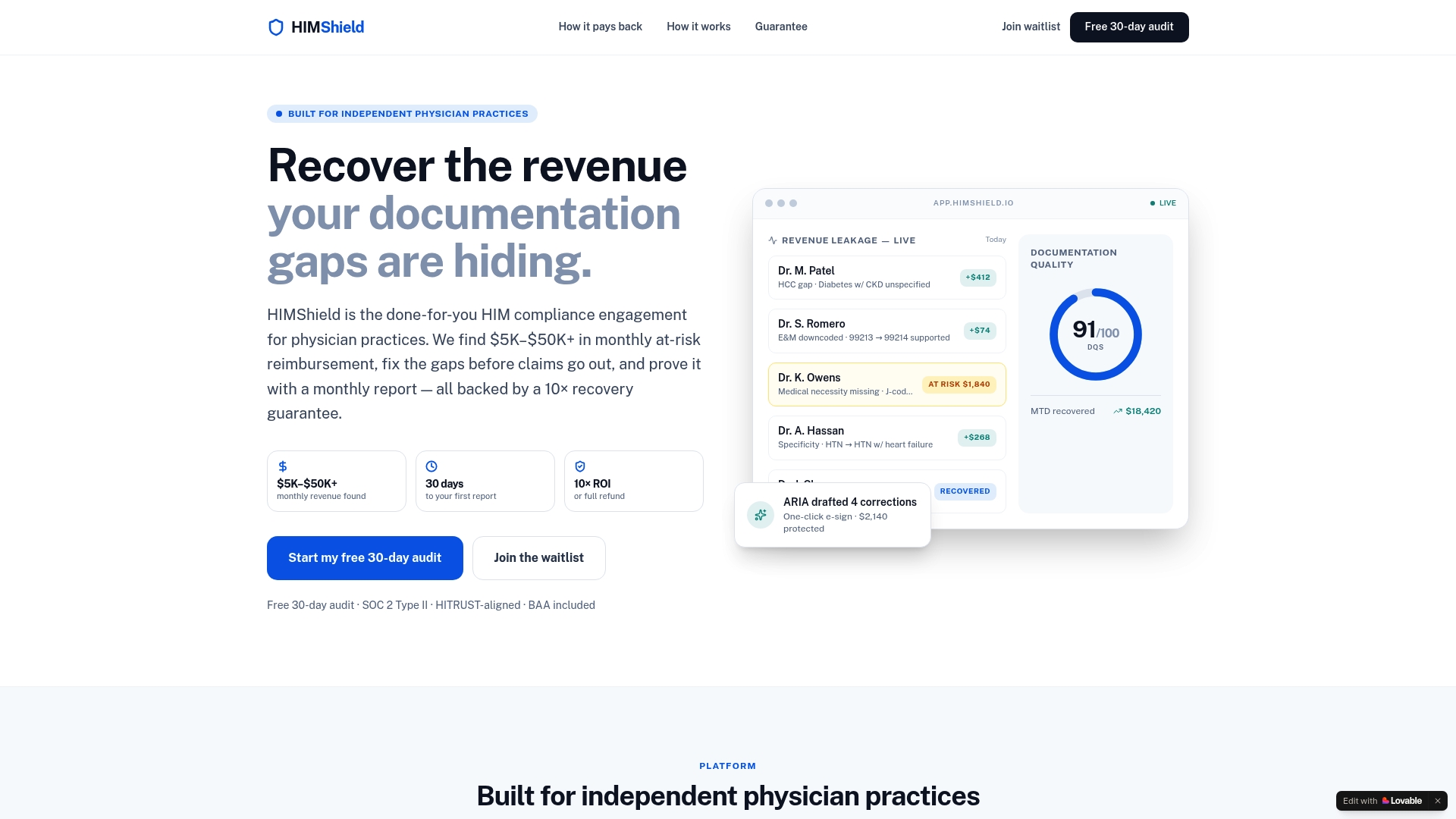
Curious how the connection works? See how HIMShield works, from EHR connection to recovered revenue in 30 days. You can also read about documentation gaps that cause revenue leakage or talk to us through our main site.
FAQ
What is a good target for how fast providers sign notes?
There is no single national number, so set the target from the rules that apply to you. Florida Medicaid, for example, requires signing within two business days of service, and Weill Cornell Medicine's policy uses the same two-business-day window for office visits. Many practices adopt that as their internal standard, then check payer contracts and state rules for anything tighter.
How do I track provider sign-off without micromanaging?
Use a weekly report that goes to each provider privately, lists only their own open notes, and shows the dollar value. Send it on the same morning every week from a named person. Providers respond better to a consistent, specific list than to ad hoc nudges.
What should we do when a note is already signed too late?
Do not backdate or simply add a late signature. For Medicare, CMS says a provider missing a required signature on a record other than an order should file an attestation created by the author. Ask your compliance lead to confirm the process for your payers and state.
Do scribes or AI documentation tools remove the need for the provider to sign?
No. CMS states that when a provider uses a scribe, including artificial intelligence technology, the provider must sign the entry to authenticate the documentation and the care provided or ordered. The scribe does not need to sign or date it. The signature is the provider's responsibility.
Sources
- Charge Lag: The Claims Waiting on Unsigned Notes
- MLN905364: Complying with Medicare Signature Requirements (CMS)
- Your Signature Can Be Worth Thousands (AAPC)
- Electronic Signature Attestation and Authorship (AHIMA)
- Authentication of Medical Record Documentation (Oncology Issues)
- Florida Administrative Code 59G-1.054
- N.J. Admin. Code 13:35-6.5
- Weill Cornell Medicine clinical documentation policy
- Missing or Illegible Signatures Continue to Cost Practices (AAO)
- The Radiology Digital Dashboard: Effects on Report Turnaround
- Evaluation of an Electronic Discharge Summary (SHM abstract)
- Transition from paper to electronic inpatient physician notes
- What a patient visit looks like under a team-based model (AMA)
- Unsigned Order Follow-Up Queue Workflow for a Solo Practice
- Completing Charts in EHRs (AHIMA)