
Monitoring payer contract compliance means running proactive, per-provider and per-payer completeness checks that reconcile clinical documentation, EHR charge-capture logs, and submitted claims. Do this before a payer flags you, not after.
Charge-capture leakage can cost a practice 1% or more of net patient revenue, and it rarely shows up in denial reports. The False Claims Act makes unresolved coding gaps a legal liability, not just a billing headache, and MGMA's contracting playbook exists precisely because payer terms shift faster than most practices track them. A platform like Himshield automates this kind of per-provider, per-payer detection.
Start this week with:
- Pull your top-20 CPT codes per payer and compare paid amounts to your contracted rate.
- Run a 30-day completeness audit: documented services versus what actually got billed.
- Set a monitoring cadence (weekly for denials, monthly for payment accuracy).
- Assign one person to own the payer contract checklist and amendment tracking.
Key Takeaways
Proactive, per-provider and per-payer completeness audits, not denial management alone, are what catch charge-capture leakage before it becomes a payer audit.
| Point | Details |
|---|---|
| Completeness beats accuracy | Compare documented services to billed services monthly, not just coding correctness. |
| Track contract clauses directly | Monitor prior authorization, bundling, downcoding, and timely-filing terms per payer. |
| Set hard KPI triggers | Flag denial rates above 5% and payments below 98% of contracted rates. |
| Preserve every remediation packet | Keep the note, superbill, charge log, and ERA together for faster appeals. |
| Start with a 30-day pilot | Himshield's free audit establishes a per-provider, per-payer baseline before any subscription commitment. |
Table of Contents
- What to Monitor for Each Payer and Provider
- Which KPIs Actually Signal Payer Compliance Trouble?
- Building the Detect, Fix, and Defend Workflow
- What Integrations and Features Does Monitoring Require?
- What ROI and Timeline Should You Expect?
- Who Owns Monitoring and When Do You Escalate?
- How Himshield Turns This Playbook Into a 30-Day Pilot
- Frequently Asked Questions
- Sources
What to Monitor for Each Payer and Provider
Payer contracts hide their risk in the fine print. Track prior authorization requirements, bundling and downcoding language, timely-filing deadlines, offset and recoupment terms, unilateral amendment clauses, and credentialing requirements for every payer relationship. Some payer agreements explicitly permit the payer to downcode or bundle services using their own proprietary editing tools, even when your documentation clearly supports the higher-level code billed.

On the clinical side, watch the details that actually drive reimbursement: E/M documentation elements (medical decision-making and time), procedure and supply logs, infusion start and stop times, implant and device logs, and lab or radiology order reconciliation against what appears on the superbill.

Reconciling this requires pulling from multiple systems: EHR clinical notes, charge-capture logs, practice management claims data, ERA/835 remittance files, clearinghouse acknowledgments, and each payer's own policy pages.
Pro Tip: Run completeness audits, not just coding-accuracy audits. A coding-accuracy review asks "was this billed correctly?" A completeness audit asks "was everything documented actually billed at all?" That second question is where charge-capture leakage hides, because it never triggers a denial.
Which KPIs Actually Signal Payer Compliance Trouble?
Five metrics tell you almost everything: denial rate by payer and provider, charge-capture rate (documented services billed divided by documented services), underpayment rate against contracted terms, timely-filing misses, and the percentage of claims downcoded by the payer.
Set concrete triggers rather than waiting for a "feeling" that something is off:
- Denial rate above 5% for any single payer warrants investigation.
- Charge-capture rate below 98% means documented work isn't making it to the claim.
- Payments below 98% of your contracted rate on top-20 CPTs should be flagged automatically, every month.
| KPI | Definition | Why it matters | Primary data source |
|---|---|---|---|
| Denial rate | Denials per 1000 claims, by payer/provider | Flags payer-specific friction early | Clearinghouse, PM system |
| Charge-capture rate | Billed services ÷ documented services | Finds revenue leakage denials never show | EHR + charge log reconciliation |
| Underpayment rate | Paid amount vs. contracted CPT rate | Catches silent payer downcoding | ERA/835 remittance files |
| Timely-filing misses | Claims filed past deadline | Prevents automatic write-offs | PM system |
| Downcode rate | % of claims paid below billed level | Signals contract-language abuse | ERA/835, payer EOBs |
Aggregate numbers hide the real story.
Building the Detect, Fix, and Defend Workflow
A 30-day pilot audit is the fastest way to get real numbers instead of guesses. Pull your top 20 CPT codes per payer, then run a completeness review focused on your highest-risk departments: emergency visits, procedure clinics, and infusion services, where charge-capture leakage concentrates.
After that baseline, settle into a repeating rhythm: near-real-time alerts when charge-capture fails, a weekly review of denials and payment accuracy, and a monthly pass through contract clauses and any payer amendments that came through quietly.
When monitoring surfaces a gap, the remediation path should be consistent every time:
- Detect the gap through the reconciliation report.
- Validate it against the original clinical documentation.
- Draft the corrective charge or appeal.
- Route it to the physician for e-signature.
- Log the action, timestamp, and outcome for the audit trail.
Data should flow in one direction: EHR notes feed the HIM/charge reconciliation step, which feeds the billing system, which reconciles against remittance files, and finally rolls up into a per-provider, per-payer dashboard. Break any link in that chain and leakage starts again.
Practices that wait for a payer to trigger the audit already lost the negotiation. The completeness check has to happen on your terms, on your calendar, using your own documentation as the baseline. That is the entire difference between a practice that recovers revenue and one that just absorbs the loss.
Pro Tip: Keep a submission-ready audit packet, the original clinical note, superbill, charge log, ERA, and any appeal letter, for every remediation you complete. When a real payer audit lands, you are not scrambling to reconstruct history. You are handing over a folder that already exists.
Denial-management tools alone will not catch this kind of leakage, because charge-capture gaps don't generate denials in the first place. They generate silence, and silence is expensive.
What Integrations and Features Does Monitoring Require?
Per-provider, per-payer monitoring only works with clean data flowing from the right places. At minimum, connect your EHR clinical notes feed, your practice management or billing system, your clearinghouse's claims and acknowledgment feed, ERA/835 remittance imports, and any implant, device, or lab/radiology order system that generates billable events.
On the platform side, require these features before you commit to any tool:
- A rule engine with payer-specific filters, not generic coding-accuracy checks.
- Automated charge reconciliation between documentation and billed claims.
- Per-provider, per-payer reporting broken out individually, not blended.
- Physician e-signature capture for corrections, built into the workflow.
- Submission-ready remediation package export for audit defense.
Evaluate any compliance monitoring platform against a technical checklist: does it support API or HL7/CCD connections, automated matching rules, a clear data latency service level, and full audit logging?
One practical warning worth repeating to your IT team: schedule a mapping and test cycle after every EHR update or workflow change. Silent charge-capture regressions after a system upgrade are common, and they are invisible until the next reconciliation catches them, sometimes months later.
What ROI and Timeline Should You Expect?
Most practices see measurable recoveries within the first 90 days of a monitoring pilot, with steady-state reviews producing recurring recoveries after that. Four factors drive the size of the number: your leakage rate as a percentage of revenue, average payment per encounter, the volume of high-risk CPT codes you run, and how often your appeals actually succeed.
Estimated recoverable revenue = annual practice revenue × estimated leakage percentage. A practice billing $2 million annually with a 1% leakage rate is leaving roughly $20,000 on the table every year, before appeals even factor in. Scale that to a $6 million multi-provider group and the number climbs into six figures fast.
Expect three layers of return:
- Immediate recoveries from fixing charge-capture failures already sitting in the system.
- Short-term gains from successful appeals on underpaid or downcoded claims.
- Long-term protection from catching contract clause changes before they erode margin.
Documentation-coding misalignment is a leadership issue, not a training footnote. Practices that treat it as a one-time in-service rarely see the gains stick.
Who Owns Monitoring and When Do You Escalate?
Monitoring fails without clear ownership. Billing or HIM staff should run daily detection work. The treating physician signs off on every correction. Practice administration, or legal counsel for anything contract-disputed, approves formal appeals and payer disputes.
Build a short governance checklist and revisit it quarterly:
- Define escalation windows: how many days before an unresolved gap moves up the chain.
- Set a documentation retention policy that covers your full appeal window.
- Review payer contract clauses and amendment notices on a fixed schedule.
- Maintain an amendment-tracking register so nobody misses a quiet payer rule change.
Escalate to your clinical lead when a documentation pattern repeats across multiple encounters. Escalate to legal counsel when contract language itself, not just a single claim, is in dispute.
Pro Tip: Name one person your "monitoring champion." Their job is watching KPI thresholds, keeping the payer watchlist current, and making sure every required amendment response actually gets sent on time. Shared ownership means no ownership.
A Front-Line View After One Pilot Audit
Running a 30-day pilot changes how a practice thinks about compliance. Fixes that used to take weeks happen in days. Appeals stop being last-minute scrambles because the documentation is already assembled. Physicians engage faster once they see per-provider numbers instead of a vague practice-wide average.
Per-provider visibility, paired with a submission-ready packet for every correction, is what actually holds up when a payer pushes back.
How Himshield Turns This Playbook Into a 30-Day Pilot
Everything in this guide, the per-provider and per-payer reconciliation, the completeness audits, the submission-ready packets, is exactly what Himshield automates for independent practices instead of leaving it to spreadsheets and manual review cycles.
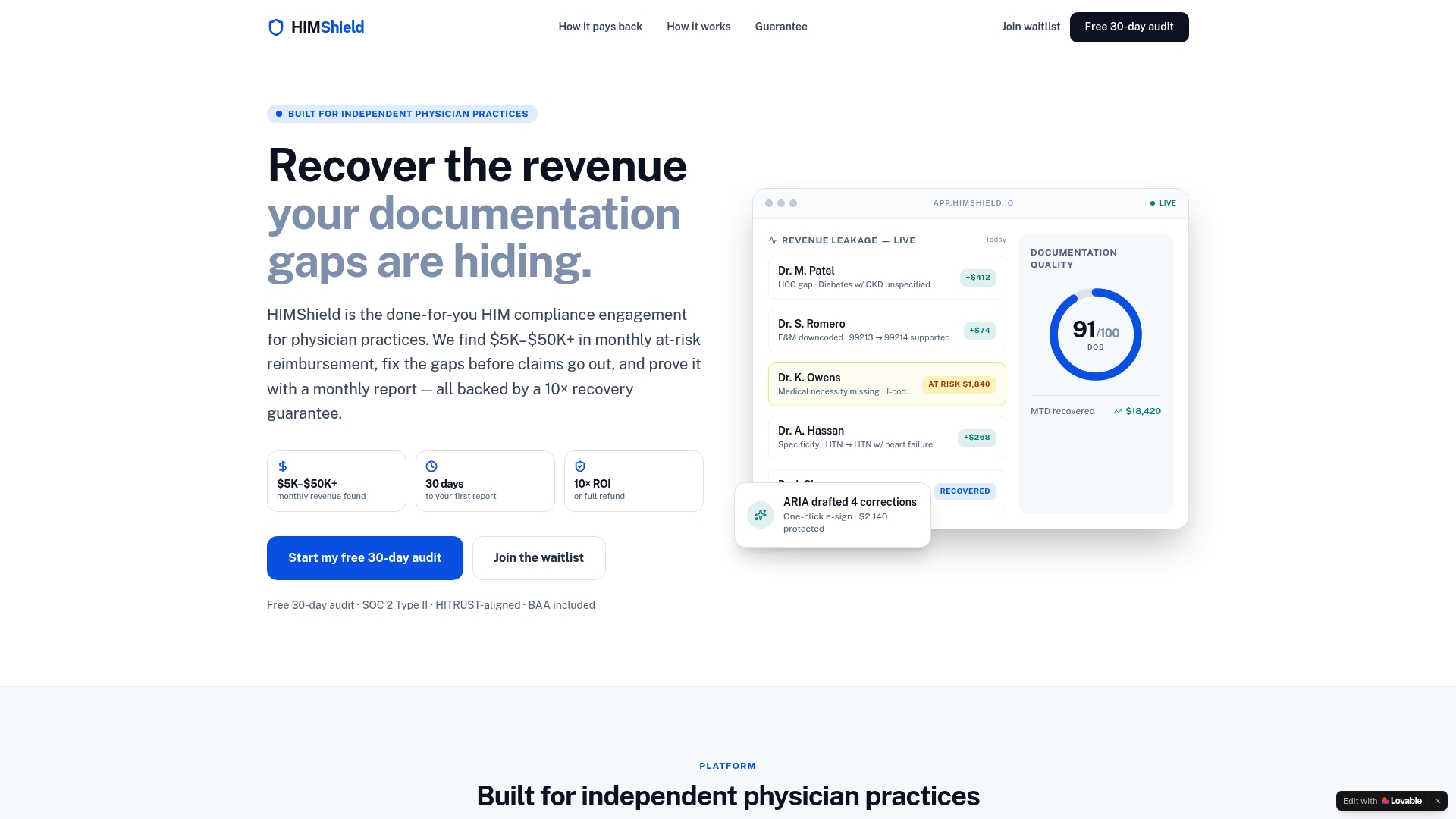
The platform generates Revenue Leakage Reports broken out by provider and payer, flags coding and charge-capture gaps automatically, and routes corrections straight to the physician for one-click e-signature. When a payer audit hits, Himshield assembles the submission-ready response instead of your staff pulling records under deadline pressure.
Himshield's free 30-day audit pilot gives you a real baseline before you commit to anything. There's no better way to see your actual leakage number than to run the audit this article recommends and let the platform do the reconciliation for you. See exactly how the platform connects to your EHR and start the pilot to find out what your practice is currently leaving unbilled.
Frequently Asked Questions
What does it mean to monitor payer contract compliance? It means running ongoing checks that compare clinical documentation, EHR charge-capture data, and submitted claims against each payer's specific contract terms, so gaps get caught before they turn into denials or audits.
How often should a practice review payer compliance? Run charge-capture alerts near real time, review denials and payment accuracy weekly, and audit contract clauses and amendments monthly.
What is the difference between a coding audit and a completeness audit? A coding audit checks whether the code billed matches the documentation. A completeness audit checks whether every documented service was billed at all, which is where most charge-capture leakage hides.
How much revenue does charge-capture leakage typically cost a practice? Leakage can run 1% or more of net patient revenue, concentrated in areas like infusion services, emergency visits, and procedures involving implants.
Sources
- Developing and Implementing an Audit Program for Physician Practices | Physician Leadership
- Payor contracting toolkit | AMA
- Charge Capture Leakage: Revenue You Earned but Never Billed | MedCodex Health
- The Documentation Gap: Why Clinical and Billing Teams Struggle to Connect (Part 1) | Maximized Revenue
- Payer strategy and contracting best practices | PayerPrice
- Payer contracting playbook | MGMA