
The moment a BCBS audit letter arrives, name an audit lead, freeze the record as it stands, and put the plan's scope and deadline demand in writing before anyone touches a chart. If federal-program claims are involved, note the date you spotted any potential overpayment: that starts the clock on a legal reporting duty. Everything else, documentation, sampling risk, and appeals, follows from getting these four moves right in the first hour.
TL;DR:
- Ensure the audit lead is designated immediately and all communications, scope details, and records are documented precisely within the first week.
- Verify BCBS audit notices are legitimate by confirming the specific Blue plan name, sender's letterhead, scope, and accurate contact details before responding.
- Respond within the specified deadline, preserving the original EHR record without edits, and request extensions early if needed to avoid penalties.
- Use automated tools or a pre-audit service to identify coding gaps and generate export-ready charts, reducing manual preparation time and errors.
- Act promptly on appeal opportunities by providing focused documentation within the first 30 days and maintaining clear communication logs throughout the process.
Table of Contents
- What a BCBS audit request typically looks like and how to verify it
- Immediate steps (day 0 to 7): a prioritized checklist to preserve rights
- Common BCBS requests and timelines: what to gather and how long you have
- Sampling, extrapolation, and the financial risks of audit findings
- Assembling an audit response package that reviewers can validate quickly
- Appeals, dispute options, and negotiating repayment
- Prevention and monitoring: everyday controls that reduce audit risk
- How automation and a done-for-you pre-audit service can help
- Practitioner perspective: what I see most practices get wrong
- Get audit-ready before the letter arrives
- Sources
- FAQ
What a BCBS audit request typically looks like and how to verify it
Blue Cross Blue Shield audits arrive as desk reviews (records mailed or uploaded), on-site reviews, probe samples of a small claim set, or full statistical reviews. Triggers usually trace back to billing outliers, patient complaints, internal plan analytics flagging unusual code patterns, or a tip passed to the plan's fraud unit.
Legitimate notices name the specific Blue plan issuing the request, a fact BCBS's own communications guidance points to as a way providers can confirm authenticity, and they arrive as a written letter or through a secure provider portal, not an unsolicited phone call.
Before sending anything, check for these signs of a legitimate request:
- The letter names the exact Blue plan (for example, a state-specific BCBS entity), not a generic "Blue Cross" reference.
- It arrives on letterhead or through the plan's established provider portal, never as a cold robocall demanding immediate records.
- It states a scope: date range, claim numbers or sample size, and a specific deadline.
- It includes a callback number matching the plan's published provider services line.
Immediate steps (day 0 to 7): a prioritized checklist to preserve rights
The first week determines whether the rest of the audit runs smoothly or spirals into missed deadlines and preventable exposure. Work through these steps in order.
- Designate one audit lead, typically the compliance officer or practice administrator, and pull in clinical, billing, IT, and finance contacts who can respond fast when the lead needs support.
- Preserve the EHR record exactly as it stands: export audit logs showing access history, and instruct staff not to edit, backdate, or "clean up" any note tied to the requested claims.
- Get the scope in writing, including the date range, sample claims, delivery method, and deadline, and ask directly whether the plan intends to use probe sampling or statistical extrapolation.
- Log every communication with the plan or its vendor, including certified mail receipts, portal upload confirmations, and phone call notes with dates and names.
- If the deadline is tight, request an extension early and document the "good cause" reason in writing rather than waiting until the due date.
- Escalate to legal counsel immediately if you suspect fraud allegations, a large extrapolated recoupment, or exposure tied to a federal program like Medicare Advantage.
Pro Tip: Assign the audit lead before the first request ever arrives. Practices that scramble to pick a point of contact after the letter shows up lose days they can't get back.
Common BCBS requests and timelines: what to gather and how long you have
BCBS plans typically ask for the full medical record tied to the claims under review: itemized bills, explanation of benefits statements, physician orders, test results, operative notes, and the charge documentation supporting each billed line. The request usually specifies exact dates of service and claim numbers rather than a broad chart pull.
- Full medical record for each date of service under review.
- Itemized bills and corresponding EOBs.
- Physician orders, operative notes, and diagnostic test results.
- Charge documentation linking each billed code to a specific service.
A BCBS Nebraska provider policy states that itemized billing must be submitted within 30 days of a post-payment audit request, and failure to respond can trigger claim reversal or recoupment. That 30-day window is common across BCBS member plans, though some allow up to 45 days depending on the review type. Federal reviews follow their own clock: CMS's ADR guidance generally gives providers 30 to 45 calendar days to submit records, with room for a "good cause" extension. Whatever the deadline, never alter a record after the request lands. Auditors rely on contemporaneous timestamps, and any post-request edit undermines the entire response.
Sampling, extrapolation, and the financial risks of audit findings
A probe sample is usually a small pull of claims, often somewhere in the 20 to 40 range, meant to check whether a broader problem exists. If the probe turns up errors, the plan may expand the review or shift to statistical sampling, which extrapolates a sample's error rate across a much larger universe of claims. That's how a handful of flagged charts can turn into a six-figure recoupment demand.
- Ask directly whether the plan intends to use probe or statistical sampling, and get the answer in writing.
- Challenge the defined universe of claims if it seems overly broad or includes services outside the stated scope.
- Document consistent clinical practice across the sample period to argue against a high extrapolated error rate.
- Bring in legal counsel early when extrapolation could produce a liability large enough to threaten the practice's finances.
OIG compliance audits of BCBS affiliates have found diagnosis codes lacking documentation support, producing significant net overpayments once extrapolated across the reviewed population. That pattern is exactly why plans scrutinize documentation so closely, and why the denominator used in extrapolation deserves as much attention as the sample itself.
Assembling an audit response package that reviewers can validate quickly
A clean response gets through review faster and draws fewer follow-up questions. Build the package methodically.
- Create a claims-to-chart crosswalk that cites the exact chart location and timestamp supporting each billed line, so reviewers don't have to hunt.
- Export records in native EHR format with timestamps intact, or use contemporaneously generated PDFs, and include an index at the front of the package.
- Include an audit log showing who accessed or modified each record and when, with a short explanation for any legitimate late entry.
- Attach a brief cover letter for each claim summarizing the clinical rationale and pointing the reviewer to the exact supporting documentation.
Pro Tip: A short cover letter per claim, two or three sentences tying the code to the note, often prevents a reviewer from flagging a claim simply because the connection wasn't obvious on first read.
Appeals, dispute options, and negotiating repayment
Most BCBS plans give providers a first-level rebuttal window, often around 30 days, to respond to a preliminary audit report with focused documentation addressing the specific findings. This is the strongest opportunity to correct the record before recoupment becomes final.
- Respond to the preliminary report inside the plan's stated window with documentation that directly addresses each disputed line, not a general rebuttal.
- Pursue a second-level appeal when available, which may route to an independent third-party reviewer or a plan management review; confirm the deadline for filing.
- Consider negotiation: a focused settlement on genuinely weak claims, a payment plan for confirmed overpayments, or a request to re-audit specific disputed sample items.
- Where a federal program is involved, keep the 60-day overpayment rule in mind: once you identify an overpayment, you must report and return it within 60 days to avoid False Claims Act exposure. Read more on how the 60-day rule works and what it means for your response timeline.
Prevention and monitoring: everyday controls that reduce audit risk
The practices that handle audits calmly are the ones that never stopped checking their own work. A few low-friction habits make the biggest difference.
- Run monthly internal coding spot checks rather than waiting for an external trigger to surface problems.
- Keep a standing audit playbook: an assigned lead, EHR export protocols, and communication templates ready before you need them.
- Train clinicians and coders on documentation specificity for high-risk diagnosis categories, since vague notes are what turn a routine audit into an extrapolated recoupment.
- Track every audit finding on an internal compliance dashboard so patterns get fixed instead of repeated.
Pro Tip: Treat every payer audit, even a small one, as free information about where your documentation is thin. The gaps that show up once tend to show up again.
A more detailed walkthrough of these habits is in our physician audit-survival checklist built for 2026 compliance expectations.
How automation and a done-for-you pre-audit service can help
Manually building crosswalks and flagging risky charts across a full patient panel takes time most practices don't have. An automated platform can scan EHR data to identify coding, documentation, and charge-capture gaps before a payer audit and generate per-provider, per-payer revenue leakage reports highlighting risk areas.

That same automation produces export-ready flagged charts and crosswalks, the kind of materials described earlier in this playbook, cutting the manual work of building an audit response package. A free 30-day Revenue Leakage Audit service can provide practices a prioritized list of corrections to make before a plan initiates an audit, helping turn audit preparation into a routine task rather than a scramble.
Practitioner perspective: what I see most practices get wrong
The single most common mistake is silence: no designated lead, no communication log, no record of why an extension was requested. Practices that survive audits well do three things every time: name a lead on day one, freeze the record instead of touching it, and write down every call and portal upload. When extrapolation risk looks real, loop in counsel before the response is due, not after the recoupment letter lands.
— Elena
Get audit-ready before the letter arrives
Waiting for a BCBS notice to find out where your documentation is weak puts you on the plan's timeline instead of yours. HIMShield's free 30-day Revenue Leakage Audit identifies coding, documentation, and charge-capture gaps across your EHR data and hands you a per-provider report showing exactly what needs fixing, before a payer ever flags it.
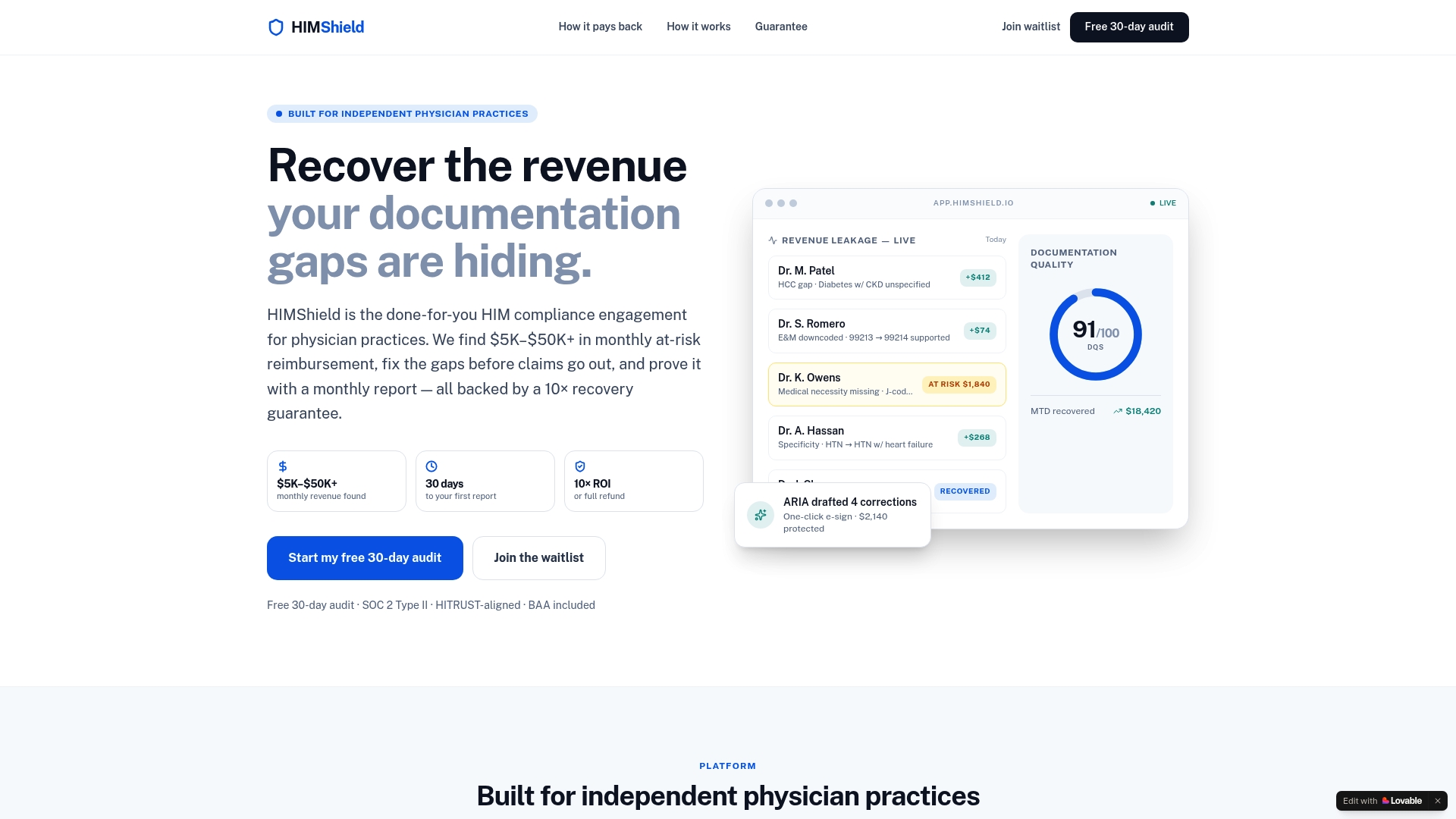
That same report doubles as a head start on any future audit response: the flagged charts and crosswalks map directly onto what a BCBS reviewer will ask for. A few things the free audit covers:
- A per-provider, per-payer breakdown of coding and documentation risk across your EHR data.
- Export-ready flagged charts that shorten the work of building a response package if you're ever audited.
- A prioritized correction list you can act on with one-click physician sign-off.
Visit the Free 30-day Revenue Leakage Audit page to see how it works, or check how HIMShield connects to your EHR and get your first report started.
Sources
Keep these on hand during any active audit or appeal:
- Additional Documentation Request | CMS
- Medicare Advantage compliance audit of specific diagnosis codes that Blue Cross and Blue Shield of Alabama submitted to CMS (OIG)
This article is general information, not a substitute for advice from a qualified lawyer. Consult a qualified legal professional about your own circumstances before acting on anything here.
FAQ
What was the Blue Cross Blue Shield scandal?
There is no single, universally defined "BCBS scandal." Various OIG compliance audits, including reviews of Blue Cross and Blue Shield of Alabama's submitted diagnosis codes, have found unsupported codes tied to significant net overpayments to CMS. These findings reflect documentation gaps at specific plan affiliates rather than a single defining event.
What triggers a health insurance audit?
Audits are commonly triggered by billing pattern outliers, patient complaints, internal plan analytics flagging unusual code combinations, or tips reported to a plan's fraud unit. A prior audit finding at your practice or a spike in a specific high-risk diagnosis code can also prompt a follow-up review.
What are the changes in CMS audit protocols for 2026?
CMS has not published a distinct overhaul of its audit protocols specifically dated to 2026 in the sources reviewed here. The core framework providers should track remains the 60-day overpayment reporting rule and the 30 to 45 day ADR response windows, both of which continue to govern federal program reviews.
Can you refuse an insurance audit?
Refusing a legitimate BCBS audit request typically isn't a workable option under most provider agreements, since plan contracts and provider handbooks generally require cooperation with medical review requests. What providers can do is verify the request's legitimacy, negotiate the timeline or scope in writing, and request an extension for good cause rather than ignoring the deadline.