
To bill an audio-only visit to Medicare, report the standard office visit code that matches the service (such as 99202–99215), append modifier 93, use the correct place of service, and document why video was not used. The old telephone-only codes 99441–99443 are no longer how Medicare audio-only visits are billed. Medicaid and commercial payers set their own rules, so one claim format does not fit every payer.
This guide walks through the current Medicare rules, the codes and modifiers that go on the claim, what your note must show, and where payers diverge. It is written for independent practices and the HIM staff who keep their claims clean.
TL;DR
- Medicare allows audio-only when the patient is at home, your practitioner can do audio-video, and the patient cannot or does not consent to video.
- Bill the code that describes the service (for example 99202–99215) with modifier 93. Telephone codes 99441–99443 are not used for Medicare audio-only visits from January 1, 2025.
- Use POS 10 when the patient is at home and POS 02 for other locations.
- Document that video was available to you but the patient could not or would not use it.
- Medicaid and commercial plans differ from Medicare. Verify each payer's policy before you bill.
Table of Contents
- When Medicare pays for an audio-only visit
- Codes and modifiers on an audio-only claim
- Place of service: 10 or 02
- Time-based coding on a phone call
- What the documentation must show
- Medicaid and commercial payers
- Common audio-only billing errors
- A workflow your front desk and coders can follow
- Perspective
- See what your phone visits are leaving behind
- FAQ
- Sources
When Medicare pays for an audio-only visit
Since January 1, 2025, a physician may use audio-only for a telehealth service when the patient is at home and the practitioner is technically capable of audio-video, but the patient is unable to use video or does not consent to it. CMS states this rule in its telehealth and remote monitoring booklet. Three conditions have to be true together:
- The patient is at home. The rule is tied to the patient's home, not to any location.
- Your practitioner can do video. The practice must have audio-video capability available. Audio-only is a fallback, not a way to avoid investing in video.
- The patient cannot or will not use video. That might be a device problem, poor broadband, or a stated preference.
If any of the three is missing, the visit is a weak claim. A patient sitting in a car, or a practice that has no video platform at all, is not the situation the rule describes.
How long the flexibility lasts
CMS guidance says Medicare non-behavioral and non-mental health telehealth services remain eligible for coverage when patients are in their homes through December 31, 2027, under current legislative extensions. Extensions have come in short windows before, so confirm the current end date on the CMS telehealth page before you build a workflow around it.
Behavioral health has its own rules
For mental health services, Medicare also expects an in-person visit. CMS requires an in-person, non-telehealth visit within 6 months of the initial mental health telehealth service and at least every 12 months afterward, with exceptions that can be documented for specific hardships. If your practice runs a behavioral health line, build that look-back into your scheduling so the claim does not fail on an eligibility check months later.
Codes and modifiers on an audio-only claim
This is where most confusion sits. During the public health emergency many practices billed telephone E/M codes 99441–99443. That is no longer the path for Medicare. The AAFP's coding guidance tells providers to use the standard CPT or HCPCS code for the service, such as 99202–99215, rather than 99441–99443, which are no longer used for these encounters as of January 1, 2025.
The same guidance notes that Medicare did not adopt the newer audio-video CPT codes 98000–98007. For Medicare, pick the office-visit E/M code that matches the work and append modifier 93.
| Element | Medicare audio-only |
|---|---|
| Visit code | Office or outpatient E/M that fits the service (e.g., 99202–99215) |
| Telephone-only codes 99441–99443 | Not used from January 1, 2025 |
| Audio-video codes 98000–98007 | Not adopted by Medicare |
| Modifier | 93 (FQ for FQHCs and RHCs, as applicable) |
| Place of service | 10 (patient at home) or 02 (other location) |
Modifier 93 and modifier FQ
For audio-only Medicare telehealth claims, use modifier 93 and/or, for FQHCs and RHCs, modifier FQ. The AAFP notes that for those clinics FQ and 93 are identical in meaning. Modifier 93 has been the CPT code for real-time interactive audio-only service since 2022, and CMS also uses it to report audio-only services in Medicare Advantage encounter data for dates of service on or after January 1, 2022.
If modifier placement and stacking trip up your billers, our modifier usage guide for physician billing covers how to sequence them and what edits to expect.
Rural health clinics and FQHCs
Clinics billing as RHCs or FQHCs follow a different pattern. For dates of service on or after October 1, 2026, CMS requires them to bill the specific CPT or HCPCS code that describes the service rather than the older G2025 code, with the appropriate revenue code and modifier 93 or 95. For mental health visits, CMS says reporting and payment are similar to in-person visits, using modifier 93 or FQ when audio-video technology is inaccessible or rejected by the patient. Our explainer on what a revenue code is helps if your clinic is new to that field.
Place of service: 10 or 02
For Medicare telehealth services furnished in the patient's home, the required place of service is 10. For any other location, use 02. The wrong POS is a quiet way to lose money: the claim may pay at the wrong rate or reject outright.

A simple check at scheduling prevents most errors: ask where the patient will be during the call, and record it. If the patient says they are driving or at work, that changes the POS and may change whether the visit qualifies at all. For a deeper refresher, see our place of service code guide.
Time-based coding on a phone call
With telephone-only codes retired for Medicare, the visit is coded like any other E/M. That means you can code by medical decision making or by total time on the date of the encounter. Time works well for audio-only visits, since a long counseling call often has modest data review but real physician work.
If you code by time, your note should state the total time and what the time covered. A time statement without a described activity is the kind of thing that draws payer questions. Our guide to time-based E/M coding lists the checks to run before the claim goes out.
What the documentation must show
Audio-only claims fail on documentation more often than on code selection. AAFP guidance says the record must reflect that the physician has audio-video available, but the patient preferred audio-only or was not able to use audio-video.
A defensible note for an audio-only visit includes:
- Modality. State plainly that the visit was real-time, audio-only.
- Reason for no video. For example, "Patient has no smartphone camera," or "Patient declined video." Use the patient's reason, not a template phrase.
- Your capability. A line that the practice offers audio-video.
- Patient location. Home or other, matching the POS on the claim.
- Practitioner location and identity, as your payer requires.
- Time or MDM. Whichever supports the E/M level billed.
- Standard visit content. History, assessment, plan, and any orders, as you would document in person.
One trap: an EHR template that auto-fills "patient declined video" on every phone visit. Auditors read that as boilerplate. A short free-text reason in each note holds up much better.
Medicaid and commercial payers
Medicare rules do not carry over automatically. Medicaid policy is set at the state level, and commercial, self-funded and Medicare Advantage telehealth policies vary. The AAFP advises checking with the state Medicaid agency, the Medicaid MCO or your provider relations representative.
The National Consortium of Telehealth Resource Centers makes the same point: Medicare's inclusion of telephone codes was temporary, and Medicare, commercial and Medicaid requirements may not align on audio-only parity.
A concrete example of the spread: UnitedHealthcare Community Plan in Louisiana does not reimburse telephone E/M services reported with 98966–98968 or 99441–99443. A practice that still bills those codes to a Medicaid plan could be writing off every one of those visits.

A payer matrix worth building
Keep a one-page table for your top payers and update it when contracts or bulletins change:
| Question | Why it matters |
|---|---|
| Is audio-only covered for E/M? | Some plans cover only certain services or specialties |
| Which codes and modifier? | Modifier 93, 95, a plan-specific modifier, or none |
| Which POS? | 02 vs 10 vs the payer's own preference |
| Any patient-location limits? | Home-only rules are common |
| Is there a documentation rule? | Reason for no video, consent, time statement |
What the patient owes also depends on the plan. For Medicare, telehealth services are generally paid at the same rate as in-person services, though patient cost depends on deductible, other insurance, and whether the provider accepts assignment.
Common audio-only billing errors
- Billing 99441–99443 to Medicare. These are no longer used for Medicare audio-only visits from 2025.
- Missing modifier 93. The claim looks like an audio-video visit and invites a payer review.
- POS mismatch. Patient was at home, claim says 02, or the reverse.
- No reason for audio-only. The note does not show video was offered or unavailable to the patient.
- Applying Medicare logic to Medicaid. State plans may not pay the same codes.
- Level inflation. Phone visits coded at a level the documentation does not support.
Most of these are visible in your own data before a payer sees them. For a broader checklist, our telehealth coding compliance guide puts these checks in one place.
A workflow your front desk and coders can follow
- At scheduling: note the visit type, the payer, and whether the patient plans to use video.
- At check-in: confirm patient location and that video was offered.
- In the visit: the clinician records modality, reason for audio-only, and time or MDM.
- At charge entry: assign the E/M code, modifier 93, and POS 10 or 02.
- Before submission: run a payer-specific edit for audio-only claims.
- After payment: review denials by payer and fix the rule, not just the claim.
Perspective
Audio-only billing is a good example of a rule that is simple on paper and messy in practice. The Medicare logic fits in one paragraph. The revenue loss comes from the gaps around it: a templated note, a missed modifier, a Medicaid plan that never paid the code you kept using.
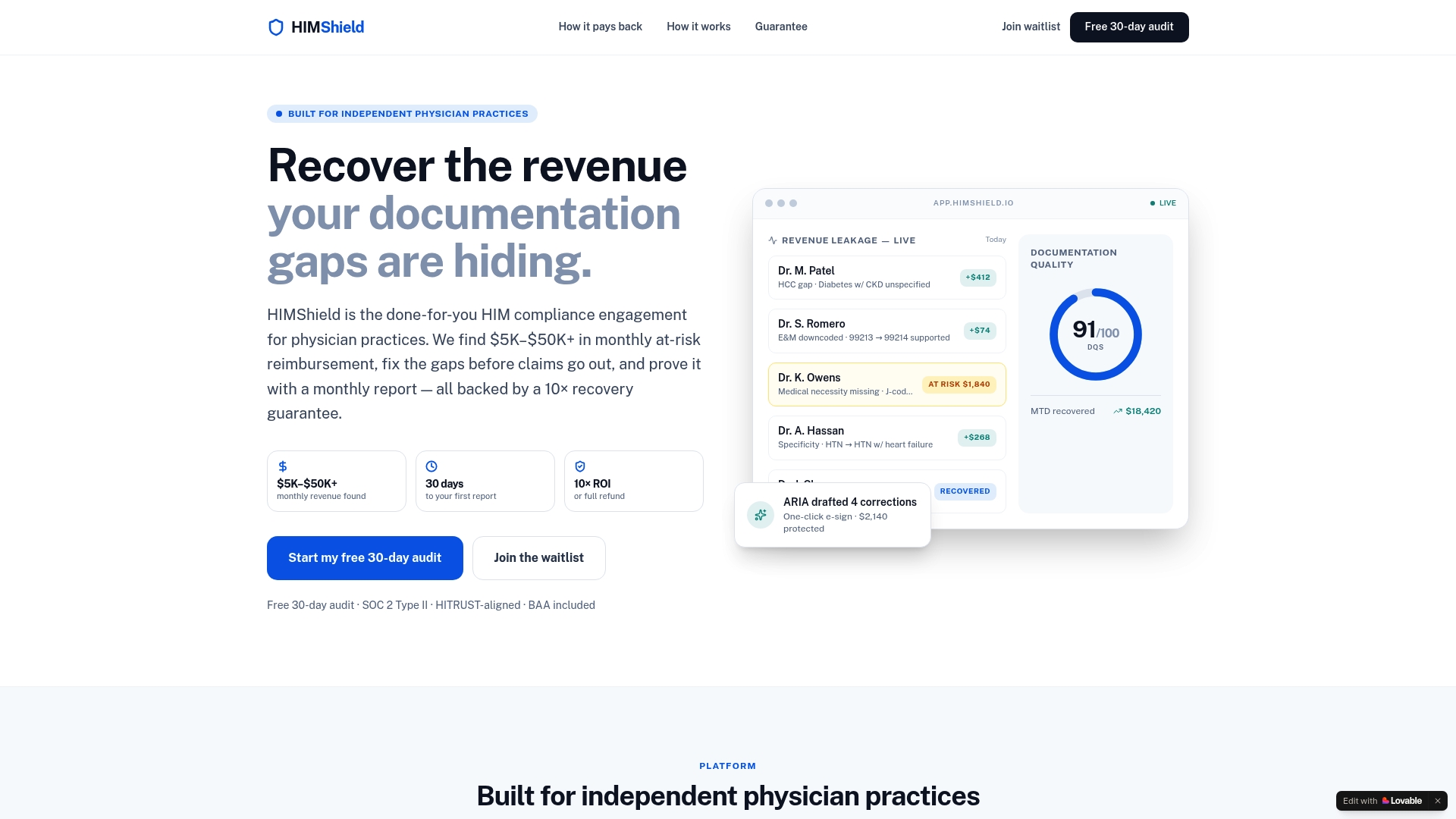
We built HIMShield to catch those gaps in EHR data before claims go out. It scans for coding, documentation and charge-capture risks, quantifies them per provider and per payer, and drafts corrections your physicians can approve with one e-signature. For audio-only visits, that means flagging claims where the note does not show why video was not used, or where the modifier and place of service do not match the visit.
Independent practices rarely have a compliance team to track every payer bulletin. Our approach is designed to work without new staff or software training, so your team keeps seeing patients while the review runs in the background.
Elena
See what your phone visits are leaving behind
If your practice has billed audio-only visits since the pandemic, a claims review is the fastest way to learn whether the modifiers, place of service and notes hold up. Our free 30-day Revenue Leakage Audit scans your EHR data for coding, documentation and charge-capture gaps and delivers per-provider, per-payer findings, with a performance guarantee. You can also read more about our HIM compliance engagement.
FAQ
Can I still bill 99441–99443 for telephone visits?
Not for Medicare audio-only visits. From January 1, 2025, the AAFP says providers should use the standard code for the service, such as 99202–99215, with modifier 93. Some other payers may still recognize telephone codes, so check each plan's policy.
Does Medicare require modifier 93 on every audio-only claim?
Medicare telehealth guidance directs providers to append modifier 93 to audio-only services. Rural health clinics and FQHCs may use modifier FQ, which carries the same meaning. Leaving the modifier off makes the claim look like an audio-video visit.
What place of service do I use for an audio-only visit?
Use POS 10 when the patient is at home and POS 02 when the patient is somewhere else. This follows Medicare guidance on telehealth billing. Other payers may specify their own preference, so confirm it in their policy.
What should the note say when the patient refuses video?
It should show that your practice can do audio-video and that the patient could not or would not use it, in the patient's own terms where possible. Add the patient's location and the total time or the decision-making that supports the E/M level.
Do Medicaid and commercial plans follow Medicare's audio-only rules?
Not necessarily. Medicaid is set by each state, and commercial plans vary. Some plans do not reimburse telephone E/M codes at all, so verify coverage, codes and modifiers with each payer.
Sources
- CMS MLN901705: Telehealth and Remote Monitoring
- CMS Telehealth FAQ, updated October 2026
- CMS MM12549: CY2022 Telehealth Update
- AAFP: Coding for telehealth, audio, video and virtual-digital visits
- Telehealth.HHS.gov: Billing and coding Medicare fee-for-service claims
- CMS: Risk Adjustment and Encounter Data update
- CMS MM14468: RHC and FQHC distant site telehealth billing
- CMS SE22001: Mental health visits via telecommunications
- Telehealth Resource Centers: Audio-only telehealth post-PHE
- UnitedHealthcare Community Plan Louisiana telehealth policy
- Medicare.gov: Telehealth insurance coverage