
AI can raise coding accuracy and reduce avoidable denials, but only when its outputs are audit-defensible and built into documentation-ready workflows. The AMA's CPT Appendix S taxonomy and HHS AI Strategy both point to the same requirement: governance before scale. The first move is validating documentation readiness and capturing an audit trail, not buying more software.
TL;DR:
- Validating documentation readiness and capturing an audit trail are essential before deploying AI at scale in medical coding.
- Assistive AI tools speed up chart reviews, while autonomous systems pose higher denial risks and require strict logging; models drift without updates.
- Building a comprehensive audit package with timestamps, model info, and reviewer actions is crucial for defending claims against payer disputes.
- AI governance requires impact assessments, ongoing monitoring, staged autonomy, and starting with assistive tools during pilot phases.
- Coders shift toward validation and oversight roles, needing specialized training in AI limitations, log literacy, and audit response procedures.
Table of Contents
- What AI Does for Coding and Compliance: Capabilities and Benefits
- AI Taxonomy and Reporting: Using CPT Appendix S to Classify AI Contributions
- Making AI Defensible: Logging, Versioning, and Audit Packages
- Workflow and Integration: Documentation Readiness and Pilot Metrics
- Governance and Risk-Based Controls: HHS Expectations and Staged Autonomy
- People and Change Management: Coder Roles, Training, and Audit Response
- Mapping Platform Capabilities to Defensible AI Practices
- Start With a Free 30-Day Revenue Leakage Audit
- FAQ
- Sources
What AI Does for Coding and Compliance: Capabilities and Benefits
AI tools in medical coding fall into three working categories, and the distinction matters because each carries different oversight obligations. Assistive tools suggest codes for a human to confirm. Augmentative tools generate quantified outputs, such as a leakage estimate or a documentation quality score, that inform a decision without making it. Autonomous tools generate charges or submit claims with minimal human intervention, which is where regulatory scrutiny concentrates.
Pilots across independent practices tend to surface a consistent pattern: gains in speed and consistency, paired with real limitations.
- Coders using assistive suggestions often finalize charts faster because the first-pass code is already drafted for review.
- Augmentative tools surface patterns, such as a recurring HCC gap, that manual review tends to miss at scale.
- Autonomous charge generation introduces the highest denial risk when payer rules shift without a corresponding model update.
AI performance drifts over time without retraining or rule updates, and that drift accelerates when payer policies change mid-year or a model trained on one specialty's documentation patterns gets applied to another. Treat every pilot result as specific to its payer mix, specialty, and documentation baseline, not as a universal benchmark.
AI Taxonomy and Reporting: Using CPT Appendix S to Classify AI Contributions
Appendix S exists because payers and auditors need a consistent way to describe how much an AI system actually did. The AMA's taxonomy separates assistive, augmentative, and autonomous AI, and each tier changes what documentation and physician involvement a claim needs to withstand scrutiny.
- Assistive: a human makes the clinical and coding decision; the AI only proposes options, so documentation should note the human's final judgment.
- Augmentative: AI contributes a quantified finding that shapes the decision; the chart should reflect what the AI reported and how the clinician weighed it.
- Autonomous: AI acts with little or no real-time human review; this tier demands the heaviest logging, since there is no contemporaneous human judgment to point to if a payer disputes the claim.
For reporting, this means every claim touched by AI should carry a record of which tier applied, not just that "AI was used." Build a simple internal checklist: tag the AI tier in the chart note, confirm a reviewer signed off proportional to that tier, and retain the AI's original output alongside the final submitted code.
Making AI Defensible: Logging, Versioning, and Audit Packages

A disputed claim needs a reconstructable path from source data to submission. The chain of custody runs from the EHR record, through the AI's input and output, to coder or physician review, to the claim itself. Breaking that chain anywhere is what turns a routine audit into a liability.
According to analysis of agentic AI design patterns. Defensible systems rely on deterministic execution, constrained autonomy, and human review logged at each decision point. In practice, that means assembling an audit package with these steps:
- Pull the exact EHR excerpt the AI read, timestamped to the encounter.
- Capture the AI's input (the query, prompt, or API call) exactly as sent.
- Record the model identifier, version number, and output timestamp.
- Log the reviewer's action (accept, modify, or reject), their credentials, and the time of review.
- Attach the final claim submission record to close the loop.
Pro Tip: Store these five artifacts together per claim, not scattered across systems. A single missing timestamp can unravel an otherwise solid audit defense.
Without this package, a practice is defending a black box, and payers rarely give the benefit of the doubt to a black box.
Workflow and Integration: Documentation Readiness and Pilot Metrics
AI outputs are only as good as the documentation feeding them. Before trusting a suggestion or a leakage estimate, confirm that structured fields are populated consistently, templates match across providers, and clinicians understand which details the AI depends on to flag a gap accurately.
Integration points matter as much as the model itself:
- Clinical documentation improvement (CDI) queries should feed the same structured fields the AI reads, not a parallel process.
- Coder validation queues need a clear flag for AI-assisted charts so reviewers know where extra scrutiny applies.
- Prior authorization checks benefit from AI extraction of unstructured notes, a pattern explored in intake and referral automation.
- Claims gatekeeping should hold any autonomous-tier output for a final rules check before submission.
During a pilot, track precision and recall on code suggestions, the change in denial rate, speed to final code, and how often reviewers override the AI. A high override rate usually signals a documentation gap, not a bad model.
Governance and Risk-Based Controls: HHS Expectations and Staged Autonomy
Federal guidance gives RCM leaders a usable blueprint even though it was not written for coding teams specifically. The HHS AI Strategy calls for institutionalized governance, AI use-case inventories, pre-deployment testing, and ongoing monitoring for high-impact applications, aligning with OMB's M-25 guidance on risk-proportionate controls.
Translated into an operational checklist, a practice needs:
- An AI impact assessment for each tool before go-live, scoped to its taxonomy tier.
- Independent review of outputs on a fixed cadence, not just at launch.
- Defined accuracy and denial-rate thresholds that trigger a pause if breached.
- A monitoring dashboard reviewed on a set schedule, weekly or monthly depending on volume.
- A documented plan to shut off or roll back a tool if it drifts out of tolerance.
Staged autonomy means assistive tools can run with light oversight, augmentative tools need a documented reviewer judgment on every output, and autonomous tools should only act automatically within narrowly defined, tested limits.
Pro Tip: Start every new AI tool at the assistive tier for the first 60 to 90 days, even if it is built for augmentative or autonomous use. The extra review period reveals blind spots before they reach a claim.
People and Change Management: Coder Roles, Training, and Audit Response
AI shifts coding work away from first-pass code entry and toward validation, exception handling, and governance. Coders who once spent most of a shift reading charts now spend more time confirming AI output, chasing documentation gaps the AI flagged, and tracking model performance over time.
That shift requires deliberate training, not a one-time software demo:
- AI limitations training: teach coders what the tool cannot see, including context that lives outside structured fields.
- Log literacy: coders need to read model version numbers, timestamps, and confidence outputs, not just accept a suggestion.
- Documentation coaching: coders increasingly coach clinicians on the specific phrasing or structured fields the AI relies on.
- Audit response drills: practice assembling a full audit package under time pressure, before a real payer request arrives.
Pair this with clear sign-off rules (who approves what tier of AI output), an escalation path for disputed suggestions, and a routine review cycle, monthly or quarterly, that checks whether the governance checklist is still being followed in practice, not just on paper.
Mapping Platform Capabilities to Defensible AI Practices
The controls above align with the functions a platform can produce to help scan EHR data to quantify coding, documentation, and charge-capture gaps, generate per-provider, per-payer Revenue Leakage Reports, and assemble submission-ready responses when a payer disputes a claim. That maps directly to the provenance, versioning, and reviewer sign-off a defensible audit package requires.
For a deeper look at preparing audit-ready documentation, see our guide to coding audits. The first practical step is a documentation readiness check paired with a 30-day audit.
— Elena
Start With a Free 30-Day Revenue Leakage Audit
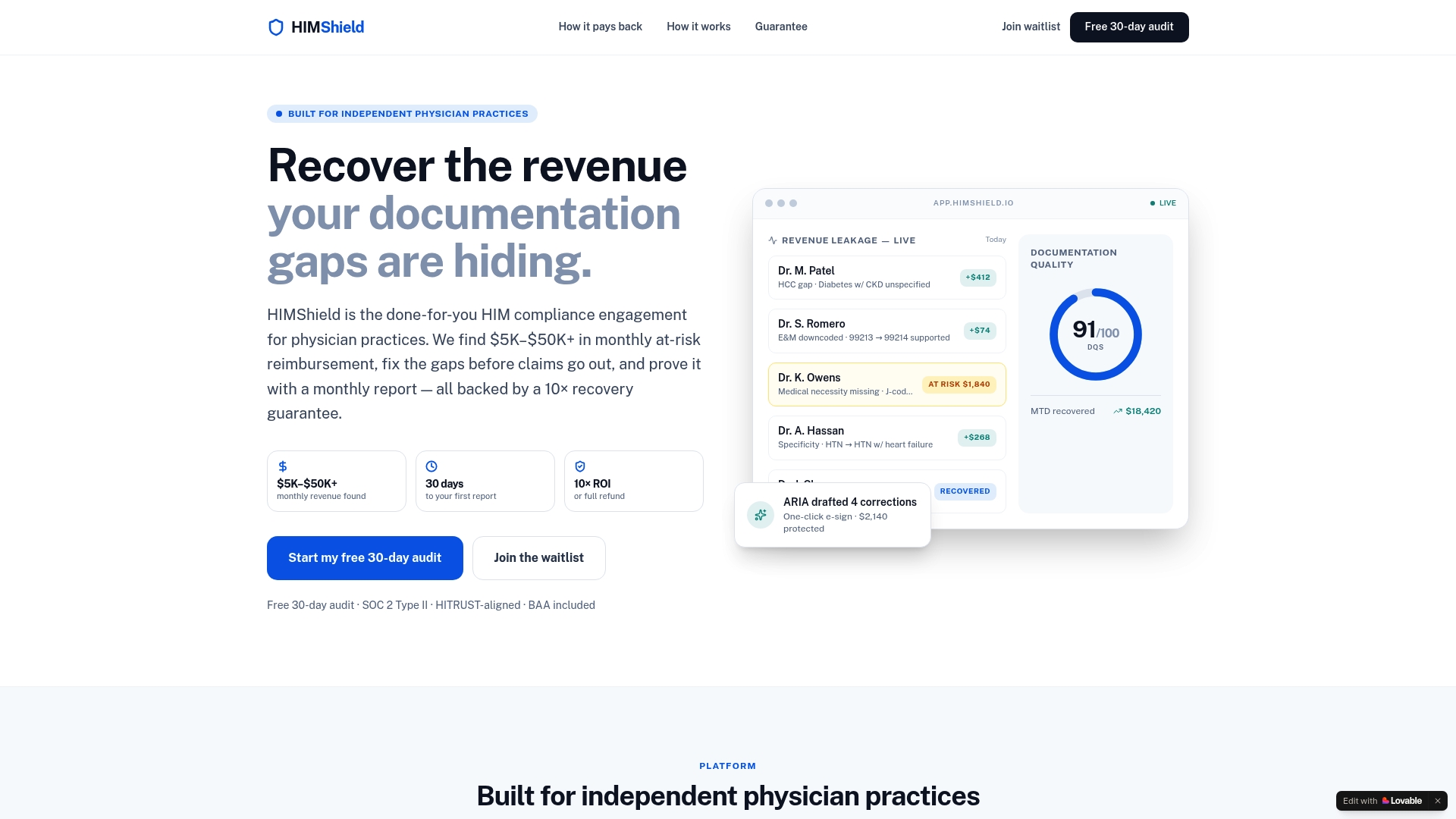
Before scaling any AI tool, you need a clear picture of where your current coding and documentation already fall short. A free 30-day revenue leakage audit can quantify coding, documentation, and charge-capture gaps across a practice and deliver a Revenue Leakage Report the team can act on immediately, with no new staff or software training required.
- The audit identifies gaps before they become denials or payer disputes.
- It gives you the documentation-readiness baseline the earlier sections describe.
- It requires no commitment beyond the 30-day assessment period.
Get your free revenue leakage audit or visit HIMShield to see how the platform fits your practice.
FAQ
What is the 30% rule for AI?
If you encounter the term in a specific payer policy or vendor document, check that source directly rather than assuming a standard threshold applies across the industry.
Which jobs are most likely to withstand AI automation?
Roles centered on judgment, exception handling, and oversight tend to hold up best, including coding validation specialists, compliance and audit response staff, and documentation improvement roles that coach clinicians on chart quality. These positions depend on human review of AI output rather than first-pass data entry, which is the work AI tools increasingly handle.
Are medical coders losing jobs to AI?
Coding roles are shifting rather than disappearing, moving from first-pass code entry toward validation, exception review, and governance of AI outputs. Practitioner deployments consistently show that documentation readiness and staffing changes, not the AI model itself, determine whether a rollout succeeds.
Will AI replace compliance functions in healthcare?
AI is not expected to replace compliance functions; AMA policy explicitly states that AI should support, not replace, physician and professional judgment. Compliance work increasingly involves overseeing AI, documenting its tier of involvement, and maintaining audit trails rather than disappearing as a function.
Sources
- Taxonomy for artificial intelligence in medical services & procedures | AMA
- Artificial Intelligence (AI) Strategy v3 | HHS
- From static compliance to living compliance: how agentic AI can make health care | Foley