
A prepayment review strategy is a provider-side, pre-submission process that catches coding, documentation, and charge-capture errors before a claim leaves the building. The single highest-impact move is turning on targeted pre-bill edits and exception queues for your top denial drivers today, so high-risk claims stop moving to submission until they're clean. Administrators, coders, and clinicians all benefit, because clean claims mean fewer appeals, faster cash, and less payer scrutiny down the line.
TL;DR:
- Targeted pre-bill edits and exception queues for high-risk claims can prevent nearly a quarter of denials caused by eligibility, demographics, and authorization errors.
- Daily charge posting, combined with second-level audits for high-dollar claims, improves claim accuracy before submission.
- Physician documentation queries, especially when based on clear trend data, significantly reduce downcoding and denial rates.
- Implementing a payer rule library and real-time eligibility checks helps catch process failures that cause about 15% of initial claim denials.
- Starting with a free 30-day revenue leakage audit provides practice-specific insights into coding and documentation gaps without new software or staffing.
Table of Contents
- Why Prepayment Review Matters Now for U.S. Practices
- Core Components of an Effective Prepayment Review Program
- Building the Workflow: Roles and Governance for Prevention
- Choosing Technology That Actually Prevents Denials
- Monitoring, KPIs, and Continuous Improvement
- Compliance Guardrails Practices Need to Know
- Quick Wins Practices Can Start This Month
- What the Data Actually Tells Practices to Prioritize
- Start With a Free 30-Day Revenue Leakage Report
- Sources
- FAQ
Why Prepayment Review Matters Now for U.S. Practices
Hospitals and practices spent roughly $19.7 billion in 2022 fighting denials that never should have gone out the door in the first place. Private payers initially deny about 15% of submitted claims, and a large share of those denials get reversed on appeal, which tells you the problem usually isn't medical necessity. It's a process failure.
By the Numbers: Roughly 15% of claims to private payers are denied on first submission, and the appeals fight to fix them cost the industry close to $20 billion in 2022 alone.
Front-end breakdowns, eligibility errors, wrong demographics, missing prior authorization, drive 22% to 24% of all denials. That's nearly a quarter of your denial volume solved before a coder ever touches the chart. Layer on a newer threat: payers now run automated tools that flag claims for E/M downcoding, often triggered by templated or vague notes. Specific documentation of medical decision-making or total time is your best defense against a machine deciding your visit was worth less than you billed.
Core Components of an Effective Prepayment Review Program
A working prepayment audit process isn't one tool. It's five interlocking checkpoints, each catching what the last one missed.
- Front-end verification. Confirm eligibility, active coverage, correct demographics, and authorization status at check-in, not at billing. This single step addresses the largest denial category your practice will ever face.
- Daily charge posting with exception queues. Post charges daily and route high-risk CPT codes or specific providers into a review queue automatically, rather than letting them ride through on volume.
- Physician documentation queries. Use non-leading, AHIMA-style query templates when a note is ambiguous. Run these concurrently when possible, pre-bill when concurrent isn't feasible, and retrospectively only for pattern analysis, never as your main defense.
- A payer rule library. Keep documented, current rules for high-risk services like ED visits, complex E/M levels, and anything requiring prior auth, since payer requirements shift more often than most staff realize.
- Second-level audits. Add a review layer for your highest-dollar or highest-risk claims before they submit, separate from the coder who first touched the chart.
Pro Tip: Set an internal SLA of 24 to 48 hours for pre-bill review on flagged claims. Anything that sits longer starts to back up your entire billing cycle, and delayed claims are exactly the ones that get rushed through without a second look.
Physician-led queries deserve special attention here. Bridging the gap between clinical documentation and coding through direct physician input, rather than a coder guessing at intent, remains one of the more effective ways to clarify medical decision-making before a claim ever submits.
Building the Workflow: Roles and Governance for Prevention
A prepayment review process only works if someone owns it. Without a named owner, exception queues pile up and nobody's accountable when denial rates creep back up.
- Name a denials-prevention owner. This is usually your practice administrator or a senior biller, someone with authority to pull a claim before it submits.
- Assign clear roles. Front desk owns eligibility and demographics. Coders own code accuracy and charge capture. Clinicians own documentation specificity. A second-level reviewer owns the final check on high-risk claims.
- Set your timing rules. Stop obvious errors at check-in. Escalate ambiguous documentation to a pre-bill query. Reserve retrospective review for trend analysis, not for catching claims that should never have submitted.
- Standardize the query process. Every query should be non-leading, logged, and resolved with a documented addendum when the physician's response changes the code or level.
- Build a training cadence. Tie physician feedback sessions directly to denial-trend reports so clinicians see the actual financial consequence of a vague note, not an abstract compliance reminder.
Physician engagement in documentation education consistently shows up in AMA and MGMA guidance as one of the more reliable levers for reducing denial rates, more reliable than adding billing staff alone.
Choosing Technology That Actually Prevents Denials
The right system does the boring, repetitive checking so your team can focus on judgment calls. The wrong system just digitizes the same errors you were already making on paper.
Look for these capabilities before signing anything:
- Real-time eligibility and benefit checks that run at scheduling and again at check-in, not once a week in batch.
- Configurable front-end edits you can tune to your own top denial codes, not a generic rule set built for a hospital system.
- Exception work queues that route flagged claims to the right person automatically, instead of a shared inbox nobody owns.
- Remittance comparison tools that flag underpayments and downcoding patterns by comparing what you billed against what actually paid.
For analytics, confirm the system can break denials down by payer, CPT, and provider, since a downcoding pattern usually only becomes visible when you filter by all three at once. Integration matters as much as features: data needs to flow cleanly from your EHR to your practice management system to your analytics layer, or you'll spend more time reconciling reports than fixing claims.
Monitoring, KPIs, and Continuous Improvement
Denials are operational feedback, not just lost revenue. Reading denials as an operations report, broken down by location, payer, CPT, and reason code, turns a frustrating pile of rejections into a specific list of fixable problems.
| Metric | What it tells you | Review cadence |
|---|---|---|
| Denial rate by payer/CPT/provider | Where the pattern lives | Weekly |
| Denial-dollar exposure | How much revenue is at risk | Weekly |
| Appeal success rate | Whether denials were valid or payer error | Monthly |
| Point-of-service collection rate | Front-end effectiveness | Monthly |
| Time-to-identify | How fast issues get caught before submission | Monthly |
Run a daily exception list, a weekly payer-issue huddle, and a monthly leadership review that tracks root-cause fixes across every location. When one payer's denial rate on a specific code climbs and stays elevated, that's the signal to open a contract compliance review or escalate directly to your payer representative rather than absorbing the loss quarter after quarter.
Compliance Guardrails Practices Need to Know
Physicians carry direct responsibility for the accuracy of what gets submitted under their name. OIG guidance recommends internal billing and coding audits and screening of anyone touching claims, and that responsibility doesn't transfer just because a biller submitted the form.
Keep every documentation query non-leading, logged, and retained per AHIMA's guidance, since a poorly worded query can itself become a compliance liability. If an internal review turns up an overpayment, practices are obligated to identify and repay it, and the Self-Referral Disclosure Protocol offers a formal path when the issue involves a referral relationship. Hold onto payer communications and remittance detail. You'll need them if a claim gets appealed or a payer opens its own audit later.
Quick Wins Practices Can Start This Month
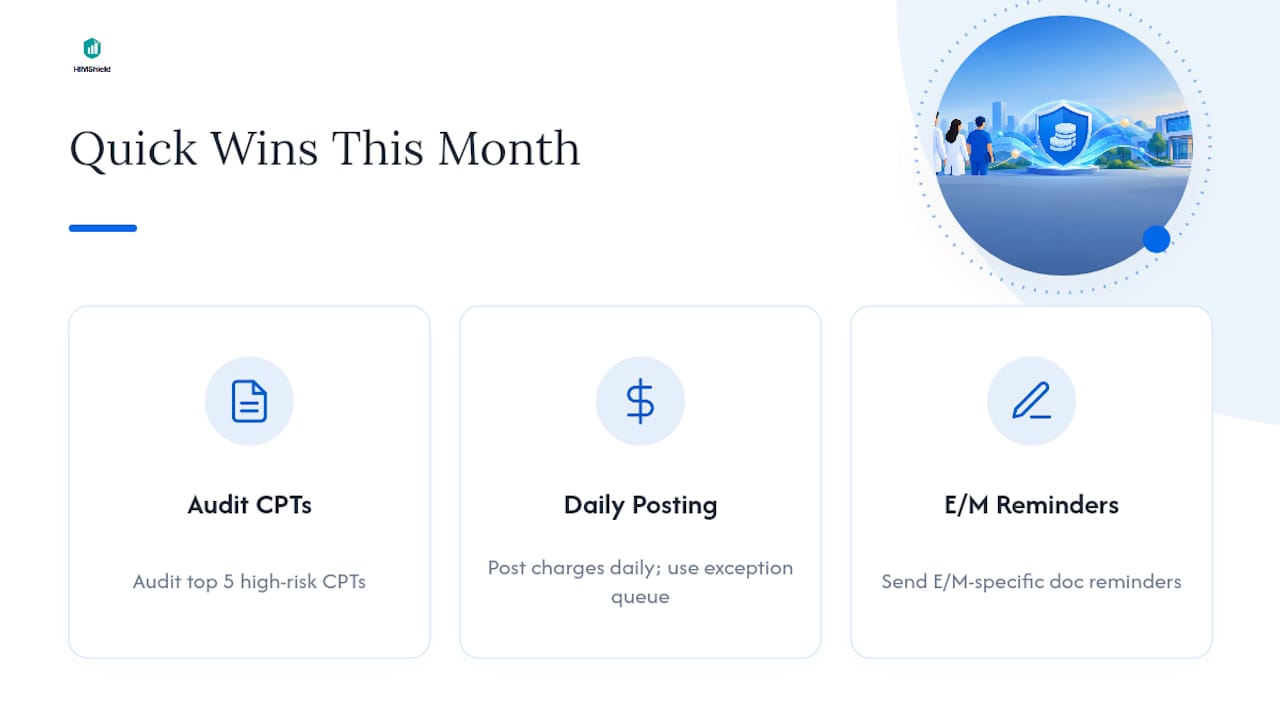
HIMShield™ builds its approach around a straightforward idea: most revenue leaks are patterns, not accidents. The platform scans EHR data for coding, documentation, and charge-capture gaps before claims go out, then quantifies exactly what's at risk by provider and payer.
Three moves deliver fast results. Run a focused pre-bill audit on your five highest-volume, highest-risk CPT codes. Post charges daily with an exception queue for anything flagged. Send clinicians a documentation reminder tied to specific E/M guidance, not a generic compliance memo. The Free 30-day Revenue Leakage Audit is built to surface exactly which of these three matters most for your practice, first.
What the Data Actually Tells Practices to Prioritize
Most denial-prevention advice treats coding accuracy as the whole battle. It isn't. Nearly a quarter of denials trace back to front-end mistakes that have nothing to do with coding skill, eligibility checks skipped, a birthdate typed wrong, an authorization nobody confirmed. Fix that layer first, and you'll cut more denials than any coding audit will produce on its own.
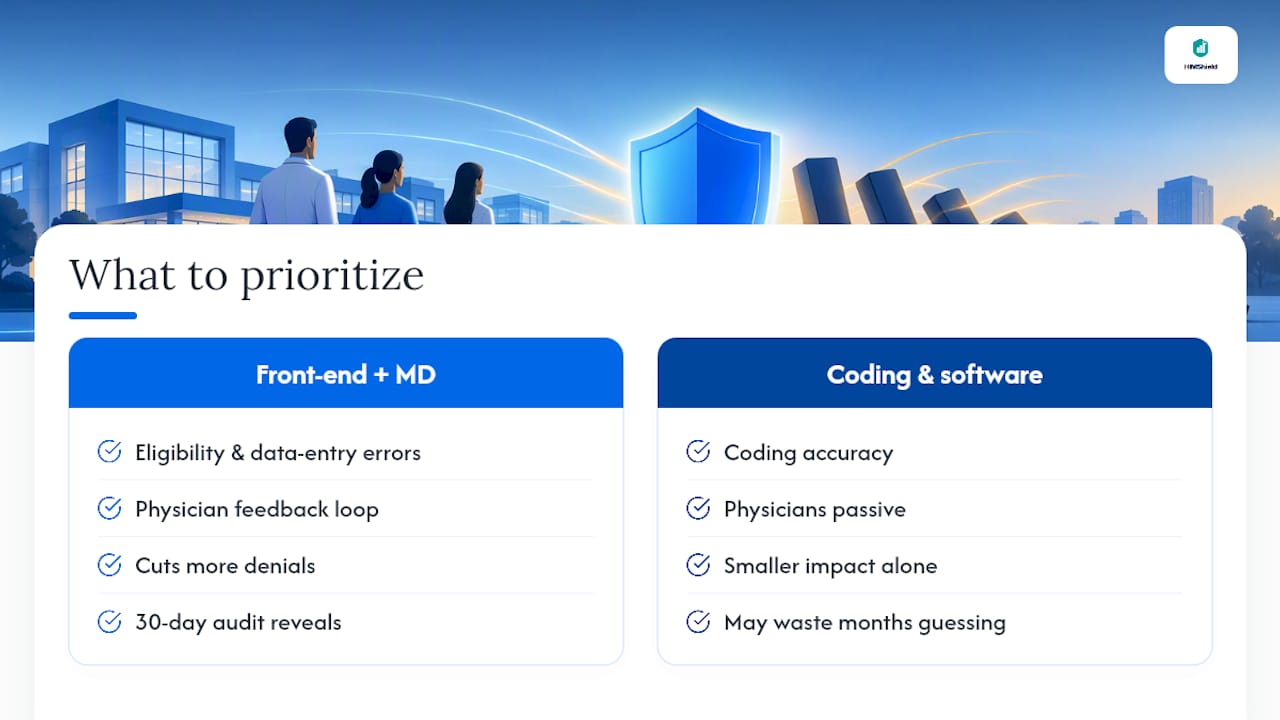
The bigger blind spot is treating physicians as bystanders in the billing process. The research is consistent: practices that pull clinicians into documentation feedback loops, tied to specific denial-trend data rather than abstract compliance training, see the biggest improvement. A physician who sees exactly which of their own notes triggered a downcoding pattern will change how they write the next one. A physician handed a generic reminder memo won't.
If you're building or rebuilding a prepayment review process, start with front-end edits and a physician feedback loop before you invest in more coding staff or more sophisticated software. The free 30-day audit exists precisely because most practices don't know which of these two levers matters more for them until someone quantifies it. Guessing wastes months. Measuring takes 30 days.
— Elena
Start With a Free 30-Day Revenue Leakage Report
This kind of service can quantify specific coding, documentation, and charge-capture gaps in 30 days, often with no new software to learn and no staff to hire.
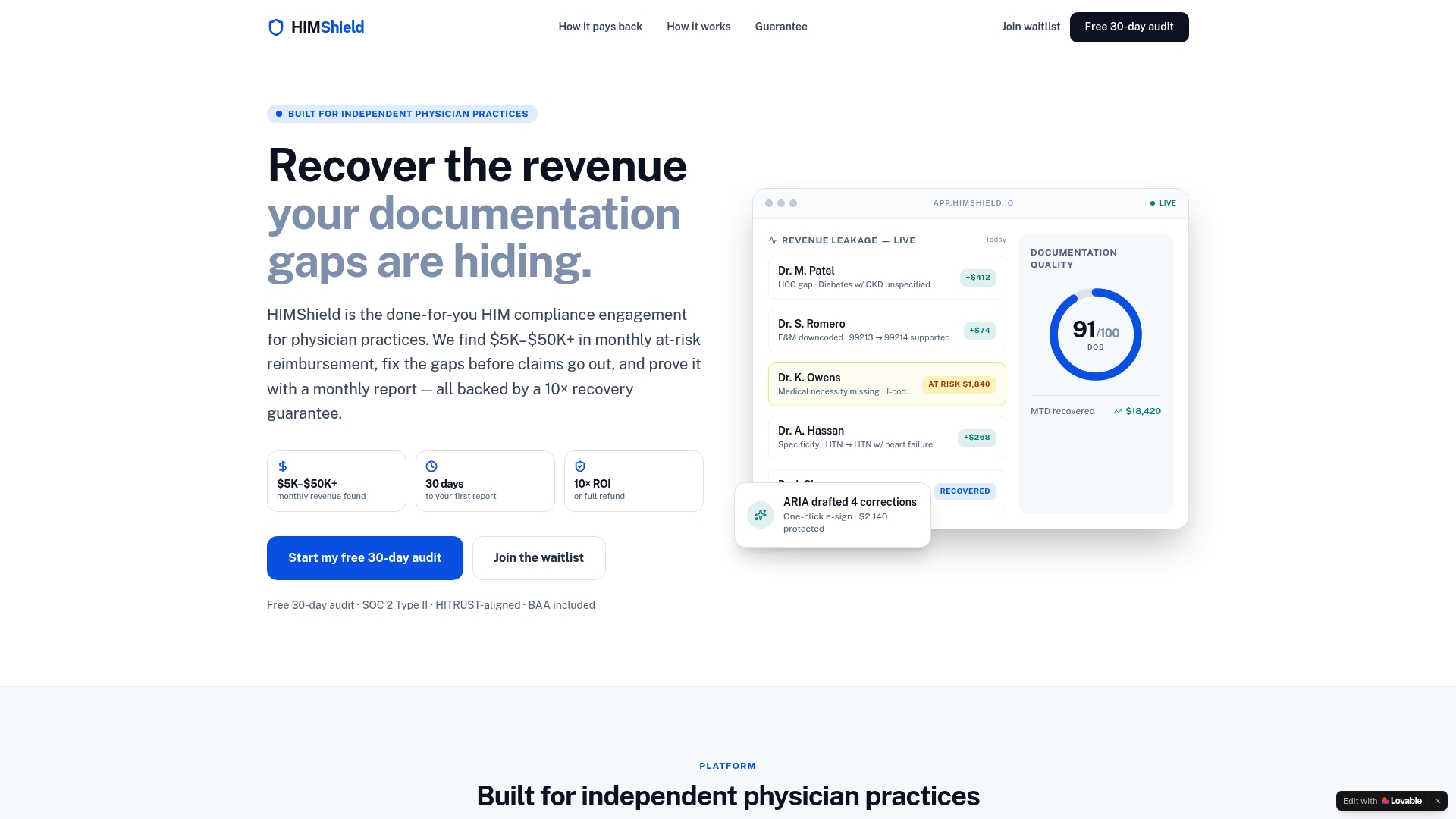
The Free 30-day Revenue Leakage Audit reviews your existing EHR data and delivers a per-provider, per-payer breakdown of exactly where revenue is at risk, not a generic industry benchmark, but your actual numbers. Some platforms can draft corrections with physician e-signature and assemble submission-ready responses if a payer opens an audit, aiming to keep remediation timely. If your practice has never had a clear dollar figure attached to its denial problem, that's the gap this audit closes. Start the free audit and see your own numbers before your next billing cycle closes.
Sources
- Payer Denial Tactics — How to Confront a $20 Billion Problem | AHA
- New AMA practice resource helps physician practices fight inappropriate E/M downcoding | HBMA / AMA guidance
- OIG guidance: Compliance Program Guidance and screening recommendations | OIG
FAQ
What Is a Prepayment Review Strategy?
It's a provider-side process that checks claims for coding, documentation, and charge-capture errors before submission, catching problems while they're still cheap and fast to fix. The goal is a clean claim that avoids denial and any risk of triggering a payer's own prepayment review.
How Do Front-End Errors Cause So Many Denials?
Eligibility mistakes, wrong demographics, and missing authorizations account for roughly 22% to 24% of all denials, often before a coder ever reviews the chart. Fixing this at check-in eliminates a large share of denials before a claim is even coded.
How Often Should Practices Run Pre-Bill Audits?
Daily charge posting with an exception queue for high-risk CPT codes catches most issues in real time, while a focused audit on your top-denial codes should run at least monthly. Practices seeing recurring downcoding on a specific payer or code should tighten that cadence to weekly.
What Does the HIMShield Free 30-Day Audit Include?
The Free 30-day Revenue Leakage Audit reviews existing EHR data to identify and quantify coding, documentation, and charge-capture gaps by provider and payer. It's designed to show a practice exactly where revenue is at risk without requiring new software or staff.
Are Physicians Legally Responsible for Claim Accuracy?
Yes. OIG guidance places responsibility on physicians for the accuracy of claims submitted under their name and recommends regular internal billing and coding audits. Overpayments identified internally must be repaid, and the Self-Referral Disclosure Protocol offers a formal path when a referral relationship is involved.